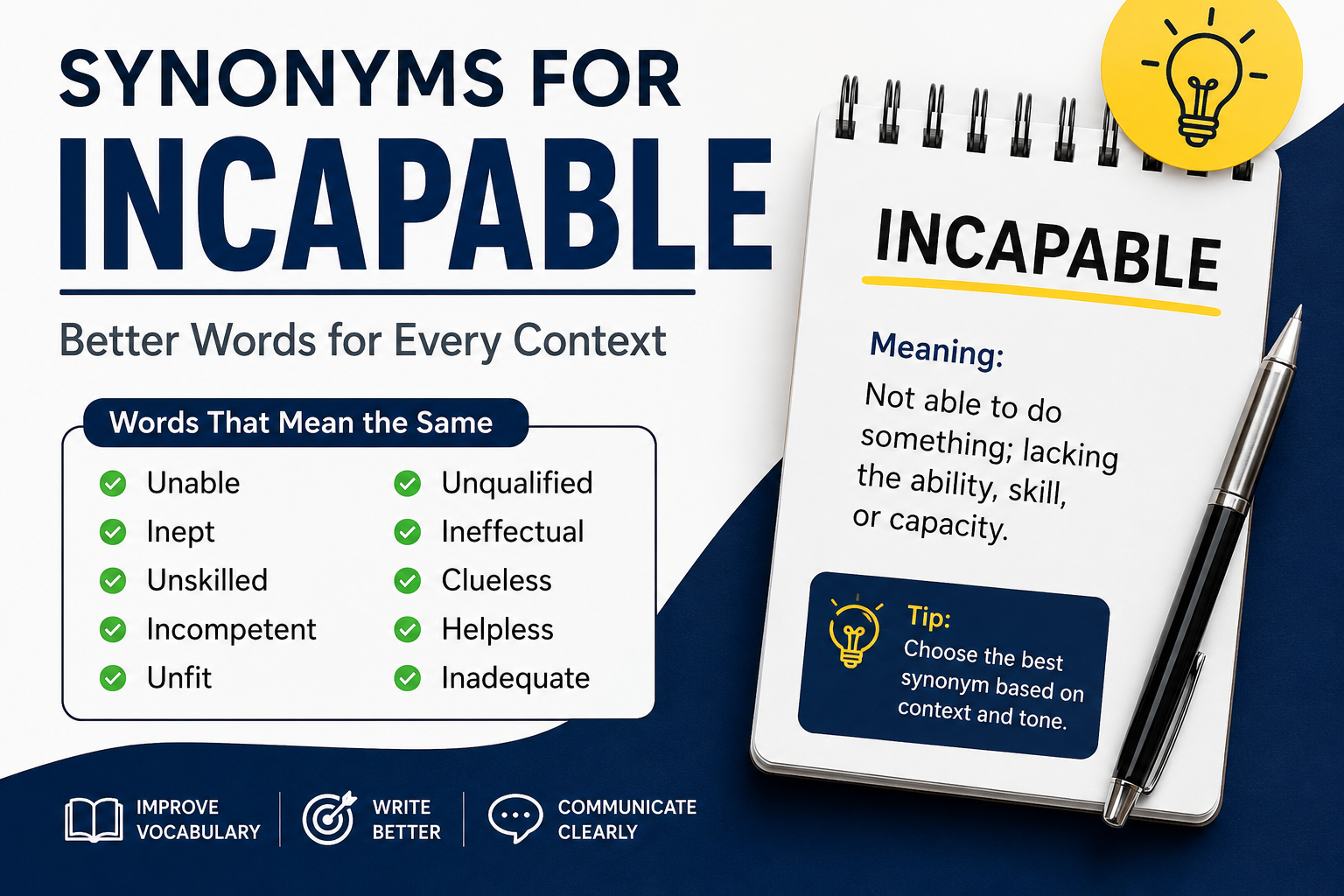
Finding the right synonym for incapable depends on what kind of inability you mean. Unable is usually the closest everyday alternative, while incompetent and inept suggest poor skill or performance. Unqualified emphasizes a lack of credentials or qualifications, powerless emphasizes a lack of control or ability to act, and unfit suggests that someone or something is unsuitable for a particular purpose.
Below, you’ll find the most useful synonyms for incapable, organized by meaning, context, tone, and natural usage.
Quick Answer: What Are the Best Synonyms for Incapable?
The closest synonyms for incapable include unable, incompetent, inept, unskilled, unqualified, unfit, inadequate, powerless, helpless, ineffective, and incapacitated. However, they are not interchangeable in every sentence. Use unable for general inability, incompetent for poor ability or performance, unqualified for missing qualifications, and powerless when someone lacks the power or control to act.
Core Synonyms for Incapable
| Word | Relationship | Meaning | Strength | Formality | Best Context |
|---|---|---|---|---|---|
| Unable | Direct/near synonym | Not able to do something | Neutral | Neutral | General inability |
| Incompetent | Near synonym | Lacking the ability or skill required | Strong | Neutral–formal | Work, management, performance |
| Inept | Near synonym | Clumsy or poorly skilled | Strong | Neutral | People, actions, performance |
| Unskilled | Near synonym | Lacking a particular skill | Moderate | Neutral | Work and practical abilities |
| Unqualified | Contextual alternative | Lacking required qualifications | Moderate–strong | Neutral–formal | Jobs, roles, professional positions |
| Unfit | Contextual alternative | Not suitable or capable for a purpose | Moderate–strong | Neutral–formal | Roles, duties, conditions |
| Inadequate | Contextual alternative | Not sufficient to meet a requirement | Moderate | Neutral–formal | People, resources, methods |
| Powerless | Contextual alternative | Lacking power or control | Strong | Neutral | Situations involving control |
| Helpless | Contextual alternative | Unable to help oneself or change a situation | Strong | Neutral | Difficult or vulnerable situations |
| Ineffective | Contextual alternative | Failing to produce the intended result | Moderate | Neutral–formal | Methods, policies, actions |
| Inefficient | Contextual alternative | Unable to perform effectively with reasonable efficiency | Moderate | Neutral–formal | Systems, workers, processes |
| Incapacitated | Contextual alternative | Temporarily unable to act or function | Strong | Formal | Injury, illness, impairment |
These distinctions reflect established dictionary usage. Cambridge lists unable, incompetent, inept, unskilled, unqualified, unfit, inadequate, inefficient, and ineffective among words related to different senses of incapable, while Merriam-Webster’s thesaurus includes many of the same alternatives.
What Does Incapable Mean?
Incapable is an adjective meaning unable to do something or lacking the ability, capacity, or qualification required for a particular purpose. It is commonly followed by of + noun or of + -ing form, as in incapable of understanding or incapable of making a decision. Cambridge gives the core meaning as “unable to do something,” while Merriam-Webster also includes the senses of lacking capacity, ability, or qualification.
Examples
- The machine is incapable of handling such a heavy load.
- He was incapable of understanding the instructions.
- She seemed incapable of making a quick decision.
- The manager was incapable of leading the team effectively.
The word can describe a person, organization, object, system, or situation.
The Best Synonyms for Incapable by Context
1. Unable — Best General Alternative
Unable is usually the safest and most natural replacement for incapable when you simply mean that someone or something cannot do something.
Example:
The technician was unable to repair the machine.
This is often more neutral than incapable.
Compare:
The technician was unable to repair the machine.
This simply states that the repair could not be completed.
The technician was incapable of repairing the machine.
This can suggest a more fundamental lack of ability.
Cambridge explicitly treats unable as a synonym related to incapable.
2. Incompetent — Best for Poor Skill or Performance
Incompetent means lacking the ability, knowledge, or skill necessary to perform a task properly.
It is more judgmental than unable.
Example:
The company replaced the incompetent manager after repeated mistakes.
You would normally use incompetent when the problem is poor performance, not merely an isolated inability.
Best for:
- employees
- managers
- professionals
- administrators
- people responsible for tasks
Do not automatically replace incapable with incompetent.
Someone can be unable to perform a task because of circumstances without being incompetent.
3. Inept — Best for Clumsy or Poor Performance
Inept describes someone who lacks skill and performs a task badly, often in an awkward or ineffective way.
Example:
His inept handling of the situation made the problem worse.
Inept often carries a stronger sense of clumsiness than incapable.
It works particularly well when describing:
- handling of situations
- practical performance
- communication
- management
- decision-making
4. Unskilled — Best When a Specific Skill Is Missing
Unskilled means lacking a particular skill or level of training.
Example:
The company should not assign the task to an unskilled worker.
This word is narrower than incapable because a person can be unskilled at one task while being highly capable in another area.
Unskilled is therefore useful when you want to identify a skill gap rather than make a broad judgment about someone’s abilities.
5. Unqualified — Best for Jobs, Roles, and Requirements
Unqualified means lacking the qualifications, credentials, training, or requirements needed for a position or activity.
Example:
He was unqualified for the position because he lacked the required certification.
This is not always the same as being incapable.
Someone might be fully capable of doing a task but still be unqualified to perform it professionally because they lack a required license or credential.
6. Unfit — Best for Suitability
Unfit means unsuitable or not capable of fulfilling a particular purpose, role, or requirement.
Example:
The old vehicle was unfit for long-distance travel.
You can also describe people as unfit for a role or responsibility, although the context can sometimes make the expression sound strongly judgmental.
Example:
The review concluded that he was unfit for the position.
7. Inadequate — Best for Insufficient Ability or Resources
Inadequate means not good enough, sufficient enough, or suitable enough for a particular requirement.
Example:
The team’s technical skills were inadequate for the complexity of the project.
Unlike incapable, inadequate does not necessarily mean completely unable.
It often means not sufficient rather than having no ability at all.
8. Powerless — Best for Lack of Control
Powerless focuses on a person’s lack of power, authority, or control rather than lack of skill.
Example:
Without the necessary authority, the manager was powerless to stop the decision.
This distinction matters:
- incapable → lacks ability or capacity
- powerless → lacks power or control
Someone may be highly skilled but powerless because circumstances prevent them from acting.
9. Helpless — Best for Situations Where Someone Cannot Help Themselves
Helpless means unable to protect, support, or help oneself, often because of difficult circumstances.
Example:
The injured passenger was helpless until emergency workers arrived.
Helpless often carries an emotional or vulnerable tone that incapable does not necessarily have.
10. Ineffective — Best for Methods, Actions, or Systems
Ineffective means failing to produce the desired result.
Example:
The company’s previous strategy was ineffective.
This is generally better than incapable when the subject is a method, strategy, policy, treatment, or action.
An ineffective strategy does not necessarily lack the ability to act; it simply does not achieve its intended outcome.
11. Inefficient — Best for Poor Use of Time or Resources
Inefficient means failing to work in an effective or economical way.
Example:
The old system was too inefficient to handle the increased workload.
The distinction is useful:
- ineffective → does not achieve the intended result
- inefficient → achieves something poorly or with unnecessary waste
- incapable → lacks the ability or capacity to do it
12. Incapacitated — Best for Temporary Loss of Ability
Incapacitated means unable to function or act, often because of injury, illness, or another physical condition.
Example:
The accident left the driver incapacitated.
This word is more specific and formal than incapable.
Incapable vs. Unable
Incapable and unable are among the closest alternatives, but they can differ in implication.
| Word | Typical implication |
| Unable | Cannot do something in a particular situation |
| Incapable | Lacks the ability or capacity to do something |
Compare:
I was unable to attend the meeting because my flight was canceled.
This describes a temporary circumstance.
He is incapable of managing the department.
This suggests a more fundamental lack of ability.
That distinction is not absolute, however. Context determines how strongly incapable implies an inherent or persistent limitation.
Incapable vs. Incompetent
These words overlap, but they are not identical.
Incapable focuses on an inability or lack of capacity.
Incompetent focuses more specifically on inadequate skill, knowledge, or performance.
Compare:
The patient was incapable of walking after the injury.
Here, incompetent would be inappropriate.
The manager was incompetent at handling the team’s finances.
Here, incompetent is much more precise because the issue is poor professional ability.
Incapable vs. Inept
Inept usually implies poor, clumsy, or awkward performance.
His inept attempt to fix the software caused another problem.
Incapable is broader:
He was incapable of fixing the software.
The first sentence criticizes how he performed the task. The second emphasizes that he could not perform it.
Incapable vs. Unqualified
These words should not be treated as interchangeable.
Unqualified means someone lacks the required qualifications.
Incapable means someone lacks the ability or capacity.
For example:
She is unqualified to practice law.
This refers to professional or legal requirements.
She is incapable of understanding the legal argument.
This refers to ability or capacity.
A person can be unqualified but capable, or qualified but incapable of performing a particular task effectively.
Incapable vs. Powerless
The difference is mainly about ability versus power.
The engineer was incapable of repairing the damaged system.
The problem is ability or capacity.
The engineer was powerless to prevent the shutdown.
The engineer may have the technical ability but lacks the authority or control to change the outcome.
Context-Specific Alternatives
The best synonym depends heavily on what you are describing.
For a person who lacks skill
Use:
- incompetent
- inept
- unskilled
- inept
- untrained
Example:
The inexperienced technician was unskilled at repairing complex equipment.
For someone who cannot do something
Use:
- unable
- incapable
- powerless
- helpless
Example:
She was unable to reach the office before closing time.
For someone who lacks qualifications
Use:
- unqualified
- untrained
- uncertified
- ineligible
Example:
He was unqualified for the position.
For something that cannot perform a function
Use:
- incapable
- ineffective
- inadequate
- inoperative
Example:
The outdated software was incapable of processing the new file format.
For something unsuitable
Use:
- unfit
- unsuitable
- inadequate
- inappropriate
Example:
The equipment was unfit for outdoor use.
Which Word Should I Use?
| Word | When to Use It |
|---|---|
| Unable | Choose this for a simple, neutral meaning of “not able.” |
| Incompetent | Best when someone lacks the knowledge or skill needed to perform properly. |
| Inept | Appropriate when someone performs a task poorly, awkwardly, or clumsily. |
| Unskilled | Use this when the main issue is a lack of a particular skill or training. |
| Unqualified | Best when someone lacks the credentials, qualifications, or requirements for a role. |
| Unfit | Use this when a person or thing is unsuitable for a particular purpose or responsibility. |
| Inadequate | Appropriate when someone’s ability, quality, resources, or performance falls below what is required. |
| Powerless | Best when someone lacks the authority, control, or power to change a situation. |
| Helpless | Use this when someone cannot protect, assist, or help themselves in a difficult situation. |
| Ineffective | Best for an action, method, policy, or strategy that fails to achieve its intended result. |
| Inefficient | Appropriate when something works poorly or wastes time, money, effort, or resources. |
Natural Examples of Incapable and Its Alternatives
Incapable
The device is incapable of operating at extremely high temperatures.
Unable
We were unable to complete the installation before sunset.
Incompetent
The incompetent administrator repeatedly entered the wrong data.
Inept
His inept response created even more confusion.
Unskilled
The unskilled worker needed additional training.
Unqualified
She was unqualified for the position because she lacked the required certification.
Unfit
The building was declared unfit for human habitation.
Inadequate
The existing staff was inadequate for the size of the project.
Powerless
Without legal authority, the committee was powerless to intervene.
Helpless
The stranded hikers felt helpless as the storm intensified.
Ineffective
The new advertising campaign proved ineffective.
Inefficient
The outdated process was inefficient and expensive.
Incapacitated
The injury left him incapacitated for several weeks.
Common Mistakes With Synonyms for Incapable
Mistake 1: Treating “unable” and “incompetent” as identical
They overlap, but unable describes inability, whereas incompetent usually evaluates someone’s skill or performance.
Mistake 2: Using “unqualified” to mean “unable”
Someone can be capable but lack the official qualifications for a job.
Mistake 3: Using “powerless” when the problem is lack of skill
Powerless concerns authority or control, not necessarily competence.
Mistake 4: Using “ineffective” for a person in every context
Ineffective is particularly natural for methods, strategies, actions, policies, and systems. It can describe people too, but the intended meaning should be clear.
Mistake 5: Assuming “incapable” always means permanently unable
Context matters. Incapable can describe a specific inability without necessarily making a claim about someone’s permanent abilities.
Antonyms of Incapable
The most direct antonym of incapable is capable.
Other useful opposites include:
- able
- competent
- skilled
- qualified
- effective
- efficient
- proficient
- capable
- adept
The best antonym depends on the sense involved. For example, qualified is the opposite of unqualified, while competent is a better opposite for incompetent.
Pronunciation of Incapable
US: /ɪnˈkeɪ.pə.bəl/
UK: /ɪnˈkeɪ.pə.bəl/
The primary stress falls on the second syllable: in-CAP-a-ble. Cambridge lists the pronunciation as /ɪnˈkeɪ.pə.bəl/.
Frequently Asked Questions
What is the closest synonym for incapable?
Unable is usually the closest everyday synonym for incapable. Both can mean that someone or something cannot do something. However, incapable can suggest a broader lack of ability or capacity, while unable often describes inability in a particular situation.
What is a professional synonym for incapable?
The best professional alternative depends on the intended meaning. Incompetent works when referring to inadequate professional skill, unqualified when someone lacks required credentials, and ineffective when describing poor performance or results.
What is a polite way to say someone is incapable?
There is no single universally polite replacement. Depending on the situation, phrases such as not yet able to, lacking the necessary experience, not sufficiently trained, or not currently equipped to handle the task can sound less judgmental than incapable.
Is “unable” the same as “incapable”?
They are very close, but not always identical. Unable generally emphasizes that someone cannot do something, whereas incapable can emphasize a lack of ability, capacity, or qualification. Context determines the exact implication.
What is a synonym for incapable at work?
For workplace contexts, useful alternatives include incompetent, unskilled, unqualified, inept, ineffective, inadequate, and unprepared. The right choice depends on the problem. Use unqualified for missing credentials and incompetent for inadequate professional ability.
What is another word for incapable of doing something?
Common alternatives include unable to, not able to, powerless to, and, in some contexts, incapacitated. For example, “She was incapable of completing the task” can become “She was unable to complete the task.”
What is a stronger word than incapable?
There is no single stronger synonym in every context. Incompetent, helpless, powerless, or incapacitated can sound stronger in particular situations, but each adds a different meaning. Incompetent implies poor skill, while powerless emphasizes lack of control.
What is the opposite of incapable?
The direct opposite is capable. Depending on the context, other antonyms include able, competent, skilled, qualified, effective, efficient, and proficient.
Conclusion
The best synonym for incapable depends on exactly what kind of inability you want to express. Unable is the safest general alternative. Choose incompetent or inept when poor skill is the issue, unqualified when credentials are missing, unfit when something is unsuitable, and powerless when someone lacks control. For methods and systems, ineffective or inefficient may be much more precise.
The key is not simply to find a word that looks similar in a thesaurus. The strongest vocabulary choice is the word that preserves the original meaning while matching the context, tone, and intended emphasis.

Daniel Carter is a professional content strategist and language enthusiast. He focuses on semantic SEO, keyword research, and creating structured vocabulary content that ranks well on search engines while remaining user-friendly.