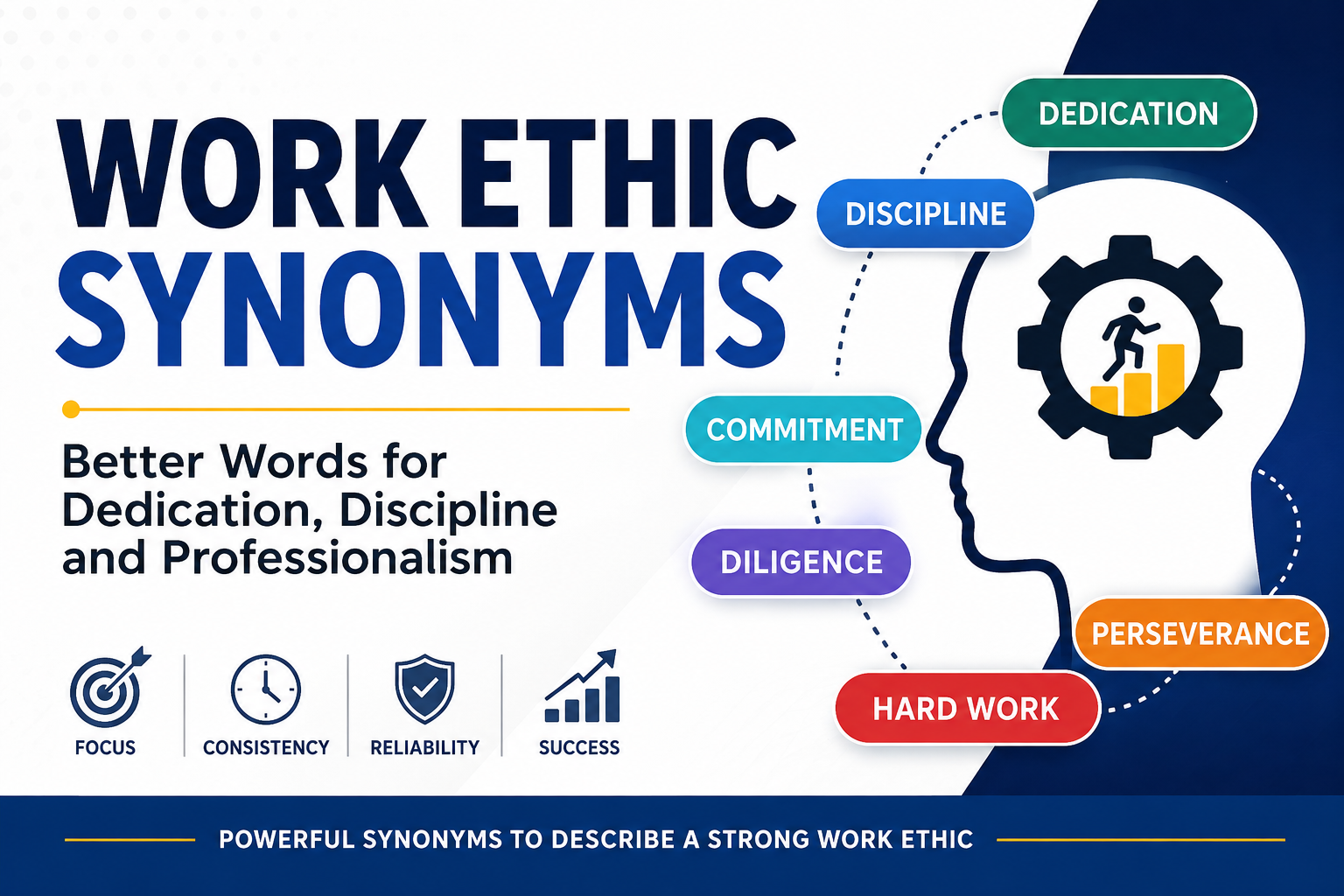
When you need another way to say “work ethic,” the best replacement depends on what you actually mean. If you mean careful, consistent effort, diligence may be the closest choice. If you mean strong dedication to a job, commitment or dedication may work better. For persistence through difficulty, perseverance or tenacity is more precise.
The important point is that these words are not all exact synonyms. Some describe specific qualities that contribute to a strong work ethic. Choosing the right one makes your writing more natural and precise, especially on resumes, in interviews, performance reviews, and professional communication.
Quick Answer: What Are the Best Work Ethic Synonyms?
The closest alternatives to work ethic include diligence, industry, industriousness, dedication, commitment, and conscientiousness. However, the best choice depends on the quality you want to emphasize. Use diligence for careful, persistent effort; dedication for strong commitment; conscientiousness for responsibility and care; and perseverance when the focus is on continuing despite difficulty.
Work Ethic Synonyms at a Glance
| Word | Relationship | Meaning | Strength | Formality | Best Context |
|---|---|---|---|---|---|
| Diligence | Close synonym | Careful, persistent effort | Strong | Formal | Work, study, professional writing |
| Industry | Close synonym | Hard work and industrious effort | Strong | Formal | General work |
| Industriousness | Close synonym | Habit of working hard | Strong | Formal | People and work habits |
| Dedication | Near synonym | Strong commitment to a task or purpose | Strong | Neutral | Careers, projects, service |
| Commitment | Near synonym | Willingness to remain devoted to something | Strong | Neutral | Work, teams, organizations |
| Conscientiousness | Near synonym | Careful responsibility and attention to duty | Strong | Formal | Professional evaluations |
| Perseverance | Contextual alternative | Continuing despite difficulty | Strong | Neutral | Long-term goals |
| Tenacity | Contextual alternative | Determination to keep going | Strong | Neutral | Difficult challenges |
| Discipline | Contextual alternative | Ability to follow through consistently | Strong | Neutral | Habits, productivity |
| Reliability | Contextual alternative | Consistent dependability | Moderate | Neutral | Employees, teams |
| Professionalism | Contextual alternative | Appropriate professional conduct | Moderate | Formal | Workplace communication |
| Initiative | Contextual alternative | Acting without waiting to be told | Moderate | Neutral | Resumes, leadership |
| Responsibility | Contextual alternative | Taking ownership of duties | Moderate | Neutral | Jobs, performance |
| Drive | Contextual alternative | Strong motivation to achieve | Strong | Neutral | Careers, performance |
| Determination | Contextual alternative | Firm intention to achieve a goal | Strong | Neutral | Challenges, goals |
| Persistence | Contextual alternative | Continuing despite obstacles | Strong | Neutral | Projects, difficult tasks |
| Consistency | Contextual alternative | Maintaining steady performance | Moderate | Neutral | Work quality, productivity |
| Hard work | Related expression | Putting substantial effort into work | Strong | Neutral | Everyday English |
| Workmanship | Related term | Quality of work produced | Context-dependent | Neutral | Skilled/manual work |
| Work culture | Related term | Shared workplace values and practices | Different meaning | Neutral | Organizations |
The distinction matters: a word such as reliability describes one component of a strong work ethic rather than the entire concept.
What Does “Work Ethic” Mean?
Work ethic is a noun referring to a person’s attitude toward work, especially the belief that hard work is valuable or morally good. Oxford also describes it in terms of the principle that hard work is a good habit and should be rewarded.
Cambridge similarly defines work ethic as a belief in the value and importance of work, while its Business English definition emphasizes an individual’s attitude toward the importance of working hard.
Merriam-Webster also connects the term with values centered on work and a desire or determination to work hard.
Example
Maria has a strong work ethic and consistently completes difficult projects on time.
Here, work ethic refers to the broader attitude and values behind Maria’s approach to work.
The Best Work Ethic Synonyms
1. Diligence
Diligence is one of the strongest alternatives when you mean careful, steady, and persistent effort.
It is particularly useful in formal or professional writing.
Example:
His diligence helped the team complete the project ahead of schedule.
Best for: careful and consistent effort.
Resume example:
Demonstrated diligence in managing complex client accounts.
2. Industry
Industry is a traditional noun meaning diligence or hard work. It is a particularly close lexical alternative when the focus is on someone’s habit of working hard.
Example:
Her industry and determination earned the respect of her colleagues.
It is less common in everyday American English than diligence, so it can sound somewhat formal.
Best for: formal writing and descriptions of sustained hard work.
3. Industriousness
Industriousness describes the quality of being hardworking and productive.
Example:
His industriousness was evident in the way he consistently took on challenging assignments.
It is closely related to work ethic, but it emphasizes the person’s actual habit of working hard more than their underlying beliefs about work.
Best for: describing a hardworking person.
4. Dedication
Dedication means strong commitment to a person, activity, task, or purpose.
It is an excellent choice when someone’s work ethic is demonstrated through devotion to their work.
Example:
Her dedication to the project helped the team overcome several setbacks.
Choose “dedication” when: you want to emphasize commitment rather than simply hard work.
5. Commitment
Commitment emphasizes a person’s willingness to remain devoted to a responsibility, goal, organization, or project.
Example:
His commitment to quality has made him a valuable member of the team.
Compared with diligence, commitment says more about devotion and loyalty and less about the manner in which someone works.
6. Conscientiousness
Conscientiousness refers to being careful, responsible, thorough, and attentive to one’s duties.
Example:
Her conscientiousness ensures that every report is checked before submission.
This is particularly useful when strong work ethic means careful and responsible work, rather than simply working long hours.
Best for: professional evaluations, academic writing, and formal descriptions.
7. Perseverance
Perseverance means continuing to work toward something despite difficulties or delays.
Example:
His perseverance helped him finish the six-month training program.
It is not a complete synonym for work ethic. Instead, it describes a particular aspect of a strong work ethic: persistence through difficulty.
8. Tenacity
Tenacity describes strong determination to continue pursuing something despite obstacles.
Example:
Her tenacity helped the company recover after a difficult quarter.
Compared with perseverance, tenacity can sound more forceful or determined.
Best for: challenging projects, competitive environments, and difficult goals.
9. Discipline
Discipline refers to the ability to control your behavior and consistently follow a plan or standard.
Example:
His discipline allows him to meet deadlines even when the workload increases.
Use discipline when the work ethic you want to describe involves self-control, routine, and consistency.
10. Reliability
Reliability means that someone can be depended on to do what they are expected to do.
Example:
Her reliability made her the team’s first choice for important assignments.
Reliability is not an exact synonym for work ethic. A reliable employee may have a strong work ethic, but the two concepts are not identical.
Best for: resumes, recommendations, performance reviews, and teamwork.
More Contextual Alternatives to “Work Ethic”
The following words can be useful, but they should not automatically replace work ethic in every sentence.
Professionalism
Use professionalism when you mean appropriate behavior, standards, communication, and conduct in a workplace.
His professionalism impressed both clients and managers.
Professionalism is broader than simply working hard.
Initiative
Use initiative when someone independently identifies what needs to be done and acts without waiting for instructions.
She showed initiative by developing a better reporting process.
Responsibility
Use responsibility when the emphasis is on accepting ownership of duties or obligations.
He takes responsibility for his assignments and meets every deadline.
Drive
Use drive when you mean strong internal motivation to achieve something.
Her drive has helped her progress rapidly in her career.
Determination
Use determination when someone has a firm intention to reach a goal.
His determination kept the project moving despite repeated setbacks.
Persistence
Use persistence when the main idea is continuing despite problems or rejection.
Her persistence eventually resulted in a successful partnership.
Consistency
Use consistency when someone maintains a reliable level of effort or performance.
His consistency has improved the team’s overall productivity.
Which Word Should You Use?
The best replacement depends on the specific quality you want to communicate.
| If you mean… | Use… |
|---|---|
| Careful, steady effort | Diligence |
| Habitual hard work | Industry / industriousness |
| Strong devotion | Dedication |
| Long-term involvement | Commitment |
| Careful responsibility | Conscientiousness |
| Continuing through difficulty | Perseverance |
| Aggressive determination | Tenacity |
| Self-control and routine | Discipline |
| Dependability | Reliability |
| Workplace conduct | Professionalism |
| Independent action | Initiative |
| Motivation to succeed | Drive |
| Ownership of duties | Responsibility |
This is more useful than treating all of these words as interchangeable.
Work Ethic Synonyms for a Resume
On a resume, simply writing “strong work ethic” can sound generic because it describes a quality without showing evidence.
Instead, choose the trait that matches your actual achievement.
Instead of “strong work ethic,” try:
- Diligence — when you emphasize careful, consistent work
- Reliability — when you emphasize dependable performance
- Initiative — when you emphasize independent action
- Conscientiousness — when you emphasize accuracy and responsibility
- Dedication — when you emphasize commitment
- Discipline — when you emphasize consistent habits
- Drive — when you emphasize motivation and achievement
- Tenacity — when you emphasize overcoming challenges
Stronger resume examples
Weak:
Strong work ethic.
Better:
Demonstrated diligence by consistently completing high-priority projects ahead of deadline.
Weak:
Excellent work ethic and commitment.
Better:
Demonstrated reliability by consistently meeting project deadlines and maintaining accurate documentation.
The second versions are stronger because they provide evidence instead of simply making a positive claim.
Work Ethic vs. Diligence
Work ethic and diligence overlap, but they are not identical.
- Work ethic = an attitude or set of values concerning work.
- Diligence = careful and persistent effort in performing a task.
Example:
She has a strong work ethic.
This describes her broader attitude toward work.
She completed the assignment with great diligence.
This focuses on how carefully and consistently she performed a particular task.
Bottom line: Choose diligence when you want a more precise word for careful effort.
Work Ethic vs. Dedication
Both words can describe a positive approach to work, but they emphasize different things.
Work ethic focuses on attitudes and values surrounding work.
Dedication focuses on strong devotion to a particular task, goal, organization, or purpose.
His strong work ethic makes him consistently productive.
His dedication to the company has lasted for more than ten years.
Bottom line: Use dedication when commitment is the main idea.
Work Ethic vs. Professionalism
These terms are often confused.
Professionalism concerns how appropriately someone behaves in a professional environment. It can include communication, appearance, reliability, conduct, and respect for workplace standards.
Work ethic is more specifically connected to attitudes toward work and the willingness or determination to work hard.
Her professionalism impressed the client.
Her strong work ethic helped her finish the project early.
Someone can demonstrate professionalism without necessarily being exceptionally hardworking, so these words should not normally be treated as exact synonyms.
Common Mistakes When Choosing a Work Ethic Synonym
1. Treating every positive workplace trait as a synonym
Words such as punctuality, reliability, professionalism, integrity, and responsibility are related to a strong work ethic, but they do not have the same meaning.
2. Using “productivity” as a direct synonym
Productivity measures output or efficiency. It does not necessarily describe someone’s values or attitude toward work.
3. Using “motivation” interchangeably with work ethic
Motivation concerns the reasons or forces that encourage someone to act. A work ethic is a broader attitude toward work.
4. Using “workmanship” incorrectly
Workmanship concerns the quality or skill demonstrated in producing something. It does not generally mean a person’s attitude toward work.
5. Assuming “hard work” means exactly the same thing
Hard work describes substantial effort. Work ethic can include hard work but also involves attitudes and values concerning work.
Words Related to Work Ethic
These words are useful for building vocabulary around the topic, but they should not all be presented as direct synonyms:
- Accountability
- Ambition
- Accuracy
- Dependability
- Efficiency
- Focus
- Integrity
- Motivation
- Productivity
- Punctuality
- Responsibility
- Self-discipline
- Teamwork
- Thoroughness
Think of these as qualities that can contribute to or demonstrate a strong work ethic, rather than automatic replacements.
Antonyms of Work Ethic
There is no single perfect opposite for every use of work ethic, but common contrasting concepts include:
- Laziness
- Idleness
- Negligence
- Indiscipline
- Unreliability
- Lack of commitment
- Poor work habits
For example:
His lack of commitment affected the team’s performance.
Here, lack of commitment describes one negative aspect of a poor work ethic.
FAQ About Work Ethic Synonyms
What is the closest synonym for work ethic?
Diligence is one of the closest practical alternatives when work ethic refers to steady, careful, and persistent effort. However, it does not reproduce the full meaning of work ethic, which can also refer to a person’s values or attitude toward work.
What is another word for a strong work ethic?
Depending on the intended meaning, good alternatives include diligence, dedication, industriousness, conscientiousness, commitment, discipline, and perseverance. Choose the word that describes the specific quality you want to emphasize.
What is a professional word for work ethic?
Diligence and conscientiousness are strong formal choices. Dedication and commitment also work well in professional communication, depending on the context.
What is another word for work ethic on a resume?
There is no single best replacement. Diligence, reliability, initiative, conscientiousness, discipline, and dedication can work well when they accurately describe your behavior. Whenever possible, support the word with a measurable achievement.
Is diligence the same as work ethic?
Not exactly. Diligence describes careful and persistent effort, whereas work ethic can describe the broader attitude or values a person has toward work. Diligence is therefore a close alternative in some contexts, not a perfect substitute.
Is professionalism a synonym for work ethic?
Not exactly. Professionalism concerns appropriate professional conduct, while work ethic concerns attitudes and values surrounding work and hard work. The two can overlap, but they should not be treated as interchangeable.
What is the best word for someone with a strong work ethic?
The best word depends on the behavior. Diligent fits someone who works carefully and consistently; industrious fits someone who works hard; conscientious fits someone who is careful and responsible; and tenacious fits someone who refuses to give up.
How do you describe a strong work ethic in one word?
Useful choices include diligent, industrious, conscientious, dedicated, disciplined, reliable, and tenacious. The right word depends on which aspect of the person’s work habits you want to highlight.
Conclusion
The best work ethic synonym depends on the exact quality you want to express. Diligence is a strong choice for careful, consistent effort; industriousness emphasizes hard work; dedication and commitment highlight devotion; conscientiousness emphasizes responsibility and care; and perseverance or tenacity focuses on continuing through difficulty.

Sarah Williams is an ESL teacher and content writer with a passion for simplifying English vocabulary. She creates easy-to-understand synonym guides and learning resources that help beginners and intermediate learners build strong language skills.