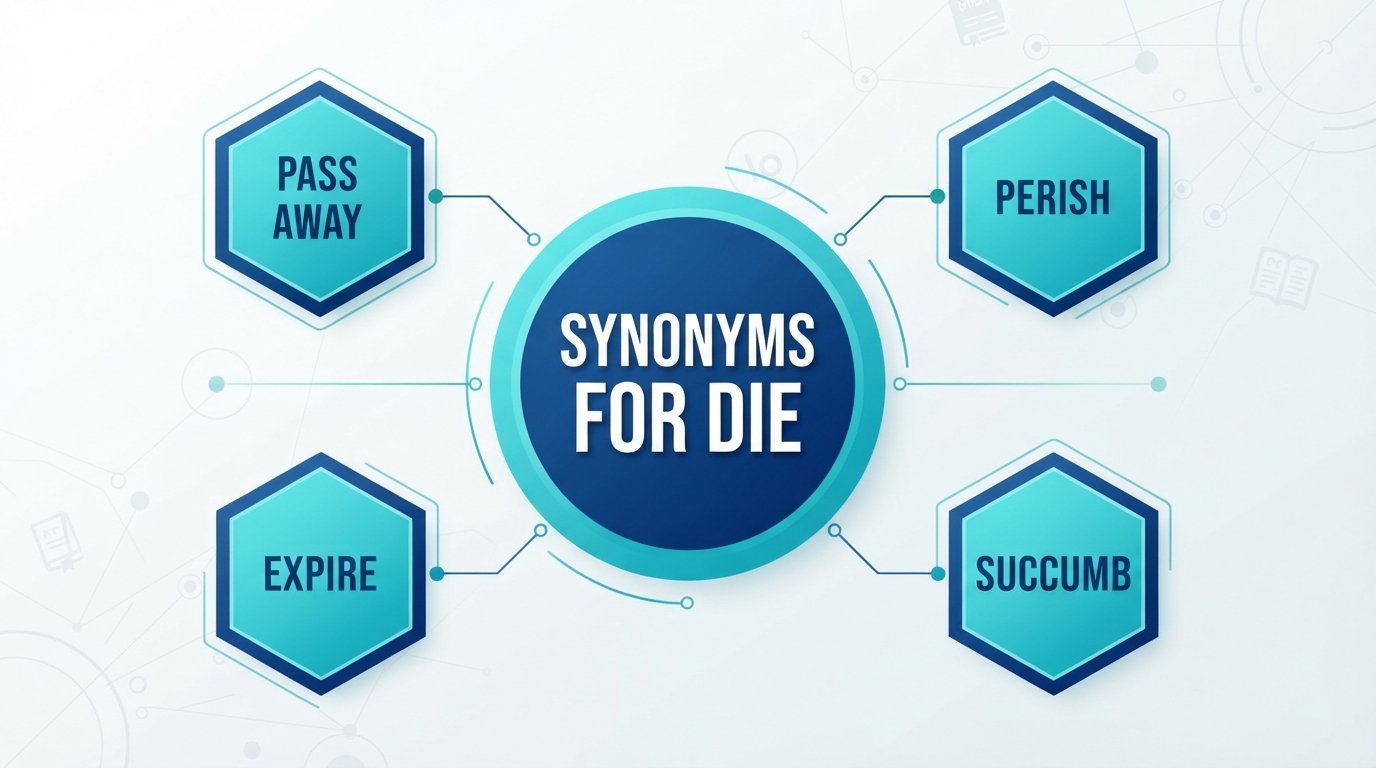
Finding the right synonym for die depends on context. In a straightforward sentence, pass away may sound more respectful, while perish can sound literary or dramatic. Expire is formal and often appears in medical, historical, or literary contexts, whereas expressions such as kick the bucket are informal and sometimes humorous. Other alternatives, including be killed, lose one’s life, and succumb, change the emphasis rather than simply replacing die. This guide separates direct synonyms from near-synonyms, euphemisms, idioms, and contextual alternatives so you can choose the most natural expression.
Quick Answer
The closest synonyms for die include pass away, perish, expire, pass on, depart, decease, succumb, and lose one’s life. The best choice depends on tone and context. Use pass away for a respectful or gentle tone, perish for formal or literary writing, expire for formal contexts, and kick the bucket only in informal or humorous situations.
| Word or Phrase | Relationship | Meaning / Use | Register | Best Context |
|---|---|---|---|---|
| pass away | Direct euphemistic alternative | Die, expressed gently | Polite / neutral | Obituaries, condolences |
| pass on | Near synonym | Die, often gently | Neutral / euphemistic | Personal conversation |
| perish | Direct / near synonym | Die, often through disaster or hardship | Formal / literary | News, literature |
| expire | Near synonym | Die or cease living | Formal / literary | Formal writing |
| succumb | Contextual alternative | Die after being overcome by disease or another force | Formal | Medical / formal writing |
| depart | Euphemistic alternative | Die, metaphorically leaving life | Literary / formal | Eulogies, literature |
| decease | Formal synonym | Die | Formal / legal | Legal or official writing |
| be killed | Contextual alternative | Die because of another person’s action or an event | Neutral | Accidents, violence |
| lose one’s life | Contextual alternative | Die, often emphasizing circumstances | Neutral | Accidents, disasters |
| suffer death | Formal alternative | Die, often as a result of violence or punishment | Formal | Historical / legal contexts |
The table deliberately distinguishes true replacements from idioms and related expressions. Not every phrase can replace die in every sentence. Cambridge, for example, lists pass away, pass on, perish, expire, succumb, and lose your life alongside informal expressions such as kick the bucket and snuff it.
What Does Die Mean?
Die is a verb meaning to stop being alive. It can describe people, animals, plants, and other living organisms. Cambridge also records separate senses of die, including stopping to exist or continuing and, informally, a machine or device stopping because it has no power.
For example:
- The old tree died during the drought.
- His grandfather died peacefully.
- Several people died in the accident.
The alternatives in this article mainly concern the “stop living” sense of die. Words such as fade, wane, and decline can relate to other senses of die, but they should not be presented as direct synonyms for human death.
Closest Synonyms for Die
Pass Away
Pass away is one of the most common gentle alternatives to die. It is especially appropriate when discussing someone’s death respectfully.
Example:
Her grandmother passed away peacefully at home.
This expression is common in condolences, obituaries, and sensitive conversations. Cambridge lists pass away as a synonym for die.
Pass On
Pass on can also mean die, particularly in gentle or euphemistic language.
Example:
His father passed on several years ago.
It is less neutral than simply saying died, so context matters.
Perish
Perish means die, but it often carries a stronger sense of destruction, suffering, disaster, or violent circumstances.
Example:
Hundreds perished in the earthquake.
It works particularly well in formal, historical, and literary writing.
Expire
Expire can mean die, especially in formal or literary language.
Example:
The soldier expired shortly after reaching the hospital.
Because it can sound clinical or detached, it is usually less natural than pass away in personal conversations.
Succumb
Succumb is useful when someone dies after being overcome by a disease, injury, condition, or other force.
Example:
He succumbed to cancer at the age of 68.
This is not always a direct replacement for die. The construction succumb to usually identifies what overwhelmed the person.
Decease
Decease is a formal term meaning death or, as a verb, to die.
Example:
The records were updated following the person’s decease.
It is much less common in everyday English than die or pass away and is most useful in formal or legal contexts.
Respectful and Gentle Alternatives
When discussing someone’s death with family members, colleagues, or readers, pass away is usually a safer choice than a slang expression.
Other gentle alternatives include:
- pass on
- leave this world
- go from this world
- go to one’s rest
- be no more
However, these expressions vary in tone and cultural or religious associations. Pass away is generally the most broadly understood respectful alternative.
Formal and Literary Alternatives
Formal or literary writing may favor stronger or more elevated vocabulary.
Perish
Best when death occurs through disaster, violence, hardship, or destruction.
Many travelers perished in the disaster.
Expire
Formal and sometimes literary.
The patient expired during the night.
Depart
Depart can function as a poetic euphemism for death.
The poet departed this life peacefully.
Breathe One’s Last
This phrase emphasizes the final moment of life.
The wounded soldier breathed his last before dawn.
It is much more literary than ordinary conversational English.
Alternatives for Death Caused by an Event or Circumstance
Sometimes the important information is not simply that someone died, but how or why they died.
Be Killed
Use be killed when another person, an accident, violence, or another external event caused the death.
Three passengers were killed in the crash.
This is not interchangeable with die in every sentence because it adds information about the circumstances.
Lose One’s Life
Lose one’s life is common in reports about accidents, disasters, wars, and dangerous events.
Five workers lost their lives in the explosion.
It often sounds more formal and sensitive than repeating died.
Meet Death
Meet death is generally literary or dramatic and often suggests a dangerous or violent situation.
The explorers met death in the frozen wilderness.
Informal and Slang Alternatives
Informal expressions can be useful in dialogue, fiction, or casual conversation, but they should not normally be used in condolences or sensitive professional writing.
Kick the Bucket
Kick the bucket is a well-known informal idiom meaning die.
He joked that he wanted to travel the world before he kicked the bucket.
Because it can sound humorous or insensitive, avoid it when discussing a recent death.
Croak
Croak is slang for die.
The old character finally croaked at the end of the story.
It is strongly informal and can sound disrespectful.
Snuff It
Snuff it is mainly British informal slang.
He joked that he would snuff it if he had to work another weekend.
Cambridge specifically labels snuff it as mainly UK informal.
Pop Off
Pop off can mean die in informal or humorous usage.
His uncle popped off unexpectedly.
This expression is not appropriate for most serious discussions of death.
Check Out
Check out can be slang for dying.
The detective’s partner checked out before the investigation ended.
The expression has many other meanings, so context is essential.
Important Comparisons
Die vs. Pass Away
Die is direct and neutral. Pass away is more euphemistic and generally gentler.
- Direct: Her father died last year.
- Gentle: Her father passed away last year.
Use die when clarity and directness matter. Use pass away when sensitivity is more important.
Die vs. Perish
Both can mean stop living, but perish often suggests destruction, disaster, suffering, or a literary tone.
Two people died in the accident.
Hundreds perished in the disaster.
The second sentence gives the event a more formal or dramatic tone.
Die vs. Expire
Expire is more formal and can sound clinical or literary.
The patient died during the night.
The patient expired during the night.
The first is natural in ordinary English; the second is more formal and context-dependent.
Die vs. Succumb
Succumb usually means being overcome by something and is often followed by to.
She died of cancer.
She succumbed to cancer.
The second emphasizes the disease as the force that overcame her.
Die vs. Be Killed
Die states the outcome. Be killed emphasizes an external cause.
Two people died in the crash.
Two people were killed in the crash.
The second construction focuses more strongly on the accident or event that caused the deaths.
Which Word Should You Use?
Choose the word based on the tone and context:
- For ordinary, direct English: die
- For a respectful or gentle tone: pass away
- For disasters or destruction: perish
- For formal or literary writing: expire
- For death caused by a disease or force: succumb to
- For accidents or violence: be killed
- For formal reporting: lose one’s life
- For literary writing: depart or breathe one’s last
- For casual humor: kick the bucket
- For slang: croak or snuff it
The most natural synonym is therefore determined by meaning, tone, register, and context, not simply by whether a thesaurus lists the word.
Common Mistakes
Treating Every Thesaurus Entry as a Direct Synonym
Words such as kick the bucket and croak are not neutral replacements for die. They add an informal or humorous tone.
Using Slang in Sensitive Situations
Expressions such as kick the bucket can sound disrespectful when discussing someone’s recent death.
Assuming “Perish” Fits Every Sentence
Perish is grammatical in many contexts, but it often sounds formal, literary, or associated with disaster and destruction.
Using “Succumb” Without the Right Context
Succumb usually describes being overcome by something:
She succumbed to the disease.
It is not simply a universal replacement for died.
Confusing Related Expressions With Synonyms
Rest in peace is not a synonym for die. It is an expression associated with someone who has died.
Antonyms of Die
The clearest antonym of die is live.
Other related opposites include:
- survive
- remain alive
- exist
- flourish
- thrive
The best choice depends on the intended contrast. Survive, for example, specifically suggests continuing to live despite danger, illness, or hardship.
FAQ
What is the most polite synonym for die?
Pass away is one of the most widely understood polite or gentle alternatives to die. It is common in condolences, obituaries, and personal conversations where a softer expression is appropriate.
What is a formal word for die?
Expire, perish, and decease can work in formal contexts, although they differ in usage. Perish often has a literary or disaster-related tone, while expire can sound formal or clinical. Decease is particularly formal and uncommon in everyday speech.
What is a respectful way to say someone died?
Passed away is usually the most natural respectful alternative. Depending on the context, phrases such as left this world or went to their rest can also work, although they are more euphemistic or literary.
What is a literary synonym for die?
Perish, depart, expire, and breathe one’s last can have literary uses. The appropriate choice depends on whether the writing emphasizes tragedy, finality, formality, or poetic expression.
What is an informal synonym for die?
Common informal expressions include kick the bucket, croak, snuff it, pop off, and check out. These should be used carefully because some can sound humorous, slangy, or disrespectful.
Is “perish” the same as “die”?
Perish can mean die, but it often suggests death through destruction, disaster, violence, or hardship. It can also sound more formal or literary than the neutral verb die.
Is “pass away” a synonym for “die”?
Yes. Pass away is a common euphemistic expression meaning die. It is generally softer and more respectful than the direct verb die, especially when referring to a person.
Conclusion
The best synonym for die depends on what you want to communicate. Pass away is gentle and respectful, perish is more formal or literary, expire is formal, and succumb emphasizes being overcome by a disease or other force. Expressions such as kick the bucket and croak are informal and should be used carefully. For precise writing, choose the alternative that matches the context, tone, register, and circumstances of death rather than selecting a word simply because it appears in a thesaurus.

Michael Thompson is an English language specialist and experienced editor who focuses on vocabulary development and clear communication. He creates high-quality synonym guides, word comparisons, and writing tips to help students and professionals express their ideas more effectively. His work combines linguistic knowledge with practical SEO strategies to make learning both useful and engaging.