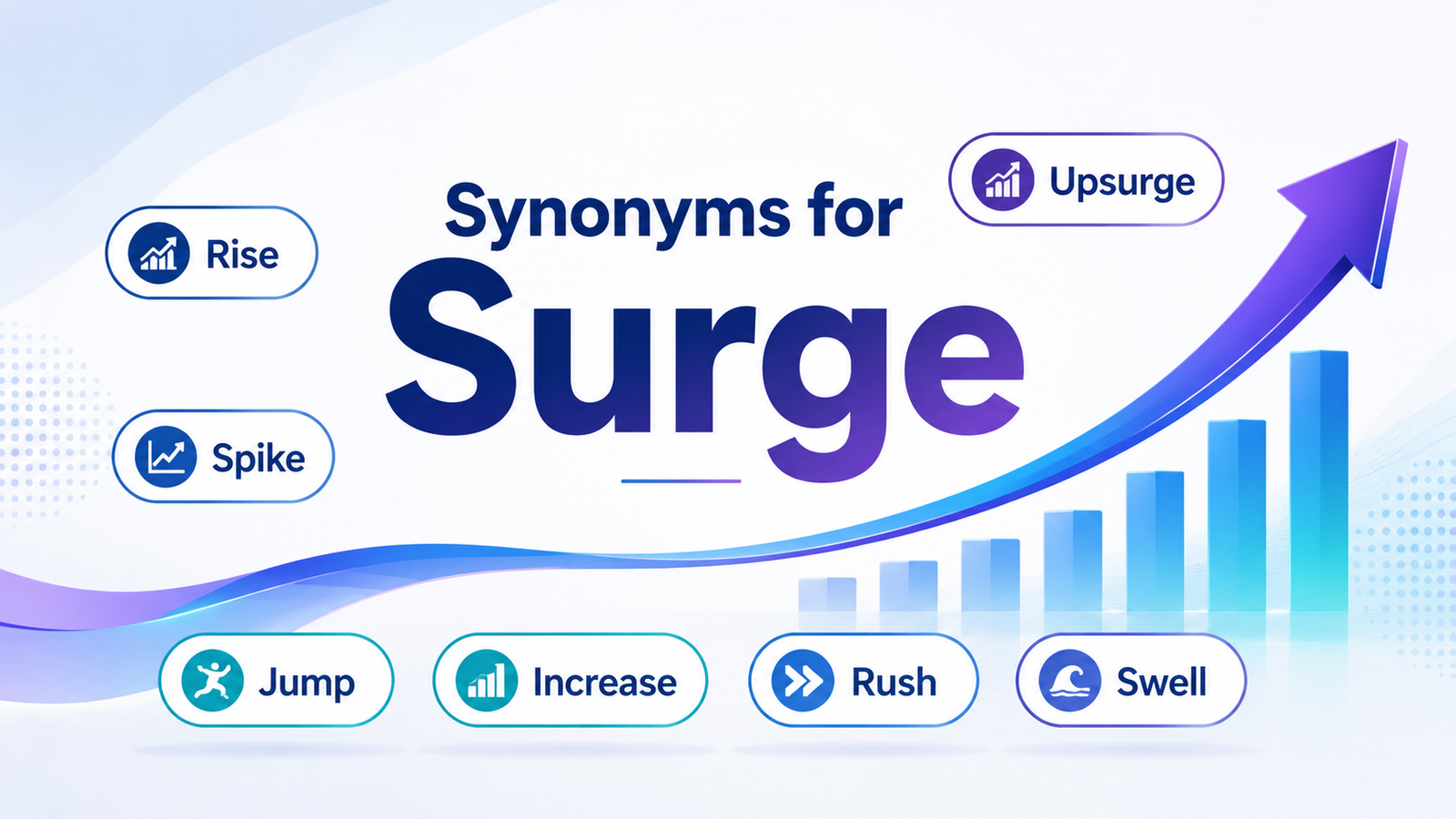
Looking for the right synonyms for surge? The best alternative depends on what surge means in your sentence. When surge describes a sudden increase, words such as rise, increase, jump, spike, upsurge, boost, and escalation may work. When it describes powerful movement, alternatives such as rush, advance, sweep, or charge may be more natural. For waves or liquids, swell, wave, gush, and flow can be better choices.
This distinction matters because surge is unusually flexible. As a noun, it can describe a sudden and substantial increase, a powerful forward movement, a wave-like movement, or a sudden rise in electrical current or voltage. As a verb, it can mean to increase suddenly and strongly or to move quickly and powerfully.
Quick Answer: What Are the Best Synonyms for Surge?
The closest synonyms for surge depend on the sense. For a sudden increase, the strongest alternatives include rise, increase, jump, spike, upsurge, boost, and upswing. When describing powerful movement, terms such as rush, advance, sweep, and charge may be more appropriate. In the context of a wave or swelling movement, swell, wave, billow, and flow can convey the idea more accurately.
For example, a surge in demand can become a sharp increase in demand, while the crowd surged forward can be rewritten as the crowd rushed forward. Although these words share related meanings, they are not interchangeable in every context.
Common Synonyms for Surge
The best synonym for surge depends on the context and the type of increase or movement being described. Words such as increase, rise, jump, spike, upsurge, boost, growth, and upswing are useful when surge refers to a sudden or noticeable increase. Other alternatives, including rush, swell, wave, flood, and spurt, are more suitable when the word describes rapid movement, a large arrival, or a wave-like expansion.
Synonyms for Surge — Increase and Growth
| Word | Relationship to “Surge” | Meaning | Strength | Formality | Best Context |
|---|---|---|---|---|---|
| Increase | Close synonym | A rise in amount, number, or degree | Moderate | Neutral | Business, statistics, general writing |
| Rise | Close synonym | An upward movement or increase | Moderate | Neutral | Prices, rates, numbers |
| Jump | Sudden-increase term | A noticeable and fairly sudden increase | Strong | Neutral | Prices, costs, numbers |
| Spike | Sharp-increase term | A sharp and often sudden increase | Strong | Neutral | Data, prices, cases, demand |
| Upsurge | Very close synonym | A sudden and substantial increase | Strong | Neutral/Formal | Interest, demand, activity |
| Boost | Improvement-related term | An increase that improves or strengthens something | Moderate | Neutral | Sales, confidence, performance |
| Growth | Longer-term alternative | An increase or development over time | Moderate | Neutral/Formal | Business, population, markets |
| Escalation | Intensity-related term | An increase in intensity, seriousness, or scale | Strong | Formal | Conflict, costs, tensions |
| Upswing | Upward-trend term | An improvement or movement toward a higher level | Moderate | Neutral | Economy, business, fortunes |
commonly Synonyms for Surge — Movement and Rapid Change
| Word | Relationship to “Surge” | Meaning | Strength | Formality | Best Context |
|---|---|---|---|---|---|
| Climb | Continuing-rise term | A gradual or continuing upward movement | Moderate | Neutral | Prices, rates, numbers |
| Soar | Strong verb | To rise very rapidly or reach a high level | Very strong | Neutral | Prices, profits, demand |
| Mount | Progressive verb | To increase gradually or progressively | Moderate/Strong | Neutral/Formal | Pressure, costs, concern |
| Rush | Movement-related term | A sudden and forceful movement | Strong | Neutral | Crowds, people, liquids |
| Swell | Expansion-related term | To grow larger, fuller, or more powerful | Moderate/Strong | Neutral | Waves, crowds, emotion |
| Wave | Large-movement term | A large or repeated movement or arrival | Moderate | Neutral | People, emotion, activity |
| Flood | Large-influx term | A very large amount arriving rapidly | Strong | Neutral | Messages, visitors, traffic |
| Gush | Sudden-flow term | To flow out suddenly and forcefully | Strong | Neutral | Water, liquid, emotion |
| Stream | Continuous-flow term | To move or flow continuously | Moderate | Neutral | People, traffic, information |
Synonyms for Surge — Bursts, Forceful Movement, and Expression
| Word | Relationship to “Surge” | Meaning | Strength | Formality | Best Context |
|---|---|---|---|---|---|
| Spurt | Brief-burst term | A short, sudden period of growth or movement | Strong but brief | Neutral | Sales, growth, activity |
| Billow | Wave-like term | To swell, expand, or move in large waves | Strong | Literary/Neutral | Smoke, fabric, water |
| Flow | Related movement term | The continuous movement of a substance, group, or stream | Variable | Neutral | Water, traffic, information |
| Advance | Forward-movement term | To move forward or make progress | Moderate | Neutral/Formal | People, projects, armies |
| Charge | Forceful-movement term | To move forward quickly and forcefully | Strong | Neutral | People, animals, attacks |
| Sweep | Broad-movement term | To move powerfully across a wide area | Strong | Neutral | Crowds, movements, events |
| Outpouring | Sudden-release noun | A large and sudden expression or release | Strong | Neutral/Formal | Emotion, support, criticism |
Choosing the Right Synonym
The right alternative to surge depends on the context, speed, and type of movement or increase being described. For rising prices or numbers, rise, jump, spike, and upswing can be suitable choices, depending on how quickly and significantly the change occurs. When people or objects move suddenly, rush, charge, and sweep often provide a more precise meaning. Words such as swell, gush, and billow work better for waves, liquids, or smoke, while outpouring is especially useful for describing a strong release of emotion, support, or criticism.
What Does “Surge” Mean?
Surge is both a noun and a verb.
As a noun, it can mean a sudden and substantial increase, as in a surge in demand. It can also mean a sudden powerful movement forward, such as a surge of people toward the exit. Other senses include a large wave or swell and a sudden rise in electrical current or voltage.
As a verb, surge commonly means to increase suddenly and strongly, as in:
Sales surged after the company introduced the new product.
It can also mean to move quickly and powerfully:
The crowd surged toward the stadium gates.
Cambridge also recognizes a separate emotional sense in which an emotion develops strongly and quickly, such as anger surged through her.
Pronunciation
US: /sɝːdʒ/
UK: /sɜːdʒ/
Part of Speech
- Noun: a surge
- Verb: to surge
- Past tense: surged
- Present participle: surging
The best Synonyms for Surge Meaning “A Sudden Increase”
This is the most common meaning in business, news, economics, technology, health reporting, and everyday writing.
1. Increase
Increase is one of the safest alternatives when you simply mean that something became larger in amount, number, or degree.
- Original: There was a surge in online sales.
- Alternative: There was a significant increase in online sales.
Unlike surge, increase does not necessarily suggest suddenness or unusual intensity.
Choose “increase” when: accuracy and neutrality matter more than dramatic emphasis.
2. Rise
Rise is another broad and natural alternative, especially with prices, rates, numbers, temperatures, and levels.
- The company reported a rise in revenue.
- The country experienced a rise in unemployment.
A rise can be gradual or sudden, whereas surge more strongly suggests a sudden and substantial movement upward.
3. Jump
Jump suggests a noticeable increase, often one that happens relatively quickly.
- There was a jump in housing prices.
- The announcement caused a jump in website traffic.
It is more conversational than surge and can sound less formal.
4. Spike
Spike is particularly useful when an increase is sharp, sudden, and often temporary.
- There was a spike in electricity demand during the heat wave.
- The website experienced a spike in traffic.
This is an excellent alternative for data and measurable quantities.
Important distinction: spike often implies a sharp peak, while surge can describe a powerful increase without implying that the increase will quickly fall again.
5. Upsurge
Upsurge is one of the closest noun alternatives to surge when the meaning is a sudden increase.
- There has been an upsurge in consumer interest.
- The region experienced an upsurge in tourism.
It is somewhat more formal and is especially common in news, academic, and analytical writing.
6. Boost
Boost is useful when the increase has a positive or beneficial effect.
- The campaign gave sales a boost.
- The new policy provided a boost to consumer confidence.
Calling a negative increase a boost would normally change the meaning because boost usually carries a favorable implication.
7. Escalation
Escalation is appropriate when something becomes more intense, serious, costly, or difficult.
- The conflict saw a sudden escalation in violence.
- The project suffered an escalation in costs.
It is not a general replacement for surge. It works best when the increase involves intensity or seriousness.
Best Synonyms for Surge Meaning “Move Forward Quickly”
When surge describes physical movement, increase-related synonyms often stop working.
Consider:
The crowd surged toward the entrance.
You cannot naturally replace surged with increased or rose. The meaning is movement.
Better alternatives include:
- rushed
- charged
- advanced
- swept
- pressed forward
- moved rapidly
- streamed forward
Rush
Rush is probably the closest everyday alternative.
The crowd rushed toward the exit.
It emphasizes speed and urgency.
Charge
Charge suggests forceful, energetic, sometimes aggressive forward movement.
The protesters charged toward the barricade.
This is stronger and more dramatic than surge.
Advance
Advance is more formal and emphasizes forward progress rather than sudden force.
The troops advanced toward the city.
It is not interchangeable with surge in every situation.
Sweep
Sweep emphasizes broad, powerful movement across or through an area.
A wave of excitement swept through the crowd.
It works especially well when the movement is figurative.
Synonyms for Surge When Talking About Water or Waves
The word surge has a physical, wave-related meaning as well. Merriam-Webster defines the noun partly as a swelling or sweeping forward like a wave, while Cambridge includes a sudden powerful movement and specifically recognizes tidal surge.
Useful alternatives include:
- swell
- wave
- billow
- rush
- flow
- gush
- flood
Swell
Best when something becomes larger or rises gradually or dramatically.
The waves began to swell.
Wave
A general term for a moving ridge of water.
A huge wave crashed against the shore.
Billow
More descriptive and often literary. It suggests something swelling or rolling outward in large masses.
Dark clouds billowed across the sky.
Gush
Best for liquid moving outward suddenly and forcefully.
Water gushed from the broken pipe.
These words overlap with surge but describe different physical patterns.
Synonyms for an Emotional Surge
Surge can describe a sudden powerful development of emotion:
A surge of relief swept through her.
Good contextual alternatives include:
- rush
- wave
- outpouring
- burst
- flood
- upswell
Rush
He felt a rush of excitement.
This emphasizes sudden intensity.
Wave
A wave of sadness came over her.
This emphasizes an emotion arriving and passing over someone.
Flood
She was overwhelmed by a flood of memories.
This suggests a large or overwhelming amount.
Outpouring
There was an outpouring of support after the announcement.
This is especially useful for emotions, sympathy, praise, or public reactions expressed by many people.
Which Word Should You Use Instead of “Surge”?
Choose increase when:
You want the most neutral word for becoming greater in amount or number.
Choose rise when:
You are describing an upward change in prices, rates, levels, or numbers.
Choose jump when:
You want to emphasize a noticeable increase that happened relatively quickly.
Choose spike when:
The increase is sharp and potentially temporary.
Choose upsurge when:
You want a close, somewhat formal noun equivalent of surge.
Choose boost when:
The increase is beneficial or helps improve something.
Choose escalation when:
The increase involves intensity, seriousness, conflict, pressure, or cost.
Choose rush when:
You mean people, water, emotion, or another force moving suddenly.
Choose swell when:
Something becomes larger, fuller, or more wave-like.
Choose soar when:
You need a strong verb for a very rapid or dramatic rise.
Surge vs. Increase
Surge and increase overlap, but they are not identical.
| Feature | Surge | Increase |
|---|---|---|
| Suddenness | Usually strong | Not required |
| Intensity | Often substantial | Neutral |
| Emotional force | Common | Less common |
| Formality | Neutral | Neutral |
| Typical use | Sudden, notable change | Any upward change |
Compare:
Prices increased over the year.
This says prices became higher.
Prices surged over the year.
This suggests a much more dramatic or sudden rise.
Bottom line: increase is broader and more neutral; surge is more vivid and forceful.
Surge vs. Rise
Both can describe upward movement.
Interest in the product rose.
Interest in the product surged.
The first is neutral. The second emphasizes a rapid or substantial increase.
Use rise when you simply need to describe upward movement. Use surge when the magnitude or speed of the change matters.
Surge vs. Spike
These words are particularly easy to confuse.
A spike usually suggests a sharp peak or sudden jump, often followed by a decline.
A surge emphasizes a powerful upward movement and does not necessarily imply that the increase will immediately reverse.
Compare:
There was a spike in website traffic after the post went viral.
This suggests a sharp peak.
There was a surge in demand for electric vehicles.
This emphasizes strong growth in demand.
Surge vs. Upsurge
These are extremely close.
Upsurge is primarily a noun meaning a sudden increase or rise.
The industry experienced an upsurge in demand.
Surge is more versatile because it can function as both a noun and a verb:
Demand surged.
There was a surge in demand.
For everyday English, surge is generally more flexible.
Surge vs. Swell
Swell is particularly associated with things becoming larger, fuller, or more wave-like.
The crowd swelled to thousands.
A wave swelled near the shore.
Surge emphasizes sudden powerful movement or increase, while swell often emphasizes expansion or growing volume.
Natural Collocations With “Surge”
Some of the most useful expressions with surge include:
Business and Economics
- surge in demand
- surge in sales
- surge in prices
- surge in profits
- surge in investment
- surge in spending
- surge in inflation
- surge in growth
Public Interest
- surge in popularity
- surge in interest
- surge in support
- surge in attention
- surge in visitors
Problems and Negative Trends
- surge in cases
- surge in crime
- surge in costs
- surge in violence
- surge in infections
- surge in unemployment
Physical or Emotional Movement
- surge of emotion
- surge of anger
- surge of excitement
- surge of relief
- surge forward
- surge through the crowd
- surge toward the door
These patterns show why there is no single replacement that works equally well everywhere.
Common Mistakes When Using Surge Synonyms
1. Treating “increase” and “surge” as identical
They overlap, but surge generally carries more force and suddenness.
2. Using “boost” for every increase
Boost often implies a positive effect.
- Natural: The campaign boosted sales.
- Awkward: The recession boosted unemployment.
For a negative increase, increase, rise, or surge is usually more appropriate.
3. Using “spike” when the increase is gradual
A long-term gradual upward trend is usually better described with growth, rise, or increase.
4. Using “rush” for numerical increases
You can say:
A rush of customers entered the store.
But:
A rush in inflation
is generally unnatural. Use surge, rise, or spike instead.
5. Assuming “upsurge” works as a verb
Upsurge is normally used as a noun.
- Natural: an upsurge in demand
- Natural: demand surged
- Incorrect: demand upsurged
6. Ignoring register
Words such as escalation can sound more formal and analytical than jump or boost. Choose according to the audience and context.
Antonyms of Surge
The best antonym depends on the meaning.
Opposite of a Sudden Increase
- decline
- decrease
- drop
- fall
- reduction
- downturn
Words for Powerful Forward Movement
- retreat
- withdrawal
- recession
- halt
When Prices or Numbers Fall
- fall
- decrease
- dip
- slump
- plunge
Notice that dip is usually a small decrease, while plunge suggests a dramatic fall. The same contextual principle used for surge applies to its opposites.
Frequently Asked Questions
What is the closest synonym for surge?
For the meaning “a sudden and substantial increase,” upsurge, rise, and increase are among the closest alternatives. Upsurge is particularly close in meaning, while increase is broader and more neutral. For physical movement, however, rush or swell may be closer depending on the sentence.
What is another word for a sudden surge?
Depending on context, you could use spike, jump, upsurge, sharp increase, sudden rise, burst, or rush. For numerical data, spike is often especially natural. For people or physical movement, rush may be better.
What is a formal synonym for surge?
Upsurge, escalation, increase, growth, and rise can work in formal writing, depending on meaning. Escalation is particularly appropriate for increasing intensity, costs, conflict, or seriousness.
Is “spike” a synonym for “surge”?
Sometimes. Both can describe a sudden increase, but spike more strongly suggests a sharp peak, often temporary. Surge emphasizes powerful upward movement and does not necessarily imply a quick return to the previous level.
Is “rise” the same as “surge”?
Not exactly. Both can describe an increase, but surge usually conveys greater suddenness or intensity. A rise can happen gradually, while a surge is generally more dramatic.
What is a synonym for “surge” in demand?
Good alternatives include increase in demand, rise in demand, jump in demand, spike in demand, upsurge in demand, and growth in demand. Choose spike when the increase is sharp or temporary and growth when the change is more sustained.
What is a synonym for “surge” in emotions?
Depending on the sentence, useful alternatives include rush, wave, flood, burst, and outpouring. For example, a surge of excitement can naturally become a rush of excitement or a wave of excitement.
Can “surge” be used as both a noun and a verb?
Yes. As a noun, you can say a surge in demand. As a verb, you can say demand surged. Cambridge and Merriam-Webster both document these noun and verb uses.
Conclusion
The best synonym for surge depends on the sense you need. When describing a sudden increase, choose among increase, rise, jump, spike, upsurge, boost, and escalation according to the degree of suddenness, intensity, and connotation you want. Words such as rush, charge, advance, and sweep are better suited to powerful or forceful movement. In descriptions involving waves and liquids, swell, wave, billow, and gush can provide a more precise meaning.

Emily Johnson is a linguistics graduate and vocabulary specialist. She writes detailed synonym explanations and helps readers understand subtle differences between words, improving both writing and speaking skills. Synonyms help express ideas more clearly and precisely in English.