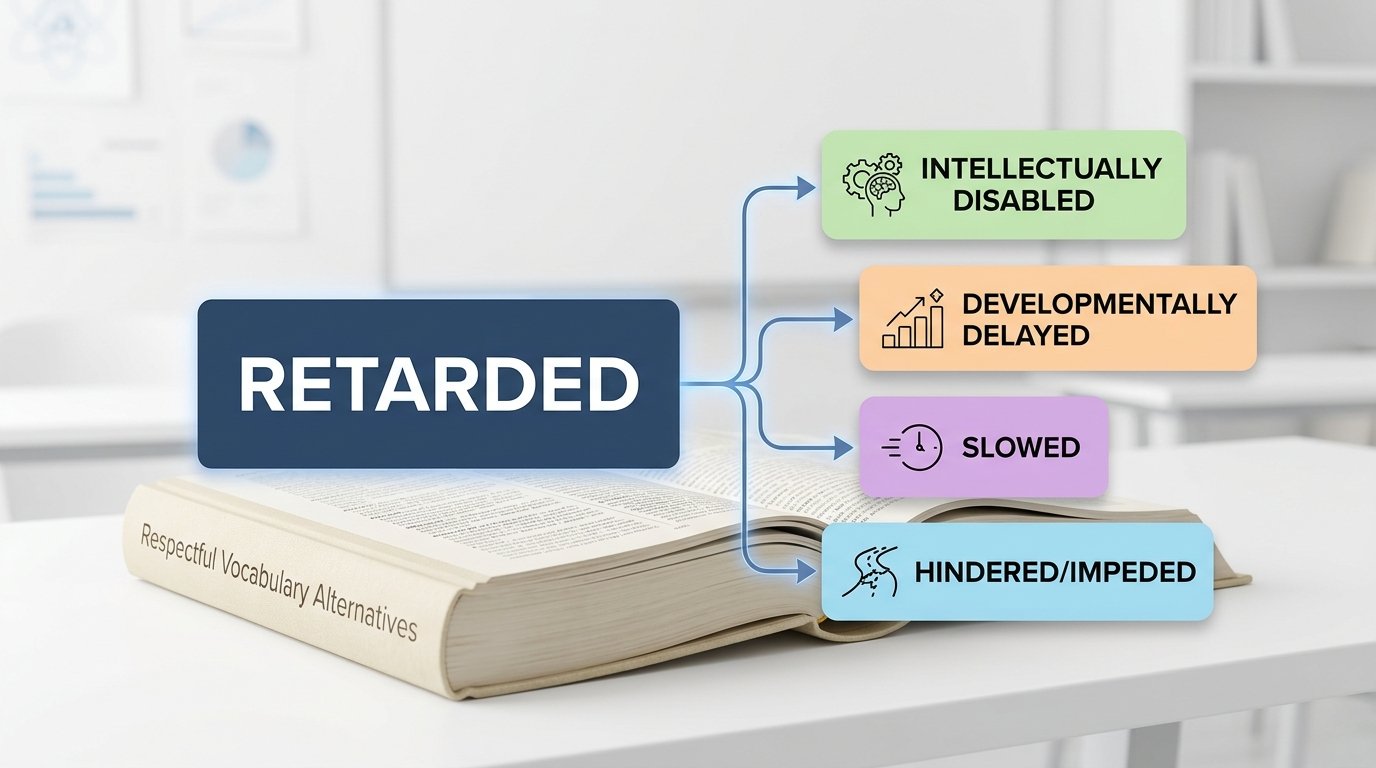
The word “retarded” has several historical and dictionary-recorded uses, but its meaning and acceptability depend heavily on context. When referring to a person with an intellectual disability, “retarded” is now considered outdated and offensive. Modern English generally uses expressions such as “intellectually disabled,” “person with an intellectual disability,” or, in some contexts, “developmentally disabled.”
In other contexts, retarded can describe something that has been slowed, delayed, impeded, or hindered. It has also been used as an offensive insult meaning stupid or foolish. Because these meanings are not interchangeable, the best alternative depends on what you are trying to say.
Quick Answer
The best alternative to “retarded” depends on its meaning. For disability-related language, use “intellectually disabled” or “a person with an intellectual disability” rather than the outdated term. When something has been slowed or delayed, choose “slowed,” “delayed,” “hindered,” “impeded,” or “set back,” depending on the context. In an insulting sense, a precise neutral alternative such as “foolish,” “absurd,” or “unreasonable” is more appropriate.
Best Alternatives at a Glance
| Alternative | Relationship | Meaning | Best Context | Formality |
|---|---|---|---|---|
| intellectually disabled | Respectful modern alternative | Having an intellectual disability | Disability-related contexts | Neutral/Formal |
| person with an intellectual disability | Person-first alternative | A person who has an intellectual disability | General, professional, educational | Neutral |
| developmentally disabled | Contextual alternative | Having a developmental disability | Some disability-related contexts | Neutral/Formal |
| delayed | Contextual alternative | Developing or progressing later than expected | Development, progress, processes | Neutral |
| slowed | Contextual alternative | Moving or developing at a reduced speed | Growth, movement, progress | Neutral |
| hindered | Contextual alternative | Prevented or made more difficult | Progress, performance, development | Neutral |
| impeded | Near synonym | Slowed or obstructed | Formal or professional writing | Formal |
| hampered | Near synonym | Made progress more difficult | Projects, efforts, performance | Neutral |
| set back | Contextual alternative | Caused progress to fall behind | Projects, development, progress | Neutral |
| stunted | Contextual alternative | Prevented normal growth or development | Growth and development | Neutral |
| foolish | Contextual alternative to the insulting sense | Lacking good judgment | Decisions, actions, remarks | Neutral |
| stupid | Contextual alternative to the insulting sense | Lacking intelligence or good judgment | Informal criticism | Informal |
| absurd | Contextual alternative | Completely unreasonable or illogical | Ideas, claims, situations | Neutral |
| ridiculous | Contextual alternative | Deserving criticism because it is unreasonable or silly | Ideas, behavior, situations | Neutral |
Important: These words are not all interchangeable. The appropriate replacement depends on whether retarded refers to disability, delayed progress, or an insult.
What Does “Retarded” Mean?
Historically, retarded was used as an adjective meaning that someone had a mental or intellectual developmental disability. Major dictionaries now label this use old-fashioned, dated, or offensive. Oxford recommends expressions such as “learning disabled” or “a person with a learning disability,” while Merriam-Webster notes that “intellectually disabled” is now preferred.
The word also comes from the verb retard, meaning to delay, slow, or impede progress. That sense remains distinct from the offensive disability-related use. Merriam-Webster, for example, defines retard as causing development or progress to slow or become delayed.
Pronunciation
- US: /rɪˈtɑr.dɪd/
- UK: /rɪˈtɑː.dɪd/
Cambridge and Oxford both identify the adjective as offensive or old-fashioned in its disability-related sense.
Respectful Alternatives for Disability-Related Language
If you are referring to a person with an intellectual disability, do not simply replace “retarded” with another old-fashioned synonym. Use modern disability terminology instead.
1. Intellectually disabled
Intellectually disabled is a standard modern term for a person who has an intellectual disability.
Example:
The organization provides educational support for intellectually disabled students.
A more person-centered construction is often:
The organization provides educational support for students with intellectual disabilities.
Merriam-Webster specifically identifies “intellectually disabled” as the preferred modern expression over the outdated term.
2. Person with an intellectual disability
This is a person-first construction that puts the person before the disability.
Example:
The program provides additional resources for people with intellectual disabilities.
This is often a safe choice when you want neutral, respectful general-purpose language.
3. Developmentally disabled
Developmentally disabled can be appropriate when the subject concerns a developmental disability, but it is not an exact synonym for intellectual disability. Developmental disabilities form a broader category, so use the term only when it accurately describes the situation.
4. Learning disabled
Learning disabled refers specifically to learning disabilities and therefore should not automatically replace intellectual disability. The two concepts are not identical.
For example:
She has a learning disability that affects reading.
This does not necessarily mean that she has an intellectual disability.
Alternatives When “Retarded” Means Slow or Delayed
The word can also occur in contexts unrelated to disability, particularly when something is slowed or prevented from progressing.
Delayed
Use delayed when something happens later than expected.
The project was delayed by severe weather.
Slowed
Use slowed when the speed or rate of something decreases.
Economic growth slowed during the final quarter.
Hindered
Use hindered when something makes progress more difficult.
Poor communication hindered the team’s progress.
Impeded
Impeded is a more formal alternative meaning that progress or movement was obstructed or slowed.
Several technical problems impeded the investigation.
Hampered
Use hampered when an obstacle makes an activity or achievement more difficult.
A lack of funding hampered the research project.
Set back
Set back is especially natural when something causes progress to fall behind.
The equipment failure set back the construction schedule by several weeks.
Stunted
Use stunted when something prevents normal growth or development.
Poor nutrition can stunt physical growth.
This word is more specific than delayed and should not be used as a general replacement.
Alternatives When “Retarded” Is Being Used as an Insult
In informal speech, retarded has also been used as an insult meaning stupid, foolish, absurd, or unreasonable. Dictionaries identify this usage as offensive.
Instead of repeating the insult, choose a word that describes the actual problem.
Foolish
Use foolish when someone makes a poor decision or demonstrates poor judgment.
It was foolish to ignore the warning.
Stupid
Stupid is a direct but blunt informal criticism.
That was a stupid mistake.
It is still insulting, so a more precise description may be better in professional communication.
Absurd
Use absurd when an idea or claim is unreasonable or logically ridiculous.
The claim that the machine works without electricity is absurd.
Ridiculous
Use ridiculous when something deserves criticism because it is unreasonable, silly, or difficult to take seriously.
The proposed deadline is ridiculous.
Unreasonable
Use unreasonable when the problem is excessive or lacking good judgment rather than lack of intelligence.
His request was unreasonable.
This is often more precise and professional than an insult.
Which Word Should I Use?
Choose “intellectually disabled” when:
You are referring to intellectual disability and need a modern, respectful term.
Choose “a person with an intellectual disability” when:
You want a person-first expression suitable for general, educational, or professional communication.
Choose “delayed” when:
Something is occurring later than expected.
Choose “slowed” when:
Something is progressing at a lower speed or rate.
Choose “hindered” when:
An obstacle is making progress more difficult.
Choose “impeded” when:
You need a more formal word for obstructed or slowed progress.
Choose “set back” when:
Something causes a project, process, or development to fall behind.
Choose “foolish” when:
You are criticizing a poor decision or lack of judgment.
Choose “absurd” when:
The problem is that an idea or claim is unreasonable or illogical.
“Retarded” vs. “Intellectually Disabled”
| Feature | Retarded | Intellectually disabled |
|---|---|---|
| Current acceptability | Outdated and offensive in disability-related use | Modern and generally appropriate |
| Disability context | Historical terminology | Current terminology |
| Professional use | Avoid | Appropriate |
| Educational use | Avoid | Appropriate |
| General communication | Avoid | Appropriate |
| Meaning | Historically referred to intellectual disability | Refers to intellectual disability |
The distinction is important because “intellectually disabled” is not merely a softer synonym. It is the current terminology used to communicate the relevant concept without the offensive historical baggage of retarded.
“Retarded” vs. “Delayed”
These words overlap only in certain contexts.
Delayed means that something is later or slower than expected.
The train was delayed.
Retarded, in its older non-disability sense, can describe something whose progress or development has been slowed or hindered.
The growth of the plants was retarded by unfavorable conditions.
For modern general writing, however, delayed, slowed, hindered, or impeded will usually be clearer.
“Retarded” vs. “Slow”
Slow is much broader and more neutral.
The computer is slow.
Economic growth is slow.
He is a slow reader.
It does not automatically carry the historical disability-related meaning associated with retarded. When describing a person, however, slow can still sound judgmental depending on context, so choose a more precise description whenever possible.
Common Mistakes
Mistake 1: Treating every dictionary synonym as interchangeable
Words such as delayed, slowed, hindered, stupid, and intellectually disabled belong to different semantic contexts. They should not be placed in one undifferentiated synonym list.
Mistake 2: Using an old synonym for a disability
Replacing retarded with another outdated label does not solve the problem. Modern terminology should be used instead.
Mistake 3: Using “developmentally disabled” automatically
Developmental disability is not exactly the same concept as intellectual disability. Choose the term that accurately describes the condition or context.
Mistake 4: Using “learning disabled” as a synonym for intellectual disability
Learning disabilities and intellectual disabilities are different concepts. Do not use the terms interchangeably.
Mistake 5: Using “stupid” when you mean “delayed”
If something is progressing slowly, delayed, slowed, hindered, or impeded is usually more accurate than stupid.
Better Examples by Context
| Intended meaning | Better wording |
|---|---|
| Intellectual disability | person with an intellectual disability |
| Formal disability reference | intellectually disabled |
| Developmental disability | person with a developmental disability |
| Later than expected | delayed |
| Reduced speed | slowed |
| Progress made more difficult | hindered |
| Progress obstructed | impeded |
| Project pushed backward | set back |
| Poor judgment | foolish |
| Illogical idea | absurd |
| Unreasonable behavior | unreasonable |
FAQ
Is “retarded” an offensive word?
Yes. When used to refer to a person with an intellectual disability, “retarded” is considered outdated and offensive by major English dictionaries. Modern alternatives include “intellectually disabled” and “person with an intellectual disability.”
What is the respectful alternative to “retarded”?
A common respectful alternative is “intellectually disabled” or “person with an intellectual disability.” The best wording depends on the exact context and the terminology preferred by the person or community being discussed.
What is a synonym for “retarded” meaning delayed?
Depending on the sentence, good alternatives include delayed, slowed, hindered, impeded, hampered, and set back. These words describe different types of delay or obstruction, so choose the one that matches the intended meaning.
What is another word for “retarded” meaning stupid?
If the intended meaning is an insult, possible context-specific alternatives include foolish, stupid, absurd, ridiculous, or unreasonable. The best choice depends on what you are criticizing. Avoid using retarded as an insult because that usage is offensive.
Is “intellectually disabled” the same as “retarded”?
They refer to the same broad disability concept in the historical sense of retarded, but they are not equivalent in modern usage. Retarded is outdated and offensive in this context, whereas intellectually disabled is an accepted modern term.
Is “developmentally disabled” the same as “intellectually disabled”?
Not necessarily. Developmental disability is a broader concept, while intellectual disability is a specific type of disability. Use the term that accurately reflects the subject.
What should I say instead of “retarded”?
First identify what you mean. Say “intellectually disabled” or “person with an intellectual disability” for the disability-related meaning; “delayed,” “slowed,” “hindered,” or “impeded” for slowed progress; and a precise word such as “foolish” or “absurd” when criticizing an idea or action.
Conclusion
The best synonym for “retarded” depends entirely on its intended meaning. For disability-related language, use respectful modern terminology such as “intellectually disabled” or “person with an intellectual disability.” For slow progress, consider “delayed,” “slowed,” “hindered,” or “impeded.” When the word is being used as an insult, replace it with a precise description such as “foolish,” “absurd,” or “unreasonable.”
The key is not to find one word that mechanically replaces retarded. It is to identify the intended meaning and choose vocabulary that is accurate, natural, and respectful.

Emily Johnson is a linguistics graduate and vocabulary specialist. She writes detailed synonym explanations and helps readers understand subtle differences between words, improving both writing and speaking skills. Synonyms help express ideas more clearly and precisely in English.