If you are looking for synonyms of ASMR, there is an important distinction to make: ASMR does not have many exact synonyms. ASMR stands for autonomous sensory meridian response, a pleasant tingling sensation that some people experience, often in response to soft sounds, visual stimuli, personal attention, or gentle repetitive actions.
Words such as tingles, brain tingles, and sensory response can describe aspects of ASMR, but they are not always interchangeable with ASMR. The best alternative depends on whether you mean the sensation, the trigger, or the audio/video content designed to produce it.
Quick Answer
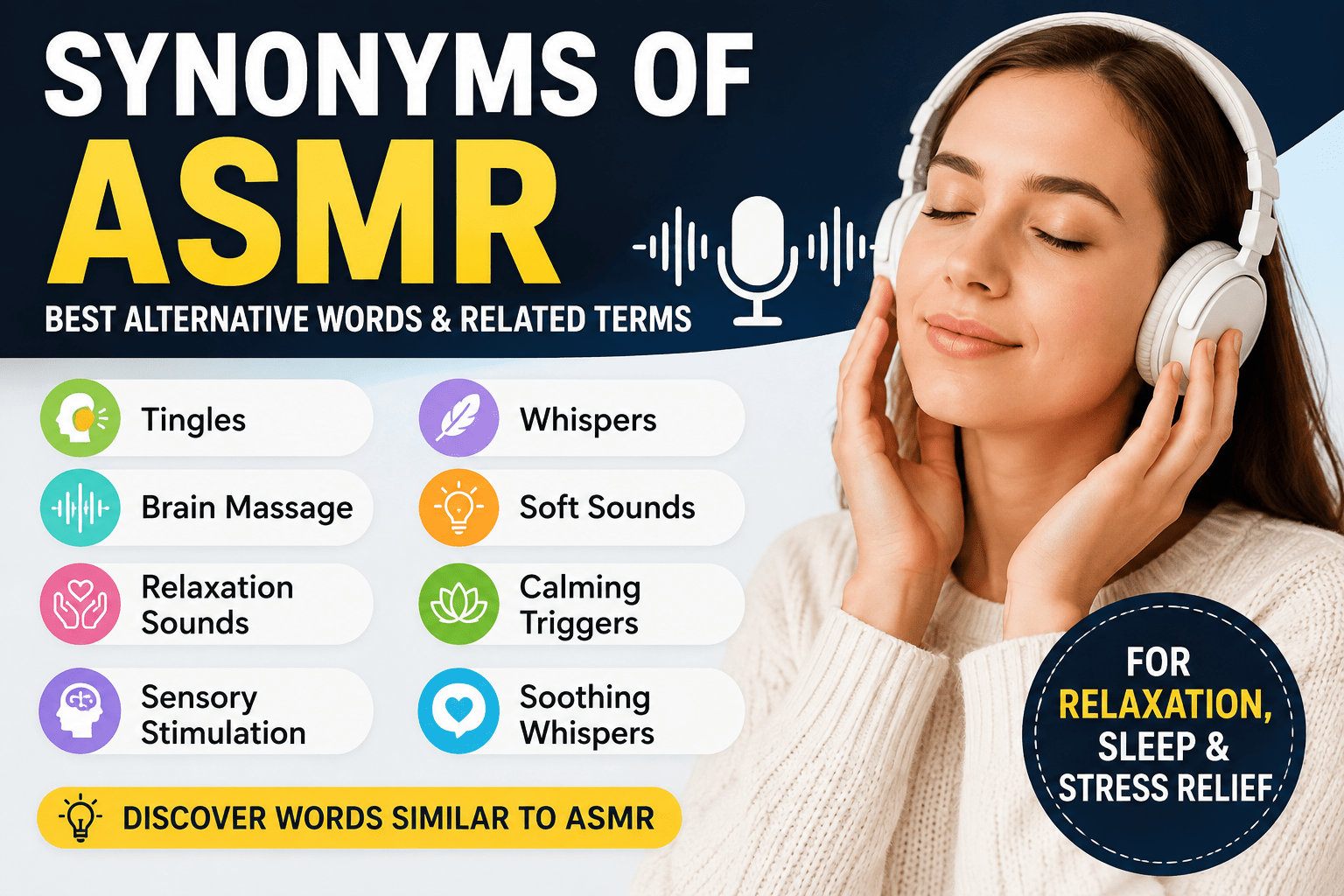
The closest alternatives to ASMR include tingles, brain tingles, autonomous sensory meridian response, and pleasant sensory response. However, these are not all exact synonyms. Tingles is an informal term for the sensation, while autonomous sensory meridian response is the full form of the acronym. Terms such as relaxation sounds, ASMR triggers, and soothing sensory content are contextual alternatives rather than direct synonyms.
What Does ASMR Mean?
ASMR is an abbreviation of autonomous sensory meridian response. It refers to a pleasant tingling sensation experienced by some people, commonly beginning around the scalp or head and sometimes spreading toward the neck and upper spine. Soft sounds such as whispering, brushing, tapping, or repetitive noises can trigger it.
ASMR can also refer to content intended to produce this response, such as an ASMR video or audio recording. Oxford, for example, gives an example of ASMR being used to describe a sound that produces the feeling, while Merriam-Webster also recognizes ASMR content as a usage of the word.
Part of Speech
ASMR is primarily used as an uncountable noun.
Pronunciation
- US: /ˌeɪ.es.emˈɑːr/
- UK: /ˌeɪ.es.emˈɑː/
Cambridge gives these pronunciations for the abbreviation.
The Closest Synonyms and Alternatives for ASMR
Because ASMR names a specific phenomenon, the following terms should be treated according to their relationship to the original term.
| Word or phrase | Relationship | Strength | Best use |
|---|---|---|---|
| Autonomous sensory meridian response | Direct equivalent | Exact | Formal or explanatory writing |
| Tingles | Near synonym | Close | Informal description of the sensation |
| Brain tingles | Near synonym | Close | Casual descriptions |
| Sensory response | Broad near synonym | Weaker | General explanatory writing |
| Pleasant sensory response | Contextual alternative | Broad | Explaining the experience |
| Relaxing sensory experience | Contextual alternative | Broad | Reader-friendly descriptions |
| Soothing sensory experience | Contextual alternative | Broad | Describing the calming aspect |
| ASMR sensation | Direct descriptive phrase | Close | Referring specifically to the feeling |
| ASMR response | Direct descriptive phrase | Close | Technical or explanatory contexts |
| Relaxation sounds | Related term | Different | Describing sounds used in ASMR |
| ASMR triggers | Related term | Different | Describing stimuli that produce ASMR |
| ASMR content | Related term | Different | Describing videos, audio, or media |
The important point is that not all of these words can replace ASMR in every sentence.
1. Autonomous Sensory Meridian Response
Autonomous sensory meridian response is the exact expanded form of ASMR, so it is the closest possible equivalent.
Best used for: definitions, educational writing, and first mentions of the acronym.
Example:
ASMR stands for autonomous sensory meridian response.
This is not merely a related term; it is what the abbreviation represents. Merriam-Webster and Cambridge both identify ASMR as an abbreviation for this phrase.
2. Tingles
Tingles is probably the most natural informal alternative when someone is talking about the physical sensation associated with ASMR.
Best used for: casual conversation and descriptions of the sensation.
Example:
That soft whispering gives me relaxing tingles.
However, tingles is not a complete synonym for ASMR. ASMR is the name of the response or phenomenon, while tingles describes the physical sensation many people associate with it.
3. Brain Tingles
Brain tingles is an informal expression used to describe the distinctive sensation associated with ASMR.
Best used for: casual writing, social media, and conversational explanations.
Example:
The gentle tapping gives me those familiar brain tingles.
It is descriptive rather than a formal scientific replacement for ASMR.
4. Sensory Response
Sensory response is a broader expression. It can refer to many reactions to sensory input and therefore does not specifically mean ASMR.
Best used for: general explanations where precision is less important.
Example:
ASMR is a particular type of sensory response triggered by certain sounds or visual cues.
Do not write sensory response as though it were always interchangeable with ASMR.
5. Pleasant Sensory Response
Pleasant sensory response emphasizes the positive sensation associated with ASMR.
Best used for: reader-friendly explanations.
Example:
Some people experience a pleasant sensory response when they hear soft repetitive sounds.
This phrase explains the experience but does not name the specific phenomenon as precisely as ASMR.
6. Relaxing Sensory Experience
Relaxing sensory experience can describe ASMR when the emphasis is on its calming quality.
Example:
For some viewers, the video creates a relaxing sensory experience.
It is a contextual alternative, not a direct synonym. ASMR is specifically associated with a distinctive tingling response, whereas many experiences can be relaxing without being ASMR.
7. Soothing Sensory Experience
Soothing sensory experience is useful when discussing the calming quality of ASMR content.
Example:
The combination of soft sounds and slow movements creates a soothing sensory experience.
This expression is broader than ASMR and can describe many non-ASMR experiences as well.
Which Word Should I Use?
Use “ASMR” when:
You are referring specifically to the recognized phenomenon or content designed to evoke it.
I listen to ASMR before bed.
Use “autonomous sensory meridian response” when:
You need the full name, particularly in explanatory or formal writing.
ASMR is short for autonomous sensory meridian response.
Use “tingles” when:
You are describing the physical sensation informally.
That sound gives me tingles.
Use “brain tingles” when:
You want an especially casual description of the sensation.
The whispering gives me brain tingles.
Use “relaxing sensory experience” when:
You want to emphasize relaxation rather than specifically naming ASMR.
The audio creates a relaxing sensory experience.
Use “ASMR trigger” when:
You mean the sound, movement, image, or action that produces the response.
Whispering is a common ASMR trigger.
Notice that ASMR trigger is not a synonym for ASMR. It is something that can cause the response.
ASMR vs. Tingles vs. ASMR Triggers
These terms are easy to confuse.
| Term | What it refers to |
| ASMR | The phenomenon or the content associated with it |
| Autonomous sensory meridian response | The full name of ASMR |
| Tingles | The physical sensation associated with ASMR |
| Brain tingles | An informal description of that sensation |
| ASMR trigger | Something that may produce the response |
| ASMR video | Media designed to evoke ASMR |
| Relaxation | A possible effect or accompanying state, not ASMR itself |
For example:
Whispering is an ASMR trigger that may produce ASMR, which some people experience as pleasant tingles and relaxation.
That sentence preserves the distinctions between the terms.
Common ASMR Triggers
Common triggers include soft or repetitive sensory stimuli. Cambridge gives examples such as whispering, brushing, turning pages, and tapping fingernails on a surface.
Common examples include:
- Whispering
- Soft speaking
- Tapping
- Brushing sounds
- Crinkling
- Turning pages
- Slow hand movements
- Personal-attention role-play
- Repetitive sounds
- Gentle visual movements
The exact triggers vary from person to person.
ASMR as a Description of Content
In modern usage, ASMR can describe not only the sensation but also content intended to evoke it. Merriam-Webster explicitly gives ASMR videos as an example of this use, while Oxford notes that a sound itself can be described as ASMR.
Compare:
I experienced ASMR while listening to the recording.
Here, ASMR refers to the response.
The whispering was my ASMR trigger.
Here, whispering is the stimulus.
Common Mistakes
Mistake 1: Treating “relaxation” as a synonym
ASMR may be relaxing, but relaxation is not the same thing as ASMR.
Better:
The ASMR video helped me relax.
Mistake 2: Calling every soothing sound ASMR
A soothing sound can be relaxing without producing an ASMR response.
Better:
The sound was soothing and may work as an ASMR trigger for some listeners.
Mistake 3: Treating “tingles” as an exact synonym
Tingles describes a sensation associated with ASMR, but it does not name the entire phenomenon.
Mistake 4: Confusing a trigger with the response
A whisper can be an ASMR trigger. The resulting sensation is ASMR.
Mistake 5: Using “brain orgasm” as a standard synonym
Some informal sources have used expressions such as brain orgasm or braingasm, but these are highly informal and potentially misleading. They should not be presented as standard equivalents in professional or educational vocabulary writing. Merriam-Webster notes these expressions as alternative names while also emphasizing that ASMR itself is nonsexual.
Examples in Different Contexts
Everyday Conversation
I love listening to ASMR while I’m getting ready for bed.
Informal Description
That tapping sound gives me tingles.
Educational Writing
ASMR, or autonomous sensory meridian response, describes a pleasant tingling sensation experienced by some people in response to particular stimuli.
Content Description
The creator produces ASMR videos featuring whispering and gentle tapping.
Describing a Trigger
Soft page-turning sounds are an ASMR trigger for some people.
Describing the Effect
The video created a calming and relaxing sensory experience.
Antonyms of ASMR
There is no single standard antonym for ASMR.
If you need to describe an opposite or contrasting sensory reaction, context-specific terms may be more appropriate. Misophonia, for example, describes strong negative emotional responses to particular sounds and should not be treated as the strict antonym of ASMR.
The distinction matters because ASMR and misophonia involve different sensory experiences rather than forming a simple dictionary-style opposite pair.
FAQ
What is another word for ASMR?
The closest exact equivalent is autonomous sensory meridian response, which is the full form of the acronym. Informally, tingles or brain tingles can describe the associated sensation.
What is the closest synonym for ASMR?
Autonomous sensory meridian response is the exact equivalent because it is what ASMR stands for. Tingles is the closest common informal term for the physical sensation.
Is “tingles” a synonym for ASMR?
Not exactly. Tingles describes the sensation commonly experienced during ASMR, while ASMR names the broader phenomenon.
What are ASMR triggers?
ASMR triggers are sounds, movements, visual cues, or other stimuli that may produce an ASMR response. Examples include whispering, tapping, brushing, and repetitive sounds.
What is a formal synonym for ASMR?
The formal equivalent is autonomous sensory meridian response. For general explanatory writing, it is usually best to introduce the full term and then use the abbreviation ASMR.
What is a casual word for ASMR?
Tingles or brain tingles can work in casual descriptions, particularly when referring to the physical sensation.
Is relaxation the same as ASMR?
No. Relaxation can accompany ASMR, but many relaxing experiences do not involve ASMR. ASMR specifically refers to a particular sensory response.
How do you describe ASMR without saying ASMR?
Depending on context, you could say a pleasant tingling sensation, a calming sensory response, brain tingles, or a relaxing sensory experience. The best choice depends on whether you are emphasizing the sensation, its calming quality, or the broader phenomenon.
Conclusion
There are fewer true synonyms of ASMR than there are for ordinary vocabulary words because ASMR names a specific sensory phenomenon. Autonomous sensory meridian response is its exact expanded form, while tingles and brain tingles are informal ways to describe the associated sensation.
For precise writing, keep the distinctions clear: ASMR is the phenomenon, tingles describe the sensation, ASMR triggers produce the response, and ASMR content is media created to evoke it. This distinction produces more natural and accurate English than treating every relaxing or sensory-related expression as a direct synonym.

Daniel Carter is a professional content strategist and language enthusiast. He focuses on semantic SEO, keyword research, and creating structured vocabulary content that ranks well on search engines while remaining user-friendly.