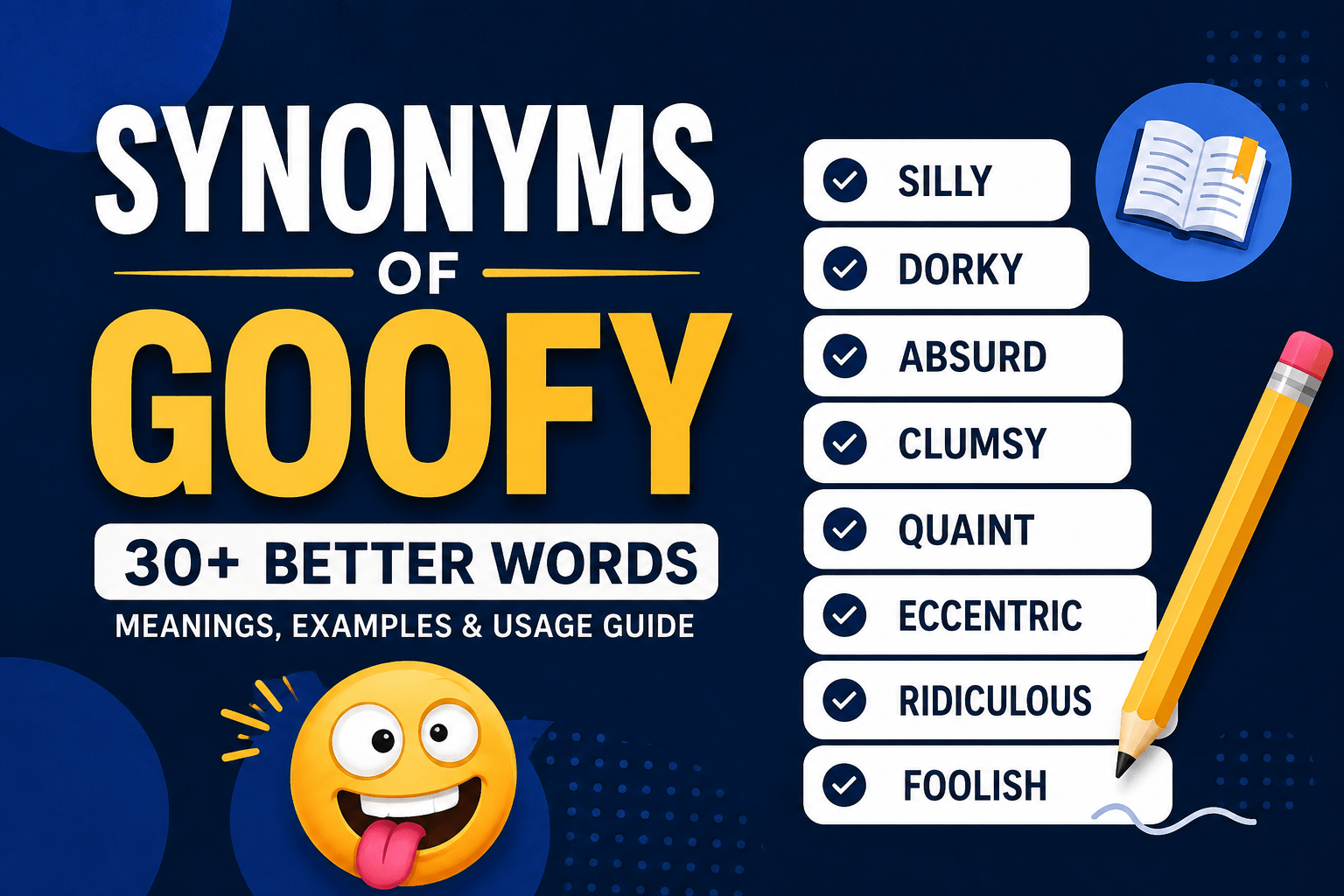
If you are looking for the synonyms of goofy, the closest choices are silly, ridiculous, foolish, comical, wacky, and zany. But they are not interchangeable in every sentence. Goofy is informal and often suggests something silly or ridiculous in an amusing, harmless, or even endearing way. The best alternative depends on whether you want to emphasize humor, oddness, foolishness, awkwardness, or absurdity.
This guide separates close synonyms from words that are useful only in particular contexts, so you can choose a word that sounds natural rather than simply replacing goofy with the first thesaurus entry you find.
Quick Answer
The closest synonyms of goofy include silly, ridiculous, foolish, comical, wacky, zany, absurd, and ludicrous. For a friendly or affectionate tone, silly, quirky, wacky, or zany can work well. For stronger criticism, ridiculous, absurd, foolish, or ludicrous are usually better. Goofy itself is an informal word, particularly common in American English.
Table of Contents
- What Does “Goofy” Mean?
- Best Synonyms of Goofy
- Closest Synonyms
- Contextual Alternatives
- How the Synonyms Differ
- Which Word Should You Use?
- Goofy vs. Silly vs. Ridiculous
- Common Mistakes
- Collocations and Natural Phrases
- Antonyms of Goofy
- FAQ
- Conclusion
What Does “Goofy” Mean?
Goofy is an adjective meaning silly, ridiculous, or foolish, often in an amusing way. It is mainly an informal word in American English. Cambridge defines it as “silly,” while its learner material specifically notes the sense of being silly in an amusing way.
For example:
He has a goofy sense of humor.
This usually does not mean that he is seriously unintelligent. It can suggest that his humor is deliberately silly, awkward, playful, or unconventional.
Likewise:
She gave me a goofy smile.
Here, goofy can sound affectionate rather than insulting.
The word can also have a more negative meaning when the context calls for it. Collins describes goofy as meaning rather silly or ridiculous and labels the usage informal.
Part of Speech
Goofy is an adjective.
- goofy
- goofier
- goofiest
- goofily — adverb
- goofiness — noun
Pronunciation
- US: /ˈɡuːfi/
- UK: /ˈɡuːfi/
Cambridge and Collins both give essentially the same pronunciation for the modern adjective.
Etymology
Goofy developed from goof plus the suffix -y. Merriam-Webster records the first known use of goofy in 1916, while Collins dates the word’s origin to approximately 1915–20.
Best Synonyms of Goofy
Not every related word is a perfect substitute. The table below separates the closest alternatives from words that carry additional meaning.
| Word | Relationship | Strength | Formality | Best Context |
|---|---|---|---|---|
| Silly | Direct/very close | Mild | Neutral | People, actions, behavior |
| Ridiculous | Close synonym | Strong | Neutral | Ideas, behavior, situations |
| Foolish | Close synonym | Moderate–strong | Neutral/formal | Decisions, actions, behavior |
| Comical | Near synonym | Mild | Neutral | Appearance, behavior, situations |
| Wacky | Near synonym | Mild | Informal | Ideas, people, behavior |
| Zany | Near synonym | Strongly humorous | Informal/neutral | People, performances, behavior |
| Absurd | Near synonym | Strong | Neutral/formal | Ideas, situations, claims |
| Ludicrous | Near synonym | Very strong | Formal/neutral | Claims, situations, behavior |
| Foolhardy | Contextual alternative | Strong | Neutral | Risky decisions/actions |
| Quirky | Contextual alternative | Mild | Neutral | Personality, habits, style |
| Eccentric | Contextual alternative | Mild–moderate | Neutral/formal | People, lifestyles, behavior |
| Awkward | Contextual alternative | Mild | Neutral | People, movements, situations |
| Dorky | Contextual alternative | Mild | Informal | Appearance, personality |
| Nutty | Near synonym | Mild–strong | Informal | People, ideas, behavior |
| Kooky | Near synonym | Mild–moderate | Informal | Personality, ideas |
| Whimsical | Contextual alternative | Positive | Neutral/literary | Imagination, style, ideas |
| Outlandish | Contextual alternative | Strong | Neutral | Appearance, claims, ideas |
| Preposterous | Contextual alternative | Very strong | Formal | Ideas, claims, situations |
| Absurdist | Related, not universal synonym | Context-dependent | Formal | Humor, art, literature |
| Off-the-wall | Contextual alternative | Strong | Informal | Ideas, behavior, humor |
The most dictionary-supported close alternatives include words such as off-the-wall, comical, eccentric, and wacky.
Closest Synonyms
1. Silly
Silly is probably the safest general replacement for goofy.
It can describe a person, action, comment, expression, idea, or situation. Unlike goofy, it does not always carry the same playful or endearing quality.
Example:
That was a silly thing to do.
Best choice when: you want a broad, natural word for something foolish or amusing.
2. Ridiculous
Ridiculous is stronger than goofy. It suggests that something deserves to be laughed at or considered unreasonable.
Example:
That’s a ridiculous idea.
You could say:
That’s a goofy idea.
But ridiculous sounds more critical.
3. Foolish
Foolish emphasizes poor judgment or lack of good sense rather than humor.
Example:
It would be foolish to ignore the warning.
Calling a person goofy can be playful. Calling a decision foolish is much more clearly critical.
4. Comical
Comical focuses on something that makes people laugh or looks amusing.
Example:
His exaggerated walk looked comical.
It is particularly useful when describing an appearance, action, performance, or situation.
5. Wacky
Wacky suggests something unusual, unconventional, or amusingly strange.
Example:
She has some wacky ideas about decorating her apartment.
It is close to goofy in informal American English.
6. Zany
Zany describes someone or something that is extremely unconventional, energetic, or amusingly eccentric.
Example:
The comedian is known for his zany performances.
Zany is usually more theatrical and exaggerated than goofy.
7. Absurd
Absurd emphasizes something unreasonable, illogical, or completely out of proportion.
Example:
The whole argument is absurd.
It can overlap with goofy, but it is normally more serious and less affectionate.
8. Ludicrous
Ludicrous is a stronger and more formal-sounding alternative to ridiculous.
Example:
The claim was so ludicrous that nobody believed it.
It is generally inappropriate if you simply want to affectionately describe someone’s playful personality.
Contextual Alternatives
Some words are useful alternatives to goofy only in particular situations.
Quirky
Quirky means noticeably unusual or unconventional, often in an appealing way.
She has a quirky sense of humor.
Unlike goofy, quirky does not necessarily imply silliness.
Eccentric
Eccentric describes behavior or personality that differs noticeably from conventional expectations.
The eccentric artist wore brightly colored suits every day.
It is more about unconventional behavior than simple silliness.
Awkward
Awkward works when goofy refers to clumsy movements, uncomfortable behavior, or an embarrassing social moment.
He gave an awkward little wave.
But awkward is not a general synonym for goofy.
Dorky
Dorky is informal and can describe someone or something as unfashionable, socially awkward, or amusingly uncool.
He looked dorky in that oversized jacket.
It is particularly conversational and can be affectionate among friends.
Kooky
Kooky describes someone or something as strange or eccentric, usually in an amusing way.
Her kooky inventions always make us laugh.
Whimsical
Whimsical is a more positive and refined alternative when the intended meaning is imaginative, playful, or fanciful.
The children’s book has a whimsical style.
It should not replace goofy when you specifically mean foolish or ridiculous.
How the Synonyms Differ
The central difference is what kind of “silly” you want to emphasize.
| If you mean… | Try… |
| General silliness | silly |
| Amusing appearance or behavior | comical |
| Unusual and funny | wacky |
| Wildly unconventional and energetic | zany |
| Poor judgment | foolish |
| Clearly unreasonable | ridiculous |
| Illogical or nonsensical | absurd |
| Extremely ridiculous | ludicrous |
| Unusual personality | quirky |
| Unconventional personality | eccentric |
| Social or physical clumsiness | awkward |
| Informally uncool or silly | dorky |
| Strange in an amusing way | kooky |
| Playful and imaginative | whimsical |
This distinction matters because goofy is unusually flexible. It can be affectionate, humorous, mildly critical, or simply descriptive depending on context.
Which Word Should You Use?
Use silly when:
You want the closest everyday alternative.
Stop being so silly.
Use wacky when:
You mean unusual and amusing.
He came up with a wacky solution.
Use quirky when:
You want to emphasize unusual personality rather than stupidity.
She has a quirky personality.
Use ridiculous when:
You want stronger criticism.
That’s a ridiculous excuse.
Use comical when:
The main point is that something looks or behaves humorously.
His attempt at dancing was comical.
Use foolish when:
You are criticizing someone’s judgment.
It was foolish to leave without checking the weather.
Use zany when:
The person or behavior is energetic, exaggerated, and humorously unconventional.
The show is full of zany characters.
Use whimsical when:
You want a positive, imaginative tone.
The designer created a whimsical garden.
Goofy vs. Silly vs. Ridiculous
These three words overlap, but their tone is different.
Goofy
Usually informal, playful, and potentially affectionate.
He made a goofy face for the camera.
Silly
Broader and more neutral.
I made a silly mistake.
Ridiculous
Stronger and more critical.
That is a ridiculous price.
A useful way to remember the distinction is:
goofy → playful silliness
silly → general foolishness
ridiculous → unreasonable or laughably extreme
Cambridge specifically describes goofy as informal and silly, especially in an amusing sense.
Goofy vs. Quirky
These words are often confused.
Goofy usually suggests silliness or ridiculous behavior.
Quirky suggests unusual or unconventional behavior.
Compare:
He has a goofy laugh.
This suggests his laugh sounds amusing or silly.
He has a quirky laugh.
This suggests his laugh is unusual or distinctive.
Someone can be quirky without being goofy, and someone can be goofy without being particularly quirky.
Goofy vs. Wacky
These are close informal alternatives.
Goofy often feels more personal and playful:
My goofy brother made everyone laugh.
Wacky often emphasizes unusual ideas, behavior, or situations:
They came up with a wacky plan.
Both can be positive, but wacky generally highlights unusualness more strongly.
Common Mistakes
1. Treating every related word as a perfect synonym
Quirky, eccentric, and awkward can overlap with goofy, but they do not have exactly the same meaning.
2. Using “ludicrous” for affectionate situations
❌ My ludicrous little brother made a funny face.
This sounds unusually harsh or formal.
Better:
✅ My goofy little brother made a funny face.
3. Using “foolish” when you mean funny
He has a foolish grin.
This can work, but it may sound more critical than:
He has a goofy grin.
4. Using “whimsical” for every kind of silliness
Whimsical usually carries a positive sense of imagination or playful fantasy. It is not a universal substitute for goofy.
Collocations and Natural Phrases
Some combinations with goofy are especially natural.
- goofy smile
- goofy grin
- goofy face
- goofy laugh
- goofy behavior
- goofy sense of humor
- goofy expression
- goofy character
- goofy personality
- goofy idea
Collins specifically lists common combinations such as goofy grin and goofy smile.
The best replacement depends on the noun:
| Phrase | Natural Alternative |
| goofy smile | silly smile / comical smile |
| goofy behavior | silly behavior / ridiculous behavior |
| goofy idea | wacky idea / ridiculous idea |
| goofy person | silly person / quirky person |
| goofy character | zany character / comical character |
| goofy mistake | silly mistake |
| goofy appearance | comical appearance / awkward appearance |
| goofy sense of humor | silly sense of humor / quirky sense of humor |
Antonyms of Goofy
The opposite depends on which sense of goofy you intend.
Possible antonyms include:
- serious
- sensible
- reasonable
- practical
- sober
- serious-minded
- conventional
- sensible
For example:
He is usually goofy around his friends, but very serious at work.
Or:
That was a goofy idea.
→
That was a sensible idea.
FAQ
What is another word for goofy?
The most natural general alternative is silly. Depending on context, wacky, ridiculous, comical, foolish, zany, and quirky can also work.
What is the closest synonym for goofy?
Silly is generally the closest broad synonym. Goofy often adds an informal, amusing, or affectionate quality to the idea of being silly.
What is a positive synonym for goofy?
Silly, quirky, wacky, zany, and sometimes whimsical can have positive or affectionate meanings. The choice depends on whether you want to emphasize humor, unusualness, or imagination.
What is a stronger synonym for goofy?
Ridiculous, absurd, and ludicrous are stronger alternatives when you want to emphasize that something is unreasonable or laughably extreme.
Is goofy a formal word?
No. Goofy is informal, and Cambridge labels it “mainly US informal.”
For formal writing, alternatives such as foolish, absurd, ridiculous, eccentric, or unconventional may be more appropriate depending on the intended meaning.
Is goofy an insult?
Not necessarily. Goofy can be affectionate or humorous, especially when describing someone’s personality, smile, laugh, or playful behavior. In a critical context, however, it can suggest foolishness or ridiculousness.
What is the difference between goofy and quirky?
Goofy emphasizes silliness or amusing foolishness, while quirky emphasizes unusual or unconventional characteristics. A quirky person does not necessarily behave foolishly.
What is the difference between goofy and ridiculous?
Goofy is often playful and informal; ridiculous is stronger and more likely to express criticism or disbelief.
Conclusion
The best synonyms of goofy depend on the shade of meaning you want.
For ordinary silliness, choose silly. When you mean unusual humor, try wacky or zany. If you want stronger criticism, use ridiculous, absurd, or ludicrous. When describing unusual personality traits, quirky or eccentric may be more precise.
The key is not simply finding a word that appears in a thesaurus. It is choosing the alternative that preserves the meaning, tone, strength, and context of the original sentence.
Goofy itself remains a useful informal word when you want to describe something as silly or ridiculous without necessarily making the judgment harsh.

Michael Thompson is an English language specialist and experienced editor who focuses on vocabulary development and clear communication. He creates high-quality synonym guides, word comparisons, and writing tips to help students and professionals express their ideas more effectively. His work combines linguistic knowledge with practical SEO strategies to make learning both useful and engaging.