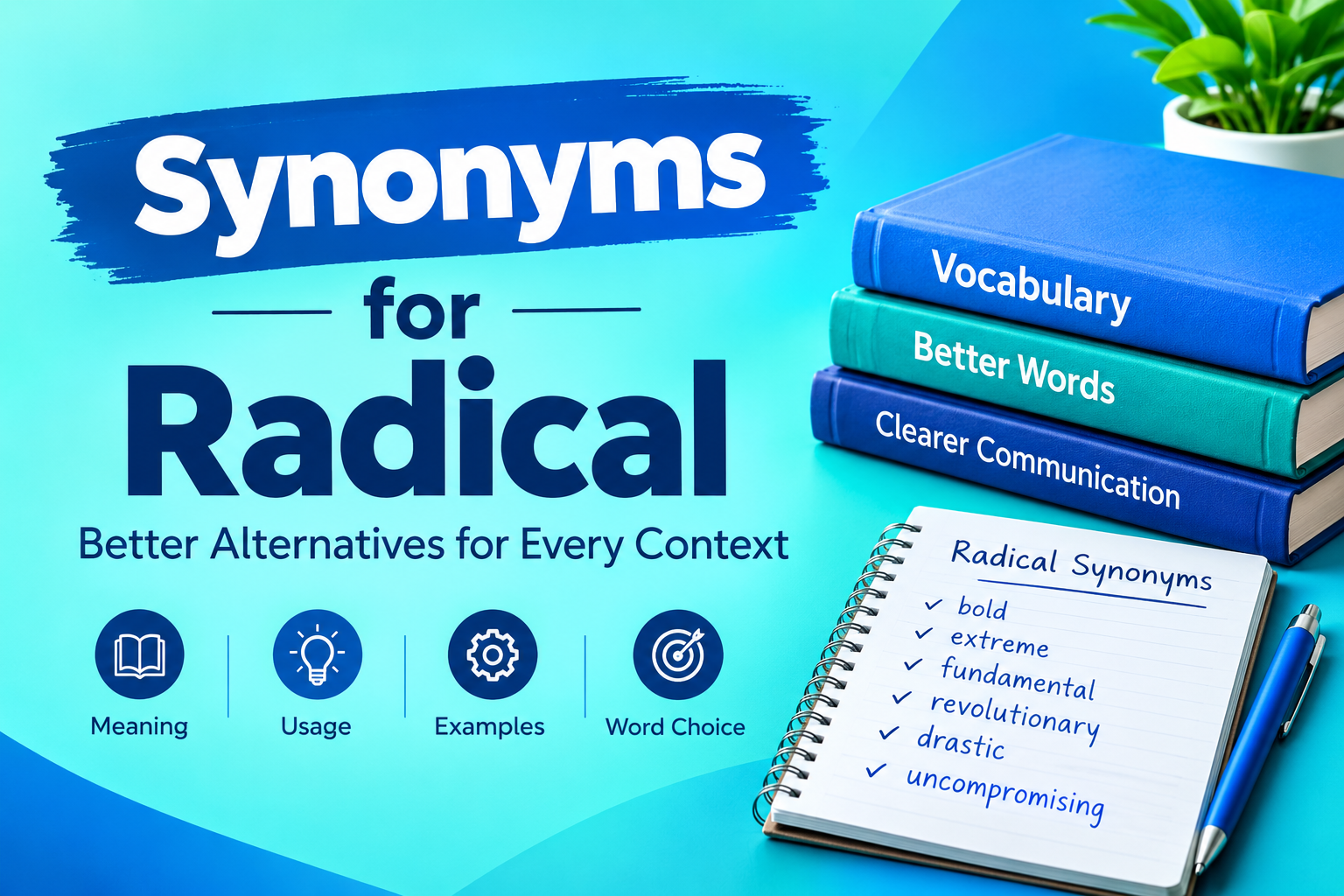
Finding a good synonym for radical depends on what you mean. Radical can describe something fundamental, a major or far-reaching change, an unconventional idea, an extreme position, or a person who supports major political or social change. Because these meanings overlap but are not identical, words such as fundamental, drastic, extreme, revolutionary, unconventional, transformative, and far-reaching are useful in different contexts.
This guide separates close synonyms from context-specific alternatives so you can choose a word that preserves the meaning and tone you want.
Quick Answer: What Are the Best Synonyms for Radical?
Common synonyms for radical include fundamental, basic, drastic, extreme, far-reaching, profound, revolutionary, transformative, sweeping, unconventional, innovative, and thoroughgoing. The best choice depends on context. For example, fundamental emphasizes importance or underlying structure, drastic emphasizes a severe change, unconventional emphasizes difference from established practice, and revolutionary suggests a major transformation.
30 Synonyms and Alternatives for “Radical”
The best alternative to radical depends on the meaning. It can describe something fundamental, extreme, innovative, unconventional, or capable of producing major change.
Fundamental and Far-Reaching Alternatives
| Word | Relationship | Meaning / Difference | Best Context |
|---|---|---|---|
| fundamental | Close synonym | Relating to the basic or essential parts of something | Principles, systems, differences |
| basic | Close synonym | Simple or underlying rather than secondary | Principles, concepts, structure |
| essential | Near synonym | Absolutely necessary or central | Requirements, qualities, elements |
| far-reaching | Close synonym | Having effects that extend widely | Reforms, consequences, changes |
| profound | Near synonym | Deep and significant rather than merely noticeable | Effects, changes, differences |
| drastic | Contextual synonym | Involving a severe or major change | Measures, actions, reforms |
| extreme | Contextual synonym | Far beyond what is usual or moderate | Views, behavior, positions |
| sweeping | Contextual synonym | Broad and affecting many parts of something | Reforms, changes, revisions |
| thoroughgoing | Near synonym | Complete and affecting fundamental aspects | Reform, analysis, change |
| transformative | Contextual alternative | Producing a major change in form or condition | Technology, education, policy |
Innovative and Unconventional Alternatives
| Word | Relationship | Meaning / Difference | Best Context |
|---|---|---|---|
| revolutionary | Contextual synonym | Causing or representing a fundamental transformation | Ideas, inventions, movements |
| groundbreaking | Contextual alternative | Introducing something new and influential | Discoveries, research, technology |
| innovative | Contextual alternative | Introducing new methods, ideas, or approaches | Products, methods, solutions |
| unconventional | Contextual alternative | Different from accepted or usual practice | Ideas, methods, behavior |
| unorthodox | Contextual alternative | Not following conventional beliefs or methods | Approaches, opinions, methods |
| bold | Near synonym | Willing to take significant risks or depart from convention | Plans, proposals, decisions |
| ambitious | Related alternative | Designed to achieve substantial change or results | Plans, projects, reforms |
| reforming | Contextual alternative | Seeking significant improvement or change | Institutions, laws, organizations |
| reformist | Contextual alternative | Favoring reform rather than preserving the status quo | Politics, institutions |
| iconoclastic | Contextual alternative | Challenging established ideas, traditions, or institutions | Thinkers, writing, art |
Political, Social, and Distinct Contexts
| Word | Relationship | Meaning / Difference | Best Context |
|---|---|---|---|
| radicalized | Related but distinct | Having undergone a process of becoming more extreme | People, groups, movements |
| militant | Contextual alternative | Actively and forcefully supporting a cause | Activism, movements, groups |
| revolutionary | Political/contextual synonym | Supporting or producing fundamental political or social change | Movements, politics, ideas |
| extremist | Political/contextual alternative | A person or position regarded as far outside a conventional political range | Political discussion |
| rebel | Contextual alternative | A person who resists established authority or control | People, movements |
| nonconformist | Contextual alternative | A person who does not follow conventional beliefs or behavior | People, culture |
| unprecedented | Contextual alternative | Never occurring or existing before | Events, changes, situations |
| complete | Near synonym | Whole or comprehensive rather than partial | Overhaul, change, revision |
| thorough | Near synonym | Extensive and careful in scope | Review, examination, reform |
| sweeping | Contextual synonym | Extensive in scope and effect | Policy, reform, revision |
Important: these words are not interchangeable in every sentence. Some are direct or close alternatives, while others work only when radical carries a particular meaning.
What Does “Radical” Mean?
Radical is an adjective with several important meanings.
It can describe something that concerns the most basic or important parts of a subject. For example:
The company needs a radical change in its operating structure.
Here, fundamental or far-reaching may be suitable alternatives.
It can also describe something very different from what is usual or accepted:
The researcher proposed a radical new approach.
In this context, unconventional, innovative, or groundbreaking may work better depending on the intended emphasis.
A third important sense describes people or ideas that support major or extreme political or social change. In that context, words such as revolutionary, extremist, or reformist may apply, but they carry different meanings and should not be treated as interchangeable.
The noun radical can also refer to a person who supports major political or social change. Cambridge and Oxford both identify this political/social sense separately from the adjective’s other meanings.
The Closest Synonyms for “Radical”
Fundamental
Fundamental is one of the best alternatives when radical means basic, essential, or relating to the underlying nature of something.
- radical difference → fundamental difference
- radical problem → fundamental problem
- radical principle → fundamental principle
The reform addresses a fundamental problem in the system.
Use fundamental when the focus is on what lies at the core of an issue, rather than on something being extreme.
Far-Reaching
Far-reaching emphasizes the wide effects or consequences of something.
The new law could have far-reaching consequences.
It is particularly natural with changes, reforms, effects, and consequences.
Drastic
Drastic suggests a severe or unusually strong change or measure.
The company took drastic measures to reduce its costs.
Unlike fundamental, which focuses on underlying importance, drastic highlights the severity of the action.
Extreme
Extreme means far beyond what is ordinary, moderate, or acceptable in a particular context.
The proposal was considered too extreme by some members of the committee.
It works especially well with views, opinions, behavior, positions, measures, and conditions.
Revolutionary
Revolutionary suggests a fundamental transformation or a dramatic break with established practice.
The invention introduced a revolutionary approach to battery technology.
It can also describe political or social movements. However, that political use should not automatically be replaced with extreme, because the two words emphasize different ideas.
Unconventional
Unconventional means different from what is usual, traditional, or generally accepted.
She developed an unconventional approach to teaching mathematics.
This is often a better choice than radical when you want to emphasize difference from convention without necessarily suggesting extremity.
Innovative
Innovative emphasizes newness and useful originality.
The team introduced an innovative solution to the problem.
A radical idea can be innovative, but radical does not necessarily mean useful or successful. Therefore, innovative should not automatically replace it.
Transformative
Transformative describes something that produces a major change in the nature, condition, or operation of something.
Digital technology has had a transformative effect on education.
This word is particularly useful for discussing large-scale changes and their effects.
Synonyms for “Radical” Change
When radical modifies change, several alternatives work particularly well:
- fundamental change — change to an underlying structure or principle
- drastic change — severe or major change
- far-reaching change — change with broad consequences
- sweeping change — extensive change across many areas
- transformative change — change that substantially alters something
- profound change — deep and significant change
- revolutionary change — change that represents a major break from the past
Example
The organization introduced radical changes to its hiring process.
Depending on the intended meaning, you could write:
The organization introduced sweeping changes to its hiring process.
or:
The organization introduced fundamental changes to its hiring process.
or:
The organization introduced drastic changes to its hiring process.
The best choice depends on whether you want to emphasize scope, underlying structure, or severity.
Synonyms for “Radical” Ideas
For radical ideas, the intended meaning often involves novelty, unconventional thinking, or a major departure from established assumptions.
Useful alternatives include:
- unconventional ideas
- innovative ideas
- groundbreaking ideas
- revolutionary ideas
- bold ideas
- unorthodox ideas
- transformative ideas
Consider the difference:
She proposed an unconventional solution.
This emphasizes that the solution differs from normal practice.
She proposed an innovative solution.
This emphasizes novelty.
She proposed a revolutionary solution.
This suggests that the solution could fundamentally change the field or system.
Synonyms for “Radical” Reform
When discussing reform, fundamental, sweeping, drastic, far-reaching, and reforming can all be useful depending on the sentence.
| Phrase | Main emphasis |
|---|---|
| fundamental reform | Changes to underlying structures |
| sweeping reform | Broad changes across multiple areas |
| drastic reform | Severe or unusually strong measures |
| far-reaching reform | Reform with wide consequences |
| transformative reform | Reform expected to substantially alter a system |
For example:
The commission recommended far-reaching reforms to the education system.
Here, far-reaching emphasizes the breadth of the consequences rather than suggesting that the reforms are extreme.
Synonyms for a “Radical” Person
The noun radical can refer to a person who supports major political or social change.
Possible alternatives include:
- revolutionary
- reformer
- militant
- activist
- rebel
- nonconformist
- extremist
These are not equivalent labels.
A reformer seeks change but does not necessarily support extreme measures.
A revolutionary may support fundamental transformation of an existing political or social system.
A militant emphasizes an active or forceful approach to a cause.
An extremist describes someone or something positioned at an extreme, particularly in political or ideological contexts.
A nonconformist simply emphasizes departure from conventional beliefs or behavior.
Therefore, replacing radical with one of these words can change the meaning substantially.
Radical vs. Extreme
Although radical and extreme overlap, they are not identical.
The word radical often emphasizes fundamental change, a major departure from established ideas, or support for substantial reform.
Extreme emphasizes distance from the ordinary, moderate, or accepted position.
Compare:
The government proposed radical reforms.
This focuses on the scale or fundamental nature of the reforms.
The politician expressed extreme views.
This focuses on how far the views depart from a perceived moderate position.
In some contexts either word may work, but the emphasis changes.
Radical vs. Drastic
Drastic usually describes a strong, severe, or far-reaching action or change.
The company took drastic action to prevent further losses.
Radical can describe the same change while emphasizing its fundamental nature.
The company made radical changes to its business model.
A useful rule is:
- radical → fundamental or major departure
- drastic → severe or forceful change
Radical vs. Revolutionary
Revolutionary can be a close alternative when radical describes something that fundamentally changes an established system.
The company developed a revolutionary manufacturing method.
However, revolutionary often carries a stronger implication of transformative innovation or fundamental social change.
Not every radical idea is revolutionary.
Radical vs. Unconventional
These words are particularly easy to confuse.
Unconventional means outside normal or traditional practice.
He uses an unconventional teaching method.
Radical can imply a much more fundamental departure or a much greater potential for change.
He proposed a radical redesign of the entire education system.
An unconventional approach can be relatively modest. A radical approach usually suggests greater structural or conceptual change.
Common Mistakes When Choosing a Synonym for “Radical”
Treating every related word as an exact synonym
Words such as innovative, bold, ambitious, and unconventional can overlap with radical, but they emphasize different qualities.
Using “extremist” for every political use
Extremist is stronger and more specific than radical. A person can favor major political change without necessarily being described accurately as an extremist.
Using “drastic” for ideas
Drastic is especially natural for measures, action, change, and similar situations. It is not always the natural choice for every noun that can follow radical.
Assuming “innovative” means “radical”
An idea may be innovative because it is new without being radical in scope or effect.
Ignoring context
The best synonym for radical change may not be the best synonym for radical politician, radical idea, or radical difference.
Common Collocations With “Radical”
These phrases show why context matters:
- radical change
- radical reform
- radical transformation
- radical difference
- radical departure
- radical idea
- radical approach
- radical solution
- radical proposal
- radical thinker
- radical politician
- radical movement
FoWhen describing a radical change, consider words such as fundamental, drastic, sweeping, or transformative.
For radical ideas, alternatives include unconventional, innovative, groundbreaking, and revolutionary.
In the context of radical political views, extreme or revolutionary may be appropriate, depending on the intended meaning.
What Is the Best Synonym for “Radical”?
There is no single best synonym for every use of radical.
Use fundamental for something basic, essential, or underlying. Drastic describes a severe or major change, while extreme applies to something far beyond what is moderate or usual.
When the focus is on broad consequences, far-reaching is more precise. Unconventional highlights a departure from established practices or usual methods.
For new ideas, methods, or approaches, innovative is often the best fit. Revolutionary suggests a fundamental transformation that significantly changes an established system or way of thinking.
The word transformative emphasizes something that produces substantial or lasting effects.
This context-based approach is more accurate than simply replacing radical with the first word in a thesaurus list.
FAQ About Radical Synonyms
What is the closest synonym for radical?
The closest synonym depends on the sense. Fundamental is a strong choice when radical means basic or underlying. Extreme is closer when it means far beyond the moderate or usual. Revolutionary can be appropriate when the word describes fundamental political or social change.
What is a formal synonym for radical?
Formal alternatives include fundamental, far-reaching, thoroughgoing, profound, and transformative, depending on context. For professional writing, choose the word that expresses the precise meaning rather than simply choosing a more formal-sounding word.
What is another word for radical change?
Possible alternatives include fundamental change, drastic change, sweeping change, far-reaching change, transformative change, and profound change. Each emphasizes a slightly different aspect of the change.
Is “extreme” a synonym for “radical”?
Sometimes. Extreme can replace radical when the word describes views, behavior, positions, or measures that go far beyond what is considered moderate. However, radical can also mean fundamental or transformative, where extreme would not be an exact replacement.
Is “revolutionary” a synonym for “radical”?
Sometimes. Revolutionary is particularly appropriate when radical describes something that fundamentally transforms an established system, field, or social order. It is not a universal replacement.
What is a synonym for radical ideas?
Depending on the intended meaning, unconventional, innovative, groundbreaking, bold, unorthodox, or revolutionary may work. Unconventional emphasizes difference from normal practice, while innovative emphasizes newness and revolutionary suggests fundamental transformation.
What is the opposite of radical?
The appropriate opposite depends on the sense. For political or social change, conservative or moderate may provide a contrast. For something described as fundamental or thoroughgoing, superficial may be a better conceptual opposite. Cambridge lists conservative and moderate among antonyms in the political sense.
Conclusion
The word radical has several meanings, so its best synonym changes with context. Fundamental works well for underlying importance, drastic for severe change, extreme for positions beyond moderation, far-reaching for broad effects, unconventional for departures from normal practice, and revolutionary for fundamental transformation.
Instead of choosing a synonym simply because it appears in a thesaurus, identify what radical means in the sentence first. That small distinction leads to more precise, natural vocabulary.

Sarah Williams is an ESL teacher and content writer with a passion for simplifying English vocabulary. She creates easy-to-understand synonym guides and learning resources that help beginners and intermediate learners build strong language skills.