Finding the right synonym of continuum can be tricky because continuum has a specialized meaning that many related words do not fully preserve. A continuum is something that changes gradually or forms a continuous series without clear dividing points. Depending on context, alternatives such as spectrum, range, sequence, progression, series, scale, gradation, and continuity may work, but they are not interchangeable in every sentence.
The best replacement depends on whether you mean a gradual scale, connected series, ongoing process, or uninterrupted flow. This guide explains the closest alternatives and shows when each word is natural.
Quick Answer: What Are the Best Synonyms of Continuum?
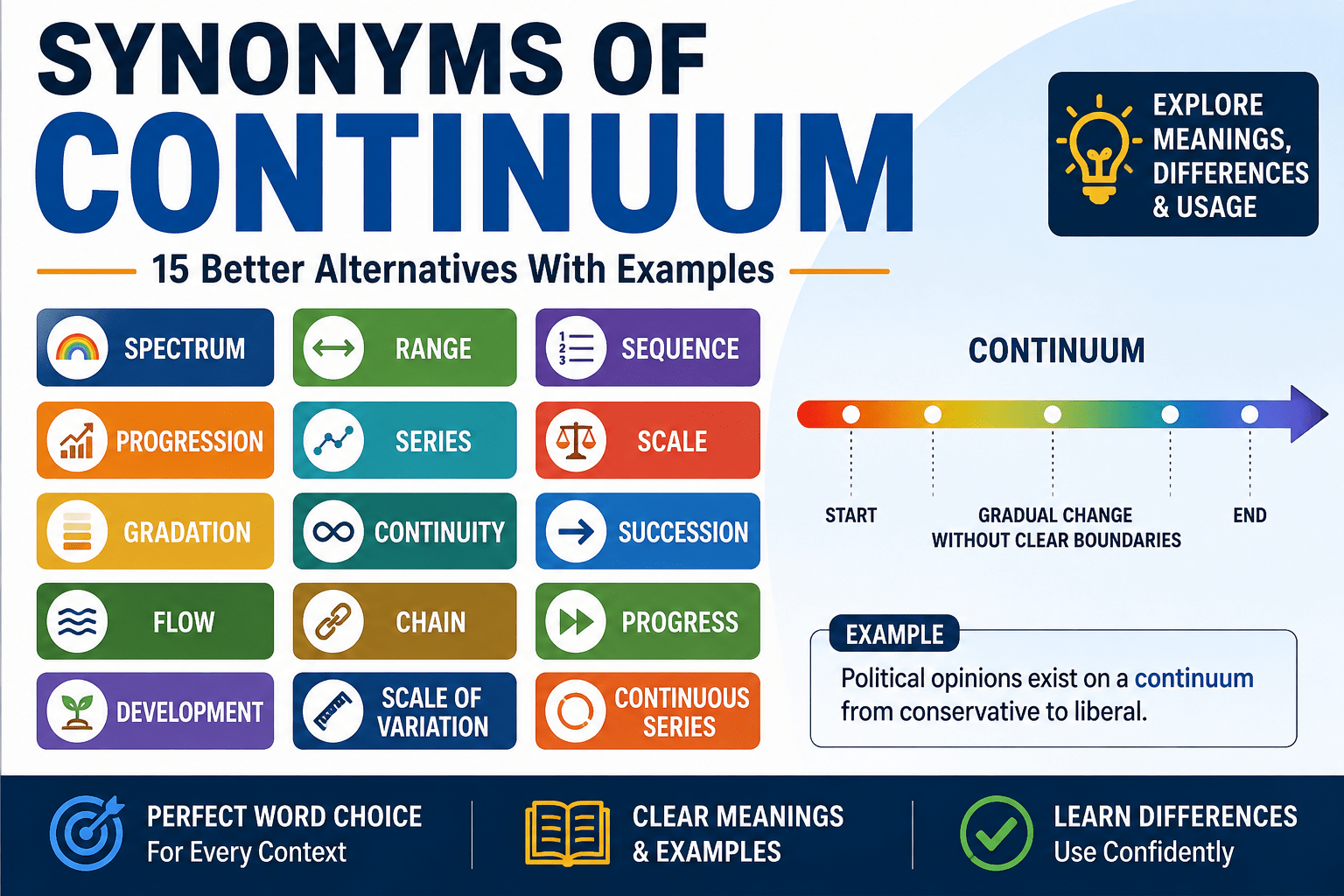
The closest alternatives to continuum include spectrum, range, sequence, progression, series, scale, gradation, continuity, succession, flow, and chain.
However, there is no single perfect substitute in every context. Spectrum is especially useful for a range of degrees or possibilities, sequence emphasizes order, progression emphasizes gradual development, and continuity emphasizes an uninterrupted connection. Continuum itself is best when the idea involves gradual variation without clear boundaries.
Core Synonyms of Continuum
| Word | Relationship | Meaning | Best Context | Formality |
|---|---|---|---|---|
| Spectrum | Close synonym | A range of degrees or variations | Qualities, opinions, states | Neutral/Formal |
| Range | Close synonym | The full extent between limits | Levels, values, possibilities | Neutral |
| Sequence | Near synonym | Things arranged in an order | Events, stages, processes | Neutral/Formal |
| Progression | Near synonym | Gradual development or change | Growth, stages, development | Neutral/Formal |
| Series | Near synonym | Connected things occurring one after another | Events, stages, items | Neutral |
| Scale | Contextual alternative | A graded system from one level to another | Measurement, intensity | Neutral/Formal |
| Gradation | Close contextual alternative | A gradual change between levels | Color, intensity, quality | Formal |
| Continuity | Related/near synonym | An uninterrupted connection | Events, ideas, processes | Formal |
| Succession | Contextual alternative | Things following one another | Events, people, stages | Formal |
| Flow | Contextual alternative | Continuous movement or development | Ideas, events, processes | Neutral |
| Chain | Contextual alternative | Connected sequence of things | Events, causes, relationships | Neutral |
| Progress | Contextual alternative | Forward development or movement | Development, improvement | Neutral |
| Development | Contextual alternative | Gradual growth or change | Skills, systems, situations | Neutral |
| Scale of variation | Phrase alternative | A range showing degrees of difference | Academic/scientific writing | Formal |
| Continuous series | Phrase alternative | An uninterrupted connected series | Technical/academic contexts | Formal |
The table deliberately distinguishes true semantic overlap from words that only work in particular contexts. A thesaurus may list terms such as continuation, continuity, continuance, and sequence, but that does not mean each one can replace continuum naturally in every sentence.
What Does “Continuum” Mean?
Continuum is a noun referring to something that changes gradually, often without clear boundaries between one state and another. Cambridge gives the example of political opinion existing along a continuum rather than falling neatly into two categories.
For example:
Political attitudes exist on a continuum from strongly conservative to strongly progressive.
The important idea is that there are intermediate positions rather than only two distinct categories.
Continuum can also refer to a continuous series of connected events, stages, or conditions. Collins gives this broader sense as a continuous series of closely connected events.
Examples include:
- a continuum of care
- a continuum of development
- a continuum of risk
- a continuum of political opinion
- the space-time continuum
- a continuum of experience
1. Spectrum
Spectrum is one of the closest practical alternatives to continuum, particularly when describing a range of different degrees or positions.
Political opinion exists on a broad spectrum.
It works especially well when something varies from one extreme to another.
Common examples include:
- a spectrum of opinions
- a spectrum of colors
- a spectrum of abilities
- a spectrum of behaviors
- a spectrum of possibilities
Choose “spectrum” when:
The focus is on different degrees, types, or positions within a range.
2. Range
Range refers to the extent or variety covered by something.
The condition exists across a wide range of severity.
It is a useful alternative when continuum emphasizes different levels between two or more limits.
However, range does not necessarily imply that the differences are gradual or without clear boundaries.
Choose “range” when:
You want to emphasize extent, variety, or limits rather than continuous change.
3. Sequence
Sequence describes things arranged or occurring in a particular order.
The disease progresses through a sequence of stages.
This overlaps with continuum when the focus is on connected stages, but it does not necessarily imply smooth or gradual variation.
Continuum:
Human development can be viewed as a continuum.
Sequence:
Human development follows a sequence of developmental stages.
The second sentence emphasizes order, not necessarily an uninterrupted scale.
4. Progression
Progression means movement or development from one stage, condition, or level to another.
The treatment represents a progression from basic care to specialized care.
It is especially useful when the continuum describes development or gradual change over time.
Choose “progression” when:
The emphasis is on movement from one stage to another.
5. Series
A series is a group of related things that occur or appear one after another.
The study examined a series of developmental stages.
Series can replace continuum when the emphasis is on connected items or events, but it does not automatically imply gradual transitions.
Choose “series” when:
You mean a connected set of events, stages, or items.
6. Scale
Scale can describe a graduated system showing different levels of something.
Anxiety can be measured on a scale from mild to severe.
This makes scale particularly useful when a continuum is being represented through levels or measurements.
Choose “scale” when:
The idea involves graded levels or measurement.
7. Gradation
Gradation refers to a gradual transition from one level, quality, or state to another.
The painting uses subtle gradations of blue and gray.
It is one of the more precise alternatives when the important feature is gradual change between neighboring states.
Choose “gradation” when:
You want to emphasize subtle differences or gradual transitions.
8. Continuity
Continuity emphasizes an uninterrupted connection between things.
The policy provides continuity of care for patients.
It is related to continuum, but the meanings are not identical.
Continuum often describes a range or continuous series.
Continuity emphasizes the fact that something remains connected or uninterrupted.
Cambridge’s thesaurus treats continuum as a related term to continuity, alongside words such as flow, progression, succession, and series.
Choose “continuity” when:
The focus is on uninterrupted connection or consistency.
9. Succession
Succession means a series of things that follow one another.
The project developed through a succession of stages.
It is more formal than sequence and is especially useful for events, stages, or people occurring one after another.
Choose “succession” when:
The important idea is one thing following another.
10. Flow
Flow describes continuous movement or development.
There is a natural flow from one stage of the process to the next.
It works well when the continuum is conceptualized as something moving smoothly rather than existing as separate categories.
Choose “flow” when:
You want to emphasize continuous movement or transition.
11. Chain
Chain can describe a series of connected events, causes, or relationships.
The researchers identified a chain of events leading to the final outcome.
It is a contextual alternative rather than a direct synonym for continuum.
Choose “chain” when:
The focus is on connections between individual elements.
12. Progress
Progress describes forward movement or development toward a later stage.
The patient’s recovery showed steady progress.
It can overlap with continuum in developmental contexts, but it adds the idea of forward movement or improvement.
Choose “progress” when:
You mean movement toward a more advanced or developed state.
13. Development
Development refers to gradual growth, change, or evolution.
Language development occurs along a complex continuum.
Replacing continuum with development changes the meaning slightly:
Language development is complex.
Here, development refers to the process of changing, while continuum describes the continuous range or structure within which that change occurs.
Choose “development” when:
The focus is on growth or change over time.
Which Word Should I Use Instead of “Continuum”?
The best choice depends on what you want to emphasize.
Choose spectrum when:
You mean a range of degrees or positions.
Opinions exist across a broad spectrum.
Choose range when:
You mean the extent between different limits.
The treatment has a wide range of possible applications.
Choose sequence when:
You mean things occurring in a particular order.
The process follows a sequence of stages.
Choose progression when:
You mean gradual movement from one stage to another.
The course provides a progression from beginner to advanced levels.
Choose scale when:
You mean measurable or graded levels.
The condition varies on a scale from mild to severe.
Choose gradation when:
You want to emphasize subtle transitions.
The design contains a gradation from light to dark.
Choose continuity when:
You mean uninterrupted connection.
The program ensures continuity of care.
Choose flow when:
You mean smooth continuous movement.
The process has a natural flow from one stage to the next.
Continuum vs. Spectrum
Continuum and spectrum are often interchangeable when describing a range of degrees.
Political beliefs exist on a continuum.
Political beliefs exist across a spectrum.
However, spectrum often emphasizes the range of possible variations, while continuum more strongly conveys the idea that the categories blend into one another without clear dividing points.
Best choice: Use continuum when the absence of clear boundaries matters. Use spectrum when you mainly want to emphasize variety or range.
Continuum vs. Range
A range is broader and more general.
The medication is effective across a range of conditions.
A continuum suggests a connected progression or gradual variation.
Pain exists on a continuum from mild discomfort to severe suffering.
A range can contain distinct values or categories; a continuum generally suggests that the values between the endpoints are connected or smoothly varying.
Continuum vs. Sequence
The distinction is mainly about order versus continuous variation.
A sequence consists of things that follow one another.
A continuum represents connected variation without necessarily having discrete stages.
Compare:
The treatment follows a sequence of steps.
The severity of the condition exists on a continuum.
Use sequence for ordered stages and continuum for gradual variation.
Common Collocations With “Continuum”
Some of the most useful expressions include:
- on a continuum
- along a continuum
- across a continuum
- continuum of care
- continuum of development
- continuum of risk
- continuum of experience
- continuum of severity
- continuum of possibilities
- political continuum
- social continuum
- space-time continuum
Cambridge specifically records combinations such as continuum approach, continuum hypothesis, and continuum mechanics, while Collins gives examples including continuum of care and space-time continuum.
Common Mistakes With Synonyms of Continuum
1. Treating “range” as a perfect synonym
A range can describe separate or bounded values. Continuum more strongly suggests gradual connection.
2. Using “sequence” when there is no order
A sequence requires an ordering relationship. A continuum can describe variation without a sequence of events.
3. Using “continuity” when you mean a scale
Continuity describes uninterrupted connection, while continuum can describe a range of degrees.
4. Using “progression” when there is no development
Progression implies movement from one stage or condition toward another. A continuum does not necessarily involve progress.
5. Assuming “spectrum” is always identical to “continuum”
The two overlap strongly, but spectrum often focuses on the range of possibilities, while continuum emphasizes continuous variation.
Antonyms of Continuum
There is no single universal antonym for continuum, because its opposite depends on the context.
Useful contrasting concepts include:
- discontinuity
- division
- separation
- break
- gap
- dichotomy
- categorization
- discrete categories
For example:
The theory treats gender as a continuum rather than a strict dichotomy.
Here, dichotomy provides a useful conceptual contrast because it divides something into two distinct categories rather than presenting it as a continuous range.
Frequently Asked Questions
What is the closest synonym for continuum?
Spectrum is often the closest practical synonym when continuum means a range of degrees or variations. However, range, progression, sequence, scale, and gradation may be better choices in particular contexts. No single alternative preserves every aspect of continuum.
What is another word for continuum?
Depending on context, another word for continuum can be spectrum, range, sequence, progression, series, scale, gradation, or continuity. The correct choice depends on whether you mean gradual variation, an ordered series, a range of levels, or uninterrupted connection.
Is spectrum a synonym for continuum?
Spectrum can be a close synonym for continuum when both describe a range of degrees or variations. However, they are not identical in every context. Continuum particularly emphasizes continuous variation without clear dividing points, while spectrum often emphasizes the range itself.
Is range a synonym for continuum?
Range can be used as a contextual synonym for continuum when the meaning is a set of possible degrees or values. However, range does not necessarily imply that the values between its limits form a continuous whole.
What is the difference between continuum and sequence?
A continuum describes continuous variation or a connected whole, while a sequence describes elements arranged or occurring in a particular order. A sequence can have distinct steps; a continuum emphasizes gradual connection between points.
What is a formal synonym for continuum?
In formal or academic writing, spectrum, progression, gradation, succession, and continuity may work depending on context. Continuum itself is already a formal and widely used term, particularly in academic, scientific, medical, and social-science writing.
What is the opposite of continuum?
Depending on context, possible contrasts include discontinuity, separation, division, dichotomy, and discrete categories. The best opposite depends on whether you are contrasting continuous variation with a break, separation, or clearly defined categories.
Conclusion
The best synonym of continuum depends on the meaning you want to preserve. Spectrum is a strong alternative for a range of degrees, range emphasizes extent, sequence emphasizes order, progression emphasizes development, scale emphasizes levels, and gradation emphasizes gradual change.
For uninterrupted connection, continuity is often better. For connected movement, flow may work naturally.
The important point is that these words are not interchangeable in every context. Continuum is especially useful when you want to express a continuous range or series in which there are no clear dividing points.

Daniel Carter is a professional content strategist and language enthusiast. He focuses on semantic SEO, keyword research, and creating structured vocabulary content that ranks well on search engines while remaining user-friendly.