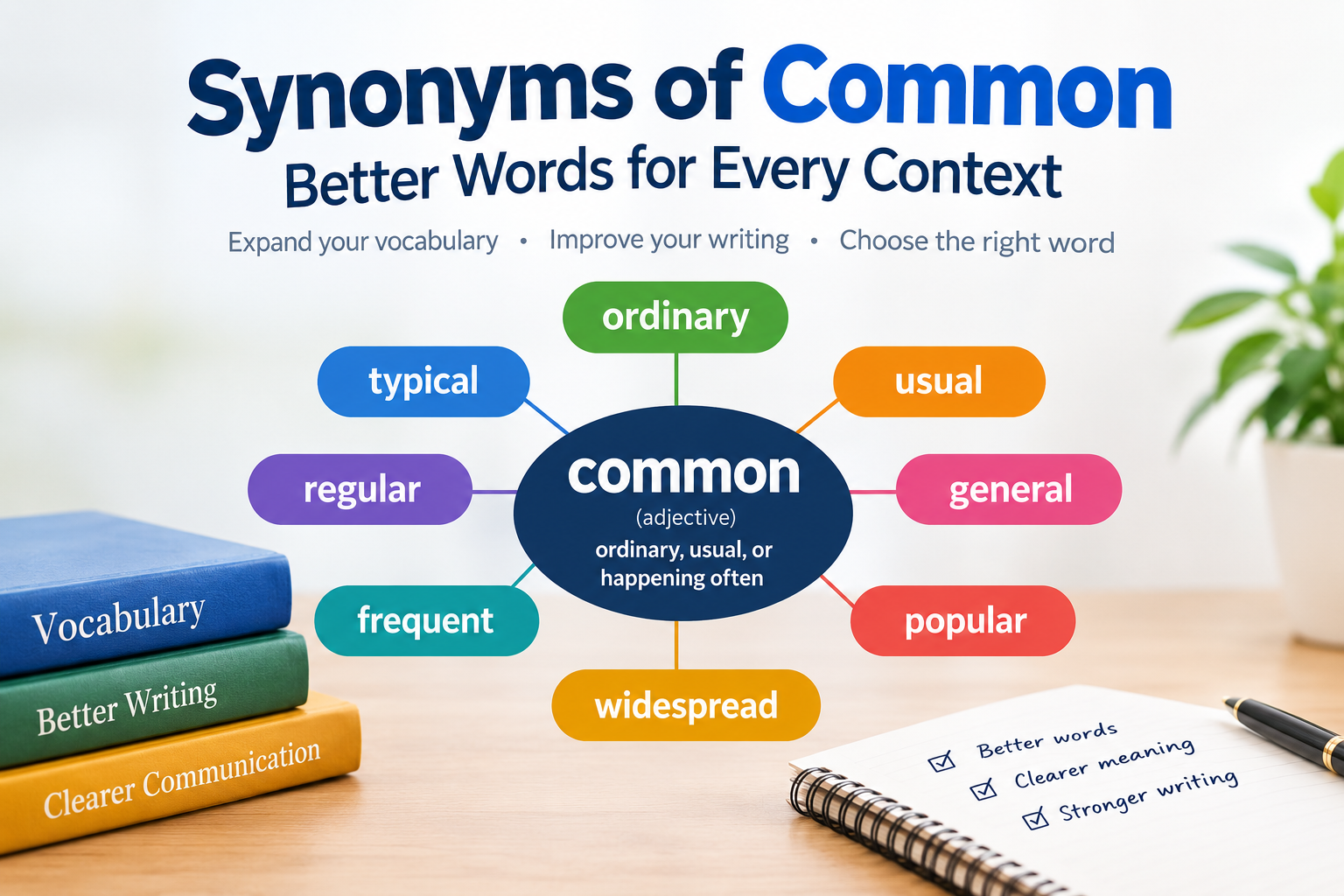
The word common is useful, but it has several meanings, so the best synonym depends on the sentence. You might use usual for something expected, frequent for something that happens often, widespread for something found across a large area, or ordinary for something that is not special. When common means shared, words such as mutual, shared, and collective may be more precise.
This guide explains 30 useful synonyms and alternatives for common, with their differences, formality, strength, and best contexts.
Quick Answer
The closest synonyms of common include usual, ordinary, typical, normal, frequent, commonplace, familiar, widespread, prevalent, everyday, customary, conventional, standard, popular, and shared. However, they are not interchangeable in every sentence. Frequent emphasizes occurrence, widespread emphasizes distribution, ordinary emphasizes lack of distinction, and shared means belonging to more than one person or group.
| Word | Relationship | Meaning / Difference | Best Context |
|---|---|---|---|
| usual | Close synonym | Normal or expected because it happens regularly | Everyday situations |
| ordinary | Close synonym | Not special, unusual, or exceptional | People, objects, experiences |
| typical | Near synonym | Characteristic of a particular person, group, or situation | Examples and characteristics |
| normal | Near synonym | Conforming to what is expected or standard | Conditions, behavior, situations |
| frequent | Close synonym | Happening often | Events, visits, problems |
| commonplace | Close synonym | Very common or unremarkable | Events, ideas, experiences |
| familiar | Contextual alternative | Well known or easily recognized | Faces, places, ideas |
| everyday | Contextual alternative | Ordinary or occurring in daily life | Life, language, objects |
| mundane | Contextual alternative | Ordinary and often lacking excitement | Tasks, experiences |
| run-of-the-mill | Informal contextual alternative | Ordinary and not exceptional | Products, experiences |
The important point is that these 30 words do not all replace common equally. Dictionaries group common into different senses, including “frequently encountered,” “ordinary,” “shared,” “popular,” and other context-dependent meanings.
What Does Common Mean?
As an adjective, common has several major meanings.
First, it can mean happening often or being found in many places or among many people:
Headaches are common among adults.
Second, it can mean ordinary or not special:
It was a common household item.
Third, it can mean shared by two or more people or things:
They have a common interest in science.
The word can therefore describe frequency, normality, ordinariness, or shared ownership/experience, depending on context.
Pronunciation
US: /ˈkɑː.mən/
UK: /ˈkɒm.ən/
The Closest Synonyms of Common
1. Usual
Usual means normal or expected because something happens regularly.
She arrived at her usual time.
Use usual when the emphasis is on what normally happens rather than how many people experience it.
Common: This is a common problem.
Usual: This is the usual procedure.
The second sentence suggests an established or expected procedure.
2. OrdinaryOrdinary describes something that is normal and not especially remarkable.
It looked like an ordinary apartment from the outside.
In contrast, ordinary can sometimes suggest a lack of distinction, while common more often emphasizes frequency.
3. Typical
Typical means characteristic of a particular person, group, place, or situation.
That is typical behavior for this species.
It is not always interchangeable with common. Something can be typical of a group without being widespread.
4. Normal
Normal refers to what conforms to an expected condition, pattern, or standard.
A slight delay is normal during the morning rush.
Choose normal when you are contrasting something with what would be unusual or abnormal.
5. Frequent
Frequent specifically emphasizes that something happens often.
Frequent interruptions made the meeting difficult.
This is often a better alternative when the meaning of common is specifically about repeated occurrence.
6. Commonplace
Commonplace means very common or ordinary, often with the additional idea that something is no longer remarkable.
Online payments are now commonplace.
It can be especially useful in formal writing when you want to emphasize how ordinary or widespread something has become.
7. Familiar
Familiar means well known, recognized, or easily recognized.
Her face was familiar to everyone in the office.
Do not automatically replace common with familiar. Common emphasizes frequency; familiar emphasizes recognition or knowledge.
8. Widespread
Widespread means found across a large area or affecting many people.
The report revealed widespread concern about the issue.
This is stronger and more specific than common when distribution is important.
9. Prevalent
Prevalent means common within a particular population, area, or situation.
The practice is prevalent in rural communities.
It is particularly useful in academic, scientific, medical, and professional writing.
10. Everyday
Everyday describes something ordinary or associated with normal daily life.
These are everyday household problems.
Remember the grammar distinction:
- everyday = ordinary or daily
- every day = each day
She uses an everyday vocabulary.
She studies vocabulary every day.
Synonyms for Different Meanings of Common
Because common has several senses, grouping alternatives by meaning is more useful than treating all 30 words as interchangeable.
When Common Means “Happening Often”
Use:
- frequent
- usual
- regular
- commonplace
- prevalent
- widespread
- recurring
Examples:
Traffic delays are frequent during rush hour.
This type of error is commonplace in early drafts.
The condition is prevalent in certain regions.
The best choice depends on what you want to emphasize: repetition, frequency, distribution, or prevalence.
When Common Means “Ordinary”
Use:
- ordinary
- typical
- normal
- everyday
- mundane
- unexceptional
- run-of-the-mill
Examples:
It was an ordinary afternoon.
She described the task as mundane.
The restaurant serves everyday comfort food.
Mundane and run-of-the-mill can carry a more negative or dismissive tone than common.
When Common Means “Shared”
This is a different meaning entirely.
Use:
- shared
- mutual
- collective
- communal
- joint
Examples:
They have a shared interest in architecture.
The two countries reached a mutual agreement.
The committee accepted collective responsibility.
Here, replacing common with frequent or ordinary would completely change the meaning.
When Common Means “Widely Accepted or Found”
Useful alternatives include:
- widespread
- prevalent
- prevailing
- general
- popular
- universal
For example:
There is widespread support for the proposal.
That remains the prevailing view.
The product has become popular among younger consumers.
These words overlap with common, but each emphasizes a different aspect of broad acceptance or distribution.
Common vs. Usual
Common and usual overlap, but they focus on different ideas.
| Word | Main emphasis | Example |
|---|---|---|
| common | Frequently encountered | Rain is common here. |
| usual | Normally expected | She took her usual route. |
You can say:
It is common for employees to work remotely.
But:
She worked remotely at her usual time.
Usual is especially natural when talking about someone’s established pattern or routine.
Common vs. Ordinary
These words are close, but not identical.
Common often emphasizes frequency:
This mistake is common among beginners.
Ordinary emphasizes lack of special qualities:
It was an ordinary mistake.
The first sentence tells us that many beginners make the mistake. The second describes the mistake as normal or unremarkable.
Merriam-Webster similarly distinguishes ordinary from common by noting that ordinary stresses conformity to the normal order, while common often stresses everyday quality or frequency.
Common vs. Typical
Typical means characteristic or representative.
This is a common problem.
means many people experience the problem.
This is a typical problem.
can mean the problem is characteristic of a particular situation or group.
Therefore, typical is often better when you are describing an example that represents a pattern.
Common vs. Normal
Normal is about conformity to an expected standard or condition.
It is common to feel nervous before an interview.
This emphasizes how often the experience occurs.
It is normal to feel nervous before an interview.
This emphasizes that the experience is expected or not abnormal.
Both may be appropriate, but they answer slightly different questions.
Common vs. Widespread
Widespread emphasizes geographical or population-level distribution.
The disease is common.
is general.
The disease is widespread.
emphasizes that it occurs across a broad area or population.
Use widespread when the extent of distribution matters.
Common vs. Prevalent
Prevalent is more formal and often appears in academic, technical, or professional contexts.
The problem is common among students.
The problem is prevalent among students.
Both are grammatical, but the second has a more formal register.
Do not assume prevalent always means “more common.” Its main value is its formal description of something widely present within a particular population or setting.
Common vs. Popular
These words are frequently confused.
Common can mean frequently encountered.
Popular means liked, accepted, chosen, or followed by many people.
Compare:
English is a common language around the world.
English is a popular language to learn.
The first emphasizes widespread occurrence or use; the second emphasizes people’s choice or preference.
Common vs. Familiar
Familiar emphasizes recognition or knowledge.
It is a common name.
means many people have that name.
It is a familiar name.
means people recognize or know the name.
This distinction is particularly useful in writing about people, places, brands, sounds, ideas, and experiences.
Common vs. Widespread vs. Prevalent
These three are useful in formal writing, but they are not identical.
| Word | Main idea | Example |
|---|---|---|
| common | Frequently encountered | The problem is common. |
| widespread | Distributed across a large area or population | The problem is widespread. |
| prevalent | Common within a specified population or setting | The problem is prevalent among teenagers. |
Choose the word that communicates the exact relationship you mean rather than selecting the most formal-sounding option.
Context-Specific Alternatives for Common
For “common problem”
Good alternatives include:
- frequent problem
- widespread problem
- recurring problem
- prevalent problem
- routine problem
Example:
Software bugs are a common problem during development.
If you want to emphasize repetition:
Software bugs are a recurring problem during development.
If you want to emphasize broad distribution:
Software bugs are a widespread problem in the industry.
For “common practice”
Possible alternatives include:
- usual practice
- standard practice
- customary practice
- conventional practice
- established practice
It is common practice to back up important files.
It is standard practice to back up important files.
The second version emphasizes an accepted procedure or standard.
For “common knowledge”
Possible alternatives include:
- generally known
- widely known
- well known
- generally accepted
It is common knowledge that the project faced delays.
It is widely known that the project faced delays.
The best replacement depends on whether you mean broad knowledge, recognition, or general acceptance.
For “common people”
This phrase requires care because its meaning depends strongly on context. Alternatives such as ordinary people, the general public, or everyday people can change the nuance.
The policy affected ordinary people as well as businesses.
If the intended meaning is simply people generally, the general public may be clearer.
Avoid replacing the phrase mechanically because common can carry a social-class or “lack of refinement” meaning in some uses. Collins lists this as a distinct sense from the more neutral meanings involving frequency and ordinariness.
Less Common but Useful Alternatives
Ubiquitous
Ubiquitous means present or encountered almost everywhere.
Smartphones are ubiquitous in modern life.
It is stronger than ordinary common and should not be used merely because something occurs frequently.
Rife
Rife describes something that exists in large amounts, often something undesirable.
The industry was rife with misleading claims.
It normally has a negative association.
Endemic
Endemic is a technical term used especially for diseases and ecological phenomena that are regularly found in a particular place or population.
The disease is endemic to the region.
It should not be treated as a general-purpose synonym for common.
Mundane
Mundane means ordinary and often lacking excitement or interest.
He was tired of his mundane routine.
It adds a negative or dismissive nuance that common does not necessarily have.
Run-of-the-mill
Run-of-the-mill means ordinary and not particularly special.
It was a run-of-the-mill hotel.
This is informal and conversational, so it is less suitable for formal academic writing.
Common Mistakes When Choosing a Synonym
Mistake 1: Treating every synonym as interchangeable
Words listed together in a thesaurus can have different meanings and grammatical or contextual restrictions.
For example:
The problem is common.
does not mean exactly the same thing as:
The problem is familiar.
Mistake 2: Using “popular” for frequency
A thing can be common without being popular.
A particular error may be common but certainly not popular.
Mistake 3: Using “widespread” when frequency is the point
Something may happen frequently in one location without being widespread.
Frequent delays occurred at the station.
is different from:
Widespread delays affected the entire region.
Mistake 4: Using “ordinary” when “shared” is intended
In:
They share a common goal.
the meaning is shared, not ordinary.
Mistake 5: Using “prevalent” simply to sound formal
A more formal word is not automatically a better word. Use prevalent when the context genuinely concerns something common within a particular population or setting.
Antonyms of Common
The best antonym depends on the sense.
When coThe word common means frequently encountered, and useful opposites include:
- rare
- uncommon
- unusual
- infrequent
- occasional
In the sense of ordinary or unremarkable, suitable alternatives include:
- exceptional
- extraordinary
- remarkable
- unusual
For the meaning shared by multiple people or groups, consider:
- individual
- personal
- separate
- private
Cambridge lists rare as an opposite in the “happening or seen often” sense and identifies terms such as private and individual as opposites of the shared sense.
Which Word Should You Use?
A quick decision guide can make the choice easier:
- Choose usual when something normally happens.
- Choose ordinary when something is not special.
- Choose typical when something represents a characteristic pattern.
- Choose normal when something conforms to expectations.
- Choose frequent when something happens often.
- Choose widespread when something extends across a large area or population.
- Choose prevalent for a formal description of something widely present in a particular group or setting.
- Choose familiar when something is recognized or well known.
- Choose popular when many people like, choose, or support something.
- Choose shared when two or more people have something together.
- Choose mutual when something is held or experienced by both sides.
- Choose collective when something involves a group as a whole.
- Choose mundane when something is ordinary in a dull or unexciting way.
- Choose ubiquitous when something seems to be everywhere.
Frequently Asked Questions
What is the closest synonym for common?
There is no single closest synonym in every context. Usual, ordinary, frequent, typical, and normal are close alternatives for different senses. If common means happening often, frequent may be the most precise; if it means not special, ordinary is often better.
What is another word for common in formal writing?
Depending on context, formal alternatives include prevalent, widespread, prevalent, customary, conventional, prevailing, and standard. However, a formal word should only be used when its meaning fits. For example, prevalent is useful for something widespread within a population, while customary describes an established practice.
What is a synonym for common in the sense of usual?
Good alternatives include usual, normal, typical, customary, regular, routine, and standard. The best choice depends on the sentence. Customary emphasizes established practice, while usual emphasizes what normally happens.
What is a synonym for common in the sense of widespread?
Useful alternatives include widespread, prevalent, pervasive, ubiquitous, general, and sometimes rife. These words differ in strength and connotation. Rife is often associated with undesirable things, while ubiquitous emphasizes being present almost everywhere.
Are common and ordinary synonyms?
They overlap, but they are not identical. Common often emphasizes frequency or how often something is encountered. Ordinary emphasizes a lack of unusual or special qualities. Therefore, they can substitute for each other in some sentences but not all.
Are common and popular the same?
No. Common can mean frequently encountered, whereas popular usually indicates that something is liked, chosen, accepted, or followed by many people. A product can be common without being popular, and an unpopular problem can still be common.
What is the synonym of common for something shared?
When common means shared by two or more people or groups, good alternatives include shared, mutual, joint, collective, and communal. The exact choice depends on the relationship being described.
What is the opposite of common?
The opposite depends on the meaning. For frequency, rare, uncommon, unusual, or infrequent may work. For the shared sense, individual, private, personal, or separate may be appropriate.
Conclusion
Common is a deceptively flexible word. Its best synonym changes according to whether you mean frequent, usual, ordinary, widespread, popular, or shared. Instead of replacing it automatically with the first word in a thesaurus, identify the exact meaning first.
When discussing frequency, frequent or usual may be more precise. The sense of ordinary quality is better expressed by ordinary or typical. For broad distribution, widespread or prevalent are suitable choices. Shared ideas or experiences can be described as shared, mutual, or collective.

Michael Thompson is an English language specialist and experienced editor who focuses on vocabulary development and clear communication. He creates high-quality synonym guides, word comparisons, and writing tips to help students and professionals express their ideas more effectively. His work combines linguistic knowledge with practical SEO strategies to make learning both useful and engaging.