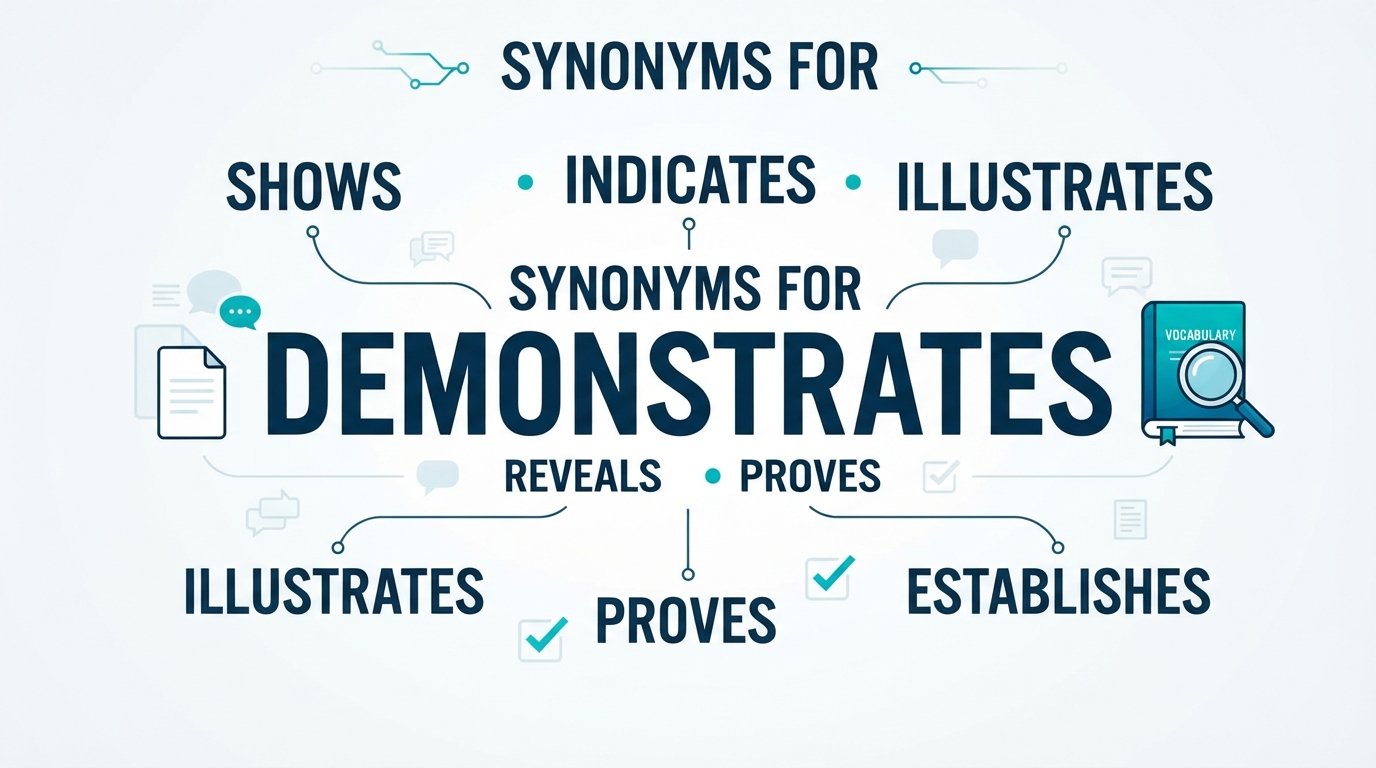
Finding the right synonym for demonstrates depends on what you mean by the word. In one sentence, demonstrates may mean “shows”; in another, it may mean “proves,” “illustrates,” “reveals,” or “shows how something works.” The strongest replacement therefore depends on the evidence, action, quality, or idea being presented.
This guide separates close synonyms from context-specific alternatives so you can choose a word that sounds natural and communicates the intended meaning accurately.
Quick Answer: What Are the Best Synonyms for Demonstrates?
The closest general synonym for demonstrates is shows. Other useful alternatives include indicates, illustrates, reveals, displays, exhibits, proves, establishes, confirms, verifies, exemplifies, expresses, manifests, highlights, and makes clear. However, these words are not interchangeable in every context. For example, proves suggests stronger evidence, while indicates is more cautious and illustrates often introduces an example or explanation.
25 Synonyms and Alternatives for Demonstrates
Closest Synonyms for Demonstrates
| Word or phrase | Relationship | Meaning / use | Strength | Formality | Best context |
|---|---|---|---|---|---|
| shows | Close synonym | Makes something visible, known, or clear | Similar | Neutral | General writing and speech |
| indicates | Near synonym | Points toward a fact, result, or conclusion | Softer | Neutral–formal | Research, data, reports |
| illustrates | Close/contextual synonym | Makes an idea clear through an example or visual | Similar | Neutral–formal | Essays, explanations, charts |
| reveals | Near synonym | Makes something previously hidden or unknown known | Similar | Neutral | Findings, discoveries, analysis |
| displays | Contextual alternative | Makes a quality or feature visible | Similar | Neutral–formal | Skills, qualities, objects |
| exhibits | Contextual alternative | Shows a characteristic, behavior, or quality | Similar | Formal | Behavior, symptoms, qualities |
| proves | Stronger synonym | Establishes something as true through evidence | Stronger | Neutral–formal | Conclusive evidence |
| establishes | Near synonym | Firmly determines or supports a fact or conclusion | Stronger | Formal | Research, law, academic writing |
| confirms | Near synonym | Shows that something already suspected or stated is true | Stronger | Neutral–formal | Tests, reports, findings |
Evidence-Based Alternatives for Demonstrates
| Word or phrase | Relationship | Meaning / use | Strength | Formality | Best context |
|---|---|---|---|---|---|
| verifies | Near synonym | Checks and establishes accuracy or truth | Stronger | Formal | Data, claims, records |
| exemplifies | Contextual synonym | Shows something by being a representative example | Similar | Formal | Qualities, principles, behavior |
| manifests | Contextual synonym | Makes a quality or condition evident or visible | Similar | Formal | Feelings, conditions, qualities |
| highlights | Contextual alternative | Draws attention to an important feature or fact | Different emphasis | Neutral–formal | Reports, essays, presentations |
| underscores | Contextual alternative | Emphasizes the importance of something | Different emphasis | Formal | Arguments, findings, reports |
| expresses | Contextual alternative | Communicates a feeling, view, or quality | Similar in some contexts | Neutral | Feelings, opinions, attitudes |
| evidences | Formal synonym | Provides evidence of something | Similar | Very formal | Academic/legal writing |
| attests to | Near synonym | Provides evidence supporting a fact or quality | Strong | Formal | Records, achievements, evidence |
Formal and Academic Alternatives for Demonstrates
| Word or phrase | Relationship | Meaning / use | Strength | Formality | Best context |
|---|---|---|---|---|---|
| testifies to | Near synonym | Serves as evidence of something | Strong | Formal | Historical or formal contexts |
| substantiates | Stronger contextual synonym | Supports a claim with evidence | Strong | Formal | Research, arguments, claims |
| corroborates | Contextual synonym | Confirms something with additional evidence | Strong | Formal | Research, testimony, reports |
| documents | Contextual alternative | Records evidence or facts systematically | Different emphasis | Formal | Reports, records, research |
| presents | Contextual alternative | Puts information, evidence, or an idea before an audience | Similar in some contexts | Neutral | Presentations, arguments |
| makes clear | Close contextual alternative | Removes uncertainty or makes meaning understandable | Similar | Neutral | General and explanatory writing |
| sets out | Contextual alternative | Clearly presents information or an argument | Similar | Neutral–formal | Essays, reports |
| shows clearly | Close synonym | Makes a fact or point particularly evident | Similar | Neutral | General and academic writing |
Cambridge’s thesaurus groups show, reveal, display, exhibit, and manifest with the evidence/showing sense of demonstrate, while prove, establish, and make clear belong to the proof or reasoning sense. Collins makes similar distinctions and also lists describe, explain, and teach for the separate “show how something works” sense.
What Does Demonstrates Mean?
Demonstrates is the third-person singular form of the verb demonstrate. In its most common uses, it means to show something clearly, show that something is true, show a particular quality through actions, or show and explain how something works.
For example:
- The research demonstrates that the treatment is effective.
- Her work demonstrates exceptional attention to detail.
- The instructor demonstrates how to use the equipment.
The appropriate synonym changes with each meaning.
1. Shows — The Best General Alternative
Shows is usually the safest and most natural replacement for demonstrates.
The report demonstrates a significant improvement in sales.
becomes:
The report shows a significant improvement in sales.
Shows is less formal and more direct. It works in academic, professional, and everyday English.
Best for: general-purpose writing.
2. Indicates — Best for Cautious Evidence
Use indicates when something points toward a conclusion without necessarily proving it.
The results indicate a possible connection between sleep and memory.
This is especially useful in research and analytical writing because it avoids claiming more certainty than the evidence supports.
Choose “indicates” when the evidence is suggestive rather than conclusive.
3. Illustrates — Best for Examples and Explanation
Illustrates works when something makes an idea easier to understand through an example, case, image, chart, or situation.
This example demonstrates the importance of preparation.
→
This example illustrates the importance of preparation.
It is particularly natural in essays, presentations, textbooks, and analytical writing.
4. Reveals — Best for Something Previously Unknown
Reveals emphasizes discovery.
The investigation demonstrates several weaknesses in the system.
If the weaknesses were previously unknown, you could write:
The investigation reveals several weaknesses in the system.
The word adds a sense of uncovering information.
5. Proves — Stronger Than Demonstrates
Proves should not automatically replace demonstrates.
The experiment demonstrates that the method works.
does not necessarily mean:
The experiment proves that the method works.
Proves makes a stronger claim and suggests that the evidence establishes the truth of the conclusion. Therefore, use it when the evidence genuinely supports that level of certainty.
6. Establishes — Strong Formal Alternative
Establishes suggests that evidence firmly determines or supports a fact, relationship, or conclusion.
The study demonstrates a relationship between the two variables.
→
The study establishes a relationship between the two variables.
It is particularly useful in academic, legal, scientific, and professional writing.
7. Confirms — When Something Is Already Suspected
Use confirms when new evidence verifies something that was already proposed, suspected, or known.
The second test confirms the original result.
This differs slightly from demonstrates: confirms carries the idea of verification.
8. Verifies — When Accuracy Matters
Verifies emphasizes checking whether something is accurate, genuine, or true.
The audit demonstrates the accuracy of the financial records.
If the audit involved checking those records, you could say:
The audit verifies the accuracy of the financial records.
This word works especially well for data, identities, claims, records, and measurements.
9. Exemplifies — When Something Is a Clear Example
Exemplifies means to represent or show a quality, idea, or principle particularly well.
Her leadership demonstrates the value of patience.
→
Her leadership exemplifies the value of patience.
It is more specific than shows because the subject itself serves as an example.
10. Displays — Best for Visible Qualities
Displays works well when someone or something visibly shows a quality, behavior, or characteristic.
The athlete demonstrates remarkable discipline.
→
The athlete displays remarkable discipline.
It is also natural for objects, exhibits, information, and visual material.
11. Exhibits — Formal and Characteristic-Focused
Exhibits is useful when a person, animal, system, or object shows a particular characteristic or behavior.
The patient demonstrates symptoms of anxiety.
→
The patient exhibits symptoms of anxiety.
However, exhibits can sound more clinical or formal than shows.
12. Manifests — Formal and Often Abstract
Manifests means that something becomes apparent or visible through its expression.
The condition demonstrates itself through several symptoms.
In an appropriate formal context:
The condition manifests through several symptoms.
It is more specialized than shows, so it should not be used merely to make ordinary writing sound sophisticated.
13. Highlights — When the Main Point Is Emphasis
Highlights does not mean exactly the same thing as demonstrates, but it can replace it when the intended meaning is “draws attention to.”
The report demonstrates the need for better training.
→
The report highlights the need for better training.
The second sentence emphasizes importance rather than proof.
14. Underscores — Strong Emphasis
Underscores is useful when evidence or an event reinforces the importance of a point.
The findings demonstrate the urgency of reform.
→
The findings underscore the urgency of reform.
It is especially common in professional and academic writing.
15. Expresses — For Feelings, Views, or Attitudes
Use expresses when something communicates a feeling, opinion, attitude, or idea.
His actions demonstrate his commitment to the project.
→
His actions express his commitment to the project.
The emphasis shifts from simply showing the quality to communicating it.
Synonyms for Demonstrates in Academic Writing
Academic writing often benefits from precise alternatives rather than repeatedly using demonstrates.
| If you mean… | Better choice |
|---|---|
| General evidence | shows |
| Tentative evidence | indicates |
| An example clarifies an idea | illustrates |
| Something becomes known | reveals |
| Evidence establishes truth | proves |
| A conclusion is firmly supported | establishes |
| New evidence supports an earlier claim | confirms |
| Accuracy has been checked | verifies |
| Evidence supports a claim | substantiates |
| One example represents a principle | exemplifies |
For example:
The findings demonstrate a relationship between exercise and sleep.
Possible alternatives include:
- The findings show a relationship between exercise and sleep.
- The findings indicate a relationship between exercise and sleep.
- The findings establish a relationship between exercise and sleep.
- The findings reveal a relationship between exercise and sleep.
The best choice depends on how certain and significant the evidence actually is.
Synonyms for Demonstrates Ability or Skill
When demonstrates describes someone’s ability, natural alternatives include:
- shows
- displays
- exhibits
- demonstrates
- exemplifies
- expresses
Examples:
She demonstrates excellent leadership skills.
She shows excellent leadership skills.
She displays excellent leadership skills.
She exhibits excellent leadership skills.
For a resume or professional profile, demonstrates, displays, and shows can work well, but the best choice often depends on the surrounding sentence.
Synonyms for Demonstrates Importance
When something makes the importance of an issue clear, consider:
- shows
- highlights
- underscores
- illustrates
- emphasizes
- makes clear
Compare:
The incident demonstrates the importance of workplace safety.
Neutral:
The incident shows the importance of workplace safety.
Emphasis:
The incident highlights the importance of workplace safety.
Stronger formal emphasis:
The incident underscores the importance of workplace safety.
These alternatives communicate slightly different ideas, so they should not be treated as exact substitutes.
Demonstrates vs. Shows
Shows is broader, simpler, and generally more conversational. Demonstrates often sounds more formal and can suggest evidence, explanation, or a clear display of a quality.
The graph shows a decline in sales.
The graph demonstrates a decline in sales.
Both are grammatical, but shows is more straightforward.
Choose “shows” when you want simplicity.
Choose “demonstrates” when you want a somewhat more formal or analytical tone.
Demonstrates vs. Proves
The distinction is important.
Demonstrates can mean “shows clearly,” but proves specifically emphasizes establishing something as true.
The evidence demonstrates that the policy has benefits.
This does not automatically mean the evidence proves the policy is universally effective.
Therefore:
- Use demonstrates for clear evidence or illustration.
- Use proves when the evidence genuinely establishes the conclusion.
Demonstrates vs. Indicates
Indicates is generally more cautious.
The results indicate that demand is increasing.
This suggests that the evidence points toward increasing demand.
The results demonstrate that demand is increasing.
This makes a more confident statement.
Therefore, indicates is often preferable when the evidence is incomplete, preliminary, or subject to interpretation.
Demonstrates vs. Illustrates
Illustrates usually focuses on clarification through an example, image, case, or situation.
The case study illustrates the challenges faced by small businesses.
Demonstrates can be broader:
The case study demonstrates the importance of careful planning.
In short:
- illustrates → makes an idea clearer through an example
- demonstrates → shows something clearly, often through evidence or action
Demonstrates vs. Reveals
Reveals emphasizes discovery.
The survey demonstrates a change in consumer behavior.
The survey reveals a change in consumer behavior.
The second sentence suggests that the information was uncovered by the survey.
Choose reveals when the idea of discovering previously unknown information matters.
Common Mistakes When Replacing Demonstrates
1. Using “proves” for weak evidence
Avoid replacing every instance of demonstrates with proves. If evidence only suggests a conclusion, indicates or suggests may be more accurate.
2. Using “depicts” as a general synonym
Depicts normally means represents something visually or artistically.
The painting depicts a crowded marketplace.
It is not a general replacement for:
The evidence demonstrates a problem.
3. Using “portrays” for evidence
Portrays usually concerns representation, especially in art, literature, media, or descriptions.
The novel portrays the character as ambitious.
It does not normally mean that evidence establishes a fact.
4. Treating “explains” as an exact synonym
Explains means makes something understandable by giving information or reasons. It can overlap with demonstrates when someone shows how something works, but it is not a universal synonym.
5. Choosing complicated words unnecessarily
Words such as manifests, evidences, and evinces can be legitimate in particular contexts, but they are not automatically better than shows or demonstrates.
Clear vocabulary is usually better vocabulary.
What Is the Best Synonym for Demonstrates?
For most situations, shows is the best general synonym because it is natural, clear, and widely applicable.
However, the best choice changes with meaning:
- shows → general replacement
- indicates → cautious evidence
- illustrates → example or clarification
- reveals → discovery
- proves → conclusive evidence
- establishes → firm conclusion
- confirms → verification of an existing claim
- verifies → checking accuracy
- exemplifies → serves as an example
- highlights → draws attention to importance
- underscores → strongly emphasizes importance
- displays / exhibits → visibly shows a quality
Common Collocations With Demonstrates
Some common structures make the intended meaning especially clear:
- demonstrates that
- demonstrates the importance of
- demonstrates a commitment to
- demonstrates an ability to
- demonstrates knowledge of
- demonstrates how
- demonstrates a lack of
- clearly demonstrates
- effectively demonstrates
- successfully demonstrates
The replacement should match the construction.
For example:
The candidate demonstrates an ability to solve complex problems.
A natural alternative is:
The candidate shows an ability to solve complex problems.
But:
The candidate proves an ability to solve complex problems.
sounds stronger and may imply a level of evidence that the original sentence does not require.
Antonyms of Demonstrates
The appropriate antonym depends on the sense.
FFor the “show” meaning, possible opposites include:
- conceals
- hides
- withholds
- obscures
- disguises
When describe means “make clear,” useful opposites include:
- confuses
- obscures
- misrepresents
For example:
The report demonstrates the problem.
Opposite:
The report obscures the problem.
Frequently Asked Questions
What is the closest synonym for demonstrates?
Shows is generally the closest broad synonym for demonstrates. However, the best alternative depends on context. Indicates is better for tentative evidence, illustrates for examples, reveals for discoveries, and proves when evidence establishes something as true.
What is a formal synonym for demonstrates?
Depending on the meaning, formal alternatives include establishes, verifies, substantiates, evidences, manifests, and illustrates. However, a formal word is not necessarily a better word. Choose the alternative that accurately expresses the intended relationship.
What is a good synonym for demonstrates in an essay?
Shows, indicates, illustrates, reveals, establishes, and highlights can all work in essays. The correct choice depends on the sentence. For example, indicates is useful for cautious academic claims, while illustrates works well when an example clarifies an idea.
Is shows the same as demonstrates?
Often, but not always. Shows is broader and more neutral, while demonstrates can suggest clear evidence, explanation, or a visible display of a quality. In many ordinary sentences, they can replace each other naturally.
Is proves stronger than demonstrates?
Yes, in many contexts. Proves implies that evidence establishes something as true, whereas demonstrates can simply mean shows something clearly. Therefore, proves should be used only when the evidence supports that stronger claim.
What is the best synonym for demonstrates ability?
Depending on context, shows, displays, exhibits, or demonstrates are natural choices. Exemplifies can work when someone’s performance represents a particularly strong example of a skill or quality.
What is the difference between demonstrates and indicates?
Demonstrates generally makes a stronger statement that something is clearly shown, while indicates often means that something points toward a conclusion. Therefore, indicates is especially useful when evidence is suggestive rather than conclusive.
What is the difference between demonstrates and illustrates?
Demonstrates can mean clearly shows or proves something, while illustrates often means makes an idea clear through an example, case, image, or comparison. They overlap, but illustrates places more emphasis on clarification.
Conclusion
The best synonym for demonstrates depends on what the sentence is trying to communicate. Shows is the safest general alternative, while indicates adds caution, illustrates emphasizes examples, reveals suggests discovery, and proves makes a stronger claim about evidence. Other choices such as establishes, confirms, verifies, exemplifies, displays, and highlights work in more specific contexts.
Instead of choosing the most sophisticated-looking word, choose the one that preserves the original meaning, strength, tone, and context. That approach produces clearer and more natural English.

Emily Johnson is a linguistics graduate and vocabulary specialist. She writes detailed synonym explanations and helps readers understand subtle differences between words, improving both writing and speaking skills. Synonyms help express ideas more clearly and precisely in English.