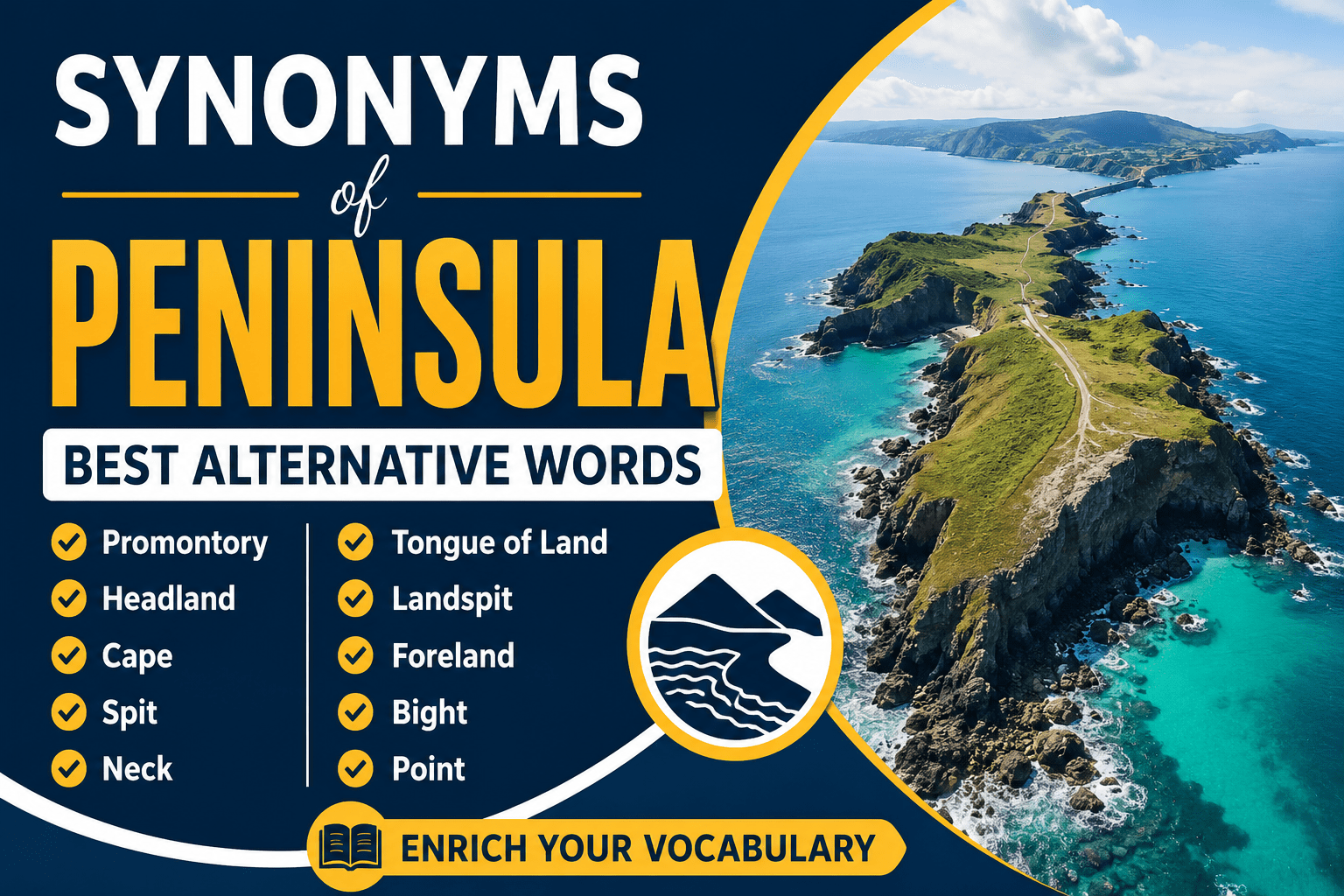
If you are looking for a synonym for peninsula, the closest choices are cape, headland, point, promontory, and arm. However, these words are not interchangeable in every sentence. A peninsula is a specific type of landform: land that extends into water while remaining connected to a larger landmass. Some alternatives, such as headland and promontory, emphasize a projecting piece of land, while spit describes a much narrower coastal feature. Choosing the right word therefore depends on the landform’s shape, size, and geographical context.
Quick Answer
The closest commonly used alternatives to peninsula are cape, headland, point, promontory, and arm. Cape and headland are especially useful for coastal geography, while point is a broader and often less technical term. Promontory emphasizes elevated or projecting land. Spit is related but more specific and should not normally be treated as a complete synonym.
What Does “Peninsula” Mean?
Peninsula is a countable noun referring to a piece of land that extends into a body of water while remaining connected to a larger landmass.
Cambridge defines it as a long piece of land projecting from a larger area into the sea or a lake, while Merriam-Webster describes it as land nearly surrounded by water and connected to a larger body by an isthmus; Merriam-Webster also notes that a peninsula can jut into water without a clearly defined isthmus.
Example:
The town is located on a narrow peninsula between two bays.
The plural is peninsulas.
Pronunciation
- US: /pəˈnɪn.sə.lə/
- UK: /pəˈnɪn.sjə.lə/
The pronunciation differs slightly between American and British English.
Etymology
Peninsula comes from Latin paeninsula, formed from paene (“almost”) and insula (“island”). The underlying idea is therefore an “almost island”—land surrounded by water on most sides but still attached to a larger landmass.
The Closest Synonyms of Peninsula
Not every word listed in a thesaurus is an exact replacement for peninsula. Merriam-Webster lists cape, point, and headland among its principal synonyms, while its broader thesaurus also includes arm, promontory, spit, ness, breakwater, foreland, and jetty.
The important distinction is that several of these are contextual alternatives or related coastal landforms, rather than perfect synonyms.
| Word | Relationship | Strength / Scope | Formality | Best Context |
|---|---|---|---|---|
| Cape | Near synonym | Specific projecting coastal land | Neutral | Coastal geography, place names |
| Headland | Near synonym | Projecting land, often elevated | Neutral | Geography, landscapes |
| Point | Contextual alternative | Broad, often smaller projection | Neutral | Coastal descriptions, place names |
| Promontory | Near synonym | Projecting, often high or steep land | Formal | Geography, descriptive writing |
| Arm | Contextual alternative | A projecting extension of land | Neutral | Physical geography |
| Spit | Related landform | Narrow, elongated coastal deposit | Technical/neutral | Coastal geography |
| Ness | Regional synonym/alternative | Promontory or headland | Regional/literary | British place names and geography |
| Foreland | Near/related term | Land projecting toward or into water | Formal | Geography |
| Jetty | Related, not true synonym | Structure extending into water | Neutral | Coastal engineering |
| Breakwater | Related, not true synonym | Protective structure in water | Technical | Coastal engineering |
1. Cape
Cape is one of the closest alternatives to peninsula, particularly when referring to a prominent piece of land projecting into a sea or other large body of water.
The ship passed the cape before entering the bay.
However, cape and peninsula are not always interchangeable. A cape is generally understood as a projecting coastal feature, often relatively prominent or named as a geographical feature. A peninsula can be much larger and can contain towns, cities, mountains, forests, or entire regions.
Best choice: Use cape when the emphasis is on a prominent coastal projection rather than the whole landmass.
2. Headland
Headland refers to land that projects into a body of water. It is particularly common in geographical and coastal descriptions.
The lighthouse stands on a rocky headland.
It is closely related to peninsula, but the words highlight different characteristics. Peninsula emphasizes the overall shape and connection of a landmass; headland emphasizes a projecting coastal feature, often one that rises above the surrounding coastline.
Best choice: Use headland for coastal geography, cliffs, elevated coastal land, and landscape descriptions.
3. Point
Point can describe a piece of land that projects into water, especially a relatively small or narrow coastal projection.
We walked to the eastern point to watch the sunset.
It is broader and less technically specific than peninsula. Many geographical names use point because it works naturally as a place-name element.
Best choice: Use point when describing a smaller coastal projection or a named geographical feature.
4. Promontory
Promontory is a more formal geographical term for a high or projecting piece of land, particularly one extending into a body of water.
The ancient fort was built on a rocky promontory overlooking the sea.
It often carries a stronger suggestion of elevation, steepness, or prominence than peninsula.
Best choice: Use promontory in formal geographical, historical, academic, or literary writing when the projecting land is prominent or elevated.
5. Arm
Arm can describe a long, narrow projection of land extending into water or a larger geographical area.
A narrow arm of land separates the two inlets.
This word is less interchangeable with peninsula than cape or headland. It works especially well when the landform is being described as an extension or branch of a larger landmass.
Best choice: Use arm when you want to emphasize the shape of an elongated extension.
Context-Specific and Related Alternatives
Some words appear in synonym lists for peninsula but require caution.
Spit
A spit is a narrow, elongated feature of land projecting into water, usually formed through the deposition of sediment.
A sandy spit stretches across the entrance to the lagoon.
A spit is therefore not a general synonym for peninsula. Its geological formation and typically narrow shape make it a more specific term.
Use it when: the feature is a narrow coastal deposit, particularly a sandy or gravelly one.
Ness
Ness is a regional term for a promontory or headland. It occurs particularly in British geographical names.
The village lies near a rocky ness on the northern coast.
It is not a normal everyday replacement for peninsula in international English.
Use it when: discussing British geography, historical place names, or regional vocabulary.
Foreland
Foreland can refer to land projecting toward or into the sea and is associated with geographical descriptions of coastal projections.
The cliffs form a prominent foreland along the northern coast.
It is more specialized and formal than peninsula.
Use it when: writing technical or geographical descriptions where the distinction between coastal landforms matters.
Jetty and Breakwater: Related, but Not Synonyms
A jetty and a breakwater may appear in broad thesaurus lists alongside peninsula, but they should not normally be used as synonyms.
A jetty is a structure built out into water, often for boats, access, or coastal management.
A breakwater is a structure designed to protect a shore or harbor from waves.
The fishing boats were moored beside the jetty.
The breakwater protected the harbor from strong waves.
These are structures, not natural landforms equivalent to a peninsula.
Peninsula Synonyms by Context
For general geography
Use:
- peninsula
- headland
- cape
- promontory
These are the most useful choices when discussing physical geography.
For coastal descriptions
Use:
- headland
- cape
- point
- promontory
These words are particularly natural when describing a projecting section of coastline.
For a narrow coastal projection
Use:
- point
- spit
- headland
But choose spit only when the physical characteristics justify it.
For formal or academic writing
Promontory, headland, and foreland can provide more specialized alternatives, depending on the exact geographical feature.
For literary or descriptive writing
Headland, promontory, cape, and sometimes point can create a more vivid description.
The old lighthouse stood above the windswept headland.
Which Word Should I Use?
A simple rule can make the choice easier:
Use peninsula when:
You mean a substantial area of land surrounded by water on most sides but connected to a larger landmass.
The Italian Peninsula extends into the Mediterranean.
Use cape when:
You mean a prominent coastal projection.
The ship sailed around the cape.
Use headland when:
You want to emphasize projecting coastal land, especially elevated land.
Waves crashed against the rocky headland.
Use point when:
You mean a smaller or more general projection of land.
We followed the trail to the point.
Use promontory when:
You want a formal term emphasizing a prominent or elevated projection.
The castle occupied a rocky promontory.
Use spit when:
The feature is a narrow, elongated coastal deposit.
A sandy spit separates the lagoon from the open sea.
This distinction is more useful than simply memorizing a long synonym list.
Peninsula vs. Cape
Peninsula and cape overlap, but they are not identical.
| Word | Main idea | Typical emphasis |
| Peninsula | Land extending into water while remaining connected to a larger landmass | Overall landform |
| Cape | A prominent projection of land into water | Coastal projection |
For example, a large peninsula can contain several smaller capes.
Example:
The peninsula has several rocky capes along its western coast.
That sentence would lose its intended geographical distinction if cape and peninsula were treated as exact equivalents.
Peninsula vs. Headland
Both terms describe projecting land, but headland generally focuses on the coastal projection itself, while peninsula identifies the broader landform.
The peninsula contains several villages and a forested headland.
Here, peninsula refers to the larger area, while headland refers to one projecting coastal section within it.
Peninsula vs. Promontory
A promontory usually suggests a prominent, elevated, or steep projection of land.
The peninsula narrowed toward a rocky promontory.
The word is therefore useful when topography matters.
For straightforward geographical descriptions, peninsula is usually the better choice when the entire landform is meant.
Peninsula vs. Spit
These are substantially different.
A peninsula is a broad category of landform defined primarily by its connection to a larger landmass and its being surrounded by water on most sides.
A spit is a narrow coastal feature, commonly formed by sediment deposition.
The peninsula supported a large town.
A sandy spit extended across the mouth of the bay.
Calling every spit a peninsula would therefore be geographically imprecise.
Common Mistakes
1. Treating every related coastal term as an exact synonym
Words such as cape, point, and headland overlap with peninsula, but their meanings are not identical.
Better: Choose the term that matches the physical feature you are describing.
2. Using “peninsular” as a noun synonym
Peninsular is normally an adjective meaning “of, relating to, or resembling a peninsula.” It can also function as a noun in specialized usage for an inhabitant of a peninsula.
The region has a distinctive peninsular climate.
Not:
We visited a peninsular.
when you simply mean peninsula.
3. Using “spit” for any peninsula
A spit is a particular kind of narrow coastal landform. It should not replace peninsula unless the physical description fits.
4. Assuming “point” always means peninsula
Point is much broader. It can refer to various projecting geographical features and is not necessarily a substantial landmass.
Natural Collocations with “Peninsula”
Some common combinations include:
- a narrow peninsula
- a rocky peninsula
- a coastal peninsula
- a remote peninsula
- a mountainous peninsula
- a forested peninsula
- a small peninsula
- a long peninsula
- the tip of the peninsula
- the northern peninsula
- the western peninsula
- on a peninsula
- across the peninsula
- along the peninsula
Examples
The resort occupies a narrow peninsula between two bays.
The northern part of the peninsula is covered by dense forest.
A road runs along the western side of the peninsula.
Real-World Usage Examples
Geography
The peninsula extends southward into the Mediterranean Sea.
Travel Writing
We spent the afternoon exploring the rocky headlands along the peninsula.
Academic Writing
The peninsula’s geography influenced patterns of settlement and trade.
Descriptive Writing
Beyond the village, the land narrowed into a windswept promontory.
Coastal Geography
A long sandy spit formed across the entrance to the bay.
These examples demonstrate why choosing a contextual alternative is often better than mechanically replacing peninsula with another word.
Antonyms and Contrasting Landforms
There is no single perfect antonym for peninsula, because it names a geographical form rather than a quality that naturally has an opposite.
However, useful contrasting geographical terms include:
- island — land completely surrounded by water
- mainland — the principal continuous landmass of a region
- inland — away from the coast or interior rather than projecting into water
An island is especially useful for comparison because a peninsula is connected to a larger landmass, whereas an island is separated from it by water.
FAQ
What is another word for peninsula?
Common alternatives include cape, headland, point, promontory, and arm. These are not always exact synonyms, so the best choice depends on the size, shape, elevation, and geographical context of the landform.
What is the closest synonym for peninsula?
Cape and headland are among the closest common alternatives, particularly for coastal geography. Promontory is also close but often emphasizes a prominent or elevated projection.
Is “cape” the same as “peninsula”?
No. A cape is a projecting coastal feature, whereas a peninsula is a larger landform connected to a larger landmass and surrounded by water on most sides. They overlap but are not interchangeable in every context.
Is “headland” a synonym for peninsula?
It can function as a near synonym in some geographical contexts, but it is not an exact substitute. Headland emphasizes a projecting section of coast, often elevated above the surrounding shoreline.
Is “promontory” another word for peninsula?
It can be a contextual alternative, but not a perfect synonym. Promontory usually emphasizes a prominent or elevated projection of land.
Is “spit” a synonym for peninsula?
Not generally. A spit is a much narrower coastal landform, commonly formed through sediment deposition. It is better described as a related geographical term than as a universal synonym.
What is a formal synonym for peninsula?
Promontory and foreland can work in formal geographical contexts, but they do not have exactly the same meaning. For most formal writing, simply using peninsula is often the clearest choice.
What is the opposite of a peninsula?
There is no exact lexical opposite. Island provides a useful geographical contrast because an island is surrounded by water, whereas a peninsula remains connected to a larger landmass.
Conclusion
The best alternatives to peninsula are cape, headland, point, promontory, and, in some contexts, arm. But these words describe different aspects or types of projecting land. Spit, ness, foreland, jetty, and breakwater should be treated more carefully because they refer to narrower geographical or structural concepts rather than being universal synonyms.
For general writing, peninsula remains the clearest and most precise choice. When the exact physical feature matters, choose the more specific term.

Emily Johnson is a linguistics graduate and vocabulary specialist. She writes detailed synonym explanations and helps readers understand subtle differences between words, improving both writing and speaking skills. Synonyms help express ideas more clearly and precisely in English.