The best synonym for retention depends on what you mean by the word. In the sense of continuing to keep something, useful alternatives include keeping, holding, preservation, maintenance, and safekeeping. When retention refers to remembering information, memory, recall, recollection, and remembrance are more natural. In business, phrases such as employee retention and customer retention usually need context-specific alternatives rather than simple word swaps.
Quick Answer: What Are the Best Synonyms for Retention?
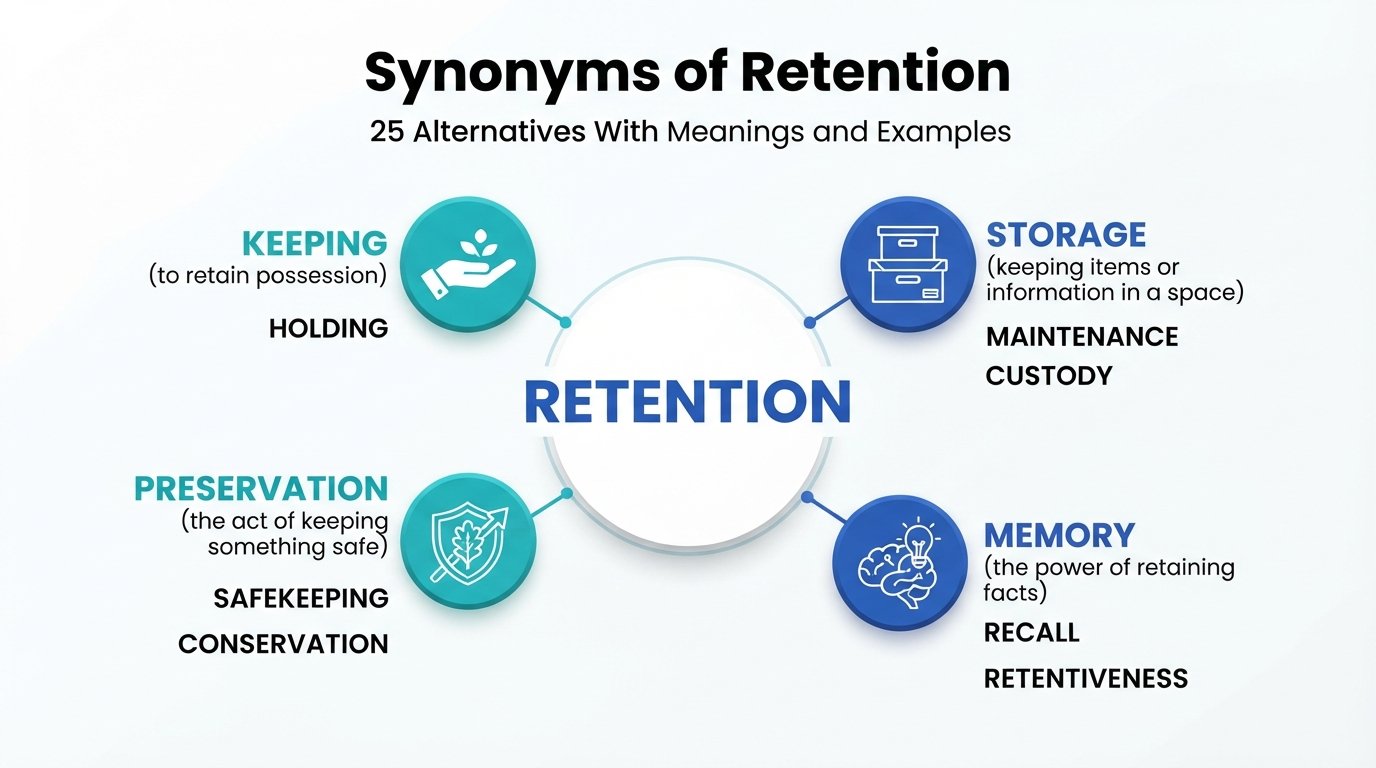
Some of the most useful synonyms and contextual alternatives for retention are:
keeping, holding, preservation, maintenance, storage, safekeeping, custody, withholding, conservation, memory, recall, recollection, remembrance, remembering, retentiveness, retentivity, continuation, possession, occupancy, tenure, detention, confinement, restraint, maintenance, and storage.
However, these words are not interchangeable in every sentence. Memory works when retention means the ability to remember, while preservation emphasizes keeping something in its existing condition. Holding and keeping are broader everyday alternatives, whereas retentiveness and retentivity are more specialized.
What Does “Retention” Mean?
Retention is a noun meaning the continued keeping, use, existence, or possession of something or someone. It can also describe the ability to keep information in the mind or a substance such as water or heat within something. Cambridge lists retention as a formal noun and gives examples involving continued possession, water retention, employee retention, and customer retention.
US and UK pronunciation: /rɪˈten.ʃən/
Common examples include:
- information retention — keeping information in memory
- employee retention — keeping employees within an organization
- customer retention — keeping customers over time
- water retention — the holding of water
- data retention — continuing to keep data
- retention period — the period during which something is kept
Because these uses differ, the right synonym depends heavily on the sentence.
25 Synonyms and Contextual Alternatives for Retention
| Word | Relationship | Meaning | Best Context |
|---|---|---|---|
| Keeping | Direct/contextual | Continuing to have or hold something | General writing |
| Holding | Direct/contextual | Having or maintaining possession | Property, control, possession |
| Preservation | Near synonym | Keeping something in its existing condition | Records, culture, objects |
| Maintenance | Near synonym | Keeping something in working or existing condition | Systems, standards, facilities |
| Storage | Contextual | Keeping something for future use | Data, files, goods |
| Safekeeping | Contextual | Keeping something secure | Documents, valuables |
| Custody | Contextual | Control or care of something or someone | Legal and official contexts |
| Withholding | Near synonym | Keeping something back or refusing to release it | Information, payment, resources |
| Conservation | Near synonym | Careful preservation or protection | Energy, resources, nature |
| Possession | Contextual | The state of having or owning something | Property and ownership |
| Continuation | Near synonym | The state of continuing | Use, existence, activity |
| Memory | Contextual | Ability to retain and recall information | Learning and cognition |
| Recall | Contextual | Ability to bring stored information back to mind | Learning, memory |
| Recollection | Contextual | An act or instance of remembering | Personal memories |
| Remembrance | Contextual | The act or state of remembering | People, events, formal writing |
| Remembering | Contextual | The process of retaining something in memory | Education, everyday use |
| Retentiveness | Close/specialized | Capacity to retain information or substances | Memory, technical contexts |
| Retentivity | Close/specialized | Capacity to retain, especially information or moisture | Technical and scientific contexts |
| Tenure | Contextual | Period of holding a position or office | Employment, institutions |
| Occupancy | Contextual | State of occupying or using a place | Property and buildings |
| Detention | Related/contextual | Holding someone in custody | Legal, institutional contexts |
| Confinement | Related/contextual | Keeping someone or something within limits | Physical or institutional contexts |
| Restraint | Related/contextual | Limiting or holding something back | Behavior, movement, action |
| Arrest | Related/contextual | Stopping or preventing movement/progress | Processes, movement, technical uses |
| Maintenance | Near synonym | Continued preservation or upkeep | Systems, conditions, standards |
Not every entry above is a universal replacement for retention. Some are contextual alternatives or words that overlap with one particular sense of the target word.
The Closest Everyday Synonyms for Retention
1. Keeping
Keeping is one of the simplest alternatives when retention means continuing to have or hold something.
Example:
- The company focuses on the retention of experienced employees.
- The company focuses on keeping experienced employees.
The second sentence is less formal and often more conversational.
2. Holding
Holding emphasizes having something in your possession, control, or grasp.
Example:
- The long-term retention of the property was disputed.
- The long-term holding of the property was disputed.
However, holding can sound less natural than retention in some formal business contexts.
3. Preservation
Preservation focuses on protecting something from damage, loss, decay, or change.
Example:
The archive prioritizes the preservation of historical documents.
Retention simply says that something continues to be kept. Preservation adds the idea of protecting it.
4. Maintenance
Maintenance is useful when something is kept in a particular condition, state, or level.
Example:
The program supports the maintenance of high safety standards.
It is not normally a direct replacement for retention when discussing memory or keeping customers.
5. Storage
Storage is appropriate when something is kept somewhere for later use.
Example:
The company has strict policies for data storage.
However, storage describes where or how something is kept, while retention often emphasizes how long it continues to be kept.
Synonyms for Retention of Information and Memory
When retention means the ability to keep information in your mind, memory is usually the clearest alternative.
Cambridge’s thesaurus specifically groups retention in the mind with remembrance, memory, recall, remembering, recollection, and related terms.
Memory
Use memory when referring generally to the ability to retain and recall information.
Repetition can improve memory of new vocabulary.
Recall
Recall emphasizes bringing information back to mind.
Regular review improves the recall of unfamiliar terms.
The distinction is useful: retention concerns keeping information, while recall concerns retrieving it.
Recollection
Recollection usually refers to the act or ability to remember something from the past.
She had no recollection of the conversation.
It is therefore not a universal substitute for retention.
Remembrance
Remembrance often carries a formal or emotional sense of remembering a person, event, or experience.
The ceremony was held in remembrance of those who had died.
Retentiveness
Retentiveness refers to the ability to retain information or, in some contexts, substances.
The student’s retentiveness improved with regular practice.
This is more specialized than everyday memory.
Retentivity
Retentivity is another specialized noun describing the capacity to retain something, including information or moisture.
The material has excellent moisture retentivity.
For ordinary writing about learning, memory is usually more natural.
Synonyms for Employee and Customer Retention
In business writing, retention has a specialized meaning: keeping employees or customers instead of losing them.
Cambridge defines employee retention as the ability of a company to keep employees and customer retention as the fact of keeping customers for a period of time.
Employee retention
Possible contextual alternatives include:
- employee continuity
- staff retention
- employee loyalty
- keeping employees
- talent retention
These are not exact synonyms. For example, employee loyalty describes an employee’s commitment to an organization, whereas employee retention focuses on whether employees remain.
Example:
The company introduced flexible schedules to improve employee retention.
A natural paraphrase is:
The company introduced flexible schedules to keep employees.
Customer retention
Useful contextual alternatives include:
- customer loyalty
- customer continuity
- keeping customers
- client retention
- customer preservation — generally less natural
Customer loyalty and customer retention are closely related but not identical. Loyalty concerns customer preference or commitment; retention concerns customers continuing to remain with or buy from a company.
Retention vs. Preservation
These words overlap, but their emphasis differs.
| Retention | Preservation |
|---|---|
| Focuses on continuing to keep something | Focuses on protecting something from damage or change |
| Common in business, memory, data, and physical processes | Common in history, culture, documents, nature, and conservation |
| “Employee retention” | “Preservation of historic buildings” |
| “Data retention” | “Preservation of records” |
Use retention when the important idea is that something continues to be kept. Use preservation when protection or maintaining its original condition is central.
Retention vs. Maintenance
Retention means continuing to keep something. Maintenance means keeping something in a usable, functioning, or desired condition.
The company improved employee retention.
The company increased equipment maintenance.
Replacing one with the other would change the meaning.
Retention vs. Storage
These words frequently appear together, especially in technology.
Storage refers to keeping data or objects somewhere for access later.
Retention often emphasizes the continued keeping of that data or information over a period of time.
For example:
The company increased its data storage capacity.
This means it can hold more data.
The company changed its data retention policy.
This concerns how data is kept over time.
Retention vs. Memory
When discussing learning, retention and memory overlap, but they are not identical.
The course improved vocabulary retention.
This emphasizes the ability to keep learned information.
The student has an excellent memory.
This describes the broader mental ability to remember.
For most everyday writing about remembering, memory is more natural.
Common Mistakes When Choosing a Synonym for Retention
Mistake 1: Treating every related word as interchangeable
Words such as storage, memory, preservation, and maintenance overlap with particular senses of retention, but they do not replace it everywhere.
Mistake 2: Using “recall” for every memory context
Recall focuses on retrieving information. Retention focuses on keeping it available in memory.
Mistake 3: Using “loyalty” as a direct synonym for customer retention
Customer loyalty can contribute to retention, but the concepts are different.
Mistake 4: Using “preservation” for employee retention
❌ The company improved employee preservation.
✅ The company improved employee retention.
Preservation is normally about protecting or maintaining something, not keeping employees from leaving.
Mistake 5: Replacing “retention” when it is already the clearest word
A synonym is not automatically better. In professional writing, retention is often the most precise term in established expressions such as employee retention, customer retention, data retention, and retention rate.
Common Collocations With Retention
Some expressions are so established that replacing retention may make the sentence less natural.
Common examples include:
- employee retention
- customer retention
- data retention
- information retention
- memory retention
- water retention
- retention rate
- retention period
- retention policy
- long-term retention
- short-term retention
- knowledge retention
Cambridge specifically documents collocations such as employee retention, retention rate, and retention period.
Which Word Should You Use?
| If you mean… | Best choice |
|---|---|
| Keeping something generally | keeping |
| Having something in your possession | holding |
| Protecting something from damage or loss | preservation |
| Keeping something functioning or in condition | maintenance |
| Keeping something for later use | storage |
| Keeping something safe | safekeeping |
| Controlling something legally or officially | custody |
| Remembering information | memory |
| Bringing stored information back to mind | recall |
| Remembering a past event | recollection |
| Formal remembrance | remembrance |
| Retaining information or moisture | retentiveness / retentivity |
| Keeping employees | employee retention |
| Keeping customers | customer retention |
Antonyms of Retention
The opposite of retention depends on the sense being discussed.
For general keeping, possible opposites include:
- release
- loss
- disposal
- letting go
- surrender
When referring to memory, the opposite concept is often:
- forgetfulness
- forgetting
- loss of memory
In employee or customer retention contexts, the opposite concept may be:
- turnover
- customer loss
- departure
- attrition
The correct antonym should match the specific meaning rather than being selected from a generic list.
Frequently Asked Questions
What is the closest synonym for retention?
There is no single synonym that works in every context. Keeping and holding are close general alternatives when retention means continuing to have something. For memory, memory or recall may be more appropriate, while preservation works when the emphasis is on protecting something.
What is another word for retention of information?
Memory is the most natural general alternative when retention means the ability to remember information. Recall is related but emphasizes retrieving information rather than keeping it. Retentiveness and retentivity are more specialized terms.
What is a synonym for employee retention?
Contextual alternatives include keeping employees, staff retention, talent retention, and employee continuity. However, these are not exact equivalents. Employee retention specifically refers to an organization’s ability to keep employees rather than lose them to other employers.
What is another word for customer retention?
Depending on the sentence, alternatives include keeping customers, client retention, and customer loyalty. However, customer loyalty describes a customer’s commitment or preference, while customer retention focuses on the customer continuing to remain with the business.
Is “preservation” a synonym for retention?
Sometimes. Preservation is a useful alternative when retention means keeping something safe or maintaining it in its existing state. It is not a universal synonym, however. For example, employee retention cannot normally be replaced with employee preservation.
Is “storage” the same as retention?
Not exactly. Storage emphasizes where or how something is kept, while retention often emphasizes the continued keeping of something, especially over a period of time. This distinction is particularly important in data-management contexts.
What is the difference between retention and recall?
Retention is the ability to keep information in memory; recall is the ability to retrieve that information when needed. A learner can therefore have good retention but still experience difficulty with immediate recall.
What is the difference between retention and maintenance?
Retention means continuing to keep something, while maintenance means preserving something in a functioning, usable, or desired condition. For example, employee retention concerns keeping workers, whereas equipment maintenance concerns keeping equipment operational.
Conclusion
The best synonym for retention depends on its meaning. Use keeping or holding for general possession, preservation when protection is important, maintenance for continued condition, and storage for keeping something for later use. When retention refers to learning, memory, recall, and recollection become more relevant.
In business, established phrases such as employee retention, customer retention, retention rate, and retention period are often more natural than forced replacements. The most accurate vocabulary choice is therefore not simply the word that looks closest in a thesaurus—it is the word that preserves the intended meaning in the specific context.

Daniel Carter is a professional content strategist and language enthusiast. He focuses on semantic SEO, keyword research, and creating structured vocabulary content that ranks well on search engines while remaining user-friendly.