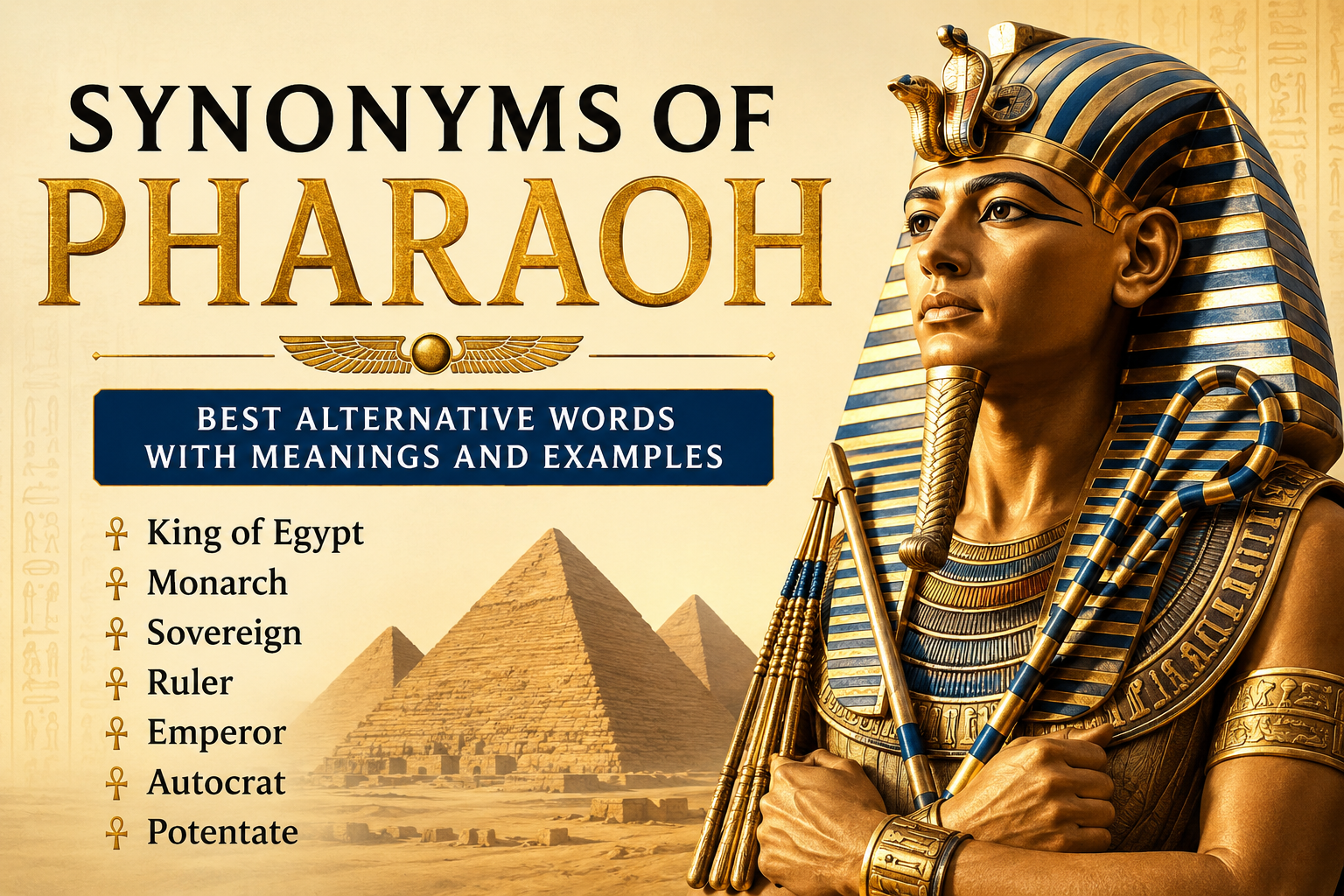
If you need a synonym for pharaoh, the best choice depends on what you mean. In historical writing, ruler, king, and monarch are the closest alternatives because a pharaoh was the title used for the kings of ancient Egypt. In figurative modern English, however, pharaoh can describe a powerful and oppressive ruler, making words such as tyrant, dictator, and despot more appropriate.
This guide explains the most useful alternatives, their differences, tone, and the contexts in which a native English speaker would naturally use them.
Quick Answer: What Are the Best Synonyms for Pharaoh?
The closest alternatives to pharaoh are ruler, king, monarch, sovereign, Egyptian king, Egyptian ruler, potentate, and dynast. For the figurative meaning of a cruel or authoritarian ruler, tyrant, dictator, despot, and autocrat can work. However, these words are not interchangeable in every sentence.
Best general replacement: ruler
Best historical replacement: king or Egyptian king
Best formal alternative: monarch or sovereign
Best for an oppressive ruler: tyrant, despot, or dictator
Core Synonyms for Pharaoh
| Word | Relationship | Meaning | Strength | Formality | Best Context |
|---|---|---|---|---|---|
| Ruler | Near synonym | A person who governs a country or territory | Neutral | Neutral | Historical writing |
| King | Contextual synonym | A male monarch | Neutral | Neutral | Ancient Egypt |
| Monarch | Near synonym | A sovereign ruler, usually hereditary | Neutral | Formal | Historical or academic writing |
| Sovereign | Near synonym | A supreme ruler or monarch | Strong | Formal | Historical/legal contexts |
| Egyptian king | Descriptive alternative | A king who ruled ancient Egypt | Neutral | Neutral | Historical explanations |
| Egyptian ruler | Descriptive alternative | A person who governed ancient Egypt | Neutral | Neutral | General historical writing |
| Potentate | Contextual alternative | A powerful ruler, especially an absolute one | Strong | Formal/literary | Historical prose |
| Dynast | Related/near synonym | A ruler belonging to a ruling dynasty | Neutral | Formal | Historical discussion |
| Tyrant | Figurative synonym | A cruel or oppressive ruler | Very strong | Neutral | Figurative criticism |
| Dictator | Figurative synonym | A ruler with unchecked or authoritarian power | Strong | Neutral | Political comparison |
| Despot | Figurative synonym | An absolute ruler who exercises power harshly | Very strong | Formal | Critical historical writing |
| Autocrat | Figurative/near synonym | A ruler who holds extensive personal power | Strong | Formal | Political or historical writing |
Not every word above is a direct dictionary replacement. Ruler and king are the most useful alternatives for the historical sense, while tyrant, dictator, and despot belong mainly to the figurative sense. Merriam-Webster specifically identifies dictator and tyrant as synonyms for the figurative meaning of pharaoh.
What Does Pharaoh Mean?
Pharaoh is a noun referring to the ruler or king of ancient Egypt. Cambridge defines it as the title of a king of ancient Egypt, while Oxford describes it as a political leader of ancient Egypt.
The word also has a historical linguistic background. Its origin ultimately goes back through Greek, Hebrew, and earlier forms to the Egyptian expression pr-ꜥꜣ, meaning “great house.” Cambridge University Press notes that Pharaoh was a title for the king of Egypt attested from the New Kingdom onward.
Part of speech: noun
US pronunciation: /ˈfer.oʊ/
UK pronunciation: /ˈfeə.rəʊ/
Example
The pharaoh ordered the construction of a magnificent temple.
A natural replacement would be:
The Egyptian king ordered the construction of a magnificent temple.
1. Ruler
Ruler is probably the safest general synonym for pharaoh.
A ruler is someone who governs a country, kingdom, territory, or people. It is broader than pharaoh because rulers exist in many historical and political systems.
Example
The pharaoh was one of the most powerful rulers of ancient Egypt.
Best for: historical writing, general explanations, educational content.
Why choose it?
Use ruler when you want to emphasize political authority rather than the specific Egyptian title.
2. King
King is one of the closest contextual alternatives because pharaohs were the kings of ancient Egypt. Cambridge directly defines pharaoh as the title of a king of ancient Egypt.
Example
Tutankhamun was a famous pharaoh of ancient Egypt.
Alternative:
Tutankhamun was a famous king of ancient Egypt.
However, king is broader. A king can rule any kingdom, whereas pharaoh specifically evokes ancient Egypt.
Best for: historical writing, children’s education, general readers.
3. Monarch
Monarch is a more formal and broader word for a king or queen.
Example
The pharaoh was regarded as the supreme monarch of Egypt.
You can also write:
The ancient Egyptian monarch commissioned the monument.
Difference: Monarch emphasizes the person’s position within a monarchy, while pharaoh identifies the distinctive title associated with ancient Egyptian rulers.
Best for: academic writing, history essays, formal prose.
4. Sovereign
Sovereign emphasizes supreme authority over a state or kingdom.
Example
The pharaoh was the sovereign authority of ancient Egypt.
Unlike king, sovereign focuses more strongly on supreme political authority than gender or royal title.
Best for: formal historical writing and discussions of political power.
5. Egyptian King
Egyptian king is not a single-word synonym, but it is one of the clearest descriptive alternatives to pharaoh.
Example
The pharaoh built an elaborate tomb.
Alternative:
The Egyptian king built an elaborate tomb.
This phrase is especially useful when writing for readers who may not know the meaning of pharaoh.
Best for: educational articles, historical explanations, and simplified writing.
6. Egyptian Ruler
Egyptian ruler is another highly useful descriptive alternative.
Example
The pharaoh controlled a vast kingdom.
Alternative:
The Egyptian ruler controlled a vast kingdom.
It is slightly broader than Egyptian king because it focuses on governing authority rather than the royal title.
7. Potentate
Potentate is a formal word for a powerful ruler, especially one with considerable or absolute authority.
Example
The ancient potentate commissioned a vast ceremonial complex.
It can describe a pharaoh, but it is not specific to Egypt.
Register: formal or literary
Best for: historical prose where you want to emphasize power and authority.
8. Dynast
A dynast is a ruler who belongs to a particular ruling dynasty.
Example
The pharaoh was a powerful dynast who expanded Egypt’s influence.
This is useful in historical discussions, but it should not replace pharaoh in every sentence.
Important distinction: A dynast is defined partly by membership in a ruling dynasty, whereas pharaoh identifies an Egyptian ruler or royal title.
9. Tyrant
Tyrant is appropriate when pharaoh is being used negatively to describe a cruel or oppressive ruler.
Example
The novel portrays the pharaoh as a ruthless tyrant.
You should not automatically replace every historical use of pharaoh with tyrant. The word adds a strong negative judgment.
Merriam-Webster recognizes this figurative sense of pharaoh: a person who uses authority in a cruel, unjust, or harmful way.
Tone: strongly negative
10. Dictator
Dictator describes a ruler who exercises extensive or unchecked political power, especially without meaningful democratic limitations.
Example
The fictional pharaoh behaves like a dictator.
This is normally a figurative or comparative replacement rather than a literal historical synonym.
Better:
The author presents the pharaoh as a ruthless dictator.
Less accurate:
Every pharaoh was a dictator.
The second sentence makes a broader historical claim that the word itself does not establish.
Merriam-Webster’s thesaurus specifically lists dictator as a synonym for the figurative sense of pharaoh.
11. Despot
A despot is a ruler who exercises power in an oppressive or arbitrary way.
Example:
The story depicts the pharaoh as a cruel despot.
Despot is stronger and more critical than ruler or monarch.
Best for: literary criticism, historical commentary, and descriptions of oppressive leadership.
12. Autocrat
An autocrat is a ruler who possesses extensive personal power and makes decisions with little or no meaningful limitation.
Example:
The fictional pharaoh is portrayed as an autocrat who refuses to share power.
Like dictator and despot, this word should not be used as a neutral replacement for every historical occurrence of pharaoh.
Register: formal
Best for: political, academic, and analytical writing.
Which Word Should You Use Instead of Pharaoh?
The best alternative depends on your sentence.
Choose “ruler” when:
You want a neutral word for someone who governs.
The pharaoh was a powerful ruler.
Choose “king” when:
You are emphasizing the royal status of the ancient Egyptian leader.
The pharaoh was the king of ancient Egypt.
Choose “monarch” when:
You want a formal historical term connected with monarchy.
The Egyptian monarch ordered the construction of the temple.
Choose “sovereign” when:
You want to emphasize supreme political authority.
The pharaoh served as the kingdom’s sovereign.
Choose “Egyptian king” when:
You want the clearest plain-English description.
The Egyptian king commissioned the monument.
Choose “tyrant” when:
The ruler is being described as cruel or oppressive.
The fictional pharaoh was portrayed as a tyrant.
Choose “dictator” when:
You are emphasizing authoritarian or unchecked political power.
The writer compares the pharaoh with a dictator.
Choose “despot” when:
You want a strongly negative and formal description of oppressive rule.
The story presents him as a ruthless despot.
Pharaoh vs. King
| Pharaoh | King |
|---|---|
| Specifically associated with ancient Egypt | Used for kings in many cultures |
| A historical Egyptian title/term | A general royal title |
| Strong Egyptian historical association | Much broader |
| Often used when discussing ancient Egypt | Used across history and geography |
Example:
Tutankhamun was a pharaoh.
Tutankhamun was a king of ancient Egypt.
Both sentences are natural, but pharaoh provides more specific historical information.
Pharaoh vs. Ruler
Pharaoh and ruler overlap strongly, but they are not identical.
A ruler can govern any country, kingdom, empire, territory, or political system. Pharaoh specifically evokes ancient Egyptian rulership.
The ruler of the kingdom ordered the army forward.
The pharaoh ordered the army forward.
The first sentence is geographically and historically neutral. The second immediately suggests ancient Egypt.
Pharaoh vs. Monarch
A monarch is a king or queen who rules a monarchy. Pharaoh is much more culturally and historically specific.
The pharaoh was an ancient Egyptian monarch.
Here, monarch describes the political role, while pharaoh identifies the distinctive Egyptian title.
Pharaoh vs. Tyrant
These words should not normally be treated as interchangeable.
Pharaoh can be neutral:
The pharaoh ruled Egypt for many years.
Tyrant is inherently negative:
The tyrant ruled through fear.
If a historical source calls a pharaoh a tyrant, the word is making a judgment about the ruler’s behavior rather than simply identifying the ruler’s position.
Common Mistakes With Pharaoh Synonyms
1. Treating every ruler as a pharaoh
Not every king or ruler in history was a pharaoh.
Better: Reserve pharaoh for ancient Egyptian rulers or contexts specifically invoking that concept.
2. Using “tyrant” as a neutral synonym
Tyrant expresses condemnation.
Incorrect approach:
The tyrant was the official title of the Egyptian king.
Better:
The Egyptian king was portrayed as a tyrant.
3. Assuming “dictator” means exactly the same thing
Dictator focuses on authoritarian political power. It does not simply mean “ancient Egyptian king.”
4. Using “emperor” automatically
Emperor is not a general synonym for pharaoh. A pharaoh is conventionally described as the king/ruler of ancient Egypt, not simply as an emperor.
5. Using “Caesar” as a direct replacement
Caesar has specific Roman historical associations. It should not be treated as a normal synonym for pharaoh.
Broad thesaurus lists can contain many such historically or contextually related terms, which is why a contextual approach is more useful than copying a long synonym list. Cambridge, for example, groups words related to pharaoh under broader categories such as ruler and monarch rather than implying that every listed term is interchangeable.
Related Words for Pharaoh
These words are related to pharaoh but should not automatically be presented as synonyms:
- ancient Egypt
- Egyptian dynasty
- monarch
- kingdom
- royal
- throne
- dynasty
- hieroglyphics
- pyramid
- tomb
- mummy
- Nile
- Egyptian ruler
- Egyptian king
- Pharaonic
These terms can strengthen topical understanding, but they describe the historical world surrounding a pharaoh rather than necessarily replacing the word.
Frequently Asked Questions
What is the closest synonym for pharaoh?
Ruler is probably the closest broad synonym because both words can refer to someone who governs a country or territory. In a specifically ancient Egyptian context, king, Egyptian king, or Egyptian ruler may be even more natural depending on the sentence.
What is another word for an Egyptian king?
The clearest alternatives are pharaoh, Egyptian ruler, Egyptian monarch, and ancient Egyptian ruler. Pharaoh is the most specific traditional term, while the other phrases explain the role more directly.
Is king a synonym for pharaoh?
King is a contextual synonym, not a perfect replacement in every situation. A pharaoh was the king or ruler of ancient Egypt, but king can refer to monarchs from many different cultures and historical periods.
Is ruler a synonym for pharaoh?
Yes, ruler is a close general synonym. However, ruler is much broader. A ruler may govern any state or territory, while pharaoh specifically refers to ancient Egyptian rulership.
Is monarch a synonym for pharaoh?
Monarch is a near synonym. It identifies a person who rules a monarchy, whereas pharaoh carries a specific ancient Egyptian historical meaning.
Is tyrant a synonym for pharaoh?
Only in the figurative or negative sense. A tyrant is a cruel or oppressive ruler, so the word can describe a pharaoh portrayed as cruel, but it cannot neutrally replace pharaoh in every historical sentence.
What is the plural of pharaoh?
The plural is pharaohs.
The ancient pharaohs ruled Egypt for thousands of years.
How do you pronounce pharaoh?
In American English, pharaoh is commonly pronounced /ˈfer.oʊ/. In British English, it is commonly pronounced /ˈfeə.rəʊ/.
Conclusion
The best synonym for pharaoh depends on the meaning and context. For neutral historical writing, ruler, king, Egyptian king, and Egyptian ruler are the most useful choices. Monarch, sovereign, and potentate provide more formal alternatives, while tyrant, dictator, despot, and autocrat work mainly when the pharaoh is being described as oppressive or authoritarian.
The key is not to choose the word that merely looks similar in a thesaurus. Choose the word that preserves the original meaning, tone, historical context, and level of specificity.

Michael Thompson is an English language specialist and experienced editor who focuses on vocabulary development and clear communication. He creates high-quality synonym guides, word comparisons, and writing tips to help students and professionals express their ideas more effectively. His work combines linguistic knowledge with practical SEO strategies to make learning both useful and engaging.