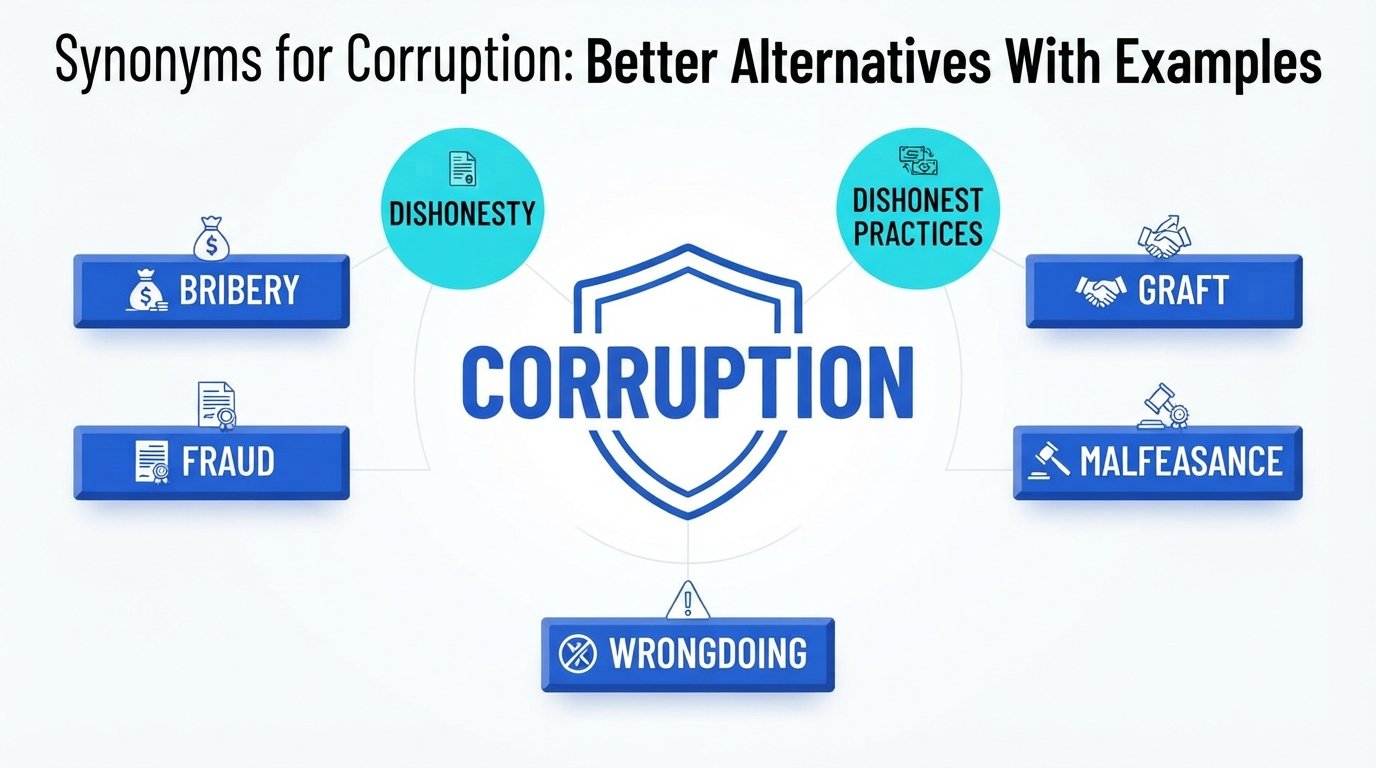
Finding the right synonym for corruption depends on what kind of corruption you mean. Dishonesty is a broad alternative, while bribery, graft, and fraud describe more specific forms of corrupt conduct. Malfeasance emphasizes wrongdoing by someone entrusted with a duty, and shady dealings is a more informal expression.
This guide explains the most useful synonyms for corruption, shows how they differ, and gives natural examples so you can choose the right word for your context.
Quick Answer: What Are the Best Synonyms for Corruption?
Useful alternatives for corruption include dishonesty, dishonest practices, bribery, graft, fraud, malfeasance, wrongdoing, misconduct, shady dealings, venality, and crookedness. However, these words are not interchangeable in every sentence. For example, bribery refers specifically to giving or receiving something improperly to influence behavior, while dishonesty has a much broader meaning.
Synonyms for Corruption at a Glance
| Word or phrase | Relationship | Main meaning | Best context |
|---|---|---|---|
| Dishonesty | Near synonym | Lack of honesty or integrity | General writing |
| Dishonest practices | Near synonym | Unethical or improper practices | Organizations, institutions |
| Bribery | Specific form | Improper influence through bribes | Government, business, law |
| Graft | Specific form / close alternative | Corrupt gain, especially through public office | Politics, public administration |
| Fraud | Related, sometimes overlapping | Deception for unlawful or unfair gain | Finance, business, law |
| Malfeasance | Near synonym | Wrongdoing by someone in a position of responsibility | Formal, legal, professional writing |
| Wrongdoing | Broad alternative | Improper or unethical conduct | General and formal writing |
| Misconduct | Contextual alternative | Improper behavior, especially in an official role | Workplace, institutions |
| Shady dealings | Informal alternative | Suspicious or dishonest transactions | Informal writing |
| Crookedness | Informal near synonym | Dishonest or corrupt behavior | Informal contexts |
| Venality | Specific near synonym | Willingness to act dishonestly for money | Formal/literary writing |
| Nepotism | Related term | Favoring relatives unfairly | Employment, government |
| Cronyism | Related term | Favoring friends or associates | Politics, business |
| Embezzlement | Specific form | Misappropriating entrusted money or property | Finance, law |
| Extortion | Related but distinct | Obtaining something through coercion or threats | Criminal/legal contexts |
The distinction matters because major dictionaries also separate broad corruption from specific practices. Oxford defines corruption in its main sense as dishonest or illegal behavior, especially involving people in authority, while Cambridge similarly emphasizes illegal, bad, or dishonest behavior, particularly among people in positions of power.
What Does “Corruption” Mean?
Corruption is a noun referring, in its main sense, to dishonest or illegal behavior, particularly by people in positions of power or authority. It commonly involves abusing a position, responsibility, or public trust for improper benefit.
For example:
The investigation uncovered widespread corruption within the department.
The word can cover many different practices. Bribery is one form, but corruption is broader than bribery alone.
Corruption also has other meanings. Cambridge lists a linguistic sense in which a word has changed from its original form and a computing sense referring to information that has become damaged or unusable.
The synonyms in this article primarily address the dishonest or unethical behavior sense.
1. Dishonesty
Dishonesty is one of the broadest alternatives to corruption. It refers to a lack of honesty and can include lying, deception, or other behavior that violates accepted standards of honesty.
Example:
The audit revealed serious dishonesty among several employees.
Use dishonesty when you want to emphasize a person’s lack of honesty rather than abuse of official power.
Best for: general writing, personal behavior, business, and professional contexts.
2. Dishonest Practices
Dishonest practices is a useful phrase when corruption involves repeated or organized improper behavior.
Example:
The company was criticized for its dishonest practices.
This expression works particularly well when discussing an organization rather than one isolated act.
3. Bribery
Bribery is closely associated with corruption but is more specific. It involves offering, giving, receiving, or soliciting something of value to improperly influence someone’s actions.
Example:
The official was investigated for bribery.
Do not use bribery whenever you mean corruption generally. A corrupt system can involve favoritism, misuse of authority, fraud, or other practices without a specific bribe.
Best for: government, business, law, and official investigations.
4. Graft
Graft is a strong alternative when corruption involves obtaining money or other benefits dishonestly through one’s position, especially public office.
Example:
The investigation focused on allegations of political graft.
Cambridge includes graft among the synonyms associated with the dishonest-behavior sense of corruption.
It is especially natural in discussions of political or public-sector corruption.
5. Fraud
Fraud involves deception or dishonest representation used to obtain an unlawful or unfair advantage.
Example:
The investigation uncovered evidence of financial fraud.
Fraud overlaps with corruption but is not a universal synonym. Someone can commit fraud without abusing public authority, and corruption does not necessarily involve deceptive financial transactions.
Use “fraud” when deception for gain is the central idea.
6. Malfeasance
Malfeasance is a formal term for wrongdoing, particularly improper or unlawful conduct by someone entrusted with a responsibility.
Example:
The report documented several instances of official malfeasance.
It is particularly suitable for legal, governmental, administrative, and professional writing.
Compared with corruption, malfeasance puts more emphasis on wrongful conduct or violation of duty.
7. Wrongdoing
Wrongdoing is a broad and relatively neutral alternative for unethical or improper conduct.
Example:
The committee was established to investigate alleged wrongdoing.
It is useful when you want to describe misconduct without specifying exactly what form it took.
For instance, an investigation may uncover wrongdoing before the precise conduct has been established.
8. Misconduct
Misconduct refers to improper behavior, especially by someone acting in a professional, official, or institutional capacity.
Example:
The agency investigated allegations of professional misconduct.
It is often a better choice than corruption when the issue concerns inappropriate conduct but there is no clear evidence of corrupt financial or political activity.
9. Shady Dealings
Shady dealings is an informal expression for suspicious, questionable, or apparently dishonest transactions or activities.
Example:
The newspaper reported several allegations involving the company’s shady dealings.
This phrase works well in conversational writing and journalism, but it is less precise and less formal than malfeasance or corruption.
10. Crookedness
Crookedness is an informal word for dishonest or corrupt behavior.
Example:
The novel portrays a world of political crookedness and deception.
It can sound conversational or literary, so it is generally not the first choice for formal reports.
11. Venality
Venality is a formal word associated with willingness to act dishonestly, especially in exchange for money or personal gain.
Example:
The report criticized the official’s venality.
This word is less common in everyday American English, but it can be useful in formal or literary writing when the emphasis is on corruption motivated by personal gain.
12. Nepotism
Nepotism is not a full synonym for corruption. It is a specific practice involving unfair favoritism toward relatives, especially when making appointments or granting opportunities.
Example:
Critics accused the organization of nepotism after several relatives received senior positions.
Use nepotism when favoritism toward family members is the specific issue.
13. Cronyism
Cronyism is another related term rather than a complete synonym. It refers to unfairly favoring friends, associates, or political allies.
Example:
The appointment was criticized as an example of cronyism.
The key distinction is simple:
- Nepotism → favoritism toward relatives
- Cronyism → favoritism toward friends or associates
- Corruption → broader category that can include various abuses of power
14. Embezzlement
Embezzlement is a specific form of financial wrongdoing involving the wrongful taking or use of money or property that has been entrusted to someone.
Example:
The accountant was charged with embezzlement.
It should not replace corruption unless the specific conduct involves misappropriating entrusted assets.
15. Extortion
Extortion involves obtaining money, property, or another benefit through threats, coercion, or other forms of pressure.
Example:
The investigation focused on allegations of extortion.
Although extortion can occur alongside corruption, it has a different core meaning and should not normally be presented as a direct synonym.
Which Synonym Should You Use?
The best alternative depends on what you want to emphasize.
Use “dishonesty” when:
You mean a general lack of honesty or integrity.
The investigation revealed widespread dishonesty.
Use “bribery” when:
Money, gifts, or another benefit were used to influence someone’s actions improperly.
The official was accused of bribery.
Use “graft” when:
You are discussing corrupt financial gain connected especially with public office.
The inquiry examined allegations of graft.
Use “fraud” when:
Deception is central to the wrongdoing.
The company was investigated for fraud.
Use “malfeasance” when:
The emphasis is on serious wrongdoing by someone entrusted with a duty.
The report identified possible official malfeasance.
Use “misconduct” when:
You need a professional or institutional term for improper behavior.
The employee was dismissed for serious misconduct.
Use “wrongdoing” when:
You want a broad term without specifying the exact offense.
The committee found evidence of wrongdoing.
Corruption vs. Bribery
Corruption is broader than bribery.
Bribery is a specific practice involving improper inducements, while corruption can encompass bribery and other abuses of authority or trust.
Compare:
The investigation uncovered corruption within the agency.
This does not specify what happened.
The investigation uncovered bribery within the agency.
This identifies a particular type of corrupt conduct.
Oxford’s definition specifically gives “bribery and corruption” as a common pairing, which reflects the close relationship without making the two terms identical.
Corruption vs. Fraud
Corruption and fraud overlap but emphasize different things.
| Corruption | Fraud |
|---|---|
| Often emphasizes abuse of power or entrusted position | Emphasizes deception |
| Common in government and institutional contexts | Common in financial and business contexts |
| Can include bribery, favoritism, or other abuses | Usually involves deceptive conduct for gain |
| Broader in many public-sector contexts | More specific in its core meaning |
For example, accepting a bribe is corruption; creating false financial documents to obtain money can be fraud.
Corruption vs. Malfeasance
Both words can describe serious wrongdoing, but malfeasance is more strongly connected with wrongful conduct in the performance of a duty.
The agency was accused of corruption.
This suggests a broader pattern of dishonest or improper conduct.
The agency was accused of malfeasance.
This places greater emphasis on wrongdoing connected to an official responsibility.
Common Mistakes With Corruption Synonyms
Mistake 1: Treating bribery as a complete synonym
Bribery is one specific type of corruption. It should not automatically replace corruption in every sentence.
Mistake 2: Calling every dishonest act corruption
A person can be dishonest without being involved in corruption. The word often carries an institutional, positional, or abuse-of-trust dimension.
Mistake 3: Using fraud when deception is not involved
Fraud is more specific than general corruption. If deception is not central, another term may be more accurate.
Mistake 4: Using nepotism as a general synonym
Nepotism refers specifically to favoritism toward relatives. It is a form of potentially corrupt or improper conduct, not a universal replacement for corruption.
Mistake 5: Using informal terms in formal reports
Words such as crookedness and shady dealings can work in informal contexts, but formal reports usually benefit from more precise terms such as malfeasance, misconduct, or the specific conduct involved.
Related Words for Corruption
Some words are closely connected with corruption but should not automatically be presented as synonyms:
- Nepotism — favoritism toward relatives
- Cronyism — favoritism toward friends or associates
- Embezzlement — misappropriation of entrusted money or property
- Extortion — obtaining something through coercion or threats
- Kickback — an improper payment, often connected with a transaction or contract
- Conflict of interest — a situation in which personal interests can improperly affect professional duties
- Abuse of power — improper use of authority
- Misappropriation — wrongful use or taking of money or property
- Profiteering — making excessive or unfair profit, particularly in circumstances where exploitation is involved
These terms are useful for describing specific forms or circumstances associated with corruption, but they should not be treated as interchangeable with the broader word.
Antonyms of Corruption
Depending on the intended meaning, useful antonyms include:
- integrity
- honesty
- trustworthiness
- transparency
- fairness
- ethical conduct
Cambridge lists honesty, trustworthiness, and integrity among the antonyms associated with the dishonest-behavior sense of corruption.
Frequently Asked Questions
What is the closest synonym for corruption?
There is no single synonym that works in every context. Dishonesty is one of the broadest alternatives, while dishonest practices can closely match corruption when discussing organizational behavior. Bribery, graft, and malfeasance are more specific.
What is a formal word for corruption?
Malfeasance and venality can work in formal writing, depending on the intended meaning. However, corruption itself is already appropriate and widely used in formal, academic, governmental, and professional contexts.
Is bribery another word for corruption?
Not exactly. Bribery is a specific form of corrupt conduct, whereas corruption is broader. An organization can have corruption involving favoritism, misuse of authority, fraud, or other practices without every instance being bribery.
What is another word for political corruption?
Depending on the specific behavior, alternatives include graft, bribery, malfeasance, dishonest practices, and abuse of power. The most accurate choice depends on what actually happened.
What is another word for corrupt practices?
Dishonest practices is a natural alternative. Other possibilities include shady dealings, wrongdoing, misconduct, or malfeasance, depending on the context and level of formality.
Is fraud a synonym for corruption?
Fraud and corruption overlap, but they are not identical. Fraud centers on deception for gain, while corruption often involves dishonest or illegal behavior connected with power, authority, or entrusted responsibility.
What is the opposite of corruption?
Common antonyms include integrity, honesty, trustworthiness, transparency, and ethical conduct. The best opposite depends on whether the sentence emphasizes personal character, institutional behavior, or responsible use of authority.
Conclusion
The best synonym for corruption depends on the specific behavior you want to describe. Dishonesty works as a broad alternative, while bribery identifies improper inducements, graft often points to corrupt financial gain connected with public office, fraud emphasizes deception, and malfeasance highlights wrongdoing connected with a duty or position.
For precise writing, avoid replacing corruption automatically. Identify theexact conduct first, then choose the word that describes it most accurately.

Sarah Williams is an ESL teacher and content writer with a passion for simplifying English vocabulary. She creates easy-to-understand synonym guides and learning resources that help beginners and intermediate learners build strong language skills.