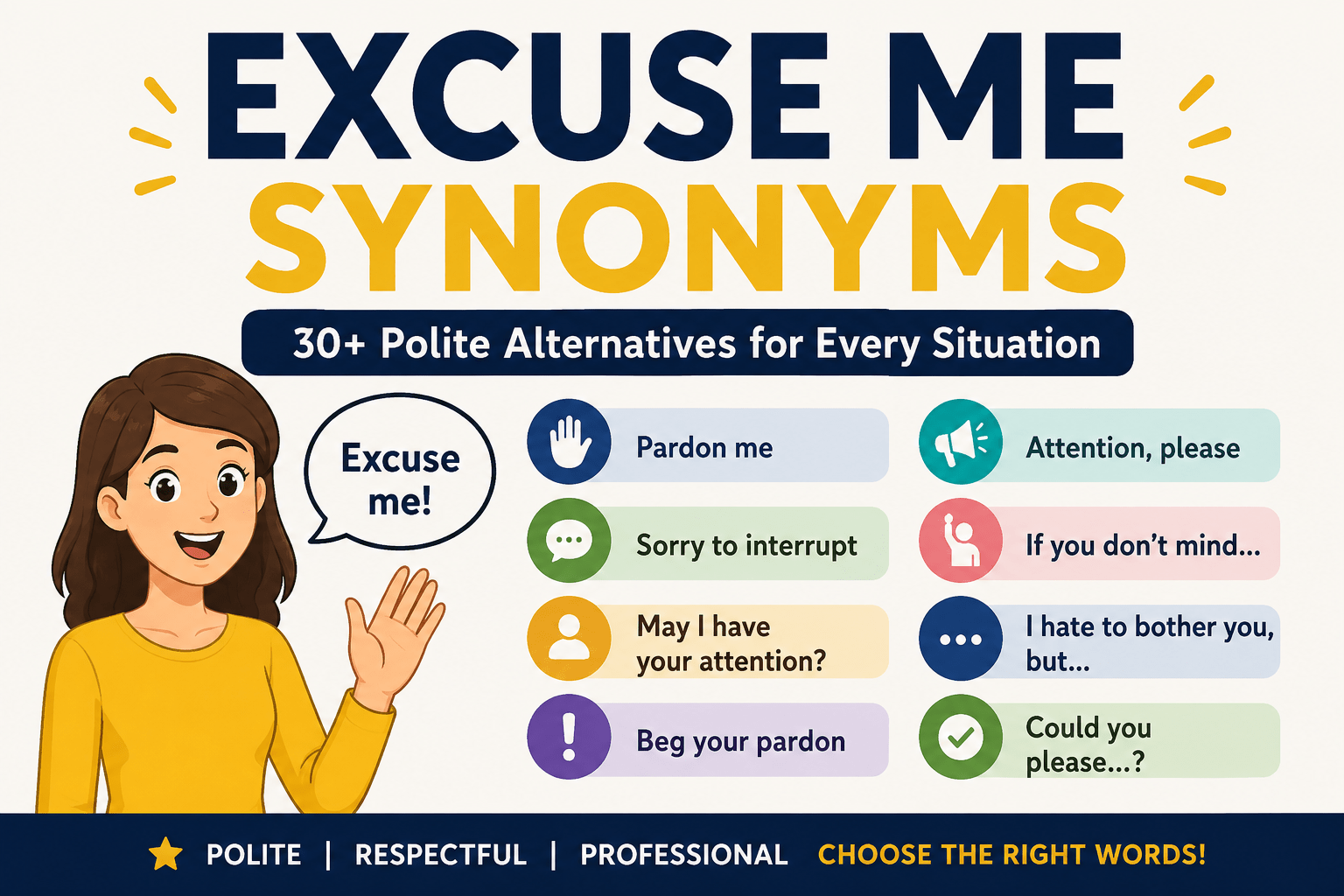
“Excuse me” is a versatile English expression used to get someone’s attention, interrupt politely, apologize for a minor inconvenience, ask someone to move, request repetition, or sometimes introduce disagreement. Because it serves several purposes, there is no single synonym that works perfectly in every situation.
The best alternative depends on what you mean, how formal you want to sound, and whether you are apologizing, requesting something, or trying to get someone’s attention.
Quick Answer: What Are the Best Synonyms for “Excuse Me”?
The closest alternatives to “excuse me” include pardon me, pardon, I beg your pardon, sorry, and forgive me. However, they are not interchangeable in every situation. Use pardon me for a polite interruption or request, sorry for a minor apology, and I beg your pardon when asking someone to repeat something or expressing strong surprise or disagreement. Collins also lists I beg your pardon, sorry, pardon, and pardon me among the principal synonyms.
Core Excuse Me Synonyms
| Word or phrase | Relationship | Best use | Formality |
|---|---|---|---|
| Pardon me | Direct synonym | Interrupting, passing, repetition | Neutral–formal |
| Pardon | Direct/near synonym | Asking for repetition or apologizing | Neutral–formal |
| I beg your pardon | Direct/contextual alternative | Repetition, interruption, disagreement | Formal |
| Sorry | Contextual alternative | Minor apologies, interruption, passing | Neutral |
| Forgive me | Contextual alternative | Apologizing or interrupting | Formal/literary |
| I apologize | Contextual alternative | Clear, deliberate apology | Formal |
| My apologies | Contextual alternative | Professional apologies | Formal |
| Could you repeat that? | Functional alternative | Asking someone to repeat | Neutral |
| Could you say that again? | Functional alternative | Asking for repetition | Neutral |
| May I interrupt? | Functional alternative | Beginning an interruption | Formal |
| May I ask you something? | Functional alternative | Getting attention before a question | Neutral–formal |
| Could I get past you? | Functional alternative | Asking someone to move | Neutral |
| Let me get by, please | Functional alternative | Passing through a crowded space | Neutral |
| If you’ll excuse me | Contextual alternative | Leaving or ending an interaction | Formal/polite |
| With your permission | Contextual alternative | Politely requesting permission | Formal |
Not every phrase above is a strict dictionary synonym. Some are functional alternatives that communicate the same practical intention in a particular context.
What Does “Excuse Me” Mean?
“Excuse me” is a polite expression with several meanings. Cambridge lists it as a way to attract someone’s attention, ask someone to move, announce that you are leaving, apologize for something accidental, disagree politely, or ask someone to repeat something.
For example:
- Getting attention: “Excuse me, could you help me?”
- Asking someone to move: “Excuse me, can I get through?”
- Apologizing: “Excuse me, I didn’t mean to bump into you.”
- Asking for repetition: “Excuse me? Could you say that again?”
- Disagreeing: “Excuse me, but I don’t think that’s correct.”
- Leaving: “Excuse me, I need to make a phone call.”
This variety is why choosing an alternative requires attention to context.
1. Pardon Me
Pardon me is probably the closest all-purpose alternative to “excuse me.”
It works when you are:
- interrupting someone
- asking someone to move
- apologizing for a minor inconvenience
- asking someone to repeat something
Example:
“Pardon me, could I get past you?”
Best choice when: You want a polite, slightly more formal version of “excuse me.”
2. Pardon
Pardon can function as a shorter alternative, particularly when asking someone to repeat what they said.
Example:
“Pardon? I didn’t hear the last part.”
It can also appear in more formal expressions such as:
“Pardon me for interrupting.”
Best choice when: You want a concise and polite expression, especially in British English or more formal speech.
3. I Beg Your Pardon
I beg your pardon is a traditional and relatively formal alternative.
It can mean:
- “Could you repeat that?”
- “I’m sorry for interrupting.”
- “I apologize.”
- In certain tones, “What did you just say?”
Example:
“I beg your pardon. Could you repeat the question?”
Be careful with tone. Said sharply, “I beg your pardon?” can express surprise, offense, or disagreement rather than simple politeness.
4. Sorry
Sorry overlaps with “excuse me” when you are apologizing for a minor inconvenience or interruption.
Example:
“Sorry, I didn’t see you there.”
You can also use it when trying to get someone’s attention:
“Sorry, could you tell me where the station is?”
However, sorry is not a universal replacement. For example, when you simply need to attract a stranger’s attention, “Excuse me” often sounds more naturally polite.
5. Forgive Me
Forgive me is a more explicit apology and can sound formal, serious, or literary depending on context.
Example:
“Forgive me for interrupting, but I need to clarify something.”
It is usually stronger than simply saying “excuse me.”
Best choice when: You want to emphasize that you are apologizing for an action.
6. I Apologize
I apologize is a clearly formal alternative when the main purpose is apologizing.
Example:
“I apologize for interrupting the meeting.”
It is generally more serious and deliberate than “excuse me.”
Best choice for: Professional communication, formal conversations, and situations where you genuinely need to apologize.
7. My Apologies
My apologies is another formal apology, particularly useful in professional settings.
Example:
“My apologies for the delay.”
It does not work naturally as a replacement whenever “excuse me” is used to get someone’s attention.
That makes it a contextual alternative, not a direct synonym.
8. Could You Repeat That?
When “excuse me?” means that you did not hear someone, a direct request can actually be clearer.
Example:
“Could you repeat that, please?”
This is especially useful in:
- meetings
- classrooms
- interviews
- phone conversations
- professional discussions
In American English, “Excuse me?” is commonly used to ask someone to repeat what they said.
9. Could You Say That Again?
This is a natural, conversational alternative when you missed something.
Example:
“Could you say that again? I didn’t catch the last part.”
It is friendly and clear, although less concise than “Excuse me?”
10. May I Interrupt?
If your purpose is specifically to interrupt someone, “May I interrupt?” communicates your intention more precisely.
Example:
“May I interrupt for a moment?”
This sounds more formal and respectful than simply saying “Excuse me.”
11. May I Ask You Something?
When you use “excuse me” to get someone’s attention before asking a question, you can replace it with a complete request.
Example:
“May I ask you something? Do you know where Room 204 is?”
This works particularly well in polite or professional situations.
12. Could I Get Past You?
When “excuse me” means “I need to pass,” this phrase is often clearer.
Example:
“Could I get past you, please?”
Compare:
- Excuse me. — Short and conventional.
- Could I get past you? — Explicit and polite.
- Move, please. — Direct and potentially rude.
The wording matters because “excuse me” can politely signal that you need space without directly telling someone to move.
13. Let Me Get By, Please
This is another practical alternative when moving through a crowded space.
Example:
“Let me get by, please.”
It is conversational and direct, but the tone can determine whether it sounds friendly or impatient.
14. If You’ll Excuse Me
If you’ll excuse me is commonly used when you want to leave an interaction politely.
Example:
“If you’ll excuse me, I need to take this call.”
This meaning is different from asking someone to repeat themselves or apologizing for bumping into them. Collins specifically identifies “excuse me” and expressions such as “if you’ll excuse me” as polite ways of indicating that you are leaving or stopping a conversation.
15. With Your Permission
With your permission is a more formal alternative when you are requesting permission to do something.
Example:
“With your permission, I’d like to leave the meeting early.”
It is not a direct synonym in ordinary conversation, but it can replace the underlying function of “excuse me” when permission is the real purpose.
Which Word Should I Use?
The easiest way to choose is to identify why you are saying “excuse me.”
Use “pardon me” when:
You want the closest polite alternative.
“Pardon me, could you tell me the time?”
Use “sorry” when:
You are apologizing for a small inconvenience.
“Sorry, I didn’t mean to interrupt.”
Use “I beg your pardon” when:
You want a more formal expression, particularly when asking for repetition.
“I beg your pardon? Could you repeat that?”
Use “I apologize” when:
You need a clearly formal apology.
“I apologize for the misunderstanding.”
Use “could you repeat that?” when:
You simply did not hear someone.
“Could you repeat that, please?”
Use “could I get past you?” when:
You need someone to make room.
“Could I get past you, please?”
Use “if you’ll excuse me” when:
You are politely leaving.
“If you’ll excuse me, I have another appointment.”
Excuse Me vs. Pardon Me
Excuse me and pardon me overlap heavily, and both can be used for polite interruption, passing, apology, or requests for repetition.
The main difference is style and regional preference.
Excuse me is extremely common in everyday American English. Pardon me can sound somewhat more formal or traditional, although it remains natural in many English-speaking contexts. Collins lists both among the principal alternatives.
Example:
- “Excuse me, could you help me?”
- “Pardon me, could you help me?”
Both are natural.
Excuse Me vs. Sorry
These expressions overlap, but their emphasis differs.
Excuse me often signals a polite interruption, request, or attempt to get attention.
Sorry more directly expresses an apology.
Compare:
“Excuse me, could I ask you a question?”
with:
“Sorry, I interrupted you.”
The first opens a request. The second acknowledges a mistake.
Excuse Me vs. I Beg Your Pardon
I beg your pardon is generally more formal and can have a wider emotional range.
It may politely request repetition:
“I beg your pardon? I didn’t hear you.”
But with strong emphasis, it can sound offended:
“I beg your pardon! That was completely unnecessary.”
Therefore, learners should pay attention to intonation.
Common Mistakes With “Excuse Me” Synonyms
Mistake 1: Treating every synonym as interchangeable
“Sorry,” “pardon me,” and “I apologize” overlap, but they do not perform exactly the same function.
Mistake 2: Using “I apologize” for everything
“I apologize” is usually too formal for casually getting a stranger’s attention.
Natural:
“Excuse me, where is the library?”
Less natural:
“I apologize, where is the library?”
Mistake 3: Using “forgive me” for a simple request
“Forgive me” can imply a more substantial apology than the situation requires.
Mistake 4: Ignoring tone
“I beg your pardon?” can sound polite, surprised, or confrontational depending on pronunciation and context.
Mistake 5: Confusing a synonym with a functional alternative
“Could you repeat that?” is not lexically synonymous with “excuse me,” but it can replace “excuse me?” when the intended meaning is “I didn’t hear you.”
FAQ About “Excuse Me” Synonyms
What is the closest synonym for “excuse me”?
Pardon me is generally the closest broad alternative. Pardon, I beg your pardon, and sorry can also overlap, but each has different contextual and stylistic uses.
What is a polite way to say “excuse me”?
Pardon me is a polite alternative. You can also use “May I interrupt?”, “Could I ask you something?”, or “Could I get past you, please?”, depending on what you are trying to communicate.
Is “sorry” a synonym for “excuse me”?
Sometimes. Sorry works especially well when “excuse me” expresses an apology for a minor inconvenience, interruption, or accidental contact. It does not replace every use of “excuse me.”
What is a formal synonym for “excuse me”?
Depending on the context, “I beg your pardon,” “pardon me,” “I apologize,” or “forgive me” can sound more formal. The best choice depends on whether you are interrupting, apologizing, or asking for repetition.
What can I say instead of “excuse me” when asking someone to move?
Try “Could I get past you, please?”, “May I get through?”, or “Could you let me by, please?” These make your intention explicit.
What can I say instead of “excuse me” when I didn’t hear someone?
Use “Could you repeat that, please?”, “Could you say that again?”, or “I beg your pardon?” In American English, “Excuse me?” itself is also commonly used for this purpose.
Is “pardon me” more polite than “excuse me”?
Not necessarily. Both are polite. Pardon me can sound somewhat more formal or traditional, while excuse me is extremely common in everyday conversation.
Can “excuse me” sound rude?
Yes. Although normally polite, tone and context can change its meaning. Merriam-Webster notes that “excuse me!” can also be used informally in an annoyed way when someone disagrees with an accusation or suggestion.
Conclusion
The best “excuse me” synonym depends on what you actually want to communicate. Pardon me is the closest general alternative, while sorry works best for minor apologies, I beg your pardon suits formal repetition or strong surprise, and I apologize is better for deliberate professional apologies. When the purpose is specific, a direct phrase such as “Could you repeat that?” or “Could I get past you?” can be even clearer.
The key is not to memorize a long synonym list. Choose the expression that matches the situation, tone, and intended meaning.

Emily Johnson is a linguistics graduate and vocabulary specialist. She writes detailed synonym explanations and helps readers understand subtle differences between words, improving both writing and speaking skills. Synonyms help express ideas more clearly and precisely in English.