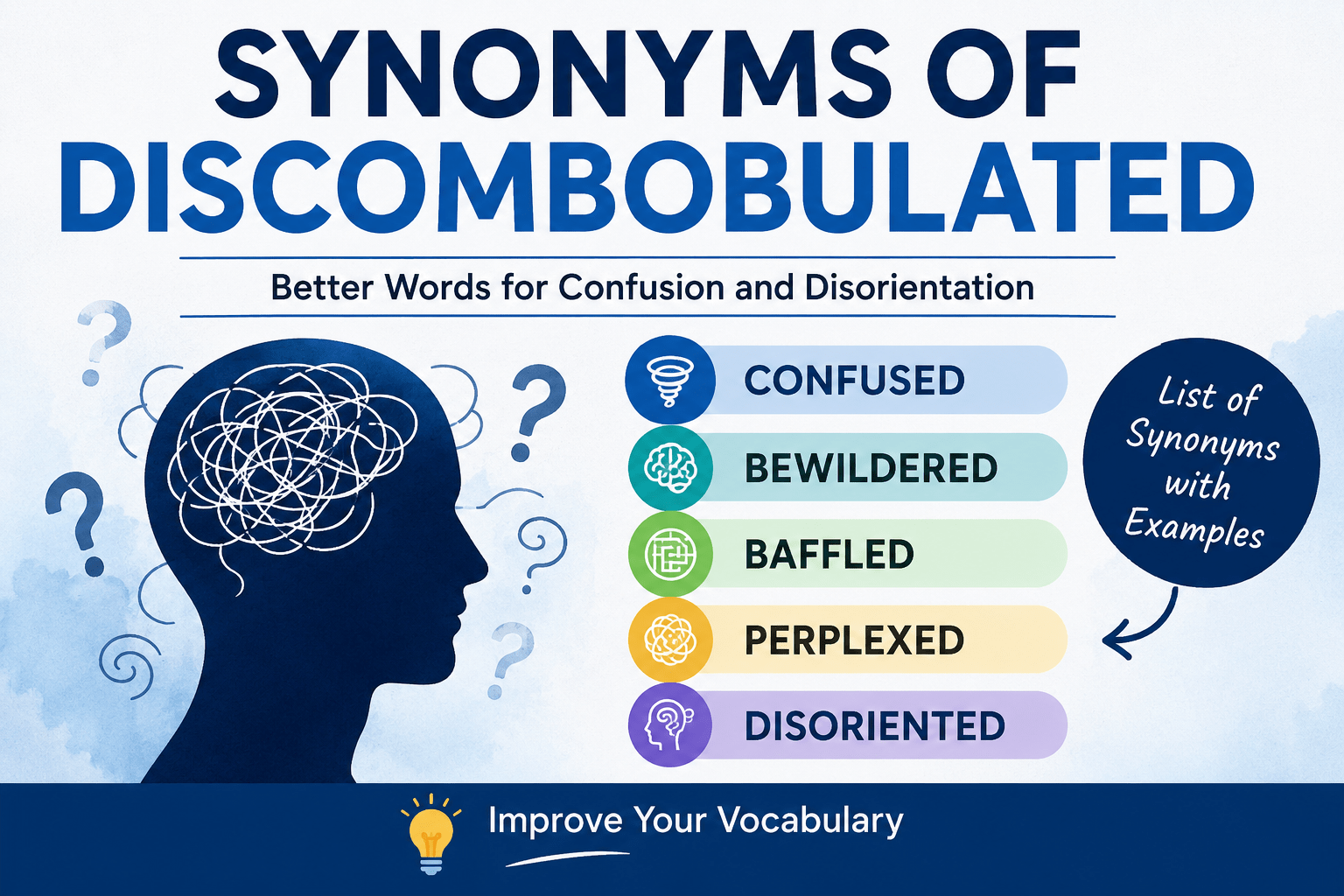
When you need a synonym for discombobulated, the best choice depends on why someone feels confused or unsettled. The closest alternatives include confused, bewildered, befuddled, puzzled, perplexed, muddled, disoriented, and disconcerted. Some emphasize a lack of understanding, while others suggest being thrown off balance, mentally unsettled, or unsure what to do.
Quick Answer: What Are the Best Synonyms for Discombobulated?
The closest synonyms for discombobulated are confused, bewildered, befuddled, puzzled, perplexed, muddled, disoriented, and disconcerted. For everyday writing, confused is the safest replacement. Use bewildered for stronger confusion, befuddled for foggy or muddled thinking, disoriented when someone has lost their sense of direction or situation, and disconcerted when something has unsettled or thrown someone off.
Merriam-Webster defines discombobulated as informal and meaning characterized by confusion or disorder. Its thesaurus includes words such as confused, baffled, bewildered, puzzled, perplexed, befuddled, and disoriented.
Core Synonyms for Discombobulated
| Word | Relationship | Main Meaning | Tone/Register | Best Context |
|---|---|---|---|---|
| Confused | Closest general synonym | Unable to understand clearly | Neutral | Almost any situation |
| Bewildered | Strong near-synonym | Deeply confused or unsure | Neutral/formal | Unexpected or complicated situations |
| Befuddled | Close near-synonym | Mentally muddled or foggy | Informal | Casual descriptions of thinking |
| Puzzled | Contextual synonym | Unsure because something is difficult to understand | Neutral | Questions, problems, unusual situations |
| Perplexed | Close near-synonym | Confused by something difficult or puzzling | Formal/neutral | Professional and academic writing |
| Muddled | Contextual synonym | Disorganized or unclear in thought | Neutral | Ideas, plans, explanations |
| Disoriented | Contextual synonym | Unsure of one’s position, surroundings, or situation | Neutral | Travel, unfamiliar places, sudden changes |
| Disconcerted | Near-synonym | Unsettled or thrown off emotionally | Formal/neutral | Unexpected events or remarks |
| Dazed | Contextual alternative | Mentally stunned or unable to think normally | Neutral | Shock, exhaustion, injury, surprise |
| Flustered | Contextual alternative | Nervous, agitated, and unable to respond calmly | Neutral | Pressure, embarrassment, stressful moments |
| Baffled | Close near-synonym | Completely unable to understand something | Neutral | Difficult questions or confusing situations |
| Mystified | Contextual alternative | Unable to explain or understand something | Neutral/formal | Strange or inexplicable events |
Collins similarly groups discombobulated with befuddled, bewildered, confused, puzzled, baffled, muddled, dazed, perplexed, and disorientated, while also identifying phrases such as at a loss and at sea as contextual alternatives.
What Does Discombobulated Mean?
Discombobulated is an informal adjective describing someone or something that is confused, disorganized, unsettled, or thrown off balance.
For example:
After three unexpected changes to the schedule, the team felt completely discombobulated.
The word can describe a person’s mental state, a group’s performance, or a situation that has become disorganized. Merriam-Webster lists its first known use as 1863 and identifies the adjective as informal.
The word is particularly useful when you want to suggest that someone has been thrown out of their normal mental or emotional state, rather than simply saying they do not understand something.
1. Confused
Confused is the best general-purpose synonym for discombobulated.
It describes difficulty understanding something, thinking clearly, or knowing what to do.
Example:
I was confused by the sudden change in instructions.
Choose confused when you want a natural, neutral word that works in almost any context.
Best for: everyday English, professional writing, explanations, and general descriptions.
2. Bewildered
Bewildered suggests stronger confusion, especially when someone does not know what to think or do.
The unexpected question left the candidate bewildered.
Compared with confused, bewildered often conveys a greater sense of uncertainty or surprise.
Best for: unexpected situations, complicated circumstances, and descriptive writing.
3. Befuddled
Befuddled describes someone whose thinking is unclear, muddled, or mentally foggy.
I was so tired that I felt completely befuddled.
It is generally more informal and colorful than confused.
Best for: casual writing and situations involving mental fog or muddled thinking.
4. Puzzled
Puzzled usually means confused because something is difficult to understand.
She looked puzzled when she read the unusual instructions.
Unlike discombobulated, puzzled often focuses specifically on trying to understand a question, event, or piece of information.
Best for: questions, mysteries, unusual behavior, and problems.
5. Perplexed
Perplexed is a more formal alternative to puzzled or confused.
The manager was perplexed by the unexpected results.
It works especially well in professional, academic, and polished written English.
Best for: formal writing, difficult problems, complex situations, and analytical contexts.
6. Muddled
Muddled suggests that thoughts, plans, information, or reasoning have become confused or disorganized.
The explanation was so complicated that it left me muddled.
It can describe both a person’s thinking and an unclear situation.
Best for: thoughts, explanations, plans, arguments, and reasoning.
7. Disoriented
Disoriented is a useful synonym when confusion involves a person’s sense of place, direction, time, or situation.
After waking from the long flight, I felt disoriented.
This is more specific than discombobulated. Someone can be disoriented without simply being puzzled by information.
Best for: unfamiliar surroundings, travel, sudden changes, and situations where someone loses their bearings.
8. Disconcerted
Disconcerted emphasizes being unsettled, disturbed, or thrown off emotionally.
The unexpected criticism left him disconcerted.
It is often a better choice than confused when the main issue is emotional disturbance rather than lack of understanding.
Best for: criticism, surprises, awkward situations, and unexpected events.
9. Dazed
Dazed describes someone who is temporarily unable to think or react normally because of shock, exhaustion, surprise, or another intense experience.
She stood there dazed after hearing the unexpected news.
It overlaps with discombobulated, but usually suggests a more pronounced loss of mental alertness.
Collins lists dazed among contextual synonyms of discombobulated, particularly where the meaning involves being stunned or confused.
10. Flustered
Flustered describes someone who is nervous, agitated, embarrassed, or unable to respond calmly.
He became flustered when everyone started asking questions at once.
This is not a perfect synonym for discombobulated. It is better when pressure or nervousness causes the person’s difficulty.
Best for: public speaking, stressful situations, embarrassment, and time pressure.
11. Baffled
Baffled means unable to understand something despite trying to figure it out.
The investigators were baffled by the strange evidence.
It is often stronger than puzzled and works particularly well when something seems difficult to explain.
Best for: mysteries, difficult questions, unusual events, and complicated problems.
12. Mystified
Mystified means completely unable to understand or explain something.
The scientists were mystified by the unexpected result.
It often focuses on the mystery itself, rather than a general state of mental disorder.
Best for: unexplained events, strange behavior, unusual results, and mysteries.
Which Word Should I Use?
The easiest way to choose is to identify what caused the confusion.
Choose “confused” when:
You simply want the safest and most natural replacement.
I was confused by the instructions.
Choose “bewildered” when:
The situation produces strong uncertainty or surprise.
She was bewildered by the sudden change.
Choose “befuddled” when:
Someone’s thinking feels foggy or muddled.
I was too tired to think clearly and felt befuddled.
Choose “puzzled” when:
Someone is trying to understand something unusual.
He looked puzzled by the question.
Choose “perplexed” when:
You want a more formal or polished alternative to puzzled.
The researchers were perplexed by the findings.
Choose “disoriented” when:
Someone has lost their bearings or sense of situation.
The unfamiliar surroundings left him disoriented.
Choose “disconcerted” when:
Someone has been emotionally unsettled or thrown off.
She was disconcerted by the unexpected criticism.
Choose “flustered” when:
Nervousness or pressure is causing the problem.
He became flustered during the interview.
Discombobulated vs. Confused
Confused is broader and more neutral than discombobulated.
I was confused by the instructions.
I was discombobulated after the entire schedule changed.
The first sentence simply says the instructions were difficult to understand. The second suggests that the change disrupted the person’s normal sense of order or composure.
For formal writing, confused is usually the safer choice because discombobulated is explicitly labeled informal by Merriam-Webster.
Discombobulated vs. Bewildered
Both words describe significant confusion, but bewildered tends to focus more directly on uncertainty and inability to understand what is happening.
Discombobulated can be broader, suggesting that someone has been thrown off mentally or emotionally.
The unfamiliar procedure left the new employee bewildered.
The sudden cancellation left the entire team discombobulated.
Use bewildered when confusion is the main idea. Use discombobulated when the person’s normal mental or organizational state has been disrupted.
Discombobulated vs. Disoriented
These words overlap, but they are not interchangeable in every situation.
Disoriented is more specific. It often concerns someone’s awareness of their surroundings, location, time, or circumstances.
After waking up in the unfamiliar hotel room, he felt disoriented.
Discombobulated is broader and can describe general confusion or disorder.
The sudden change in plans left everyone discombobulated.
Discombobulated vs. Perplexed
Perplexed usually means confused by something difficult to understand.
Discombobulated can describe a broader state of being thrown off.
The complicated equation left the student perplexed.
The sudden changes to the entire project left the team discombobulated.
For academic and professional writing, perplexed will often sound more conventional than discombobulated.
Common Collocations and Natural Alternatives
The best synonym can change depending on the noun or situation.
| Phrase | Natural Alternative |
|---|---|
| discombobulated by the news | shocked, bewildered, disconcerted |
| discombobulated by instructions | confused, puzzled, perplexed |
| discombobulated after traveling | disoriented, dazed |
| discombobulated during an interview | flustered, rattled |
| discombobulated thoughts | muddled, confused |
| discombobulated explanation | muddled, unclear, confusing |
| discombobulated after a surprise | dazed, bewildered, disconcerted |
| discombobulated by a difficult problem | baffled, perplexed, puzzled |
These distinctions are more useful than simply memorizing a long synonym list.
Common Mistakes With Discombobulated Synonyms
1. Treating every related word as an exact synonym
Words such as dazed, flustered, and disoriented overlap with discombobulated, but each adds a specific meaning.
2. Using “disoriented” for every type of confusion
Disoriented is particularly useful when someone loses their bearings or awareness of their situation. It is not always the best replacement for ordinary intellectual confusion.
3. Using “perplexed” in very casual speech
Perplexed is perfectly natural English, but it can sound more formal than confused.
4. Assuming “befuddled” is formal
Befuddled has a playful or informal quality. It is usually not the strongest choice for highly formal professional writing.
5. Using “flustered” when there is no nervousness
Someone can be confused without being nervous. Flustered specifically brings emotional agitation or pressure into the meaning.
Is Discombobulated a Formal Word?
No. Discombobulated is generally informal.
It is a legitimate English word, but it has a playful, somewhat whimsical character. Merriam-Webster labels it informal, while Collins also identifies it as informal in its thesaurus material.
For formal or professional writing, consider:
- confused
- perplexed
- bewildered
- disoriented
- disconcerted
The best choice depends on the intended meaning.
Is “Confused” the Best Synonym for Discombobulated?
Usually, yes, if you need a neutral replacement.
Confused has a wider range of uses and does not carry the informal, playful quality associated with discombobulated. However, it can lose some of the original word’s sense of being thrown off balance or put into disorder.
So:
Discombobulated → confused is usually the safest substitution.
But:
Discombobulated and disoriented overlap when someone has lost their bearings. For difficult problems, perplexed is usually more precise. If nervousness causes the confusion, flustered is a better choice. When the confusion comes with emotional disturbance, disconcerted may fit best.
FAQ
What is another word for discombobulated?
The most useful alternatives are confused, bewildered, befuddled, puzzled, perplexed, muddled, disoriented, and disconcerted. The best choice depends on whether the confusion involves understanding, direction, emotional disturbance, nervousness, or mental fog.
What is a more formal word for discombobulated?
Perplexed, confused, bewildered, or disconcerted can work well in formal writing. Confused is the most broadly applicable, while perplexed is especially useful when someone cannot understand a difficult issue.
Is bewildered stronger than confused?
Generally, bewildered suggests a deeper or more pronounced state of confusion than ordinary confused. It often implies that a person is unsure what to think or do because a situation is unexpected or difficult to understand.
Is befuddled a synonym for discombobulated?
Yes, befuddled is a close synonym, especially when discombobulated refers to muddled or foggy thinking. However, befuddled is generally more informal and can have a slightly humorous tone.
Is disoriented the same as discombobulated?
Not exactly. Disoriented is more specific and often describes losing one’s sense of location, direction, time, or surroundings. Discombobulated is broader and can describe general confusion or disorder.
What is the opposite of discombobulated?
Depending on context, useful opposites include composed, organized, clear-headed, oriented, calm, focused, and assured. The best antonym depends on whether the original meaning concerns confusion, disorder, emotional disturbance, or loss of direction.
Is discombobulated a positive or negative word?
It is generally negative or mildly humorous, depending on context. It describes a state of confusion or disorder, but its unusual sound often gives it a playful quality in informal English.
Conclusion
The best synonym for discombobulated depends on the exact kind of confusion you want to describe. Confused is the safest general alternative, while bewildered emphasizes strong uncertainty, befuddled suggests foggy thinking, perplexed fits difficult problems, disoriented focuses on lost bearings, and disconcerted emphasizes being emotionally unsettled.
The key is not to choose the longest synonym list. Choose the word that preserves the meaning, tone, and context of the original sentence.

Michael Thompson is an English language specialist and experienced editor who focuses on vocabulary development and clear communication. He creates high-quality synonym guides, word comparisons, and writing tips to help students and professionals express their ideas more effectively. His work combines linguistic knowledge with practical SEO strategies to make learning both useful and engaging.