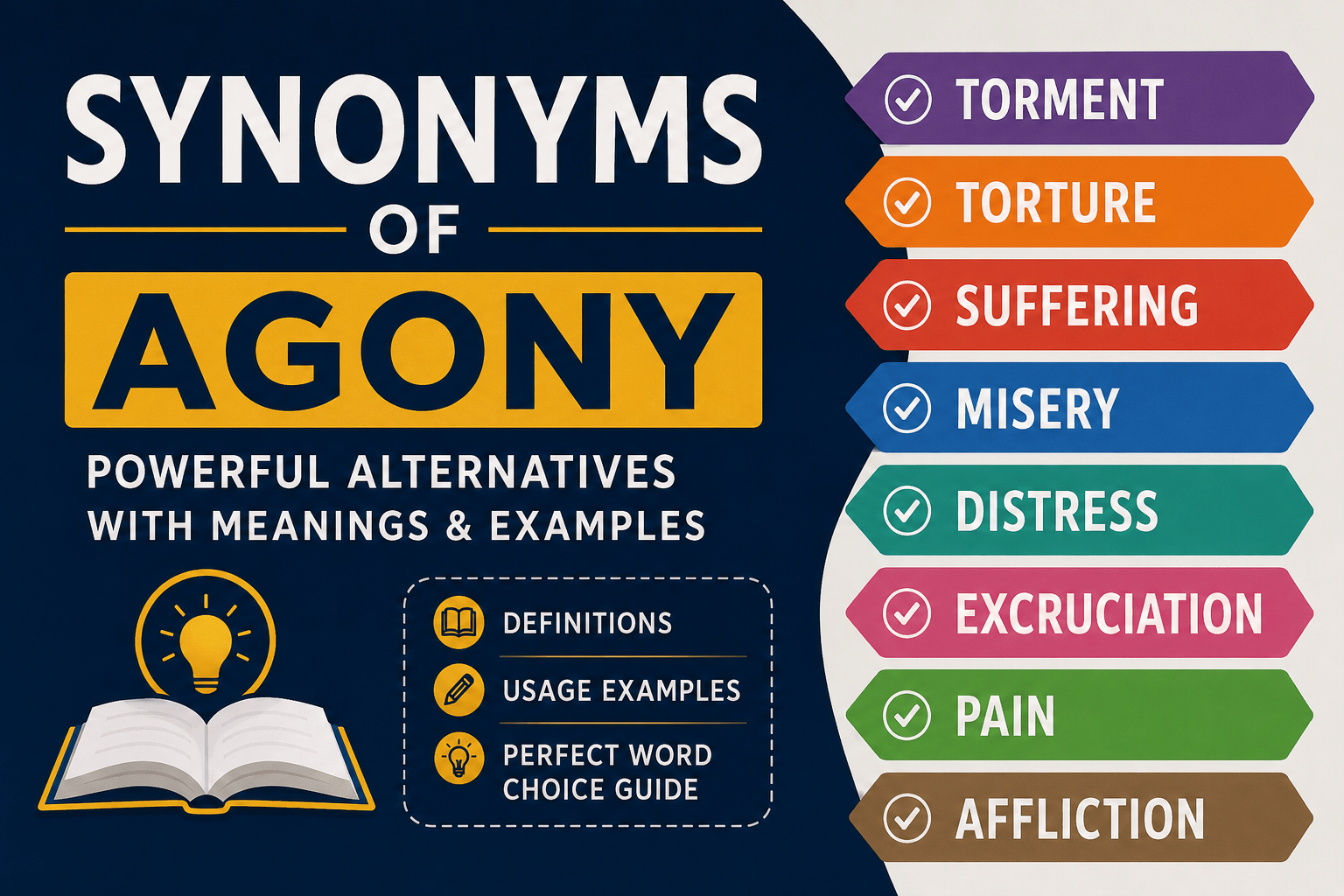
Finding the right synonym for agony is not simply a matter of replacing one word with another. Agony refers to extreme physical or mental pain or suffering, so the best alternative depends on whether you are describing bodily pain, emotional distress, prolonged suffering, or a deliberately inflicted experience.
Words such as anguish, torment, suffering, pain, misery, distress, and torture overlap with agony, but they are not interchangeable in every sentence. Understanding their differences helps you choose vocabulary that sounds natural and conveys exactly the intended intensity.
Quick Answer: What Are the Best Synonyms for Agony?
The closest synonyms of agony include anguish, torment, suffering, pain, torture, distress, misery, woe, and affliction. The best choice depends on context. Anguish is especially suitable for severe emotional suffering, torment suggests prolonged or repeated suffering, while pain is broader and can describe ordinary or severe physical or emotional discomfort.
Core Synonyms of Agony
| Word | Relationship | Main Meaning | Typical Context | Intensity |
|---|---|---|---|---|
| Anguish | Very close synonym | Severe emotional or mental suffering | Grief, loss, fear | Very high |
| Torment | Very close synonym | Severe, often prolonged suffering | Emotional or physical suffering | Very high |
| Suffering | Broad synonym | Experiencing pain or distress | Physical or emotional pain | Variable |
| Pain | Broad synonym | Physical or emotional discomfort or suffering | Medical, emotional, everyday | Variable |
| Torture | Contextual synonym | Extreme suffering, often deliberately inflicted | Physical or psychological suffering | Extremely high |
| Misery | Near synonym | Extreme unhappiness or distress | Loss, hardship, poor conditions | High |
| Distress | Near synonym | Severe anxiety, trouble, or suffering | Emotional, financial, physical situations | Moderate–high |
| Woe | Literary/expressive synonym | Deep sorrow or distress | Literary and formal writing | High |
| Affliction | Contextual synonym | Persistent source or state of suffering | Illness, hardship, adversity | High |
| Pangs | Contextual alternative | Sudden sharp feelings of pain or emotion | Pangs of guilt, hunger, regret | Moderate–high |
| Throes | Contextual alternative | Intense struggle or painful experience | Throes of death, conflict, change | High |
| Heartache | Emotional alternative | Deep emotional sadness | Loss, rejection, relationships | High |
| Excruciating pain | Phrase-level alternative | Extremely severe pain | Physical or figurative pain | Extremely high |
| Severe suffering | Phrase-level alternative | Very serious physical or emotional suffering | Formal and general writing | High |
| Unbearable pain | Phrase-level alternative | Pain that feels impossible to tolerate | Physical or emotional contexts | Extremely high |
Not every word in this table is a perfect one-to-one replacement for agony. The distinctions are important because agony itself emphasizes exceptionally intense pain or suffering. Merriam-Webster specifically distinguishes it from broader terms such as distress, suffering, and misery, noting that agony suggests pain that is exceptionally intense.
What Does Agony Mean?
Agony is a noun meaning extreme physical or mental pain or suffering. It can describe bodily pain, emotional suffering, or a period of intense distress. Cambridge lists both physical and mental suffering as part of the word’s meaning.
Example:
After the accident, he was in agony.
Here, agony describes extremely severe physical pain.
It can also describe emotional suffering:
She felt deep agony after losing her closest friend.
The word is pronounced /ˈæɡ.ə.ni/ in both American and British English.
1. Anguish
Anguish is one of the closest alternatives to agony, especially when the suffering is emotional or psychological.
He was filled with anguish after hearing the tragic news.
While agony can describe both physical and emotional pain, anguish strongly emphasizes emotional distress, grief, or mental suffering.
Best for: grief, loss, fear, despair, emotional pain.
Choose “anguish” when: you want to emphasize what someone is experiencing emotionally.
2. Torment
Torment refers to severe suffering that may be physical or emotional and often suggests that the suffering continues over time.
The uncertainty tormented her for weeks.
Compared with agony, torment often emphasizes duration, repeated suffering, or the thing causing the suffering.
Best for: prolonged emotional pain, guilt, anxiety, persistent physical suffering.
He lived in torment, unable to forget what had happened.
3. Suffering
Suffering is broader than agony. It can refer to almost any significant experience of physical or emotional pain.
The disease caused years of suffering.
Unlike agony, it does not necessarily imply the highest possible level of pain.
Best for: general descriptions of pain, illness, hardship, grief, and adversity.
This distinction is important: a person can experience suffering without being in agony.
4. Pain
it is the most general and everyday alternative.
She was in severe pain after the injury.
Pain can range from mild discomfort to extreme suffering. Agony is much stronger.
Compare:
- I have some pain in my shoulder. → General physical discomfort.
- I was in agony after the accident. → Extremely severe pain.
Therefore, pain is a useful synonym when the context does not require the extreme intensity associated with agony.
5. Torture
Torture can mean extreme physical or psychological suffering, but it often carries an additional implication: the suffering is deliberately inflicted.
The prisoners were subjected to torture.
It is also commonly used figuratively:
Waiting for the test results was torture.
In the second example, torture emphasizes how unbearable the experience felt.
Best for: deliberate physical or psychological suffering, or highly figurative descriptions of unbearable experiences.
Do not automatically replace agony with torture. They overlap, but their meanings are not identical.
6. Misery
Misery emphasizes extreme unhappiness or distress, rather than physical pain itself.
He lived in misery after losing his job and home.
Someone can be in misery without experiencing physical agony.
Best for: poverty, loneliness, grief, unhappiness, difficult living conditions, and prolonged emotional distress.
A useful distinction is:
Agony emphasizes extreme pain; misery emphasizes extreme unhappiness.
7. Distress
Distress describes serious emotional or physical trouble, anxiety, or suffering.
The family was in considerable distress after the accident.
It is generally broader and less intense than agony.
Best for: emotional difficulty, anxiety, emergencies, financial problems, and situations causing serious trouble.
In formal or professional writing, distress can often sound more measured than agony.
8. Woe
Woe is an expressive word for deep sorrow, trouble, or distress. It is more literary than everyday agony.
The poem describes the woes of war.
It can be useful when writing creatively or discussing serious hardship, but it would sound unnatural in many ordinary conversations.
Best for: literary writing, formal expression, sorrow, hardship, and serious trouble.
9. Affliction
Affliction usually refers to a condition or circumstance that causes prolonged suffering.
The disease was a serious affliction.
Unlike agony, which usually describes the experience of intense pain, affliction can identify the source or condition responsible for suffering.
Best for: illness, adversity, chronic problems, and serious hardships.
10. Pangs
Pangs describes sudden or sharp feelings, often physical or emotional.
Common expressions include:
- pangs of guilt
- pangs of regret
- pangs of hunger
- pangs of jealousy
- pangs of loneliness
She felt pangs of regret after leaving.
It is not a direct replacement for agony in most sentences, but it is a useful contextual alternative when describing brief, sharp episodes of pain or emotion.
11. Throes
Throes usually appears in the phrase “in the throes of” and describes an intense struggle or difficult experience.
The country was in the throes of a major crisis.
It can also refer to severe physical suffering, particularly in expressions such as “the throes of death.”
Because it is normally used in particular constructions, it should not be treated as a universal synonym for agony.
12. Heartache
Heartache is specifically associated with deep emotional sadness or distress, particularly after loss, rejection, or relationship problems.
The breakup caused her months of heartache.
It is more specific than agony because it normally points toward emotional rather than physical suffering.
Best for: heartbreak, grief, separation, rejection, and emotional loss.
13. Excruciating Pain
It is not a single-word synonym, but it is a strong phrase-level alternative to agony.
He experienced excruciating pain after the injury.
Excruciating means extremely painful or difficult to endure. This phrase works especially well when you want to describe severe physical pain precisely.
Which Synonym Should You Use?
The easiest way to choose is to identify the type of suffering you want to emphasize.
Choose “agony” when:
You mean extreme physical or mental pain.
She was in agony after the accident.
Choose “anguish” when:
The emphasis is on severe emotional suffering.
He cried out in anguish after hearing the news.
Choose “torment” when:
The suffering is prolonged, repeated, or psychologically consuming.
The guilt continued to torment him.
Choose “pain” when:
You need a general, everyday word.
She felt pain in her knee.
Choose “suffering” when:
You are describing the general experience of enduring pain or hardship.
The treatment reduced his suffering.
Choose “torture” when:
The suffering is deliberately inflicted or something is figuratively unbearable.
Waiting for the decision was torture.
Choose “misery” when:
The emphasis is on extreme unhappiness.
Poverty had left the family in misery.
Choose “distress” when:
You want a broader or more measured term for serious trouble or emotional suffering.
The incident caused considerable distress.
Agony vs. Anguish
These two words are especially easy to confuse.
| Agony | Anguish |
| Extreme physical or mental pain | Severe emotional or mental suffering |
| Common for physical pain | Strongly associated with emotional pain |
| Can describe injuries | Often describes grief, fear, or loss |
| Very intense | Very intense |
Example:
The athlete was in agony after the injury.
His family waited in anguish for news.
Both words describe severe suffering, but agony is more flexible for physical pain.
Agony vs. Torment
Both can describe intense suffering, but torment often suggests ongoing or repeated suffering.
The injury left him in agony.
The memory continued to torment him.
The first emphasizes the intensity of pain. The second emphasizes the continuing psychological suffering.
Agony vs. Suffering
Suffering is the broader term.
The illness caused considerable suffering.
The patient was in agony.
The first sentence does not necessarily indicate extreme pain. The second does.
A useful rule is:
All agony is suffering, but not all suffering is agony.
Agony vs. Torture
These words overlap when describing extreme suffering, but torture often implies intentional infliction of pain.
The injury caused him agony.
The prisoner endured torture.
In informal speech, torture can also be used metaphorically:
That three-hour meeting was torture.
Here it means the experience felt extremely unpleasant rather than literal physical torture.
Common Mistakes When Choosing a Synonym for Agony
1. Treating “pain” as equally intense
Pain is broader than agony. A minor headache can involve pain, but calling it agony suggests something much more severe.
2. Using “misery” for physical pain
Misery mainly emphasizes unhappiness or distress. It is not normally the best word for describing a severe physical injury.
3. Using “anguish” for every kind of pain
Anguish is especially natural for emotional or psychological suffering. For straightforward physical pain, agony or pain may be better.
4. Assuming “torture” always means agony
Torture has its own meaning involving severe suffering, often deliberately inflicted. It is stronger and more specific than agony in many contexts.
5. Treating “discomfort” as a strong synonym
Discomfort is usually much weaker than agony. Saying someone experienced discomfort after a serious injury may significantly understate the intensity.
Related Words That Are Not Exact Synonyms
Some words are associated with agony but should not automatically be presented as direct replacements.
- Ordeal — a difficult or painful experience, not the feeling of pain itself.
- Hardship — difficult living conditions or circumstances.
- Tragedy — a disastrous or deeply sad event.
- Horror — intense fear, shock, or revulsion.
- Regret — sadness or disappointment about something that happened.
- Grief — profound sorrow, especially after loss.
- Discomfort — mild or moderate physical or emotional unease.
These words can occur in contexts involving agony, but their meanings are different.
Antonyms of Agony
The opposite of agony depends on what aspect of the word you are contrasting.
Useful antonyms include:
- comfort
- relief
- ease
- peace
- pleasure
- contentment
- joy
For example:
The medication finally brought relief from the agony.
Here, relief is the most natural opposite because it describes the reduction of pain.
Frequently Asked Questions
What is the closest synonym for agony?
Anguish, torment, and suffering are among the closest alternatives, depending on context. Anguish is particularly strong for emotional suffering, while torment often suggests prolonged suffering. Pain is more general and does not necessarily carry the extreme intensity of agony.
What is another word for extreme agony?
For extreme physical pain, phrases such as excruciating pain, unbearable pain, and intense suffering are natural alternatives. For emotional suffering, deep anguish or severe torment may be more precise.
Is anguish a synonym for agony?
Yes, anguish is a close synonym, particularly when agony refers to severe emotional or mental suffering. However, agony can describe extreme physical pain more naturally, while anguish strongly emphasizes emotional suffering.
Is suffering stronger than agony?
Usually, no. Suffering is a broader term that can describe mild, moderate, or severe pain and hardship. Agony specifically suggests an exceptionally intense level of physical or mental suffering.
What is a formal synonym for agony?
Depending on the context, anguish, suffering, distress, torment, or affliction can work in formal writing. The best choice depends on the exact meaning rather than formality alone.
What is a synonym for emotional agony?
Useful alternatives include anguish, torment, heartache, misery, and deep distress. Anguish is often the strongest one-word choice when the focus is severe emotional suffering.
What is a synonym for physical agony?
Extreme pain, excruciating pain, severe suffering, and torment can describe physical agony. However, pain is the most general term, while agony and excruciating pain communicate much greater intensity.
Can agony describe emotional pain?
Yes. Agony can describe both physical and mental or emotional suffering. For example, someone can experience agony after a serious injury or after devastating emotional loss.
Conclusion
The best synonym for agony depends on the kind of suffering you want to describe. Anguish works especially well for severe emotional pain, torment emphasizes prolonged suffering, pain is broader and more neutral, suffering covers the general experience of enduring hardship, and torture suggests extreme or deliberately inflicted suffering.
Rather than choosing the strongest-looking word, choose the one that matches the type, intensity, duration, and context of the suffering. That approach produces more precise and natural English.

Sarah Williams is an ESL teacher and content writer with a passion for simplifying English vocabulary. She creates easy-to-understand synonym guides and learning resources that help beginners and intermediate learners build strong language skills.