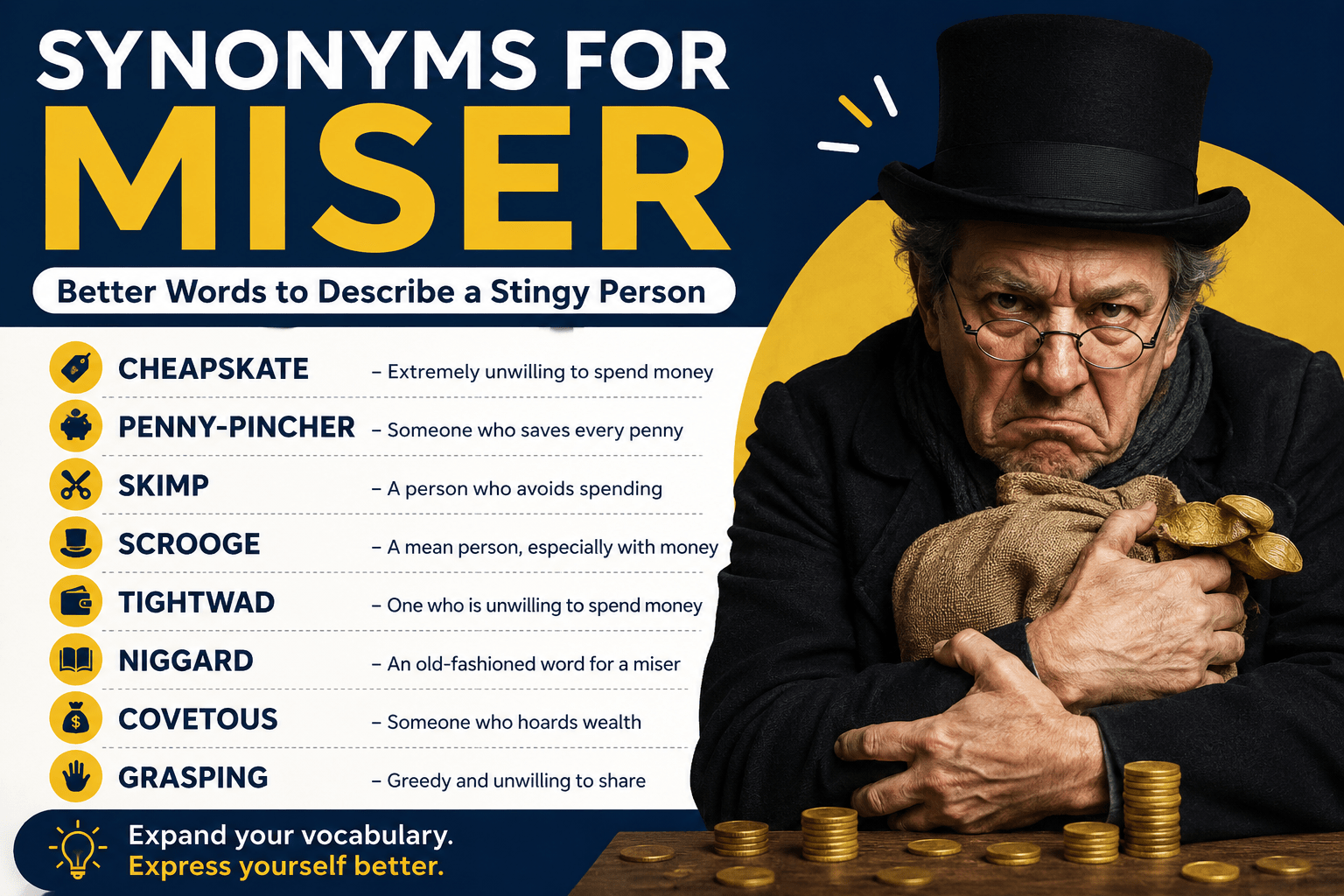
If you need another word for miser, the closest choices include skinflint, tightwad, penny-pincher, cheapskate, pinchpenny, and Scrooge. They all describe someone who is notably unwilling to spend money, but they differ in tone and emphasis. Skinflint is a strong general alternative, tightwad and cheapskate are informal, and Scrooge is especially expressive or literary. A word such as frugal is related but is not an exact synonym because frugality can be sensible and positive, whereas miser normally carries criticism.
Quick Answer
The closest synonyms for miser are skinflint, tightwad, penny-pincher, pinchpenny, cheapskate, and Scrooge. For neutral-to-formal writing, miser or skinflint works well; for casual speech, cheapskate or tightwad sounds more natural. Use frugal or economical only when you mean careful spending rather than excessive unwillingness to spend.
What Does “Miser” Mean?
Miser is a noun for a person who has a strong desire to keep money and strongly dislikes spending it. The word is normally disapproving. Cambridge defines a miser as someone who wants money and hates to spend it, while Merriam-Webster emphasizes extreme stinginess with money.
A miser is therefore more than simply someone who saves money. The word suggests excessive, often unreasonable reluctance to spend.
Example:
Everyone knew Mr. Hale was a miser; he had plenty of money but refused to spend any of it.
Part of speech
- Miser — noun
- Plural: misers
- Related adjective: miserly
- Related noun: miserliness
Pronunciation
- US: /ˈmaɪ.zɚ/
- UK: /ˈmaɪ.zə/
Cambridge gives these pronunciations for the noun miser.
Where Does “Miser” Come From?
The modern English noun has an interesting history. Merriam-Webster traces miser to the Latin miser, meaning “miserable” or “wretched,” and records its first known English use around the 1560s.
The modern meaning developed around the idea of a person who is so obsessed with keeping money that they may live poorly despite possessing wealth.
The Best Synonyms for Miser
Not every word associated with stinginess has exactly the same meaning. The table below separates the strongest alternatives from words that are only useful in particular contexts.
| Word | Relationship | Tone / Register | Main Nuance |
|---|---|---|---|
| Skinflint | Direct/near synonym | Neutral to informal | Extremely unwilling to spend |
| Tightwad | Direct synonym | Informal | Very unwilling to spend money |
| Penny-pincher | Direct/near synonym | Informal | Extremely careful about spending small amounts |
| Pinchpenny | Near synonym | Literary / somewhat old-fashioned | Someone excessively reluctant to spend |
| Cheapskate | Near synonym | Informal | Someone unwilling to pay or spend fairly |
| Scrooge | Contextual synonym | Informal / literary | Miserly, ungenerous person; often expressive |
| Hunks | Near synonym | Informal / less common | A miserly person |
| Niggard | Historical/lexical synonym | Formal / uncommon | A stingy person |
| Money-grubber | Contextual alternative | Informal | Someone aggressively interested in obtaining money |
| Hoarder | Related word | Neutral | Someone who accumulates and keeps possessions or money |
| Saver | Related word, not exact | Neutral | Someone who regularly saves money |
| Frugal person | Related word, not exact | Neutral/positive | Someone who avoids unnecessary spending |
Established thesaurus sources list words such as skinflint, tightwad, cheapskate, Scrooge, penny-pincher, pinchpenny, and hunks among alternatives associated with miser.
1. Skinflint
Skinflint is one of the closest alternatives to miser. It describes someone who is extremely reluctant to spend money.
Example:
The old skinflint refused to replace his broken furniture.
Best choice when: you want a strong, vivid noun without making the expression particularly slangy.
2. Tightwad
Tightwad is an informal word for someone who is unwilling to spend money.
Example:
Don’t be such a tightwad—it’s only five dollars.
It is particularly natural in casual American English.
Best choice when: writing dialogue, informal messages, or conversational prose.
3. Penny-pincher
A penny-pincher is someone who is extremely careful about spending money, sometimes to an unreasonable degree.
Example:
He’s such a penny-pincher that he compares the price of every item before buying it.
It is generally informal and often humorous or mildly critical.
4. Cheapskate
Cheapskate is an informal word for someone who is unwilling to spend or pay money, especially when spending would be reasonable or expected.
Example:
He was too much of a cheapskate to leave a tip.
The emphasis is often on unwillingness to pay, rather than the miser’s broader obsession with accumulating and retaining wealth.
Best choice when: describing someone who refuses to pay their fair share.
5. Pinchpenny
Pinchpenny describes someone who is excessively careful with money.
Example:
The pinchpenny manager refused to replace the worn-out office equipment.
It is recognizable English vocabulary but less common in everyday conversation than cheapskate or tightwad.
6. Scrooge
Scrooge is a highly recognizable way to describe a miserly or ungenerous person. It comes from Ebenezer Scrooge, the famously miserly character in Charles Dickens’s A Christmas Carol.
Example:
Don’t be a Scrooge—buy your children a gift.
Unlike miser, Scrooge carries a strong cultural and literary association with selfishness, especially around generosity and giving.
7. Hunks
Hunks is an older or less common noun meaning a miserly person. Merriam-Webster includes it among words similar to miser.
Because it is uncommon in modern everyday English, skinflint, tightwad, or cheapskate will usually be clearer choices.
8. Niggard
Niggard is an established English word meaning a stingy or miserly person, and dictionaries list it among synonyms of miser.
However, it is rare and easily misunderstood because of its resemblance to an offensive racial slur. For modern general-purpose writing, it is usually better to choose stingy person, skinflint, miser, or another clearer alternative.
This is a good example of why dictionary synonym lists should not be treated as interchangeable word lists.
Miser vs. Frugal: An Important Difference
One of the most important distinctions is between miser and frugal.
A frugal person carefully manages money and avoids unnecessary expenses. Frugality can be sensible or even admirable.
A miser, by contrast, is characterized by an excessive reluctance to spend.
Compare:
Frugal: Maria brings lunch from home to save money.
Miser: Maria has plenty of money but refuses to buy food even when she needs it.
So frugal is not normally a direct synonym for miser.
Other related words such as economical, thrifty, prudent, and saver can similarly describe sensible financial behavior rather than pathological or excessive stinginess.
Which Synonym Should You Use?
Use skinflint when:
You want a close, vivid alternative to miser.
The skinflint landlord refused to repair the leaking roof.
Use cheapskate when:
You are describing someone who refuses to pay or spend money, especially in an everyday situation.
Don’t be a cheapskate—everyone contributed except you.
Use tightwad when:
You want an informal and conversational expression.
My brother is such a tightwad that he never buys coffee.
Use penny-pincher when:
The person’s extreme attention to spending is the main idea.
He’s a notorious penny-pincher.
Use Scrooge when:
You want a humorous, expressive, or culturally recognizable comparison.
Stop acting like a Scrooge and join the celebration.
Use frugal when:
You mean financially careful rather than excessively stingy.
She is frugal and rarely wastes money.
Synonyms by Tone and Context
Neutral or relatively standard
- miser
- skinflint
- stingy person
- pinchpenny
Informal
- cheapskate
- tightwad
- penny-pincher
Literary or expressive
- Scrooge
- pinchpenny
- hunks
Describing behavior rather than the person
These are useful when you want an adjective rather than a noun:
- miserly
- stingy
- parsimonious
- ungenerous
- tight-fisted
- penny-pinching
Notice the grammatical difference:
He is a miser.
He is miserly.
He is stingy with money.
You cannot simply substitute an adjective for the noun miser.
Miser vs. Cheapskate vs. Skinflint vs. Tightwad
These four are easy to confuse, but their practical uses differ.
| Word | Main emphasis | Register | Example |
|---|---|---|---|
| Miser | Hoarding money and extreme reluctance to spend | Standard | He lived like a miser despite his wealth. |
| Cheapskate | Refusing to pay or spend fairly | Informal | He’s a cheapskate who never pays his share. |
| Skinflint | Extreme unwillingness to spend | Standard/informal | The skinflint refused to replace anything. |
| Tightwad | Extreme reluctance to spend | Informal | Don’t be a tightwad. |
The words overlap substantially, but they are not always interchangeable.
Miser is particularly strong when the person has money but is obsessed with keeping it. Cheapskate is especially natural when someone is reluctant to pay for something. Tightwad is more conversational, while skinflint is a vivid general-purpose term.
Miser vs. Hoarder
A hoarder is not necessarily a miser.
A hoarder may accumulate:
- money
- possessions
- clothes
- books
- objects
- other materials
The central idea is accumulation and difficulty getting rid of things, not necessarily hatred of spending money.
A miser specifically has a strong association with keeping money and avoiding expenditure.
Miser: He refuses to spend his savings.
Hoarder: She keeps boxes of things she no longer uses.
Therefore, hoarder is a contextual or related word, not a universal synonym for miser.
Miser vs. Saver
A saver simply saves money rather than spending it.
That can be responsible financial behavior.
James is a careful saver who puts part of every paycheck into his retirement account.
Calling James a miser would suggest that his saving is excessive, unreasonable, or socially noticeable.
This distinction matters in professional and educational writing: saver is neutral, while miser is normally negative.
Natural Collocations with “Miser”
Common phrases include:
- a wealthy miser
- a notorious miser
- a notorious old miser
- a notorious penny-pincher
- live like a miser
- become a miser
- a miser with money
- the miser refused to spend
- a miser who hoards his wealth
Natural examples
Despite his enormous fortune, he lived like a miser.
Everyone considered the landlord a notorious skinflint.
Her boss was such a penny-pincher that he counted every expense.
Don’t be a cheapskate when your friends are paying their fair share.
Common Mistakes When Choosing a Synonym
Mistake 1: Treating “frugal” as exactly the same as “miser”
Incorrect idea:
A frugal person is always a miser.
Better:
A frugal person spends carefully; a miser is excessively reluctant to spend.
Mistake 2: Using “hoarder” for every person who saves money
A hoarder accumulates things; a miser specifically emphasizes excessive retention of money or extreme reluctance to spend.
Mistake 3: Using “cheap” when you mean “miser”
Cheap can describe prices, products, quality, or people.
That shirt was cheap.
He’s cheap.
The second sentence can mean he is unwilling to spend money, but cheapskate is a clearer noun when you specifically mean a person.
Mistake 4: Using slang in formal writing
Words such as tightwad and cheapskate work well in conversation but can sound inappropriate in formal academic or professional writing.
For formal contexts, miser, stingy person, or a precise adjective such as parsimonious may be better.
Mistake 5: Assuming every thesaurus entry is interchangeable
Thesauruses can group words by semantic relationship rather than perfect substitutability. Cambridge, for example, lists hoarder and Scrooge among words related to miser, but their meanings and contexts are not identical.
Antonyms of Miser
The clearest opposites include:
- spender
- spendthrift
- big spender
- prodigal
- generous person
A spendthrift is particularly useful as an opposite because it describes someone who spends money freely or excessively.
Cambridge and Merriam-Webster both list spender and spendthrift among antonyms or near-antonyms of miser.
Compare:
Miser: He refuses to spend any of his fortune.
Spendthrift: She spends her money almost as quickly as she earns it.
FAQ: Synonyms for Miser
What is the closest synonym for “miser”?
Skinflint is one of the closest practical synonyms. Tightwad, penny-pincher, and pinchpenny are also close alternatives. Merriam-Webster specifically lists skinflint, tightwad, and cheapskate among synonyms of miser.
What is a formal word for a miser?
Miser itself is appropriate in standard and formal English. Parsimonious can describe a person’s unwillingness to spend, but it is an adjective, not a direct noun replacement for miser.
What is an informal word for miser?
Cheapskate and tightwad are common informal alternatives. Penny-pincher is also natural in casual English.
Is “frugal” a synonym for “miser”?
Not exactly. Frugal generally suggests sensible and economical spending, while miser is strongly associated with excessive reluctance to spend and usually has a negative connotation.
Is “cheapskate” the same as “miser”?
They overlap, but they are not identical. A cheapskate is especially someone who refuses to spend or pay money, while a miser often suggests someone who hoards money and is excessively unwilling to spend it.
Is “Scrooge” a synonym for “miser”?
Yes, in appropriate contexts. Scrooge is commonly used for a miserly or ungenerous person and comes from Ebenezer Scrooge, the character in Dickens’s A Christmas Carol. It is more expressive and culturally specific than miser.
What is the opposite of “miser”?
Common opposites include spender, spendthrift, and big spender. A generous person can also be an opposite when the focus is unwillingness versus willingness to give or spend.
What is the difference between a miser and a penny-pincher?
Both describe someone extremely careful about spending. Penny-pincher often emphasizes attention to even small expenses, while miser can suggest a broader obsession with retaining wealth.
Conclusion
The best synonym for miser depends on the exact shade of meaning you want. Skinflint is a strong close alternative; cheapskate and tightwad are natural informal choices; penny-pincher emphasizes extreme attention to spending; and Scrooge adds a recognizable literary or humorous association. Avoid treating frugal, saver, or hoarder as exact synonyms because they describe different ideas.
For pIf you need another word for miser, the closest choices include skinflint, tightwad, penny-pincher, cheapskate, pinchpenny, and Scrooge. They all describe someone who is notably unwilling to spend money, but they differ in tone and emphasis. Skinflint is a strong general alternative, tightwad and cheapskate are informal, and Scrooge is especially expressive or literary. A word such as frugal is related but is not an exact synonym because frugality can be sensible and positive, whereas miser normally carries criticism.
Quick Answer
The closest synonyms for miser are skinflint, tightwad, penny-pincher, pinchpenny, cheapskate, and Scrooge. For neutral-to-formal writing, miser or skinflint works well; for casual speech, cheapskate or tightwad sounds more natural. Use frugal or economical only when you mean careful spending rather than excessive unwillingness to spend.
What Does “Miser” Mean?
Miser is a noun for a person who has a strong desire to keep money and strongly dislikes spending it. The word is normally disapproving. Cambridge defines a miser as someone who wants money and hates to spend it, while Merriam-Webster emphasizes extreme stinginess with money.
A miser is therefore more than simply someone who saves money. The word suggests excessive, often unreasonable reluctance to spend.
Example:
Everyone knew Mr. Hale was a miser; he had plenty of money but refused to spend any of it.
Part of speech
- Miser — noun
- Plural: misers
- Related adjective: miserly
- Related noun: miserliness
Pronunciation
- US: /ˈmaɪ.zɚ/
- UK: /ˈmaɪ.zə/
Cambridge gives these pronunciations for the noun miser.
Where Does “Miser” Come From?
The modern English noun has an interesting history. Merriam-Webster traces miser to the Latin miser, meaning “miserable” or “wretched,” and records its first known English use around the 1560s.
The modern meaning developed around the idea of a person who is so obsessed with keeping money that they may live poorly despite possessing wealth.
The Best Synonyms for Miser
Not every word associated with stinginess has exactly the same meaning. The table below separates the strongest alternatives from words that are only useful in particular contexts.
| Word | Relationship | Tone / Register | Main Nuance |
|---|---|---|---|
| Skinflint | Direct/near synonym | Neutral to informal | Extremely unwilling to spend |
| Tightwad | Direct synonym | Informal | Very unwilling to spend money |
| Penny-pincher | Direct/near synonym | Informal | Extremely careful about spending small amounts |
| Pinchpenny | Near synonym | Literary / somewhat old-fashioned | Someone excessively reluctant to spend |
| Cheapskate | Near synonym | Informal | Someone unwilling to pay or spend fairly |
| Scrooge | Contextual synonym | Informal / literary | Miserly, ungenerous person; often expressive |
| Hunks | Near synonym | Informal / less common | A miserly person |
| Niggard | Historical/lexical synonym | Formal / uncommon | A stingy person |
| Money-grubber | Contextual alternative | Informal | Someone aggressively interested in obtaining money |
| Hoarder | Related word | Neutral | Someone who accumulates and keeps possessions or money |
| Saver | Related word, not exact | Neutral | Someone who regularly saves money |
| Frugal person | Related word, not exact | Neutral/positive | Someone who avoids unnecessary spending |
Established thesaurus sources list words such as skinflint, tightwad, cheapskate, Scrooge, penny-pincher, pinchpenny, and hunks among alternatives associated with miser.
1. Skinflint
Skinflint is one of the closest alternatives to miser. It describes someone who is extremely reluctant to spend money.
Example:
The old skinflint refused to replace his broken furniture.
Best choice when: you want a strong, vivid noun without making the expression particularly slangy.
2. Tightwad
Tightwad is an informal word for someone who is unwilling to spend money.
Example:
Don’t be such a tightwad—it’s only five dollars.
It is particularly natural in casual American English.
Best choice when: writing dialogue, informal messages, or conversational prose.
3. Penny-pincher
A penny-pincher is someone who is extremely careful about spending money, sometimes to an unreasonable degree.
Example:
He’s such a penny-pincher that he compares the price of every item before buying it.
It is generally informal and often humorous or mildly critical.
4. Cheapskate
Cheapskate is an informal word for someone who is unwilling to spend or pay money, especially when spending would be reasonable or expected.
Example:
He was too much of a cheapskate to leave a tip.
The emphasis is often on unwillingness to pay, rather than the miser’s broader obsession with accumulating and retaining wealth.
Best choice when: describing someone who refuses to pay their fair share.
5. Pinchpenny
Pinchpenny describes someone who is excessively careful with money.
Example:
The pinchpenny manager refused to replace the worn-out office equipment.
It is recognizable English vocabulary but less common in everyday conversation than cheapskate or tightwad.
6. Scrooge
Scrooge is a highly recognizable way to describe a miserly or ungenerous person. It comes from Ebenezer Scrooge, the famously miserly character in Charles Dickens’s A Christmas Carol.
Example:
Don’t be a Scrooge—buy your children a gift.
Unlike miser, Scrooge carries a strong cultural and literary association with selfishness, especially around generosity and giving.
7. Hunks
Hunks is an older or less common noun meaning a miserly person. Merriam-Webster includes it among words similar to miser.
Because it is uncommon in modern everyday English, skinflint, tightwad, or cheapskate will usually be clearer choices.
8. Niggard
Niggard is an established English word meaning a stingy or miserly person, and dictionaries list it among synonyms of miser.
However, it is rare and easily misunderstood because of its resemblance to an offensive racial slur. For modern general-purpose writing, it is usually better to choose stingy person, skinflint, miser, or another clearer alternative.
This is a good example of why dictionary synonym lists should not be treated as interchangeable word lists.
Miser vs. Frugal: An Important Difference
One of the most important distinctions is between miser and frugal.
A frugal person carefully manages money and avoids unnecessary expenses. Frugality can be sensible or even admirable.
A miser, by contrast, is characterized by an excessive reluctance to spend.
Compare:
Frugal: Maria brings lunch from home to save money.
Miser: Maria has plenty of money but refuses to buy food even when she needs it.
So frugal is not normally a direct synonym for miser.
Other related words such as economical, thrifty, prudent, and saver can similarly describe sensible financial behavior rather than pathological or excessive stinginess.
Which Synonym Should You Use?
Use skinflint when:
You want a close, vivid alternative to miser.
The skinflint landlord refused to repair the leaking roof.
Use cheapskate when:
You are describing someone who refuses to pay or spend money, especially in an everyday situation.
Don’t be a cheapskate—everyone contributed except you.
Use tightwad when:
You want an informal and conversational expression.
My brother is such a tightwad that he never buys coffee.
Use penny-pincher when:
The person’s extreme attention to spending is the main idea.
He’s a notorious penny-pincher.
Use Scrooge when:
You want a humorous, expressive, or culturally recognizable comparison.
Stop acting like a Scrooge and join the celebration.
Use frugal when:
You mean financially careful rather than excessively stingy.
She is frugal and rarely wastes money.
Synonyms by Tone and Context
Neutral or relatively standard
- miser
- skinflint
- stingy person
- pinchpenny
Informal
- cheapskate
- tightwad
- penny-pincher
Literary or expressive
- Scrooge
- pinchpenny
- hunks
Describing behavior rather than the person
These are useful when you want an adjective rather than a noun:
- miserly
- stingy
- parsimonious
- ungenerous
- tight-fisted
- penny-pinching
Notice the grammatical difference:
He is a miser.
He is miserly.
He is stingy with money.
You cannot simply substitute an adjective for the noun miser.
Miser vs. Cheapskate vs. Skinflint vs. Tightwad
These four are easy to confuse, but their practical uses differ.
| Word | Main emphasis | Register | Example |
|---|---|---|---|
| Miser | Hoarding money and extreme reluctance to spend | Standard | He lived like a miser despite his wealth. |
| Cheapskate | Refusing to pay or spend fairly | Informal | He’s a cheapskate who never pays his share. |
| Skinflint | Extreme unwillingness to spend | Standard/informal | The skinflint refused to replace anything. |
| Tightwad | Extreme reluctance to spend | Informal | Don’t be a tightwad. |
The words overlap substantially, but they are not always interchangeable.
Miser is particularly strong when the person has money but is obsessed with keeping it. Cheapskate is especially natural when someone is reluctant to pay for something. Tightwad is more conversational, while skinflint is a vivid general-purpose term.
Miser vs. Hoarder
A hoarder is not necessarily a miser.
A hoarder may accumulate:
- money
- possessions
- clothes
- books
- objects
- other materials
The central idea is accumulation and difficulty getting rid of things, not necessarily hatred of spending money.
A miser specifically has a strong association with keeping money and avoiding expenditure.
Miser: He refuses to spend his savings.
Hoarder: She keeps boxes of things she no longer uses.
Therefore, hoarder is a contextual or related word, not a universal synonym for miser.
Miser vs. Saver
A saver simply saves money rather than spending it.
That can be responsible financial behavior.
James is a careful saver who puts part of every paycheck into his retirement account.
Calling James a miser would suggest that his saving is excessive, unreasonable, or socially noticeable.
This distinction matters in professional and educational writing: saver is neutral, while miser is normally negative.
Natural Collocations with “Miser”
Common phrases include:
- a wealthy miser
- a notorious miser
- a notorious old miser
- a notorious penny-pincher
- live like a miser
- become a miser
- a miser with money
- the miser refused to spend
- a miser who hoards his wealth
Natural examples
Despite his enormous fortune, he lived like a miser.
Everyone considered the landlord a notorious skinflint.
Her boss was such a penny-pincher that he counted every expense.
Don’t be a cheapskate when your friends are paying their fair share.
Common Mistakes When Choosing a Synonym
Mistake 1: Treating “frugal” as exactly the same as “miser”
Incorrect idea:
A frugal person is always a miser.
Better:
A frugal person spends carefully; a miser is excessively reluctant to spend.
Mistake 2: Using “hoarder” for every person who saves money
A hoarder accumulates things; a miser specifically emphasizes excessive retention of money or extreme reluctance to spend.
Mistake 3: Using “cheap” when you mean “miser”
Cheap can describe prices, products, quality, or people.
That shirt was cheap.
He’s cheap.
The second sentence can mean he is unwilling to spend money, but cheapskate is a clearer noun when you specifically mean a person.
Mistake 4: Using slang in formal writing
Words such as tightwad and cheapskate work well in conversation but can sound inappropriate in formal academic or professional writing.
For formal contexts, miser, stingy person, or a precise adjective such as parsimonious may be better.
Mistake 5: Assuming every thesaurus entry is interchangeable
Thesauruses can group words by semantic relationship rather than perfect substitutability. Cambridge, for example, lists hoarder and Scrooge among words related to miser, but their meanings and contexts are not identical.
Antonyms of Miser
The clearest opposites include:
- spender
- spendthrift
- big spender
- prodigal
- generous person
A spendthrift is particularly useful as an opposite because it describes someone who spends money freely or excessively.
Cambridge and Merriam-Webster both list spender and spendthrift among antonyms or near-antonyms of miser.
Compare:
Miser: He refuses to spend any of his fortune.
Spendthrift: She spends her money almost as quickly as she earns it.
FAQ: Synonyms for Miser
What is the closest synonym for “miser”?
Skinflint is one of the closest practical synonyms. Tightwad, penny-pincher, and pinchpenny are also close alternatives. Merriam-Webster specifically lists skinflint, tightwad, and cheapskate among synonyms of miser.
What is a formal word for a miser?
Miser itself is appropriate in standard and formal English. Parsimonious can describe a person’s unwillingness to spend, but it is an adjective, not a direct noun replacement for miser.
What is an informal word for miser?
Cheapskate and tightwad are common informal alternatives. Penny-pincher is also natural in casual English.
Is “frugal” a synonym for “miser”?
Not exactly. Frugal generally suggests sensible and economical spending, while miser is strongly associated with excessive reluctance to spend and usually has a negative connotation.
Is “cheapskate” the same as “miser”?
They overlap, but they are not identical. A cheapskate is especially someone who refuses to spend or pay money, while a miser often suggests someone who hoards money and is excessively unwilling to spend it.
Is “Scrooge” a synonym for “miser”?
Yes, in appropriate contexts. Scrooge is commonly used for a miserly or ungenerous person and comes from Ebenezer Scrooge, the character in Dickens’s A Christmas Carol. It is more expressive and culturally specific than miser.
What is the opposite of “miser”?
Common opposites include spender, spendthrift, and big spender. A generous person can also be an opposite when the focus is unwillingness versus willingness to give or spend.
What is the difference between a miser and a penny-pincher?
Both describe someone extremely careful about spending. Penny-pincher often emphasizes attention to even small expenses, while miser can suggest a broader obsession with retaining wealth.
Conclusion
The best synonym for miser depends on the exact shade of meaning you want. Skinflint is a strong close alternative; cheapskate and tightwad are natural informal choices; penny-pincher emphasizes extreme attention to spending; and Scrooge adds a recognizable literary or humorous association. Avoid treating frugal, saver, or hoarder as exact synonyms because they describe different ideas.
For precise writing, the key distinction is simple: a miser is not merely someone who saves money—it is someone whose reluctance to spend is excessive enough to attract criticism.recise writing, the key distinction is simple: a miser is not merely someone who saves money—it is someone whose reluctance to spend is excessive enough to attract criticism.

Daniel Carter is a professional content strategist and language enthusiast. He focuses on semantic SEO, keyword research, and creating structured vocabulary content that ranks well on search engines while remaining user-friendly.