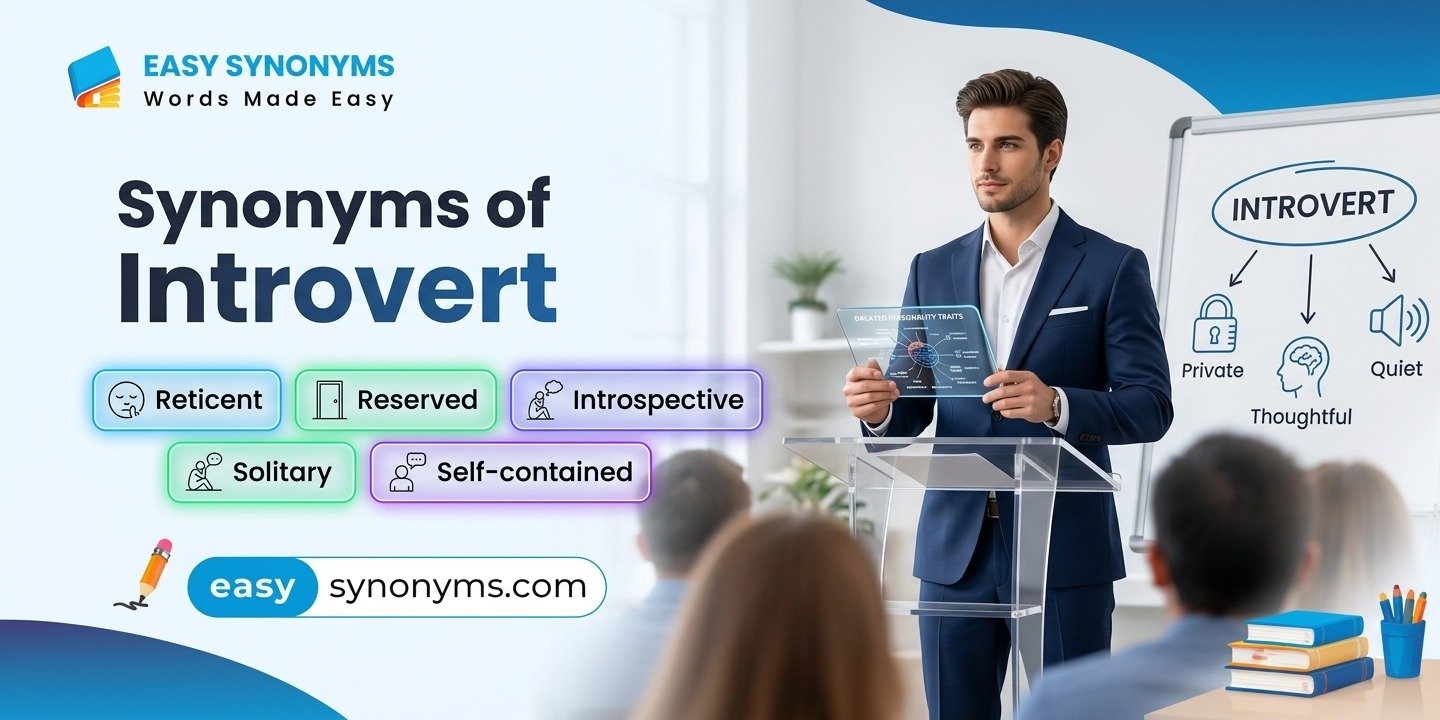
If you need a different way to say introvert, the best choice depends on what you mean. Reserved, private person, withdrawn, loner, and wallflower can all describe aspects of introversion, but they are not exact replacements in every sentence.
Some emphasize quietness, some solitude, and others social hesitation.
This guide explains the most useful synonyms for introvert, separates close synonyms from contextual alternatives, and shows which word sounds most natural in different situations. It also explains why shy, recluse, and antisocial should not automatically be treated as synonyms.
Quick Answer: What Are the Best Synonyms for Introvert?
The closest useful alternatives for introvert include private person, withdrawn person, self-contained person, reserved person, loner, wallflower, and introspective person. However, they emphasize different qualities. Private suggests limited self-disclosure, withdrawn suggests reduced social participation, and loner emphasizes spending time alone. Cambridge lists several of these as words related to introvert, while Merriam-Webster includes terms such as wallflower.
Core Synonyms for Introvert
| Word or phrase | Relationship | What it emphasizes | Best context | Tone |
| Private person | Near synonym | Keeping thoughts and personal life to oneself | Personal or professional descriptions | Neutral |
| Reserved person | Near synonym | Quiet, restrained social behavior | Personality descriptions | Neutral |
| Withdrawn person | Near synonym | Limited engagement with others | Behavior and social situations | Neutral to slightly negative |
| Self-contained person | Near synonym | Independence and emotional reserve | Personality or professional writing | Neutral/positive |
| Loner | Contextual alternative | Preference for being alone | Casual descriptions | Neutral to negative |
| Wallflower | Contextual alternative | Staying unnoticed in social settings | Parties and group situations | Informal |
| Introspective person | Contextual alternative | Focus on one’s own thoughts | Thoughtful or intellectual contexts | Positive/neutral |
| Contemplative person | Contextual alternative | Quiet reflection | Writing and thoughtful descriptions | Formal/positive |
| Shy person | Related, not exact | Nervousness or discomfort socially | Social behavior | Neutral |
| Recluse | Related, not exact | Strong withdrawal from society | Extreme isolation | Negative/strong |
| Hermit | Related, not exact | Living or spending substantial time in isolation | Extreme solitude | Strong/informal |
The distinction matters because an introvert is not necessarily shy, lonely, unfriendly, or socially incapable. Introversion primarily concerns a person’s preference for inward focus and, commonly, less stimulating social environments.
What Does “Introvert” Mean?
Introvert is primarily a noun when it refers to a person who tends toward introversion.
Pronunciation:
US: /ˈɪn.trə.vɝːt/
UK: /ˈɪn.trə.vɜːt/
An introvert is generally a person who tends to focus inward and may prefer spending time alone or in smaller social settings rather than constantly seeking large-group interaction. Dictionary.com specifically notes that introversion and shyness are often confused, even though they involve different motivations.
Example:
Maya is an introvert who enjoys spending quiet evenings reading.
The adjective is introverted:
Maya has an introverted personality.
The word can also function as a verb, although that use is much less common in everyday English.
1. Private Person
Private person is one of the most useful alternatives when you want to emphasize that someone does not readily share personal information.
It does not necessarily mean that the person avoids people. A private person can be highly social while still keeping personal matters to themselves.
Example:
Daniel is a private person and rarely discusses his personal life at work.
Choose this when: the emphasis is on privacy rather than solitude.
2. Reserved Person
Reserved describes someone who tends not to express their thoughts, feelings, or opinions openly.
It is one of the most natural alternatives when describing a quiet personality, especially in professional or formal writing.
Example:
Although she was reserved at first, she became more comfortable with the team over time.
Important distinction: Someone can be reserved without being an introvert. Likewise, an introvert can be talkative and socially confident in the right setting.
3. Withdrawn Person
Withdrawn suggests that someone participates less in social interaction or keeps away from others.
It can overlap with introversion, but it often carries a stronger suggestion of reduced social engagement.
Example:
He became more withdrawn after moving to a new city.
Best use: when describing observable behavior rather than a stable personality preference.
4. Self-Contained Person
A self-contained person tends to be comfortable operating independently and may not need constant interaction with others.
This expression can have a positive meaning, especially when describing someone who is independent and emotionally composed.
Example:
She is quiet and self-contained, preferring to solve problems independently.
Cambridge includes self-contained person among terms related to introvert.
5. Loner
A loner is someone who prefers to spend substantial time alone.
It is a useful alternative when solitude is the main idea, but it is not an exact synonym for introvert.
Example:
He’s something of a loner and often spends his weekends hiking alone.
Difference: Introvert describes a personality orientation; loner focuses more directly on a person’s tendency to be alone.
A person can be an introvert and still have many close friends.
6. Wallflower
Wallflower is an informal, often mildly sympathetic word for someone who remains quiet or unnoticed in a social gathering.
Example:
She was a wallflower at the party until someone invited her into the conversation.
Merriam-Webster lists wallflower among the synonyms or closely related alternatives for introvert.
Best context: parties, meetings, classrooms, and other social situations.
Do not use it as a general replacement for introvert. It focuses on visible behavior in social settings.
7. Introspective Person
An introspective person spends considerable time examining their own thoughts, feelings, and experiences.
This can overlap with introversion but describes self-reflection, not simply a preference for limited social interaction.
Example:
Her introspective nature makes her thoughtful about the decisions she makes.
Best use: essays, biographies, literary writing, and thoughtful personality descriptions.
8. Contemplative Person
Contemplative describes someone who spends time thinking deeply or quietly considering something.
It is more about reflection and thoughtfulness than social preference.
Example:
He has a contemplative personality and enjoys long periods of quiet reflection.
Use this when you want a more sophisticated or positive description rather than simply saying someone is quiet.
Words That Are Related but Not Exact Synonyms
Some commonly suggested alternatives need a warning.
Shy
Shy is probably the most important word not to confuse with introvert.
A shy person may feel nervous, self-conscious, or uncomfortable in social situations. An introvert may simply prefer less social stimulation without feeling nervous about interacting with people.
Example:
She’s an introvert, but she isn’t shy about speaking in meetings.
That sentence demonstrates why the two concepts should remain separate.
Dictionary.com explicitly distinguishes shyness from introversion, noting that their outward behavior can look similar while their underlying characteristics differ.
Recluse
A recluse is someone who deliberately avoids society or lives in considerable isolation.
It is much stronger than introvert.
He is an introvert who enjoys quiet weekends.
does not mean the same thing as:
He is a recluse who rarely interacts with anyone.
Hermit
Hermit traditionally describes someone who lives in seclusion, often away from ordinary society.
It is therefore a poor general substitute for introvert.
Antisocial
Antisocial should generally not be used as a synonym for introvert.
In everyday English, people sometimes use antisocial to mean someone who does not enjoy socializing. However, the term has other established meanings and can imply behavior that goes against social norms. Calling every introvert “antisocial” is therefore misleading.
Which Word Should You Use?
Use the following quick guide when choosing an alternative:
Choose “reserved” when:
You mean someone who speaks or expresses feelings cautiously.
Choose “private person” when:
You mean someone who keeps personal thoughts or information to themselves.
Choose “withdrawn” when:
You want to describe limited social participation or increasing social distance.
Choose “loner” when:
The main idea is that someone prefers spending time alone.
Choose “wallflower” when:
You are describing someone who stays quiet or unnoticed in a social gathering.
Choose “introspective” when:
The emphasis is on self-reflection and inner thought.
Choose “contemplative” when:
You want to emphasize deep, thoughtful reflection.
Choose “recluse” when:
The person is strongly isolated from society. Do not use it simply because someone is introverted.
Introvert vs. Reserved
These words overlap, but they describe different things.
| Introvert | Reserved |
| Describes a personality orientation | Describes outward behavior |
| Often associated with a preference for less social stimulation | Emphasizes restraint in expression |
| Does not necessarily mean quiet | Usually suggests less open expression |
| Can describe someone’s general personality | Often describes how someone behaves around others |
Example:
Liam is an introvert, but he is not particularly reserved with close friends.
This shows that the concepts can overlap without being identical.
Introvert vs. Shy
| Introvert | Shy |
| May prefer solitude or smaller social settings | May feel nervous or self-conscious socially |
| Does not inherently imply fear | Often involves social discomfort |
| Can be socially confident | May find social interaction difficult |
| Describes a personality tendency | Describes a social-emotional response |
Someone can be introverted but confident, shy but highly outgoing, or both introverted and shy.
Introvert vs. Loner
A loner emphasizes spending time alone. An introvert describes a broader personality tendency.
For example:
She is an introvert who enjoys dinner with a few close friends.
That person is not necessarily a loner.
By contrast:
He is a loner who usually chooses to spend his free time alone.
Here, loner is more precise because solitude is the central characteristic.
Common Collocations and Natural Alternatives
Different contexts call for different vocabulary.
| Context | Natural choice |
| Quiet personality | reserved |
| Keeps personal matters private | private person |
| Avoids social interaction | withdrawn |
| Likes spending time alone | loner |
| Quiet at parties | wallflower |
| Thinks deeply about personal experiences | introspective |
| Reflects deeply | contemplative |
| Strongly isolated from society | recluse |
| Lives in extreme seclusion | hermit |
For example, instead of forcing introvert into every context:
- an introverted employee → natural
- a reserved employee → natural
- a private employee → possible, but means something different
- a wallflower employee → unusual unless discussing social events
- a recluse employee → very strong and usually inappropriate
The most natural alternative depends on the exact quality you want to emphasize.
Common Mistakes
Mistake 1: Treating “shy” and “introvert” as identical
They can describe similar outward behavior, but they are not interchangeable.
Mistake 2: Calling an introvert “antisocial”
Introversion does not mean disliking people or behaving against social norms.
Mistake 3: Using “recluse” for anyone who enjoys solitude
A recluse suggests much stronger social isolation.
Mistake 4: Using “loner” when you mean thoughtful
If you want to describe someone who spends time examining their thoughts, introspective is more accurate.
Mistake 5: Using “wallflower” in every context
A wallflower specifically works well for someone who remains quiet or unnoticed in a social environment. It is not a universal replacement for introvert.
Antonyms of Introvert
The clearest antonym is extrovert or extroverted.
Other contextual opposites include:
- outgoing
- sociable
- gregarious
- social
- talkative
These are not all exact antonyms in every sentence, but they generally describe greater outward social engagement.
Cambridge lists extrovert and outgoing person as antonyms of introvert.
Frequently Asked Questions
What is the closest synonym for introvert?
There is no single perfect synonym in every context. Private person, reserved person, and withdrawn person are among the closest alternatives, while loner and wallflower describe specific aspects of introversion. Cambridge includes several of these terms among words related to introvert.
What is a positive word for introvert?
Introspective, contemplative, and self-contained can be positive alternatives when you want to emphasize thoughtfulness, reflection, or independence rather than social quietness.
Is “shy” a synonym for “introvert”?
Not exactly. Shy usually describes discomfort, nervousness, or self-consciousness in social situations, whereas introvert describes a personality tendency associated with inward focus and often a preference for less social stimulation.
What is a formal synonym for introvert?
In formal writing, reserved person, self-contained person, or introspective person may work depending on the intended meaning. The best choice depends on whether you are emphasizing social restraint, independence, or inward reflection.
What is another word for someone who likes being alone?
Loner is a common informal term. Private person, solitary person, or self-contained person may be more appropriate depending on the context. However, enjoying solitude does not automatically make someone an introvert.
Is “loner” the same as “introvert”?
No. A loner emphasizes spending time alone, while an introvert describes a broader personality orientation. An introvert may still enjoy close friendships and social activities.
Is “recluse” a synonym for introvert?
Not generally. Recluse implies much stronger withdrawal from society. It can describe an extremely isolated person, whereas an introvert may have an active social life and close relationships.
What is the opposite of introvert?
The most direct opposite is extrovert. Depending on the sentence, outgoing, sociable, and gregarious can also express contrasting characteristics.
Practice: Choose the Best Word
Choose the most precise word from reserved, private, loner, wallflower, introspective, and recluse.
1. Emma rarely talks about her family or personal life.
Answer: private
2. Jack spends most weekends alone and actively prefers his own company.
Answer: loner
3. Sarah barely speaks at parties and tends to remain unnoticed.
Answer: wallflower
4. David carefully examines his thoughts before making important decisions.
Answer: introspective
5. Maria speaks very little in meetings and rarely expresses her opinions openly.
Answer: reserved
6. The writer lives almost completely isolated from society.
Answer: recluse
The key lesson is that these words overlap with introvert but highlight different characteristics. Choosing the right alternative makes your writing more precise.
Conclusion
The best synonym for introvert depends on the quality you want to emphasize. Use reserved for restrained behavior, private person for limited self-disclosure, withdrawn for reduced social engagement, loner for a preference for solitude, and wallflower for quietness in social situations. For thoughtful personality descriptions, introspective and contemplative are often better choices.
Most importantly, do not treat shy, antisocial, recluse, or hermit as automatic substitutes. They carry meanings that can be substantially different from introvert. Precise synonym selection is less about finding a longer list of words and more about choosing the word that fits the intended meaning.

Michael Thompson is an English language specialist and experienced editor who focuses on vocabulary development and clear communication. He creates high-quality synonym guides, word comparisons, and writing tips to help students and professionals express their ideas more effectively. His work combines linguistic knowledge with practical SEO strategies to make learning both useful and engaging.