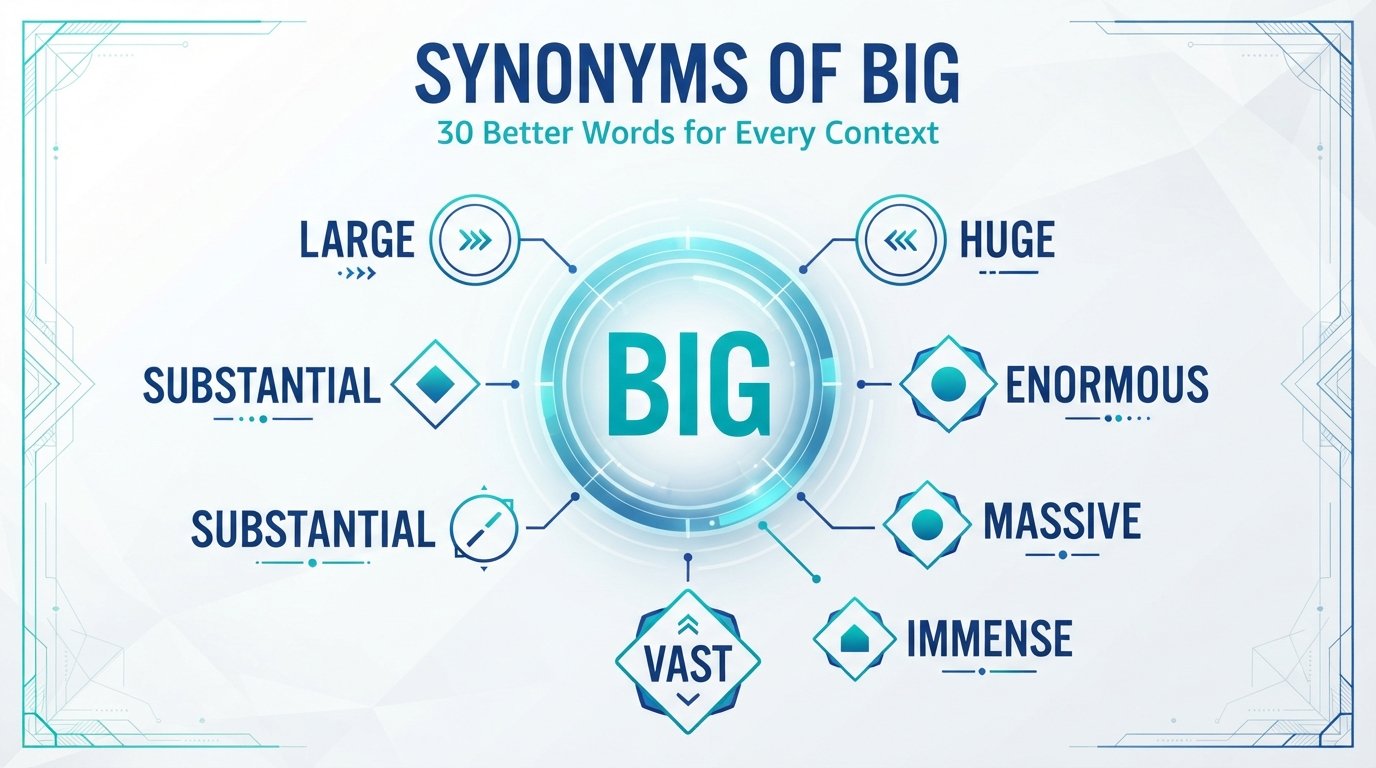
Finding a good synonym for big depends on what you mean. You might be describing physical size, a large amount, strong intensity, importance, influence, or an unusually high degree. Words such as large, huge, enormous, massive, immense, substantial, significant, major, and vast overlap with big, but they are not interchangeable in every sentence. This guide organizes 30 useful alternatives by meaning and context so you can choose a word that sounds natural and precise.
Quick Answer
The closest synonyms of big include large, huge, enormous, sizable, substantial, massive, immense, gigantic, and vast. However, the best choice depends on context. Use large for general size, huge for strong informal emphasis, substantial for amounts or degrees, major for importance, and vast for something extensive in size, area, or scope.
30 Synonyms of Big
| Word | Relationship | Best Context | Tone |
|---|---|---|---|
| Large | Direct synonym | General size or amount | Neutral |
| Huge | Strong synonym | Very large size or degree | Informal/neutral |
| Enormous | Strong synonym | Extremely large size or amount | Neutral |
| Sizable | Near synonym | Noticeably large amount or size | Neutral |
| Massive | Strong synonym | Heavy, solid, or extremely large things | Neutral |
| Immense | Strong synonym | Extremely large scale or extent | Formal |
| Gigantic | Strong synonym | Extremely large physical size | Neutral |
| Vast | Contextual synonym | Areas, amounts, ranges, or scope | Formal |
| Mammoth | Strong contextual alternative | Exceptionally large projects or tasks | Informal |
| Colossal | Strong synonym | Extremely large scale or size | Emphatic |
| Tremendous | Contextual alternative | Degree, amount, impact, or intensity | Emphatic |
| Substantial | Near synonym | Amount, size, value, or degree | Formal |
| Considerable | Near synonym | Significant amount or degree | Formal |
| Significant | Contextual alternative | Importance, effect, or amount | Formal |
| Major | Contextual alternative | Importance, seriousness, or scale | Neutral/formal |
| Important | Contextual alternative | Importance rather than physical size | Neutral |
| Great | Contextual alternative | Degree, importance, or intensity | Neutral |
| Extensive | Contextual alternative | Coverage, range, or scope | Formal |
| Expansive | Contextual alternative | Space, scope, or reach | Formal |
| Broad | Contextual alternative | Range, scope, or coverage | Neutral |
| Wide | Contextual alternative | Physical or figurative extent | Neutral |
| Bulky | Contextual alternative | Large and difficult-to-handle objects | Neutral |
| Oversized | Contextual alternative | Larger than the standard size | Neutral |
| Towering | Contextual alternative | Very tall people or structures | Descriptive |
| Gargantuan | Strong synonym | Extremely large things | Informal/emphatic |
| Monumental | Contextual alternative | Importance, scale, or achievement | Formal |
| Staggering | Contextual alternative | Surprisingly large numbers or amounts | Emphatic |
| Hefty | Contextual alternative | Large amounts, weights, or costs | Informal |
| Voluminous | Contextual alternative | Large quantity or volume | Formal |
| Astronomical | Contextual alternative | Extremely large numbers, costs, or amounts | Emphatic |
Important: Not all 30 words are interchangeable with big in every sentence. Several are contextual alternatives that become natural only when big expresses a particular meaning.
What Does “Big” Mean?
Big is a versatile adjective that commonly describes something large in physical size, amount, degree, importance, influence, or intensity.
For example:
- a big house — large in physical size
- a big amount of money — large in quantity
- a big problem — serious or important
- a big decision — important or consequential
- a big change — substantial or significant
- a big success — highly successful
- a big mistake — serious or consequential
This wide range of meanings explains why there is no single perfect synonym for big.
Closest Synonyms for Physical Size
When big describes the actual size of an object, place, animal, or person, these are usually the strongest alternatives.
1. Large
Large is the most straightforward neutral synonym for big. It works in many situations and is often interchangeable with big.
Example:
They bought a large house near the lake.
Best for: general physical size, quantities, and measurements.
2. Huge
Huge means very large and usually carries more emphasis than large.
A huge crowd gathered outside the stadium.
It is common in everyday English and works particularly well when the speaker wants to emphasize size.
3. Enormous
Enormous describes something exceptionally large in size, quantity, or degree.
The company received an enormous number of applications.
It is stronger than ordinary big and often suggests that the size is surprising.
4. Massive
Massive often suggests great physical size, weight, or bulk.
The workers moved a massive concrete block.
It can also describe abstract things such as massive investment or massive damage.
5. Immense
Immense means extremely large or extensive.
The project required an immense amount of funding.
It tends to sound more formal than huge.
6. Gigantic
Gigantic emphasizes exceptionally large physical size.
A gigantic statue stood at the entrance.
It is especially useful when the physical dimensions are striking.
Synonyms for Big Amounts and Degrees
Sometimes big refers to quantity rather than physical dimensions.
7. Sizable
Sizable means fairly or noticeably large.
The company made a sizable investment in research.
It is useful for amounts, profits, investments, portions, and groups.
8. Substantial
Substantial often describes a large or significant amount, degree, or value.
The renovation required a substantial investment.
It is especially natural in professional, financial, and academic writing.
9. Considerable
Considerable means fairly large in amount or degree.
The project required considerable effort.
This is a useful formal alternative when big sounds too casual.
10. Extensive
Extensive focuses on a wide range, coverage, or scope rather than simple physical size.
The researchers conducted extensive testing.
It works especially well with research, experience, damage, knowledge, analysis, and coverage.
11. Voluminous
Voluminous refers to a very large amount or volume.
The investigation generated a voluminous amount of documentation.
It is more specialized and formal than big.
Synonyms for Big Importance or Impact
A particularly important distinction is that big does not always mean physically large.
In phrases such as a big decision or a big problem, the intended meaning is often important, serious, or consequential.
12. Major
Major is one of the best alternatives when big means important or significant.
The company announced a major change to its policy.
13. Significant
Significant emphasizes importance, effect, or meaningful size.
The discovery had a significant impact on the field.
It is particularly useful in academic and professional writing.
14. Important
When big means important, important may be the clearest replacement.
This is a big decision.
becomes:
This is an important decision.
Unlike large, important directly expresses significance.
15. Monumental
Monumental describes something exceptionally important, consequential, or impressive in scale.
The agreement represented a monumental achievement.
It is much stronger and more dramatic than ordinary big.
Strong and Emphatic Synonyms for Big
When you want to emphasize an unusually high degree, stronger vocabulary can make the sentence more precise.
16. Colossal
Colossal means extremely large, often to an extraordinary degree.
The company faced a colossal financial loss.
17. Gargantuan
Gargantuan describes something exceptionally large.
The team faced a gargantuan task.
It is vivid and emphatic rather than neutral.
18. Mammoth
Mammoth is commonly used figuratively for something extremely large, difficult, or ambitious.
Completing the project was a mammoth undertaking.
19. Tremendous
Tremendous can describe a very high degree of size, strength, success, or impact.
The new system produced tremendous improvements.
It does not simply mean physically large, so context matters.
20. Staggering
Staggering emphasizes an amount or figure that is surprisingly large.
The company reported a staggering increase in costs.
It is especially effective with numbers, costs, losses, increases, and figures.
21. Astronomical
Astronomical is often used figuratively for extremely large numbers, prices, or amounts.
The project came with astronomical costs.
It is not normally a general replacement for big.
Context-Specific Alternatives for Big
Some words become better choices when you know exactly what big describes.
22. Vast
Use vast for very large areas, ranges, quantities, or scopes.
The country has vast natural resources.
Vast sounds natural with land, areas, amounts, knowledge, resources, and differences.
23. Expansive
Expansive emphasizes broad physical or figurative reach.
The company has an expansive international network.
24. Broad
Broad is useful when big refers to range, coverage, or scope.
The study takes a broad approach to the subject.
25. Wide
Wide works for physical dimensions and figurative range.
The campaign attracted a wide audience.
26. Bulky
Bulky describes something large and difficult to carry, store, or handle.
The old equipment was too bulky for the small room.
It adds a specific idea that big does not necessarily contain.
27. Oversized
Oversized means larger than the standard or expected size.
The package contained an oversized item.
This is more precise than simply saying big.
28. Towering
Towering is useful for something exceptionally tall.
A towering building dominated the skyline.
It should not be treated as a general synonym for big.
29. Hefty
Hefty can describe a large weight, amount, cost, or quantity.
The repair came with a hefty price tag.
It is more conversational than substantial.
30. Great
Great can mean large in degree or extent, although it is not always interchangeable with big.
The decision was of great importance.
It is particularly useful in established phrases such as great importance, great difficulty, great value, and great concern.
Big vs. Large: What’s the Difference?
Big and large are often interchangeable when describing physical size or quantity.
| Big | Large |
|---|---|
| More conversational | More neutral/formal |
| Very common in everyday speech | Common in writing and speech |
| Broad range of meanings | Often more literal or measurable |
| Can express importance or intensity | Usually emphasizes size or amount |
For example:
She lives in a big house.
and:
She lives in a large house.
both sound natural.
However, big is more flexible in expressions such as big mistake, big decision, big deal, and big success, where large would often sound unnatural.
Big vs. Huge
Huge is generally stronger than big.
- big house → large house
- huge house → exceptionally large house
Compare:
They bought a big house.
with:
They bought a huge house.
The second sentence creates a stronger impression of size.
Big vs. Massive
Massive often suggests great physical size, weight, density, or scale.
They built a big wall.
They built a massive concrete wall.
The second sentence emphasizes not only size but also the wall’s substantial physical presence.
Big vs. Significant
These words overlap when big means important, but they are not interchangeable in every context.
This was a big change.
This was a significant change.
The second sentence sounds more precise and formal. Significant is particularly appropriate in academic, professional, and analytical writing.
Which Word Should You Use?
Use large when:
You need a neutral alternative for physical size or quantity.
Use huge when:
You want to emphasize that something is very large.
Use enormous when:
The size or amount is exceptionally large.
Use substantial when:
You are describing a considerable amount, value, or degree.
Use major when:
Big means important or consequential.
Use significant when:
You want a formal word for importance, effect, or meaningful size.
Use vast when:
You are describing extensive space, range, scope, or resources.
Use massive when:
You want to emphasize physical bulk, weight, or large-scale impact.
Use colossal or gargantuan when:
You deliberately want an extremely strong and dramatic description.
Common Mistakes When Choosing a Synonym for Big
1. Treating every synonym as interchangeable
Words such as towering, astronomical, bulky, and major have specific meanings. They cannot replace big in every sentence.
2. Using “large” for importance
❌ This is a large decision.
✅ This is a major decision.
When big means important, major or significant is usually more natural.
3. Using “huge” in formal writing unnecessarily
Huge is perfectly normal English, but substantial, considerable, or significant may be more appropriate in formal contexts.
4. Confusing size with scope
Vast is especially useful for areas, ranges, resources, and scope. It does not simply mean “big” in every situation.
5. Choosing a stronger word than the meaning requires
Replacing every instance of big with colossal or gigantic can make writing sound exaggerated. Precision matters more than intensity.
FAQ About Synonyms of Big
What is the best synonym for big?
Large is usually the closest neutral synonym when big refers to physical size or quantity. However, major, significant, substantial, or huge may be better when big expresses importance, amount, or intensity.
What is a stronger word for big?
Depending on context, stronger alternatives include huge, enormous, immense, massive, gigantic, colossal, and gargantuan. The best choice depends on whether you are emphasizing size, scale, weight, or degree.
What is a formal synonym for big?
Good formal alternatives include large, substantial, considerable, significant, extensive, immense, and major. Choose according to meaning rather than formality alone.
What is another word for big in academic writing?
Significant, substantial, considerable, extensive, major, and large are often useful in academic writing. The appropriate word depends on whether big refers to amount, effect, scope, importance, or physical size.
What is a synonym for big when it means important?
Use major, significant, important, consequential, or substantial, depending on the sentence. For example, “a big decision” can naturally become “a major decision.”
Is huge stronger than big?
Generally, yes. Huge usually emphasizes a much greater size or degree than ordinary big. However, the exact strength depends on context and speaker intention.
What is the difference between big and large?
Both commonly describe size or quantity, but big is more conversational and has a wider range of figurative uses. Large often sounds more neutral and is especially common in formal or measurable contexts.
Can big and great mean the same thing?
Sometimes, but not always. Great can express a high degree, importance, value, or intensity, while big is broader and more conversational. They overlap in expressions such as “great importance” and “big importance,” although the latter is less natural.
Conclusion
The best synonym for big depends on what you are actually trying to express. Large is the safest general alternative, while huge, enormous, massive, and gigantic emphasize size. For amounts, substantial and considerable are often more precise. When big means important, major and significant are usually stronger choices. For scope, vast and extensive work well. Choosing by meaning and context—not simply by synonym length—will make your writing more natural, precise, and effective.

Michael Thompson is an English language specialist and experienced editor who focuses on vocabulary development and clear communication. He creates high-quality synonym guides, word comparisons, and writing tips to help students and professionals express their ideas more effectively. His work combines linguistic knowledge with practical SEO strategies to make learning both useful and engaging.