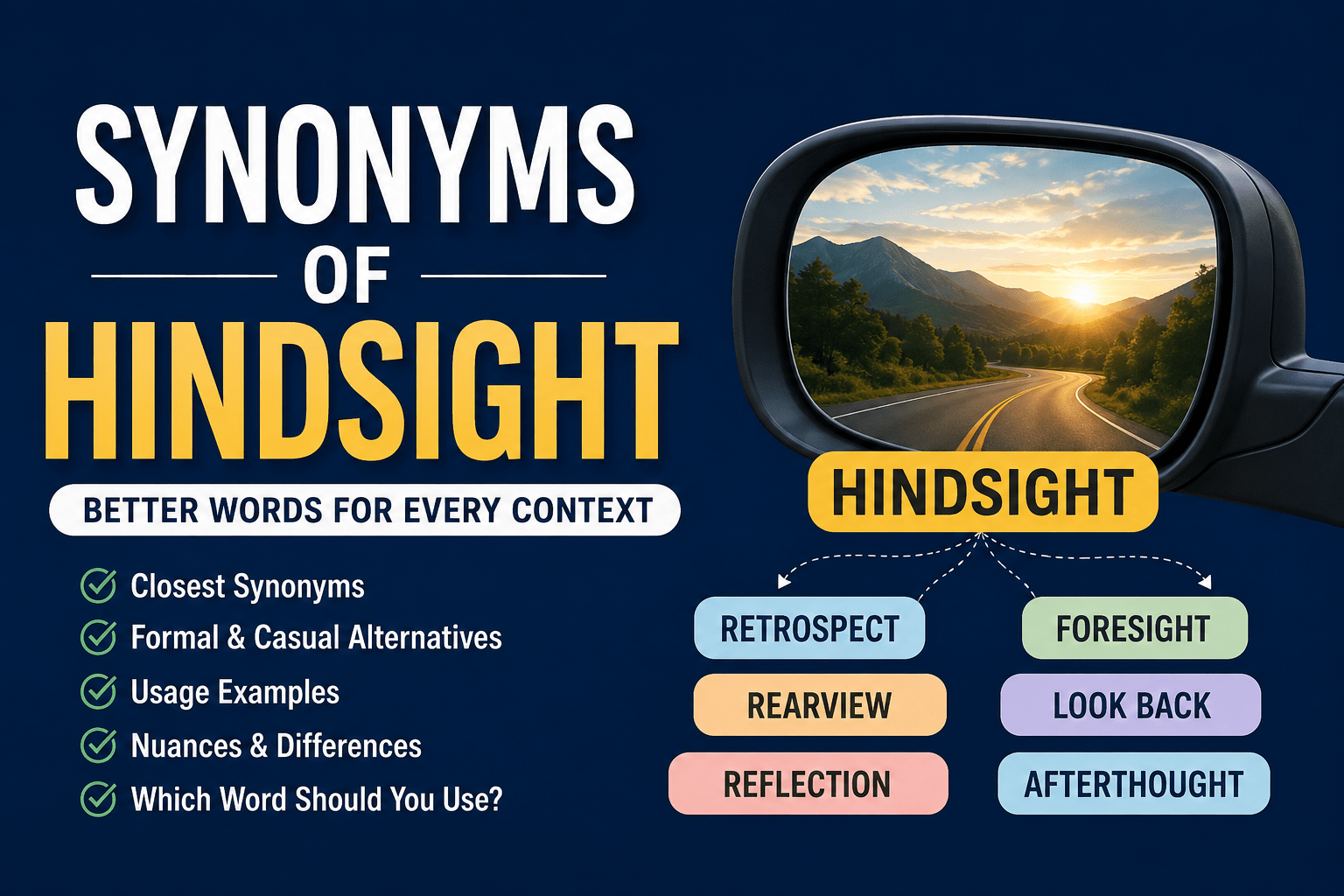
When you need another word for hindsight, the closest choice is usually retrospect. Depending on the sentence, however, retrospection, reflection, reassessment, or the phrase looking back may be more natural.
The important distinction is that these words are not interchangeable in every context. Hindsight specifically involves understanding an event after it has happened, often with knowledge that was unavailable at the time. Cambridge, Oxford, and Merriam-Webster all emphasize this retrospective element.
This guide separates true synonyms from near synonyms and contextual alternatives so you can choose the most precise word.
Quick Answer
The closest synonyms of hindsight are retrospect and retrospection. Reflection is a useful near synonym when the emphasis is on thinking about the past, while reassessment works when someone evaluates a past decision again. Looking back is a natural conversational alternative. Afterthought is related but usually means a thought or addition that occurs later, so it is not a direct synonym.
What Does “Hindsight” Mean?
Hindsight is a noun meaning the ability to understand an event, decision, or situation more clearly after it has happened. It often involves recognizing what went wrong, what could have been done differently, or why an outcome occurred.
Part of speech: noun
Countability: usually uncountable
Pronunciation: /ˈhaɪnd.saɪt/ (UK and US)
For example:
In hindsight, I should have waited before making the decision.
The speaker now has information that was unavailable when the decision was made.
Common expressions include:
- in hindsight
- with hindsight
- with the benefit of hindsight
- with the wisdom of hindsight
- 20/20 hindsight
These phrases are especially common when discussing past decisions or outcomes.
The Best Synonyms of Hindsight
Not every word below is a perfect substitute. The table distinguishes direct and near alternatives.
| Word or phrase | Relationship | Formality | Best use |
|---|---|---|---|
| Retrospect | Closest synonym | Neutral–formal | Understanding or considering something after it happened |
| Retrospection | Direct/near synonym | Formal | Deliberate examination of the past |
| Reflection | Near synonym | Neutral | Thoughtful consideration of past experiences |
| Reassessment | Contextual alternative | Neutral–formal | Evaluating a past decision or situation again |
| Re-examination | Contextual alternative | Formal | Looking at a past matter again in detail |
| Review | Contextual alternative | Neutral–formal | Systematic examination of a past event or decision |
| Looking back | Natural contextual alternative | Casual–neutral | Everyday reference to considering the past |
| Second look | Contextual alternative | Casual | Reconsidering something after more information |
| Reconsideration | Contextual alternative | Formal | Thinking again about a previous judgment or choice |
| Retrospective perspective | Contextual phrase | Formal | Analysis based on knowledge gained later |
Collins lists retrospect, review, afterthought, and re-examination among words associated with hindsight, but these alternatives cover different meanings and should not be treated as interchangeable in every sentence.
1. Retrospect
Retrospect is generally the closest one-word alternative to hindsight.
It refers to considering or understanding something after the event, especially when looking back from the present.
Example:
In retrospect, accepting the offer was the right decision.
Best when: You want a concise, natural, slightly more formal alternative to hindsight.
Hindsight vs retrospect:
Hindsight often highlights the advantage of knowing the outcome, while retrospect more broadly emphasizes looking back at something from the present.
2. Retrospection
Retrospection means examination or contemplation of the past.
It is more formal and less common in everyday conversation than hindsight or retrospect.
Example:
His retrospection led him to reconsider several assumptions about the project.
Best when: Writing is academic, analytical, literary, or deliberately formal.
It is usually not the best choice for casual conversation.
3. Reflection
Reflection is a useful near synonym when the focus is on thoughtful consideration of past experiences.
Example:
After some reflection, she realized that the warning signs had been obvious.
The distinction matters: reflection does not necessarily require hindsight. You can reflect on something while still experiencing it or immediately afterward.
Best when: You want to emphasize thought, consideration, or personal learning rather than knowledge gained from the outcome.
4. Reassessment
Reassessment means evaluating something again, usually after obtaining new information or a new perspective.
Example:
The failure prompted a reassessment of the company’s strategy.
It overlaps with hindsight when someone revisits a past decision, but it does not mean hindsight itself.
Best when: Discussing decisions, policies, strategies, plans, or judgments.
5. Re-examination
Re-examination emphasizes looking at something again, often carefully or systematically.
Example:
A re-examination of the evidence revealed several overlooked details.
This is particularly useful in academic, professional, legal, or analytical writing.
6. Review
Review can work when hindsight involves systematically examining a past event.
Example:
The post-project review identified several weaknesses in the original plan.
But review is broader than hindsight. A review can happen without the retrospective insight implied by hindsight.
7. Looking Back
Looking back is one of the most natural conversational alternatives.
Example:
Looking back, I think we made the right choice.
It communicates the same basic retrospective viewpoint without sounding formal.
Best when: Conversation, personal writing, interviews, blogs, and informal communication.
8. Second Look
Second look works when the idea is specifically to reconsider something after gaining additional information.
Example:
With what we know now, the decision deserves a second look.
It is not a direct synonym for hindsight, but it can replace the concept in certain sentences.
9. Reconsideration
Reconsideration focuses on thinking about a previous decision or opinion again.
Example:
The new evidence led to a reconsideration of the original conclusion.
Use it when the important idea is changing or revisiting a judgment, rather than simply recognizing something in hindsight.
Closest Synonyms vs Contextual Alternatives
A useful way to understand the vocabulary is to separate words that genuinely overlap with hindsight from words that only work in particular situations.
Closest alternatives
- Retrospect
- Retrospection
These most directly express a backward-looking understanding or examination.
Strong near synonyms
- Reflection
- Reassessment
- Re-examination
These overlap with hindsight but add their own meaning.
Contextual alternatives
- Review
- Looking back
- Second look
- Reconsideration
These can express similar ideas in particular sentences but should not automatically replace hindsight.
Related but not synonymous
- Afterthought
- Regret
- Insight
- Foresight
- Perspective
- Memory
These words can occur in discussions about hindsight but have distinct meanings.
Hindsight vs Retrospect
These are the two words most likely to be confused.
| Hindsight | Retrospect | |
| Core idea | Understanding after an event | Looking back at something |
| Outcome knowledge | Often important | Not necessarily emphasized |
| Typical tone | Neutral | Neutral to formal |
| Common phrase | In hindsight | In retrospect |
| Everyday use | Very common | Common |
| Example | In hindsight, we should have waited. | In retrospect, we should have waited. |
The two sentences are very close in meaning.
However, hindsight strongly suggests the advantage of knowing what happened afterward. Merriam-Webster defines it as perception of an event’s nature after it has happened, while Oxford similarly emphasizes understanding gained after the event and the possibility of seeing what should have been done differently.
Hindsight vs Reflection
Hindsight requires a retrospective perspective.
Reflection is broader.
Compare:
In hindsight, the warning signs were obvious.
After some reflection, I decided to apologize.
The first sentence focuses on knowledge gained after events unfolded. The second focuses on thoughtful consideration.
So, use hindsight when timing and later knowledge matter. Use reflection when thoughtful consideration is the main idea.
Hindsight vs Reassessment
Reassessment means evaluating something again.
In hindsight, the strategy was too ambitious.
The results led to a reassessment of the strategy.
The first sentence describes a later understanding. The second describes an active process of evaluating the strategy again.
They can overlap, but they perform different semantic jobs.
Hindsight vs Afterthought
Afterthought is often mistakenly treated as a synonym for hindsight.
It is not a close substitute.
An afterthought is a thought, idea, or addition that occurs later, often after the main thought or decision has already been made.
For example:
The final paragraph felt like an afterthought.
That does not mean the paragraph involved retrospective understanding.
Use hindsight for later understanding; use afterthought for something considered or added afterward.
Hindsight vs Foresight
These words describe opposite directions in time.
Hindsight = understanding the past after events occur.
Foresight = anticipating future events or consequences.
With hindsight, the mistake was obvious.
Her foresight helped the company prepare for the downturn.
Oxford explicitly contrasts hindsight with foresight.
Another Way to Say “In Hindsight”
If you want alternatives to the phrase in hindsight, choose according to tone:
Natural and common
- In retrospect
- Looking back
- Looking back now
In retrospect, we made the right decision.
Looking back, we made the right decision.
More formal
- Upon reflection
- On reflection
- From a retrospective perspective
Upon reflection, the original approach was too risky.
When reassessment is intended
- After reassessing the situation
- On reconsideration
- After reviewing the decision
These are not exact replacements in every sentence, but they can communicate the intended idea more precisely.
Synonyms by Context
For everyday conversation
Prefer:
- looking back
- in retrospect
- thinking back
Example:
Looking back, I probably should have asked more questions.
For academic writing
Prefer:
- retrospect
- retrospection
- reflection
- reassessment
- re-examination
Example:
A retrospective assessment reveals several weaknesses in the original methodology.
For professional writing
Prefer:
- retrospect
- reassessment
- review
- re-examination
Example:
In retrospect, the organization underestimated the implementation risks.
For personal reflection
Prefer:
- reflection
- looking back
- retrospect
Example:
After reflecting on the experience, she recognized how much she had learned.
Natural Collocations with Hindsight
Some expressions are much more natural than others.
Common expressions
- in hindsight
- with hindsight
- with the benefit of hindsight
- with the wisdom of hindsight
- the advantage of hindsight
- 20/20 hindsight
- hindsight bias
Examples:
In hindsight, the decision seems obvious.
With the benefit of hindsight, we can identify several warning signs.
The team reviewed the decision without the benefit of hindsight.
Cambridge specifically records in hindsight, with hindsight, the benefit of hindsight, and the wisdom of hindsight as established expressions.
How Strong Is Each Alternative?
The following is an editorial guide rather than a scientific scale.
| Word | Retrospective meaning | Main nuance |
| Hindsight | Very strong | Later understanding based on what happened |
| Retrospect | Very strong | Looking back from the present |
| Retrospection | Very strong | Formal examination of the past |
| Reflection | Moderate | Thoughtful consideration |
| Reassessment | Moderate | Evaluating something again |
| Re-examination | Moderate | Detailed second examination |
| Review | Moderate | Systematic examination |
| Looking back | Strong in context | Natural backward-looking expression |
| Reconsideration | Context-dependent | Revisiting a judgment |
| Afterthought | Weak | Later thought, not retrospective insight |
Common Mistakes
Mistake 1: Treating every related word as a synonym
Words such as regret, insight, memory, and foresight are related to ideas that can surround hindsight, but they do not mean the same thing.
Mistake 2: Using “afterthought” as a direct replacement
An afterthought is something considered later; hindsight is understanding gained after an event.
Mistake 3: Assuming hindsight always means regret
Hindsight can reveal mistakes, but it can also confirm that a decision was sensible.
In hindsight, postponing the launch was the right decision.
There is no necessary feeling of regret in this sentence.
Mistake 4: Confusing hindsight with foresight
Hindsight looks backward. Foresight looks ahead.
Mistake 5: Overusing “retrospection”
Although grammatically valid, retrospection is more formal and less conversational than hindsight or retrospect.
Antonyms of Hindsight
The clearest conceptual opposite is foresight: the ability to anticipate future events or consequences.
Other contrasting concepts include:
- anticipation
- forethought
- prediction
- prescience
These are not exact antonyms in every context, but they represent forward-looking thinking rather than retrospective understanding.
Frequently Asked Questions
What is the closest synonym for hindsight?
Retrospect is generally the closest everyday synonym. Retrospection is also closely related but more formal. Reflection is broader and does not necessarily imply that the insight came after an event.
What is another word for hindsight?
Depending on context, you can use retrospect, retrospection, reflection, reassessment, or looking back. The best choice depends on whether you mean retrospective understanding, thoughtful consideration, or reevaluation.
What is a formal synonym for hindsight?
Retrospection is a formal alternative. Retrospect, reassessment, and re-examination can also work well in formal or academic writing, depending on the intended meaning.
Is “retrospect” the same as “hindsight”?
They are very close, especially in phrases such as “in retrospect” and “in hindsight.” Hindsight more strongly emphasizes knowledge gained after an event, while retrospect broadly describes looking back on something from the present.
Is “reflection” a synonym for hindsight?
Reflection is a near synonym, not a perfect synonym. Reflection means thoughtful consideration and does not necessarily require the event to have already ended or its outcome to be known.
Is “afterthought” a synonym for hindsight?
No. An afterthought is a thought or addition that occurs later. Hindsight is the understanding gained after an event has happened.
What is the opposite of hindsight?
Foresight is the clearest opposite. Hindsight involves understanding the past after events occur, while foresight involves anticipating future events or consequences.
What is another way to say “in hindsight”?
Common alternatives include in retrospect, looking back, and upon reflection. Choose in retrospect when you want the closest natural replacement; choose looking back for a more conversational tone.
Conclusion
The best synonym for hindsight is usually retrospect, especially when you mean looking back at an event with knowledge of its outcome. Retrospection offers a more formal alternative, while reflection, reassessment, and re-examination work when the sentence emphasizes a particular aspect of looking back.
For everyday writing, in retrospect and looking back are often the most natural alternatives to in hindsight. Just remember that words such as afterthought, regret, insight, and foresight have different meanings and should not be substituted automatically.

Michael Thompson is an English language specialist and experienced editor who focuses on vocabulary development and clear communication. He creates high-quality synonym guides, word comparisons, and writing tips to help students and professionals express their ideas more effectively. His work combines linguistic knowledge with practical SEO strategies to make learning both useful and engaging.