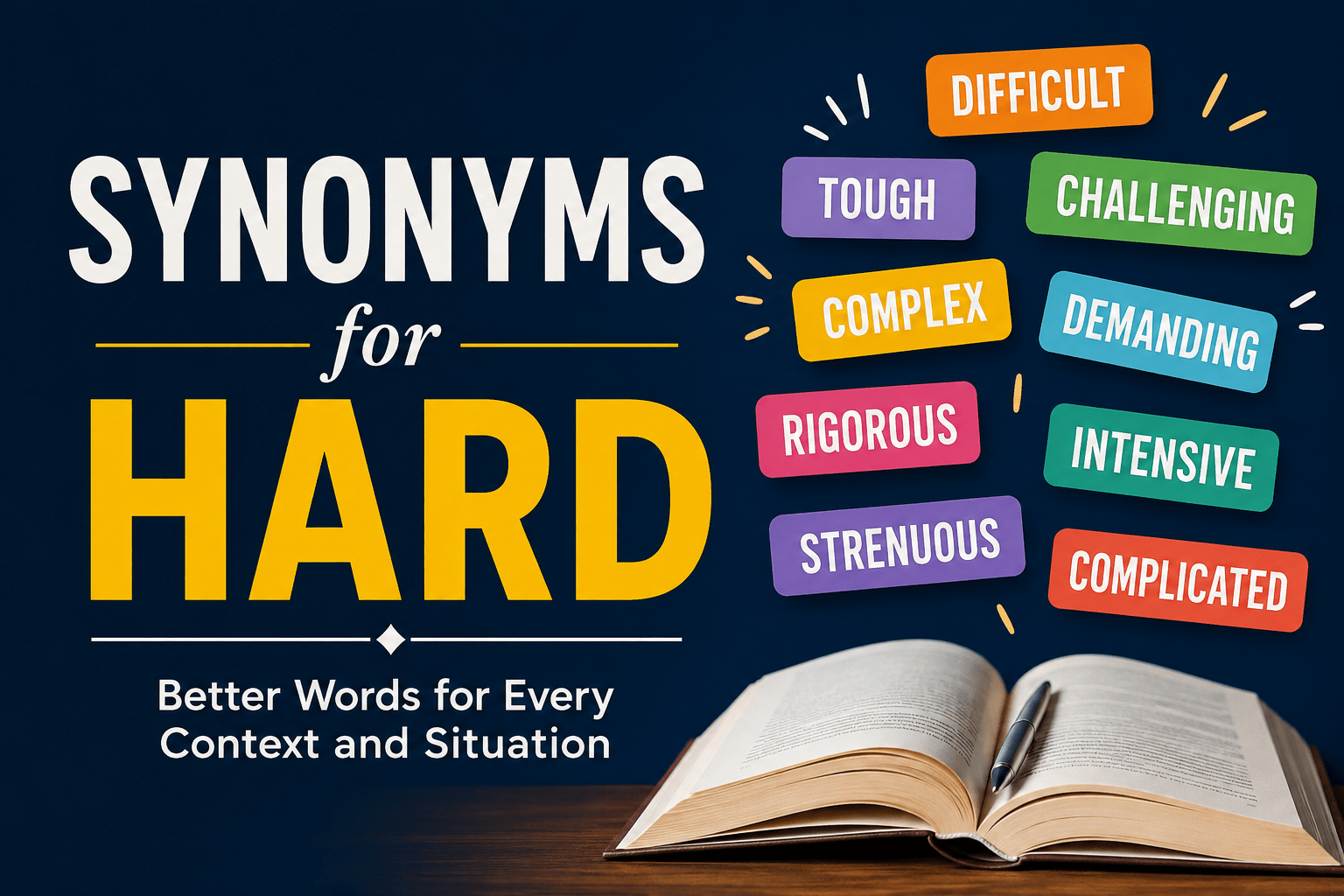
Finding the right synonym for hard depends on what you mean by it. When hard means difficult, the closest alternatives include difficult, challenging, tough, demanding, arduous, complicated, complex, tricky, strenuous, and formidable. But these words are not interchangeable in every sentence.
For example, a challenging assignment suggests that something tests your ability, while an arduous journey emphasizes sustained effort. A complicated problem may be difficult because it has many interconnected parts. Choosing the right alternative therefore depends on the type and degree of difficulty you want to express.
This guide separates genuine synonyms from contextual alternatives and shows how native English speakers use them.
Quick Answer: What Are the Best Synonyms of Hard?
The closest general synonym for hard meaning “difficult” is difficult. Other useful alternatives include challenging, tough, demanding, arduous, strenuous, formidable, tricky, complicated, complex, and exacting. The best choice depends on context: challenging often suggests a test of ability, arduous emphasizes prolonged effort, and complicated focuses on complexity.
What Does “Hard” Mean?
Hard is an adjective with several meanings. In the sense relevant to this article, it means difficult to do, understand, experience, or deal with. It can describe a task, question, decision, situation, experience, or problem:
- a hard exam
- a hard question
- a hard decision
- a hard situation
- a hard problem
- a hard life
Cambridge also identifies other major senses of hard, including something that is physically firm, something requiring considerable effort, something severe or unpleasant, and the adverbial sense of doing something with considerable effort or force.
Part of speech: adjective and adverb
US pronunciation: /hɑrd/
UK pronunciation: /hɑːd/
The key distinction
Compare:
The exam was hard.
Here, hard means difficult.
But:
The table is hard.
Here, hard means firm and not easily bent or damaged.
And:
She worked hard.
Here, hard is an adverb meaning with a lot of effort.
So the correct synonym depends on the particular sense of hard.
Core Synonyms of Hard
When hard = difficult, these are among the most useful alternatives:
| Word | Relationship | Strength | Formality | Best Context |
|---|---|---|---|---|
| difficult | Direct synonym | Equal | Neutral | General use |
| challenging | Near synonym | Moderate–strong | Neutral | Tasks that test ability |
| tough | Near synonym | Strong | Neutral/informal | Problems, decisions, experiences |
| demanding | Near synonym | Strong | Neutral/formal | Work, jobs, tasks |
| arduous | Near synonym | Very strong | Formal | Long, tiring effort |
| strenuous | Contextual alternative | Strong | Formal/neutral | Physical or sustained effort |
| formidable | Near synonym | Strong | Formal | Difficult task or opponent |
| complicated | Contextual alternative | Variable | Neutral | Problems with many parts |
| complex | Contextual alternative | Variable | Neutral/formal | Systems, ideas, problems |
| tricky | Near synonym | Moderate | Informal/neutral | Situations requiring care |
| exacting | Near synonym | Strong | Formal | High standards or precision |
| laborious | Contextual alternative | Strong | Formal | Work requiring much time and effort |
Cambridge’s thesaurus distinguishes several of these according to the particular kind of difficulty involved, including difficult, arduous, laborious, strenuous, tough, exacting, and formidable.
1. Difficult
Meaning: Not easy to do, understand, experience, or deal with.
How it differs: This is the safest and most direct replacement for hard when hard means “not easy.”
Best used for: Almost any general situation involving difficulty.
Example:
The final exam was extremely difficult.
Best choice when: You want a neutral, precise word without adding a special nuance.
2. Challenging
Meaning: Difficult in a way that tests someone’s ability, skill, determination, or knowledge.
How it differs: Challenging often sounds more constructive or positive than hard or difficult. It suggests that the difficulty provides a worthwhile test.
Example:
The course was challenging, but I learned a great deal.
Cambridge defines challenging as difficult in a way that tests ability or determination.
Best choice for: Work, education, projects, careers, physical activities, and intellectually demanding tasks.
3. Tough
Meaning: Difficult to deal with, complete, or endure.
How it differs: Tough is especially natural when discussing difficult experiences, decisions, periods of life, negotiations, or circumstances.
Examples:
It was a tough decision to leave the company.
She went through a tough year.
Tough is a particularly natural alternative in phrases such as tough decision, tough assignment, tough job, and tough time.
Register: Neutral to informal.
4. Demanding
Meaning: Requiring a lot of effort, ability, attention, or time.
How it differs: Demanding emphasizes what a task requires from you, rather than simply saying that it is difficult.
Example:
Nursing can be a physically and emotionally demanding profession.
Best choice for: Jobs, schedules, courses, projects, responsibilities, and activities.
5. Arduous
Meaning: Requiring a great deal of effort, especially over a prolonged period.
How it differs: Arduous is stronger and more formal than everyday hard. It often suggests that something is tiring, laborious, and sustained.
Example:
The team completed the arduous task of restoring the historic building.
Best choice for: Formal writing, long processes, difficult journeys, demanding work, and sustained physical or mental effort.
6. Strenuous
Meaning: Requiring considerable physical or mental effort.
How it differs: Strenuous is particularly associated with effort and exertion, especially physical activity.
Example:
The hikers prepared for a strenuous climb.
It can also describe mental or professional activity, but it is especially natural when substantial effort is involved.
Best choice for: Exercise, climbing, physical work, demanding activity, and intensive effort.
7. Formidable
Meaning: Very difficult to deal with, overcome, or achieve.
How it differs: Formidable often emphasizes that something presents a serious challenge and may be difficult to overcome.
Examples:
She faced a formidable opponent in the final.
The researchers confronted a formidable technical problem.
Register: Neutral to formal.
Best choice for: Opponents, obstacles, challenges, tasks, and problems that appear particularly difficult.
8. Complicated
Meaning: Difficult because something contains many connected parts or details.
How it differs: Complicated does not simply mean “very hard.” It identifies complexity as the source of difficulty.
Example:
The instructions were too complicated to follow.
Best choice for: Instructions, procedures, systems, explanations, rules, and problems involving many elements.
9. Complex
Meaning: Consisting of many interconnected or difficult-to-understand parts.
How it differs: Complex is often more neutral and technical than complicated. It does not necessarily imply that something is badly designed or unnecessarily difficult.
Example:
Climate systems are extremely complex.
This distinction matters in professional and academic writing: something can be complex without being problematic.
10. Tricky
Meaning: Difficult because it requires care, skill, judgment, or careful handling.
How it differs: Tricky often suggests that the difficulty is subtle rather than overwhelming.
Examples:
This is a tricky question.
Negotiating the contract could be tricky.
Register: Informal to neutral.
Best choice for: Questions, situations, decisions, technical details, and tasks where mistakes are easy to make.
11. Exacting
Meaning: Requiring a very high degree of skill, precision, effort, or attention.
How it differs: Exacting emphasizes high demands or standards.
Example:
The position requires exacting attention to detail.
Best choice for: Professional work, standards, procedures, craftsmanship, and tasks demanding precision.
12. Laborious
Meaning: Requiring considerable time and effort, often in a tedious way.
How it differs: Unlike challenging, which can sound positive, laborious often carries a negative suggestion that the work is long, tiring, or tedious.
Example:
Manually checking thousands of records was a laborious process.
Best choice for: Repetitive work, lengthy processes, manual tasks, and time-consuming activities.
Synonyms of Hard by Context
The most useful synonym is often determined by why something is hard.
For a difficult task
Use:
- difficult
- challenging
- demanding
- arduous
- formidable
Completing the project was challenging.
For a difficult question
Use:
- difficult
- challenging
- tricky
- complicated
- complex
The interviewer asked a tricky question.
For a difficult job
Use:
- demanding
- challenging
- strenuous
- arduous
- difficult
It is a highly demanding job.
For a difficult decision
Use:
- tough
- difficult
- challenging
- agonizing (when emotionally painful)
It was a tough decision.
For a difficult experience
Use:
- tough
- difficult
- painful
- distressing
- challenging
She went through a tough period after losing her job.
For difficult physical activity
Use:
- strenuous
- arduous
- demanding
- exhausting
- challenging
The expedition involved a strenuous climb.
For a difficult system or problem
Use:
- complex
- complicated
- intricate
- difficult
- challenging
The software has a complex architecture.
Formal Synonyms for Hard
If you are writing an academic, professional, or formal document, consider:
- difficult
- challenging
- demanding
- arduous
- formidable
- strenuous
- exacting
- laborious
- complex
- intricate
However, formal does not automatically mean better.
For example:
The project was difficult.
is often better than:
The project was arduous.
unless the project genuinely required prolonged, exhausting effort.
Likewise, replacing every instance of hard with an elaborate synonym can make writing less natural rather than more sophisticated.
Casual Alternatives to Hard
In everyday conversation, these are particularly natural:
- difficult
- tough
- tricky
- challenging
- a pain (contextual and informal)
- rough (especially for experiences or periods)
Examples:
That exam was tough.
This part is tricky.
We’ve had a rough few months.
Be careful with a pain: it means something is annoying or troublesome, not simply intellectually difficult.
Which Word Should I Use?
A quick decision guide:
Use difficult
when you simply mean not easy.
It was a difficult exam.
Use challenging
when the difficulty tests ability or determination.
It was a challenging assignment.
Use tough
when describing a difficult decision, experience, period, or situation.
It was a tough decision.
Use demanding
when something requires considerable effort, time, or attention.
She has a demanding job.
Use arduous
when something requires prolonged and substantial effort.
They completed an arduous journey.
Use strenuous
when the emphasis is on physical or sustained exertion.
It was a strenuous workout.
Use complicated
when the difficulty comes from many parts or details.
The procedure is complicated.
Use complex
when something has many interconnected elements, especially in technical or academic contexts.
The problem is complex.
Use tricky
when something requires care, skill, or judgment.
It’s a tricky situation.
Use formidable
when something presents a serious obstacle or challenge.
They faced a formidable opponent.
Hard vs Difficult vs Challenging vs Tough
These four words overlap considerably, but their typical uses differ.
| Word | Main idea | Typical tone | Example |
|---|---|---|---|
| hard | Not easy | Everyday | The test was hard. |
| difficult | Not easy | Neutral | The test was difficult. |
| challenging | Tests ability | Often positive | The test was challenging. |
| tough | Difficult to handle or endure | Informal/neutral | The test was tough. |
Hard vs difficult
These are the closest general equivalents.
The exam was hard.
The exam was difficult.
Both are completely natural.
Difficult is somewhat more neutral and is often preferred in formal writing.
Hard vs challenging
Challenging adds the idea of a test.
The assignment was hard.
simply says the assignment was difficult.
The assignment was challenging.
suggests that it required skill, thought, or determination.
Hard vs tough
Tough is especially natural for difficult circumstances and experiences:
It was a tough year.
You could say It was a hard year, too, but tough has a particularly conversational feel.
Hard vs complicated
These are not always interchangeable.
The problem is hard.
means it is difficult.
The problem is complicated.
suggests that its complexity contributes to the difficulty.
Synonym Strength: How Strong Are These Words?
There is no objective numerical scale for synonym strength, because context changes how intense a word sounds. As practical editorial guidance:
| Word | Approximate Strength | Main Nuance |
|---|---|---|
| difficult | Moderate | General difficulty |
| challenging | Moderate–strong | Tests ability |
| tricky | Moderate | Requires care |
| tough | Strong | Difficult to handle/endure |
| demanding | Strong | Requires substantial effort |
| complex | Variable | Many interconnected parts |
| arduous | Very strong | Prolonged, tiring effort |
| strenuous | Strong–very strong | Heavy exertion |
| formidable | Strong–very strong | Serious obstacle |
| exacting | Strong | High standards/precision |
The strongest word is therefore not always the “best” word. Specificity matters more than intensity.
Collocations: Natural Phrases with “Hard”
Some expressions are so established that replacing hard with a synonym can make the sentence less natural.
Common combinations include:
- hard work
- hard decision
- hard question
- hard problem
- hard task
- hard time
- hard life
- hard situation
- hard choice
- hard lesson
- hard experience
- hard to understand
- hard to explain
- hard to believe
- hard to accept
Consider:
hard work
You could say:
demanding work
but arduous work or strenuous work changes the nuance and may sound unnecessarily formal.
Similarly:
a hard decision
is extremely natural, while:
an arduous decision
is usually unnatural because arduous describes sustained effort rather than the decision itself.
Better:
It was a difficult decision.
It was a tough decision.
When “Hard” Has a Different Meaning
One of the biggest mistakes is treating hard as though it always means difficult.
Hard = physically firm
The floor is hard.
Possible alternatives:
- firm
- solid
- rigid
- stiff
Cambridge lists stiff, rigid, solid, and firm among alternatives for this sense.
Hard = requiring effort
She works hard.
Possible alternatives include:
- diligently
- vigorously
- industriously
- persistently
- strenuously
Here, hard is an adverb, not an adjective.
Hard = severe or unpleasant
They had a hard life.
Depending on the exact meaning, alternatives might include:
- difficult
- harsh
- severe
- tough
- painful
- challenging
Hard = forceful
He hit the ball hard.
Possible alternatives include:
- forcefully
- powerfully
- strongly
- heavily
Cambridge distinguishes this force-related adverbial sense from the “difficult” sense.
Common Mistakes When Choosing a Synonym for Hard
1. Using “arduous” for every difficult thing
Incorrect choice:
The math question was arduous.
This is possible in unusual contexts, but it is not the natural everyday choice.
Better:
The math question was difficult.
Arduous usually emphasizes sustained, demanding effort.
2. Treating “complex” as a direct replacement every time
The exam was complex.
This means something different from:
The exam was hard.
The first suggests that the exam had complicated or interconnected elements. The second simply says it was difficult.
3. Using “challenging” when you mean unpleasant
Losing his home was challenging.
This is grammatically fine, but depending on context, painful, devastating, or difficult may communicate the experience more precisely.
Challenging can make adversity sound more like a test or opportunity.
4. Using “strenuous” for mental difficulty without considering context
Strenuous strongly suggests exertion.
a strenuous workout
is completely natural.
For an abstract intellectual problem, difficult, challenging, or demanding will often be more idiomatic.
5. Replacing every “hard” with a more formal word
Good vocabulary is not about choosing the longest or most sophisticated synonym.
It was a difficult problem.
is often better than:
It was a formidable problem.
unless the stronger nuance is intended.
Antonyms of Hard
When hard means difficult, the main antonym is:
easy
Depending on context, related opposites include:
- simple
- straightforward
- uncomplicated
- effortless
- manageable
- accessible
The precise opposite depends on what kind of difficulty is being discussed.
For example:
a hard question → an easy question
but:
a complicated procedure → a simple procedure
and:
a demanding task → a manageable task
FAQ: Synonyms of Hard
What is the closest synonym for hard?
Difficult is the closest general synonym when hard means “not easy.” The two words can replace each other naturally in many contexts, such as a hard exam and a difficult exam.
What is a stronger word for hard?
Depending on the context, arduous, formidable, demanding, strenuous, or exacting can express a more specific or intense form of difficulty. There is no single strongest synonym because each emphasizes a different type of difficulty.
What is a formal synonym for hard?
Difficult is already appropriate in formal writing. Depending on context, arduous, demanding, formidable, exacting, and strenuous can provide more precise formal alternatives.
What is a professional synonym for hard?
For professional writing, challenging, demanding, difficult, complex, or exacting are often useful. Choose based on meaning rather than formality alone.
The role is demanding.
sounds more precise than simply:
The role is hard.
What is another word for a hard decision?
The most natural choices are difficult decision and tough decision.
It was a difficult decision.
It was a tough decision.
What is another word for hard work?
Depending on the intended meaning, alternatives include demanding work, strenuous work, arduous work, intensive work, and laborious work. However, hard work remains the most natural general expression.
Is “challenging” a synonym for “hard”?
Yes, when hard means difficult. But challenging adds the nuance that something tests your ability, skill, or determination.
Is “tough” a synonym for “hard”?
Yes, in many contexts. Tough is particularly natural for difficult experiences, decisions, situations, assignments, and periods of life.
Conclusion
The best synonym for hard depends on the kind of difficulty you want to express. Difficult is the safest general alternative; challenging emphasizes a test of ability; tough suits difficult experiences and decisions; demanding highlights effort or requirements; arduous suggests prolonged, tiring effort; and complex or complicated focuses on structural difficulty.
The most effective vocabulary choice is therefore not necessarily the strongest synonym. Choose the word that explains why something is hard.

Michael Thompson is an English language specialist and experienced editor who focuses on vocabulary development and clear communication. He creates high-quality synonym guides, word comparisons, and writing tips to help students and professionals express their ideas more effectively. His work combines linguistic knowledge with practical SEO strategies to make learning both useful and engaging.