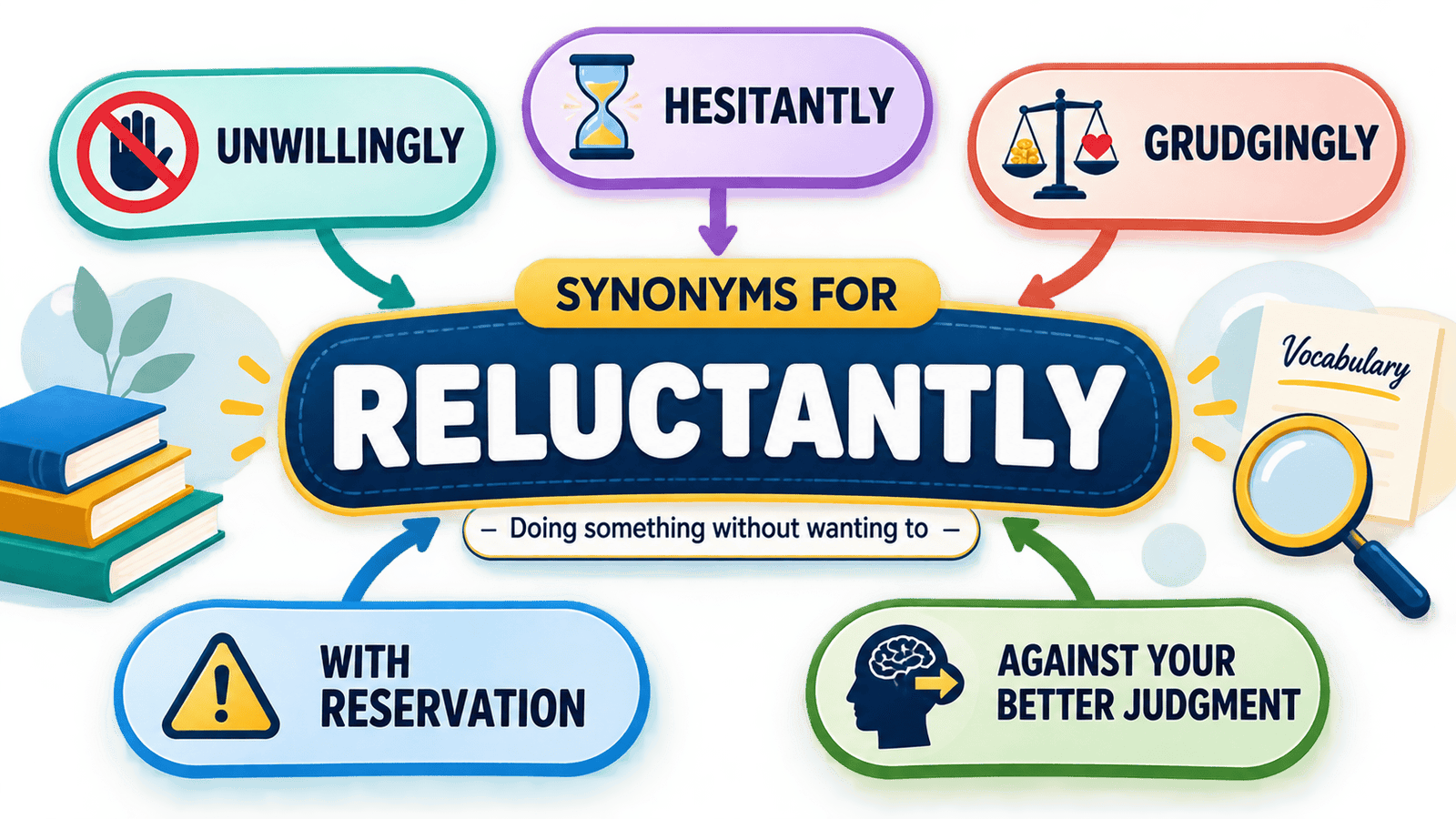
Finding the right synonym for reluctantly depends on what kind of unwillingness you want to express. The closest alternatives include hesitantly, unwillingly, grudgingly, with reservation, against your better judgment, and under protest. However, these expressions are not interchangeable in every situation. Some emphasize hesitation or uncertainty, while others suggest resentment, disagreement, or a lack of enthusiasm.
This guide explains the most useful synonyms for reluctantly, shows how they differ, and gives natural examples so you can choose the right word for your sentence.
Quick Answer: What Are the Best Synonyms for Reluctantly?
The closest synonyms for reluctantly are unwillingly, hesitantly, and grudgingly. Other useful alternatives include with reservation, against your better judgment, under protest, unenthusiastically, and half-heartedly. The best choice depends on the reason behind the reluctance: hesitantly suggests uncertainty, while grudgingly often suggests resentment or unwilling acceptance.
Best Synonyms for Reluctantly
| Word or phrase | Relationship | Main nuance | Best context |
|---|---|---|---|
| unwillingly | Direct synonym | Not wanting to do something | General use |
| hesitantly | Near synonym | Holding back because of uncertainty | Decisions, actions, responses |
| grudgingly | Near synonym | Accepting something unwillingly, often with resentment | Concessions, praise, agreement |
| with reservation | Contextual alternative | Accepting something but expressing doubt | Formal or professional writing |
| against your better judgment | Contextual alternative | Doing something despite believing it is unwise | Decisions and choices |
| under protest | Contextual alternative | Doing something while openly objecting | Rules, orders, disputes |
| unenthusiastically | Near synonym | Doing something without enthusiasm | Participation, support, approval |
| half-heartedly | Near synonym | Doing something with little commitment or enthusiasm | Effort, support, participation |
| without enthusiasm | Contextual alternative | Showing little excitement or support | General and professional writing |
| with reluctance | Equivalent phrase | In a reluctant manner | Formal and general writing |
| against one’s will | Contextual alternative | Doing something despite not wanting to | Situations involving pressure |
| with misgivings | Contextual alternative | Acting while having doubts or concerns | Decisions and formal writing |
The strongest direct replacements are unwillingly and, depending on context, hesitantly or grudgingly. Merriam-Webster specifically identifies hesitantly and unwillingly among the principal synonyms for reluctantly, while Collins includes grudgingly, unwillingly, with reservation, and against your better judgment.
What Does “Reluctantly” Mean?
Reluctantly is an adverb meaning in a way that shows you are unwilling to do something, often because you have doubts, reservations, or a lack of desire. Cambridge defines it as doing something in a way that shows you are not willing and are therefore slow to do it.
For example:
She reluctantly agreed to the proposal.
This means she agreed, but she did not really want to do so.
The important point is that reluctantly does not mean refusing. Someone can be reluctant and still eventually agree, participate, leave, accept something, or take action.
1. Unwillingly
Unwillingly is one of the closest and most straightforward synonyms for reluctantly.
It emphasizes that someone does not want to do something.
Example:
He reluctantly accepted the offer.
He unwillingly accepted the offer.
Both sentences communicate unwilling acceptance, although unwillingly can sound slightly more direct.
Best for:
- accepting something
- doing an unwanted task
- participating in something
- general situations involving lack of willingness
Choose “unwillingly” when the main idea is simply that someone did not want to do something.
2. Hesitantly
Hesitantly is a useful near-synonym, but it adds an important nuance: uncertainty or hesitation.
Merriam-Webster distinguishes hesitant from reluctant by noting that hesitation especially involves fear or uncertainty, whereas reluctance emphasizes unwillingness.
Example:
She reluctantly entered the room.
This suggests that she did not want to enter.
She hesitantly entered the room.
This suggests that she was uncertain, nervous, or unsure about entering.
Choose “hesitantly” when:
- the person is uncertain
- the decision is difficult
- fear or doubt is involved
- the action is slow or tentative
Reluctantly = “I don’t want to.”
Hesitantly = “I’m not sure.”
3. Grudgingly
Grudgingly means doing or accepting something unwillingly, often while showing resentment or a lack of generosity.
Example:
He reluctantly admitted that she was right.
If you write:
He grudgingly admitted that she was right.
the sentence suggests more than reluctance. It implies that he did not want to give her credit.
Best for:
- admitting someone is right
- giving praise
- accepting an opponent’s point
- making a concession
- agreeing when you resent doing so
This is one of the best alternatives when the reluctance has an element of resentment.
4. With Reservation
With reservation is a useful phrase when someone agrees or accepts something but still has doubts or concerns.
Example:
The committee reluctantly approved the proposal.
Could become:
The committee approved the proposal with reservation.
The second version emphasizes the committee’s remaining concerns, rather than simply its unwillingness.
Best for:
- professional writing
- formal decisions
- approvals
- agreements
- recommendations
It is especially useful when you want a more formal expression than reluctantly.
5. Against Your Better Judgment
Against your better judgment is an excellent contextual alternative when someone does something despite believing that it is not a wise decision.
Example:
I reluctantly agreed to go with them.
A more specific alternative is:
I agreed to go with them against my better judgment.
This does not merely mean “I did not want to.” It means I believed I should probably not do it, but I did it anyway.
Best for:
- difficult personal decisions
- risky choices
- questionable decisions
- situations involving advice or common sense
It is therefore more specific than reluctantly.
6. Under Protest
Under protest means doing something while openly objecting to it.
Example:
The company reluctantly paid the fee.
If the company strongly objected to paying it, you could write:
The company paid the fee under protest.
The phrase is particularly useful when an action is required by an authority, rule, agreement, or dispute.
Best for:
- legal or administrative situations
- orders
- payments
- formal objections
- disputes
It is not a universal synonym for reluctantly because it specifically suggests an expressed objection.
7. Unenthusiastically
Unenthusiastically means doing something without enthusiasm or excitement.
Example:
The students reluctantly joined the activity.
You could write:
The students joined the activity unenthusiastically.
The difference is subtle but important. Reluctantly emphasizes unwillingness, whereas unenthusiastically emphasizes lack of excitement or energy.
Someone can participate unenthusiastically without strongly resisting the activity.
8. Half-Heartedly
Half-heartedly describes an action performed with little enthusiasm, effort, or commitment.
Example:
He reluctantly supported the proposal.
Compare:
He supported the proposal half-heartedly.
The first sentence focuses on his unwillingness. The second suggests that his support was weak or not fully sincere.
Best for:
- support
- effort
- participation
- attempts
- encouragement
It is therefore a near-synonym rather than a perfect replacement.
9. Without Enthusiasm
Without enthusiasm is a simple phrase-level alternative to reluctantly when the important idea is a lack of excitement.
Example:
She reluctantly agreed to participate.
Possible alternative:
She agreed to participate without enthusiasm.
This version is clear and natural, especially when you want to avoid repeating reluctantly.
10. With Reluctance
With reluctance is essentially a phrase form of the same idea.
Example:
He reluctantly accepted the responsibility.
He accepted the responsibility with reluctance.
The second sentence is somewhat more formal and can work well in essays, reports, and professional writing.
Because it contains the noun reluctance, however, it is not a true vocabulary replacement if your goal is specifically to avoid the same word family.
11. Against One’s Will
Against one’s will means doing something despite not wanting to do it.
Example:
He reluctantly went to the meeting.
A stronger alternative might be:
He went to the meeting against his will.
The second sentence can suggest external pressure or force, so it should not automatically replace reluctantly.
Important distinction
Someone may go somewhere reluctantly because they have doubts.
Someone who goes against their will may have been pressured or compelled.
12. With Misgivings
With misgivings means doing something while having doubts, concerns, or uneasy feelings about it.
Example:
She reluctantly accepted the offer.
More specific:
She accepted the offer with misgivings.
This is useful when the person’s reluctance comes from concerns about the consequences.
Which Synonym Should You Use?
The best alternative depends on why the person is reluctant.
| If you mean… | Use… |
| The person simply does not want to | unwillingly |
| The person is uncertain or nervous | hesitantly |
| The person resents having to agree | grudgingly |
| The person accepts but has doubts | with reservation |
| The person thinks the decision is unwise | against your better judgment |
| The person openly objects while complying | under protest |
| The person lacks enthusiasm | unenthusiastically |
| The person gives weak or limited effort | half-heartedly |
| The person has concerns about the decision | with misgivings |
| The person is pressured into doing it | against one’s will |
This distinction is important because these expressions overlap in meaning but do not all communicate the same reason for reluctance.
Reluctantly vs. Hesitantly
These words are closely related, but they emphasize different ideas.
Reluctantly focuses on unwillingness.
Hesitantly focuses on uncertainty or doubt.
Compare:
Maria reluctantly signed the agreement.
Maria did not want to sign it.
Maria hesitantly signed the agreement.
Maria may have been unsure whether signing was the right decision.
Merriam-Webster similarly distinguishes reluctant as holding back through unwillingness from hesitant as holding back especially through fear or uncertainty.
Reluctantly vs. Unwillingly
These are probably the closest general alternatives.
He reluctantly agreed.
He unwillingly agreed.
Both mean he agreed even though he did not want to.
The difference is mainly one of emphasis. Reluctantly often suggests hesitation or resistance before an action, while unwillingly states the lack of willingness more directly.
For general writing, either can work naturally in many contexts.
Reluctantly vs. Grudgingly
These words overlap, but grudgingly is stronger in emotional tone.
She reluctantly praised her competitor.
She did not particularly want to praise the competitor.
She grudgingly praised her competitor.
She praised the competitor but likely resented giving the praise.
Use grudgingly when you want the reader to notice the person’s resentment or lack of generosity.
Reluctantly vs. Against Your Better Judgment
These expressions should not always be treated as interchangeable.
I reluctantly took the job.
This means I did not really want to take it.
I took the job against my better judgment.
This means I believed taking it was probably a bad or unwise decision.
The second expression communicates a stronger idea about judgment and consequences.
Common Mistakes With “Reluctantly” Synonyms
Mistake 1: Treating “hesitantly” as an exact synonym
Hesitation often involves uncertainty, while reluctance involves unwillingness.
Mistake 2: Using “involuntarily” for “reluctantly”
Involuntarily means something happens without conscious choice or voluntary control. It is not simply a stronger version of reluctantly.
Incorrect:
He reluctantly sneezed.
Better:
He involuntarily sneezed.
Mistake 3: Using “cautiously” as a synonym
Cautiously means carefully because of possible danger or problems. Someone can act cautiously while being completely willing.
Mistake 4: Confusing “unenthusiastically” with “reluctantly”
A person can participate enthusiastically or unenthusiastically, while reluctance specifically concerns willingness.
Mistake 5: Using “against one’s will” too casually
This phrase can imply pressure, coercion, or lack of free choice. Reluctantly does not necessarily imply force.
Natural Examples of “Reluctantly”
Here are several common contexts in which reluctantly sounds natural:
- Reluctantly agreed: She reluctantly agreed to the new schedule.
- Reluctantly accepted: He reluctantly accepted the criticism.
- Reluctantly admitted: The manager reluctantly admitted that the customer was right.
- Reluctantly left: We reluctantly left the beach before sunset.
- Reluctantly apologized: He reluctantly apologized for his mistake.
- Reluctantly joined: She reluctantly joined the discussion.
- Reluctantly allowed: The teacher reluctantly allowed the students to leave early.
- Reluctantly accepted responsibility: He reluctantly accepted responsibility for the error.
Cambridge’s examples likewise show reluctantly commonly modifying actions such as agreeing, resigning, allowing, withdrawing, and accepting.
Synonyms for “Reluctantly Agreed”
If your specific phrase is “reluctantly agreed,” several alternatives are useful:
- unwillingly agreed
- grudgingly agreed
- agreed with reservation
- agreed under protest
- agreed against his better judgment
- agreed without enthusiasm
The best choice depends on the situation.
She reluctantly agreed to the plan.
Neutral unwillingness.
She grudgingly agreed to the plan.
She resented agreeing.
She agreed with reservations.
She had doubts or concerns.
She agreed under protest.
She openly objected but complied.
She agreed against her better judgment.
She believed agreeing was probably unwise.
This is why choosing a synonym based only on a thesaurus list can produce an inaccurate sentence.
Formal Synonyms for Reluctantly
For formal or professional writing, these expressions can work particularly well:
- with reservation
- with reluctance
- with misgivings
- unwillingly
- against one’s better judgment
For example:
The board reluctantly approved the proposal.
More formal alternatives include:
The board approved the proposal with reservations.
or:
The board approved the proposal with considerable reluctance.
The best choice depends on whether you want to emphasize doubt, concern, or unwillingness.
Antonyms of Reluctantly
The opposite of reluctantly is language that expresses willingness, enthusiasm, or readiness.
Useful antonyms include:
- willingly
- readily
- eagerly
- enthusiastically
- gladly
- cheerfully
- wholeheartedly
For example:
She reluctantly accepted the invitation.
The opposite could be:
She eagerly accepted the invitation.
or:
She gladly accepted the invitation.
The exact antonym depends on whether the intended contrast is willingness or enthusiasm.
Frequently Asked Questions
What is the closest synonym for reluctantly?
The closest general synonyms are unwillingly and hesitantly, although they are not identical. Unwillingly focuses on not wanting to do something, while hesitantly emphasizes uncertainty or hesitation. Grudgingly is another strong alternative when reluctance includes resentment.
What is another word for reluctantly?
Depending on the context, you can use unwillingly, hesitantly, grudgingly, unenthusiastically, or with reservation. Phrases such as against your better judgment and under protest can also work when they express the specific reason for the reluctance.
Is “hesitantly” the same as “reluctantly”?
Not exactly. Reluctantly means doing something despite being unwilling, whereas hesitantly usually suggests uncertainty, doubt, fear, or a lack of confidence. The two overlap when someone’s unwillingness is caused by uncertainty.
Is “unwillingly” a synonym for “reluctantly”?
Yes. Unwillingly is one of the closest general synonyms for reluctantly. Both can describe doing something that you do not want to do. Merriam-Webster lists unwillingly among the principal synonyms of reluctantly.
What is a stronger word than reluctantly?
There is no single universally stronger synonym. Grudgingly can sound stronger because it may suggest resentment, while under protest can indicate open objection. Against one’s will can suggest external pressure or coercion, making it stronger in a different way.
What is a formal way to say reluctantly?
Depending on the context, use with reluctance, with reservation, with misgivings, or unwillingly. In professional writing, with reservation is especially useful when someone agrees or approves something while retaining doubts.
What is the difference between reluctantly and grudgingly?
Reluctantly means doing something unwillingly. Grudgingly adds the idea of resentment, annoyance, or an unwilling concession. Someone can act reluctantly without feeling resentful, but grudgingly often implies a negative attitude toward the concession.
Can “against your better judgment” replace “reluctantly”?
Sometimes. Against your better judgment is more specific: it means you do something even though you believe it is probably not a wise decision. Reluctantly only tells us that you were unwilling or hesitant.
Conclusion
The best synonym for reluctantly depends on the exact kind of unwillingness you want to express. Unwillingly is the closest straightforward alternative; hesitantly highlights uncertainty; grudgingly adds resentment; with reservation emphasizes doubts; and under protest indicates open objection.
For precise writing, do not choose a synonym simply because it appears in a thesaurus. Choose the word that matches the reason, tone, and context of the reluctance. That small distinction can make your writing sound considerably more natural and precise.

Michael Thompson is an English language specialist and experienced editor who focuses on vocabulary development and clear communication. He creates high-quality synonym guides, word comparisons, and writing tips to help students and professionals express their ideas more effectively. His work combines linguistic knowledge with practical SEO strategies to make learning both useful and engaging.