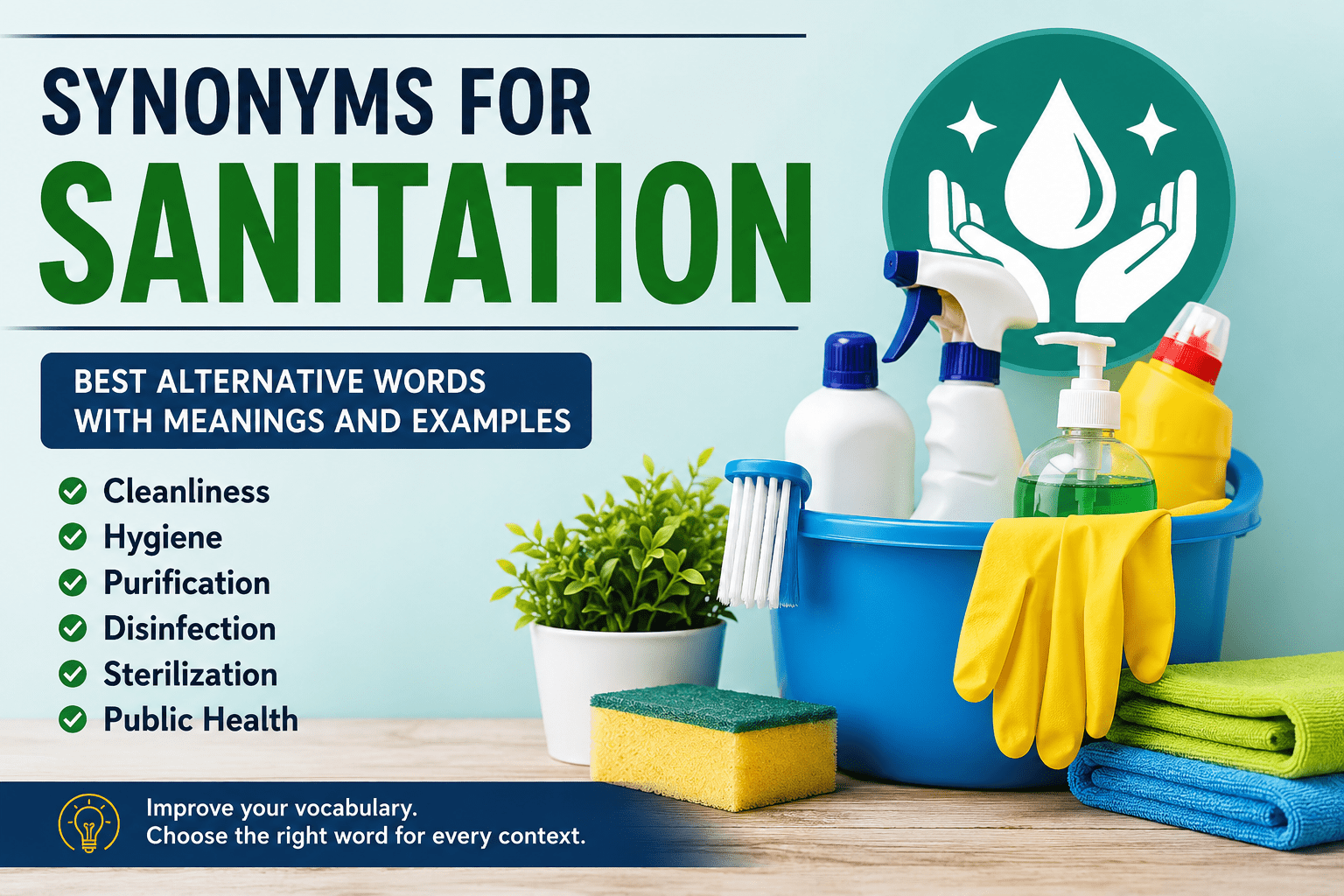
Looking for synonyms for sanitation can be surprisingly tricky because sanitation covers more than simply being clean. It can refer to systems and practices that protect health through safe waste disposal, wastewater management, cleanliness, and sanitary conditions. In some contexts, hygiene is the closest alternative; in others, cleanliness, sanitization, or sanitary measures may be more appropriate. The best word depends on what you are describing.
This guide separates genuine synonyms from near-synonyms and related terms, so you can choose an alternative that sounds natural and preserves the intended meaning.
Quick Answer: What Are the Best Synonyms for Sanitation?
The closest alternatives to sanitation include hygiene, cleanliness, hygienics, sanitary measures, and, in certain contexts, sanitization. However, they are not interchangeable in every sentence. Hygiene usually emphasizes practices that promote health and cleanliness, while sanitation often refers to systems, facilities, or measures for maintaining sanitary conditions and safely managing waste.
Synonyms for Sanitation at a Glance
| Word or phrase | Relationship | Best meaning/context | Formality |
|---|---|---|---|
| Hygiene | Near synonym | Health-related cleanliness and practices | Neutral |
| Cleanliness | Near synonym | Being clean and free from dirt | Neutral |
| Hygienics | Direct/near synonym | The study or practice of hygiene | Formal |
| Sanitary measures | Contextual alternative | Actions taken to protect health | Formal |
| Sanitization | Contextual alternative | Making something sanitary, especially by reducing germs | Technical/neutral |
| Asepsis | Contextual alternative | Prevention of contamination by harmful microorganisms | Technical |
| Disinfection | Related/contextual | Destroying or reducing harmful microorganisms | Technical |
| Public health measures | Contextual alternative | Broader measures protecting community health | Formal |
| Waste management | Related alternative | Collection, treatment, and disposal of waste | Professional |
| Sewage disposal | Related alternative | Safe removal or treatment of sewage | Technical |
The table deliberately does not treat every related word as a perfect synonym. For example, disinfection is a specific process, whereas sanitation is a broader concept. The CDC distinguishes cleaning, sanitizing, and disinfecting as different processes, which makes that distinction especially important.
What Does Sanitation Mean?
Sanitation is the system, practice, or set of measures used to protect health by maintaining sanitary conditions and safely managing waste, wastewater, and human excreta.
Cambridge defines sanitation in terms of systems for removing dirty water and other waste products to protect people’s health. WHO likewise uses the term broadly for facilities and services that safely manage human urine and feces, while noting that sanitation can also encompass services such as garbage collection and wastewater disposal.
Example sentences
- The town needs better sanitation facilities.
- Poor sanitation can contribute to the spread of disease.
- The restaurant must meet strict sanitation standards.
- Access to safe water and sanitation is essential for public health.
Because the word often refers to systems and services, simply replacing it with cleanliness can sometimes make a sentence less precise.
1. Hygiene
it is probably the most familiar alternative to sanitation, but the two words are not identical.
Hygiene generally refers to behaviors and practices that maintain cleanliness and support good health. Examples include washing hands, bathing, dental care, and keeping environments clean. The CDC specifically describes hygiene as behaviors that can improve cleanliness and lead to good health.
Example
- Good hygiene helps prevent the spread of infection.
- Good sanitation requires safe systems for handling waste.
Choose hygiene when: you are talking about habits, personal cleanliness, or health-related practices.
Choose sanitation when: you are talking about facilities, waste systems, sewage, or broader sanitary infrastructure.
Sanitation vs. hygiene
A useful way to remember the difference is:
Hygiene = what people do to stay clean and healthy.
Sanitation = systems and conditions that help keep people and communities healthy.
There is substantial overlap, but they are not exact equivalents.
2. Cleanliness
Cleanliness refers to the state or quality of being clean and free from dirt, unwanted material, or contamination.
It can work as an alternative to sanitation when the focus is specifically on being clean.
Example
- The restaurant maintains high standards of cleanliness.
- The facility must meet strict sanitation standards.
The first sentence emphasizes how clean the restaurant is. The second can include broader requirements involving procedures, waste, surfaces, facilities, and health protection.
Choose cleanliness when: the main idea is a clean condition or environment.
3. Hygienics
Hygienics is a more formal and less common term referring to the principles or practices of hygiene.
It can appear in technical or historical writing, but most modern readers will find hygiene more natural.
Example
- The course covers principles of hygienics and public health.
For ordinary writing, hygiene is usually the better choice.
4. Sanitary Measures
Sanitary measures is a useful phrase when you mean specific actions or precautions taken to protect health and maintain sanitary conditions.
Example
- The authorities introduced additional sanitary measures after the outbreak.
- Food producers must follow appropriate sanitary measures.
This phrase works especially well in formal, governmental, medical, environmental, and professional writing.
5. Sanitization
Sanitization is closely related to sanitation but should not automatically be treated as an exact synonym.
It usually refers to the process of making something sanitary, particularly by reducing microorganisms to an acceptable level.
The CDC distinguishes sanitizing from disinfecting: sanitizing reduces germs to levels considered safe under relevant public-health standards, while disinfecting involves killing remaining germs with appropriate products.
Example
- The kitchen requires regular sanitization of food-contact surfaces.
- Proper sanitation requires more than surface sanitization.
Choose sanitization when: you are describing a particular process of making an object, surface, or environment safer and more sanitary.
6. Asepsis
Asepsis is a specialized medical and scientific term referring to conditions or practices designed to prevent contamination by harmful microorganisms.
Example
- Surgical procedures require strict asepsis.
- The laboratory follows procedures designed to maintain asepsis.
It should not normally replace sanitation in everyday writing.
Choose asepsis when: the context involves medical, laboratory, surgical, or microbiological contamination control.
7. Disinfection
it is another closely related term, but it is more specific than sanitation.
Disinfection refers to using a process or product to destroy harmful microorganisms on surfaces or objects. It is therefore one possible component of broader sanitation practices rather than a universal replacement for sanitation.
Example
- The hospital requires regular disinfection of high-touch surfaces.
- The building needs better sanitation, including waste management and cleaning procedures.
Choose disinfection when: the specific action involves killing or eliminating harmful microorganisms.
8. Public Health Measures
In some formal contexts, public health measures can replace sanitation when the intended meaning is broader.
Example
- Improved sanitation reduced health risks in the community.
- Improved public health measures reduced health risks in the community.
The second sentence is broader, however. Public health measures can include vaccination, disease surveillance, health education, sanitation, and many other interventions.
So this is a contextual alternative, not a direct synonym.
9. Waste Management
Waste management is closely associated with sanitation, especially when discussing garbage, solid waste, wastewater, or municipal services.
Example
- The city needs better waste management.
- The city needs better sanitation.
These sentences can overlap, but waste management focuses specifically on handling waste. Sanitation can encompass a wider range of health-protective systems.
10. Sewage Disposal
Sewage disposal is another context-specific alternative.
It refers specifically to the removal, treatment, or safe disposal of sewage.
Example
- The village lacks adequate sewage disposal facilities.
- The village lacks adequate sanitation facilities.
The second statement is broader because sanitation can include sewage, toilets, waste handling, and other sanitary services.
Which Word Should I Use?
If you’re unsure which synonym to choose, use this quick guide:
Choose hygiene when:
You mean habits or practices that promote health and cleanliness.
Handwashing is an important part of good hygiene.
Choose cleanliness when:
You mean the condition of being clean.
The hotel is known for its high standards of cleanliness.
Choose sanitization when:
You mean the process of making a surface or object sanitary.
Regular sanitization of food-contact surfaces is required.
Choose disinfection when:
You specifically mean destroying harmful microorganisms.
The clinic requires regular disinfection of frequently touched surfaces.
Choose asepsis when:
You are discussing prevention of microbial contamination in a medical or laboratory setting.
The procedure must be performed under strict asepsis.
Choose waste management when:
You are specifically discussing collection, treatment, recycling, or disposal of waste.
Effective waste management reduces environmental pollution.
Choose sanitation when:
You mean the broader system of sanitary facilities, services, conditions, or practices that protect public health.
The community needs better sanitation and wastewater infrastructure.
Sanitation Synonyms by Context
For personal health
Best choices:
- hygiene
- personal hygiene
- cleanliness
Example:
Good personal hygiene includes regular handwashing.
For restaurants and food preparation
Best choices:
- hygiene
- cleanliness
- sanitization
- sanitary measures
Example:
The restaurant follows strict sanitary measures when preparing food.
For hospitals and laboratories
Best choices:
- sanitation
- disinfection
- asepsis
- infection-control measures
Example:
The laboratory follows strict aseptic procedures.
For cities and communities
Best choices:
- sanitation
- waste management
- sewage disposal
- sanitary services
- public health measures
Example:
The city is investing in improved sanitation services.
For environmental infrastructure
Best choices:
- sanitation
- wastewater management
- sewage disposal
- waste management
Example:
The project aims to improve wastewater management in rural communities.
Sanitation vs. Hygiene: What’s the Difference?
Sanitation and hygiene are closely connected but describe different ideas.
| Sanitation | Hygiene |
|---|---|
| Often concerns systems and services | Usually concerns behaviors and practices |
| Includes safe waste management | Includes handwashing and personal care |
| Can involve toilets and sewage systems | Can involve bathing and hand hygiene |
| Often has a community or infrastructure focus | Often has a personal or behavioral focus |
| Protects health through sanitary conditions | Promotes health through cleanliness practices |
WHO describes sanitation primarily around safe disposal and management of human waste, while the CDC describes hygiene in terms of behaviors that promote cleanliness and health.
Sanitation vs. Sanitization
These words look similar because they share the same linguistic family, but they are used differently.
Sanitation is the broader concept involving sanitary conditions, systems, facilities, and services.
Sanitization generally describes an action or process that makes something sanitary, particularly by reducing microorganisms.
Compare:
The school needs better sanitation facilities.
The kitchen requires regular sanitization.
The first concerns a broader system or provision. The second describes a specific process.
Sanitation vs. Disinfection
Disinfection is more specific.
A sanitation program may include cleaning, waste disposal, hygiene procedures, and disinfection. Disinfection itself focuses on reducing or killing harmful microorganisms.
The CDC recommends distinguishing cleaning, sanitizing, and disinfecting rather than treating them as interchangeable processes.
Common Mistakes With Sanitation Synonyms
Mistake 1: Treating hygiene and sanitation as identical
They overlap, but they are not interchangeable in every context.
Less precise:
The city needs better hygiene infrastructure.
More natural:
The city needs better sanitation infrastructure.
Mistake 2: Using disinfection for every sanitation context
Disinfection is a specific process. It does not normally mean sewage treatment, garbage collection, or access to toilets.
Mistake 3: Using cleanliness when infrastructure is meant
If you write:
The region lacks adequate cleanliness.
you may mean that the area is dirty. If the actual issue is toilets, wastewater, sewage, or waste disposal, sanitation is more precise.
Mistake 4: Using sanitization as a general replacement
Sanitization often refers to an action or process, while sanitation can describe an entire system.
Mistake 5: Calling every related word a synonym
Words such as sewage, wastewater, garbage collection, waste management, and public health are strongly associated with sanitation, but they do not have the same meaning.
Antonyms of Sanitation
There is no single perfect antonym for sanitation in every context, but useful opposites include:
- unsanitary conditions
- poor hygiene
- dirtiness
- filth
- contamination
- lack of sanitation
For example:
Poor sanitation can create serious health risks.
Unsanitary conditions can create serious health risks.
The second phrase describes the undesirable condition rather than the system or measures intended to prevent it.
Frequently Asked Questions
What is another word for sanitation?
The best alternative depends on context. Hygiene and cleanliness are common near-synonyms, while sanitary measures works well in formal writing. Sanitization, disinfection, and asepsis are more specific terms and should be used only when their particular meanings fit.
Is hygiene a synonym for sanitation?
Hygiene is a close but not exact synonym for sanitation. Hygiene usually refers to behaviors and practices that maintain cleanliness and promote health. Sanitation more often refers to systems, facilities, services, or measures for maintaining sanitary conditions and safely managing waste.
What is a formal synonym for sanitation?
Depending on the context, sanitary measures, sanitary services, or hygienics can provide a more formal alternative. However, sanitation itself is already appropriate for professional, academic, governmental, and public-health writing.
What is the difference between sanitation and sanitization?
Sanitation generally describes the broader system or practice of maintaining sanitary conditions and protecting health. Sanitization refers more specifically to the process of making something sanitary, particularly by reducing microorganisms.
Is cleanliness the same as sanitation?
No. Cleanliness refers mainly to the state of being clean, while sanitation can include facilities, services, waste disposal, wastewater management, and other measures that protect health.
Is disinfection a synonym for sanitation?
Not exactly. Disinfection is a specific process for destroying or reducing harmful microorganisms. It may be part of sanitation practices, but sanitation has a broader meaning.
What is a synonym for sanitation services?
Depending on what the service involves, alternatives include sanitary services, waste management services, waste disposal services, sewage services, or public sanitation services. The most accurate choice depends on whether you mean garbage collection, sewage management, wastewater treatment, or broader public-health infrastructure.
What is the closest synonym for sanitation?
There is no single perfect substitute in every context. Hygiene is one of the closest general alternatives, while sanitary measures can be especially useful when referring to actions taken to protect health. For waste and infrastructure contexts, sanitation is often more precise than either word.
Conclusion
The best synonym for sanitation depends on what you are trying to describe. Use hygiene for health-related habits and practices, cleanliness for the condition of being clean, sanitization for the process of making something sanitary, and disinfection for specifically reducing or destroying harmful microorganisms. For community infrastructure, waste disposal, sewage, and sanitary services, sanitation is often the most accurate word.
The key is not simply finding a word that appears in a thesaurus. It is choosing the alternative that preserves the meaning, context, register, and practical use of the original word.

Daniel Carter is a professional content strategist and language enthusiast. He focuses on semantic SEO, keyword research, and creating structured vocabulary content that ranks well on search engines while remaining user-friendly.