Finding the right synonym for agenda depends on what you mean. In a meeting, schedule, program, docket, or order of business may work. When agenda means a broader plan or set of goals, words such as plan, strategy, or program can be better choices. This guide explains the closest alternatives, where they fit naturally, and which words you should avoid treating as exact synonyms.
Quick Answer
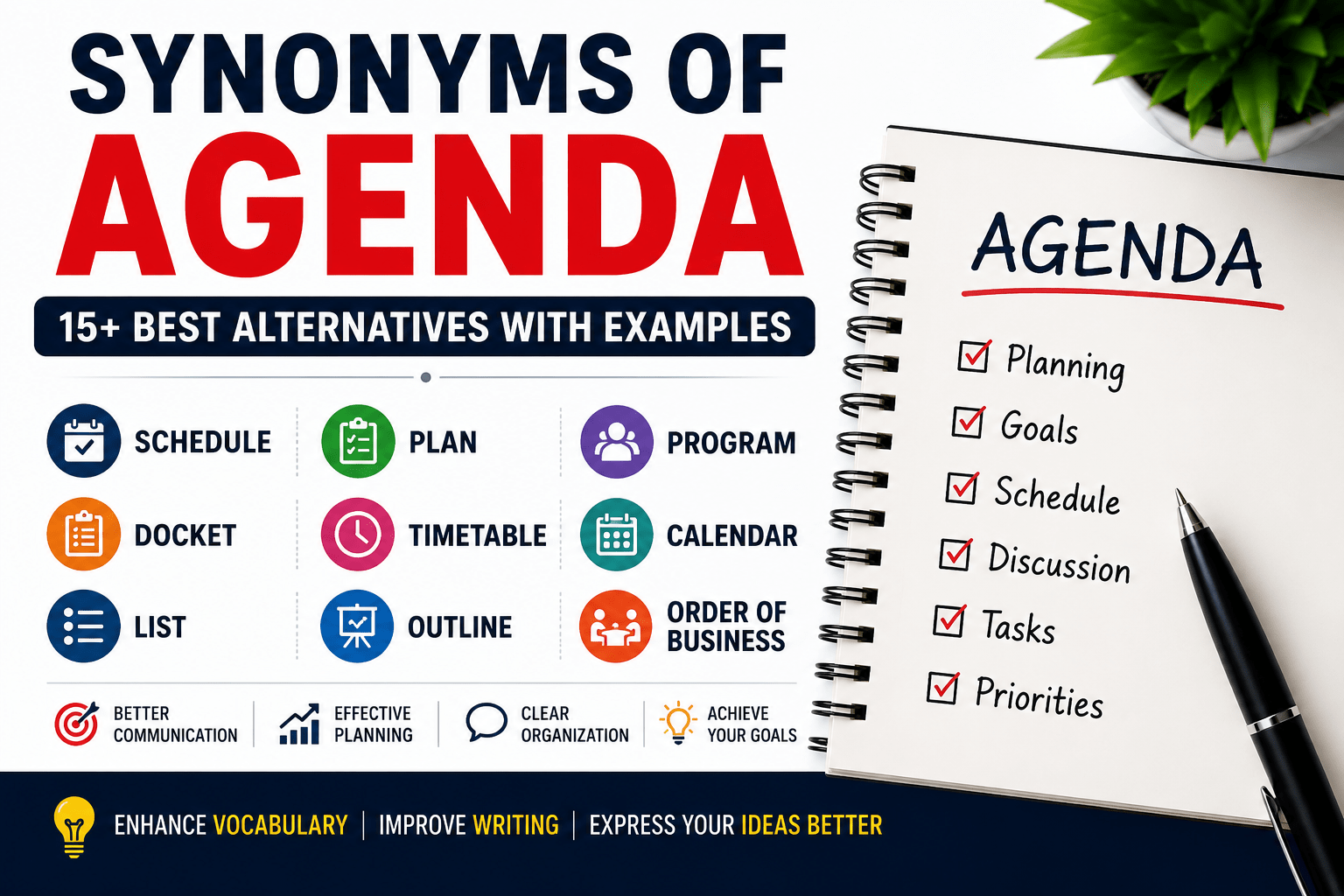
The closest synonyms of agenda include schedule, program, plan, docket, list, calendar, timetable, and order of business. However, they are not interchangeable in every situation. Docket is especially common for formal proceedings, schedule emphasizes timing, and plan focuses more on intended action or goals.
Best Synonyms for Agenda
| Synonym | Relationship | Best Context | Formality |
|---|---|---|---|
| Schedule | Near synonym | Meetings, events, planned activities | Neutral |
| Program | Near synonym | Events, meetings, organized activities | Neutral/Formal |
| Plan | Near synonym | Goals, actions, future intentions | Neutral |
| Docket | Contextual synonym | Courts, formal meetings, official business | Formal |
| List | Contextual synonym | Items or topics to address | Neutral |
| Order of business | Strong contextual alternative | Formal meetings | Formal |
| Timetable | Contextual synonym | Time-based plans and events | Neutral |
| Calendar | Near synonym | Planned events and priorities | Neutral |
| Outline | Contextual alternative | Topics or structure of a discussion | Neutral |
| Program / Programme | Near synonym | Organized events or activities | Neutral/Formal |
| Strategy | Contextual alternative | Long-term goals or policy | Formal |
| Action plan | Contextual alternative | Tasks and implementation | Professional |
| To-do list | Contextual alternative | Personal tasks | Informal |
| Itinerary | Contextual alternative | Travel plans | Neutral |
| Slate | Contextual alternative | Planned activities or candidates | Neutral |
Not every word in a thesaurus should be treated as a direct replacement. Major dictionaries group agenda with words such as schedule, calendar, program, and timetable, while context determines which alternative sounds natural.
What Does “Agenda” Mean?
Agenda is a noun with two closely related meanings.
First, it can mean a list or outline of things to be considered or done, especially during a meeting. For example:
“The first item on the agenda is the annual budget.”
Second, agenda can mean an underlying plan, program, or set of goals, particularly in political, social, or organizational contexts:
“The organization has an ambitious environmental agenda.”
Merriam-Webster identifies both meanings and traces agenda to the plural of the Latin-derived agendum, referring to things that are to be done.
1. Schedule
Schedule is one of the closest alternatives when an agenda organizes activities or events.
Example:
- “The meeting schedule includes a discussion of the new budget.”
Choose schedule when timing is important. An agenda usually emphasizes what will be discussed or done, while a schedule more strongly emphasizes when things will happen.
Best for: meetings, events, appointments, work activities.
2. Program
Program can replace agenda when referring to an organized series of events, activities, or planned actions.
Example:
- “The conference program includes a keynote speech and three workshops.”
In American English, program is standard; programme is commonly used in British English.
Cambridge lists agenda, schedule, plan, and order of business among related senses of program.
Best for: conferences, events, organized activities, projects.
3. Plan
Plan is a useful alternative when agenda means an intended course of action rather than a meeting’s list of topics.
Example:
- “The committee presented its plan for improving public transportation.”
The difference is important: an agenda may identify issues or goals, while a plan usually explains what someone intends to do about them.
Best for: goals, projects, strategies, future actions.
4. Docket
Docket is a formal alternative, particularly for matters scheduled for discussion or consideration.
Example:
- “Several cases are on the court’s docket.”
It is also used in some formal meeting contexts.
Best for: courts, official proceedings, formal business.
Because docket has specialized uses, it should not replace agenda in ordinary conversation.
5. List
List is the simplest alternative when an agenda is essentially a collection of items.
Example:
- “The chair circulated a list of topics before the meeting.”
However, list is broader than agenda. A list does not necessarily imply that the items will be discussed or acted upon.
Best for: simple, general communication.
6. Order of Business
Order of business is a highly useful formal alternative to meeting agenda.
Example:
- “The first item on the order of business was the election of officers.”
It specifically suggests the matters that will be handled during a formal meeting and often implies their sequence.
Best for: formal meetings, organizations, boards, committees.
7. Timetable
Timetable is appropriate when the agenda emphasizes specific times or a sequence of scheduled events.
Example:
- “The conference timetable shows when each session begins.”
Unlike agenda, timetable strongly emphasizes time.
Best for: conferences, classes, events, transportation, schedules.
8. Calendar
Calendar can be an alternative when agenda refers to planned events or activities over a period of time.
Example:
- “The organization has a busy calendar of events this fall.”
But a calendar normally organizes activities by dates, while an agenda may organize topics or tasks without focusing on dates.
Best for: events, appointments, deadlines, activities.
9. Outline
Outline works when an agenda gives the basic structure or topics of a discussion.
Example:
- “The speaker sent an outline of the presentation before the meeting.”
An outline focuses on the structure and main points, whereas an agenda often focuses on what participants will discuss or accomplish.
Best for: presentations, discussions, meetings, reports.
10. Strategy
Strategy can replace agenda only when the word refers to a broader set of objectives or an approach to achieving them.
Example:
- “The company’s growth strategy focuses on expanding into new markets.”
A strategy is more specific than an agenda because it normally describes how goals will be pursued.
Best for: business, politics, policy, long-term goals.
11. Action Plan
An action plan is a strong alternative when an agenda describes specific tasks that need to be completed.
Example:
- “The team created an action plan for launching the new product.”
An action plan is generally more concrete than an agenda because it focuses on implementation.
Best for: projects, workplace tasks, organizational goals.
12. To-Do List
To-do list is a natural informal alternative when agenda means a collection of tasks.
Example:
- “I have a long to-do list for this weekend.”
It is not a good replacement for agenda in a formal meeting context.
Best for: personal tasks, errands, everyday planning.
13. Itinerary
Itinerary is sometimes listed as a synonym of agenda, but it is actually more context-specific.
An itinerary normally describes a journey or travel schedule, including destinations, activities, and timing.
Example:
- “Our travel itinerary includes three days in Rome.”
Do not use itinerary as a general replacement for a business meeting agenda. The distinction is especially clear when comparing meeting planning with travel planning.
14. Slate
Slate can refer to a set of planned activities, items, or candidates.
Example:
- “The committee has a full slate of issues to address.”
It is less interchangeable with agenda than schedule or plan, so use it only when the context supports the meaning.
15. Program / Programme
Both program and programme can overlap with agenda in the sense of an organized plan or series of activities.
Example:
- “The conference program outlines the sessions for each day.”
Use program in American English and programme in British English when appropriate.
Agenda Synonyms by Context
For a Meeting
Best choices:
- schedule
- order of business
- docket
- program
- outline
- list
Example:
Instead of:
“Please review the meeting agenda.”
You could write:
“Please review the meeting schedule.”
However, meeting agenda remains the most natural phrase when you mean the specific topics to be discussed.
For Business Goals
Best choices:
- plan
- strategy
- program
- action plan
- objectives
Example:
“The company’s strategic agenda focuses on international growth.”
Possible alternative:
“The company’s strategy focuses on international growth.”
Here, strategy is more precise because it describes the approach to achieving the goal.
For Political or Social Goals
Best choices:
- program
- platform
- plan
- policy agenda
- objectives
Example:
“The candidate outlined her policy agenda.”
Depending on the meaning, platform may be appropriate when referring to a candidate’s stated political positions.
For Personal Tasks
Best choices:
- to-do list
- plan
- schedule
- list
Example:
“My weekend agenda is packed.”
A natural alternative is:
“My weekend schedule is packed.”
Agenda vs. Schedule
These words overlap, but they are not identical.
| Word | Main emphasis |
|---|---|
| Agenda | Topics, matters, or tasks to address |
| Schedule | When activities will happen |
Agenda:
“The budget is the first item on the meeting agenda.”
Schedule:
“The meeting is scheduled for 10 a.m.”
Use agenda when you mean the content of a meeting and schedule when you mean its timing.
Agenda vs. Plan
Agenda and plan overlap when both describe intended activities or goals.
- Agenda: what someone intends to address, discuss, or pursue.
- Plan: how someone intends to accomplish something.
Example:
“The committee’s agenda includes reducing costs.”
versus:
“The committee’s plan explains how it will reduce costs.”
Agenda vs. Itinerary
The distinction is straightforward:
- Agenda → meeting, discussion, organizational matters
- Itinerary → journey, travel route, planned stops
Example:
“The board approved the meeting agenda.”
“The travelers reviewed their itinerary.”
Calling a travel plan an agenda is possible in some broad contexts, but itinerary is the more precise word.
Agenda vs. Calendar
A calendar organizes events by dates, while an agenda can organize topics or matters without focusing on dates.
Calendar:
“The conference is on my calendar for September 15.”
Agenda:
“The conference agenda includes a panel discussion on education.”
Hidden Agenda: A Special Meaning
The phrase hidden agenda has a different connotation from an ordinary meeting agenda.
A hidden agenda means an unstated or concealed motive, purpose, or objective.
Example:
“I suspected that the proposal had a hidden agenda.”
In this context, agenda does not simply mean a meeting schedule. It suggests an underlying motive.
This second sense is recognized by major dictionaries, which distinguish an agenda as a list of matters from an underlying plan or program.
Which Word Should I Use?
Choose schedule when the emphasis is on time.
For an organized series of events or activities, program is a natural choice.
When referring to intended actions or goals, plan works best.
In formal proceedings, especially legal contexts, docket is more appropriate.
For formal meetings, order of business is a useful alternative.
If you mean the main structure or discussion points, choose outline.
When agenda refers to a long-term approach for achieving goals, strategy may be more precise.
For specific steps and implementation, action plan is the better choice.
In travel contexts, itinerary is the most natural option.
For informal personal tasks, to-do list works well.
Common Mistakes With Agenda Synonyms
Mistake 1: Treating every related word as an exact synonym
Words such as strategy, itinerary, calendar, and to-do list can overlap with agenda, but they have narrower or different meanings.
Mistake 2: Using itinerary for every type of schedule
An itinerary is strongly associated with travel or a detailed sequence of activities. It is not the standard replacement for a business meeting agenda.
Mistake 3: Assuming schedule and agenda mean exactly the same thing
A schedule emphasizes timing. An agenda emphasizes items to discuss or address.
Mistake 4: Using plan when you mean meeting topics
“The meeting plan” may be understandable, but meeting agenda is usually more natural when referring to the topics that participants will discuss.
Mistake 5: Ignoring the negative meaning of agenda
In phrases such as hidden agenda or political agenda, the word can refer to underlying goals or motives rather than a simple list of meeting topics.
Frequently Asked Questions
What is the closest synonym for agenda?
The closest synonym depends on the context. Schedule, program, plan, and docket are among the closest alternatives. For a formal meeting, order of business is also highly appropriate.
What is another word for a meeting agenda?
Common alternatives include meeting schedule, order of business, meeting program, discussion outline, and docket. However, meeting agenda is often the most natural and precise phrase.
What is a professional synonym for agenda?
For professional writing, schedule, program, plan, docket, order of business, and action plan can work depending on the intended meaning.
Is “schedule” a synonym for “agenda”?
Sometimes. A schedule emphasizes when activities occur, while an agenda usually emphasizes what will be discussed, considered, or done.
Is “itinerary” a synonym for “agenda”?
Only in a limited sense. An itinerary is primarily a detailed plan for a journey or sequence of travel activities, whereas an agenda commonly concerns meetings, discussions, or matters to be addressed.
What is a synonym for political agenda?
Depending on the meaning, alternatives include political program, policy agenda, political platform, policy goals, or political objectives. The best choice depends on whether you mean policies, goals, or a broader program.
What is a synonym for hidden agenda?
Depending on context, alternatives include hidden motive, ulterior motive, secret purpose, or underlying objective. These expressions emphasize the concealed intention behind someone’s actions.
What is the plural of agenda?
The standard modern English plural is agendas. Agenda originally comes from the plural of the Latin-derived noun agendum, but English commonly treats agenda as a singular noun. Merriam-Webster lists agendas as the plural.
Conclusion
The best synonym for agenda depends on what you want to emphasize. Choose schedule for timing, program for organized activities, plan for intended action, docket for formal proceedings, order of business for formal meetings, and itinerary for travel. When agenda refers to broader goals or motives, strategy, program, objectives, or underlying purpose may be more precise.
The key is not simply finding a word that looks similar in a thesaurus. The strongest vocabulary choice is the one that preserves the original meaning while fitting the context naturally.

Michael Thompson is an English language specialist and experienced editor who focuses on vocabulary development and clear communication. He creates high-quality synonym guides, word comparisons, and writing tips to help students and professionals express their ideas more effectively. His work combines linguistic knowledge with practical SEO strategies to make learning both useful and engaging.