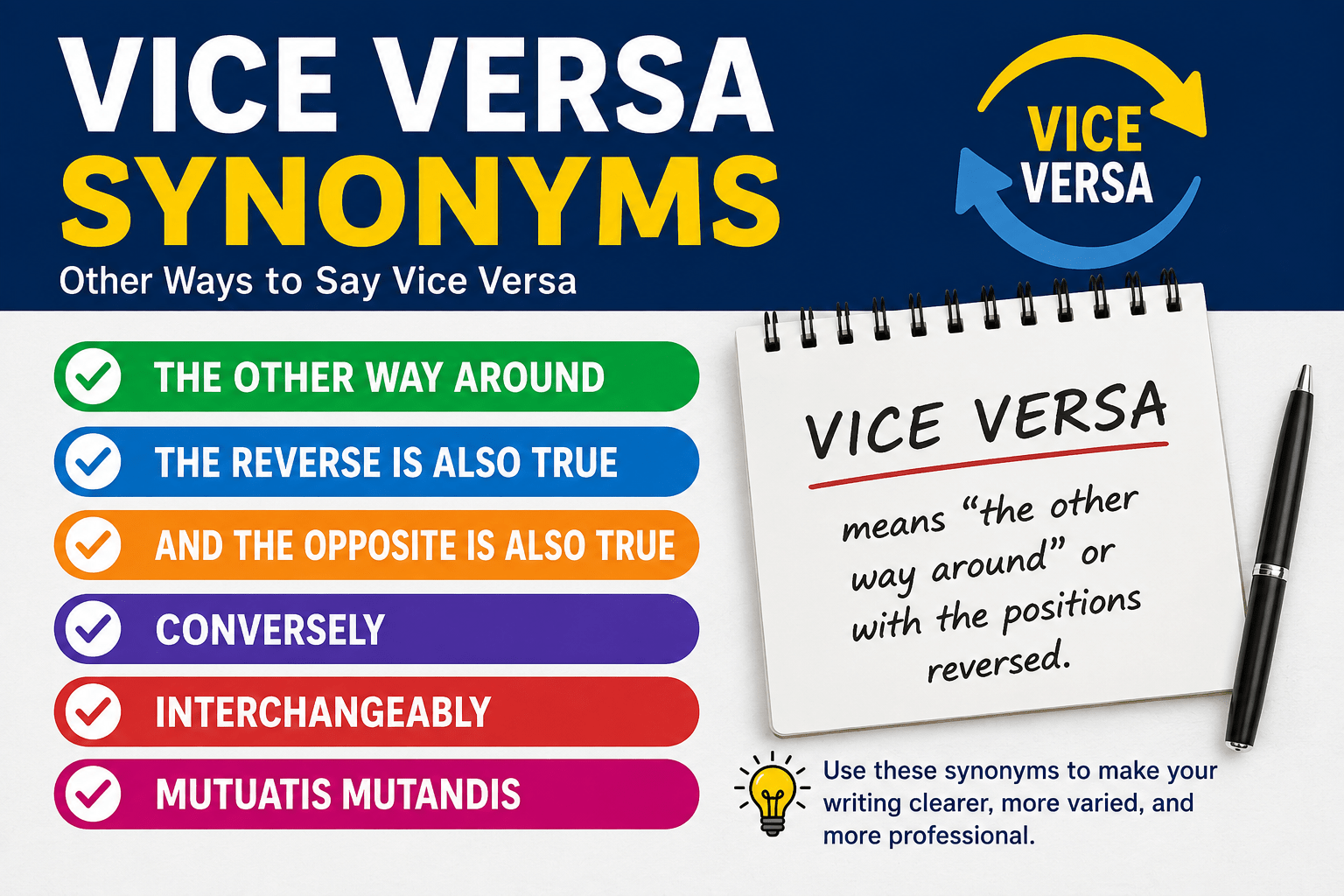
If you need a synonym for vice versa, the closest and most natural alternatives are the other way around, the other way round, in reverse, and conversely. However, these expressions are not interchangeable in every sentence. Some emphasize a reversed order, while others describe a reversed relationship or contrasting statement.
This guide explains the most useful alternatives to vice versa, how they differ, and when a native English speaker would naturally choose each one.
Quick Answer: What Are the Best Synonyms for Vice Versa?
The closest alternatives to vice versa are:
- The other way around — the most natural everyday alternative
- The other way round — especially common in British English
- In reverse — emphasizes reversed order or direction
- Conversely — useful for formal or academic writing
- In the opposite order — precise when sequence is being reversed
- Contrariwise — formal and uncommon
- Inversely — appropriate when two things vary in opposite directions
- The reverse is also true — a clear explanatory alternative
- With the roles reversed — useful when people or positions switch
- With the relationship reversed — useful when the relationship between two things changes direction
Cambridge lists the other way round, in reverse, in the opposite order, contrariwise, and conversely among words and phrases related to vice versa. Merriam-Webster similarly connects vice versa with conversely and describes it as changing the order or reversing the relations.
Vice Versa Meaning
Vice versa is an adverb meaning that what has just been said is also true when the order or relationship is reversed.
For example:
Sarah trusts David, and vice versa.
This means:
Sarah trusts David, and David trusts Sarah.
Another example:
You can exchange dollars for euros and vice versa.
This means:
You can exchange dollars for euros, and you can exchange euros for dollars.
Cambridge defines vice versa as being used when something just stated is also true “in the opposite order.” Merriam-Webster similarly defines it as having the order or relationships reversed.
Best Synonyms for Vice Versa at a Glance
| Alternative | Relationship | Best Use | Formality |
|---|---|---|---|
| The other way around | Direct alternative | Everyday English | Neutral |
| The other way round | Direct alternative | Everyday/British English | Neutral |
| In reverse | Contextual alternative | Order, direction, sequence | Neutral |
| Conversely | Near synonym | Formal comparisons and arguments | Formal |
| In the opposite order | Contextual alternative | Sequences and arrangements | Neutral/Formal |
| The reverse is also true | Phrase-level alternative | Clear explanations | Neutral |
| With the roles reversed | Contextual alternative | People, positions, responsibilities | Neutral |
| Inversely | Contextual/technical alternative | Opposite mathematical relationships | Formal/Technical |
| Contrariwise | Near synonym | Formal or literary writing | Formal/Archaic |
| With the relationship reversed | Contextual alternative | Explicit relational reversal | Formal |
The important point is that these alternatives are not all equal synonyms. The other way around is usually a direct replacement, while inversely has a much narrower meaning.
1. The Other Way Around
The other way around is probably the best everyday replacement for vice versa.
It means that the situation is true when the positions or relationships are reversed.
Example:
I thought James was helping Maria, but it was the other way around.
It can also replace vice versa directly:
Maria helps James, and the other way around.
In natural conversation, however, speakers may prefer:
Maria helps James, and James helps Maria.
Best for:
- Everyday conversation
- Informal writing
- Clear explanations
- Situations involving two people or things
Verdict:
Closest natural everyday alternative.
2. The Other Way Round
The other way round has essentially the same meaning as the other way around.
It is especially common in British English.
Example:
You can put the lid on first and the container afterward, or do it the other way round.
Cambridge specifically lists the other way round as a synonym-related expression for vice versa.
Best for:
- Everyday English
- British English
- Explaining reversed arrangements
Verdict:
Direct and natural alternative.
3. In Reverse
In reverse means that something happens in the opposite direction, sequence, or order.
Example:
Read the instructions in reverse.
It can sometimes replace vice versa, but it is not always interchangeable.
Compare:
She teaches him, and vice versa.
This means he teaches her.
But:
She teaches him, and in reverse.
This sounds unnatural because in reverse is not normally used to express a reciprocal relationship between people.
A better version would be:
She teaches him, and the same is true in reverse.
Best for:
- Direction
- Sequence
- Order
- Processes
- Instructions
Verdict:
Useful contextual alternative, but not a universal substitute.
4. Conversely
Conversely is one of the most useful formal alternatives to vice versa, but the two words do not always mean exactly the same thing.
Conversely introduces a statement that contrasts with or reverses the preceding idea.
Example:
High demand can increase prices. Conversely, low demand can reduce them.
Here, conversely signals an opposite relationship.
It is especially useful in:
- Academic writing
- Essays
- Reports
- Professional writing
- Analytical arguments
Vice versa vs conversely
Tom respects Sarah, and vice versa.
means:
Sarah respects Tom too.
But:
Tom is highly experienced. Conversely, Sarah is relatively new to the field.
does not mean that Sarah is the reversed version of Tom. It introduces a contrasting situation.
Verdict:
Excellent formal alternative in the right context, but not a universal replacement.
5. In the Opposite Order
In the opposite order is a precise alternative when the main idea concerns sequence or arrangement.
Example:
You can enter your first name followed by your last name, or enter them in the opposite order.
This is clearer than vice versa when the reader needs to understand exactly what is being reversed.
Best for:
- Instructions
- Processes
- Lists
- Sequences
- Arrangements
Verdict:
Very clear contextual alternative.
6. The Reverse Is Also True
The reverse is also true is a useful phrase when clarity matters more than brevity.
Example:
If regular exercise improves physical fitness, the reverse is also true: poor physical activity can contribute to poorer fitness.
It is particularly useful when writing for readers who may not immediately understand vice versa.
Best for:
- Educational writing
- Explanations
- Articles
- Formal prose
Verdict:
Excellent explanatory alternative.
7. With the Roles Reversed
With the roles reversed works when two people, groups, or things exchange positions or responsibilities.
Example:
The manager usually evaluates the employee. With the roles reversed, the employee would evaluate the manager.
This is more specific than vice versa because it tells the reader exactly what is being reversed: the roles.
Best for:
- People
- Responsibilities
- Social situations
- Scenarios involving two sides
Verdict:
Strong contextual alternative.
8. Inversely
Inversely is a narrower term and should not be treated as a general synonym for vice versa.
It is particularly appropriate when two quantities or relationships change in opposite ways.
Example:
As price increases, demand tends to decrease inversely.
However, ordinary reciprocal statements usually should not use inversely.
For example:
Sarah likes John, and inversely.
This is unnatural.
A better sentence is:
Sarah likes John, and vice versa.
Best for:
- Mathematics
- Science
- Statistics
- Technical relationships
Verdict:
Use only when an inverse relationship is genuinely intended.
9. Contrariwise
Contrariwise means in the opposite way or from the opposite point of view.
It is a legitimate synonym-related word, but it is uncommon in modern everyday English.
Example:
Some people believe that technology makes life simpler; contrariwise, others argue that it creates additional complications.
For most modern readers, conversely or on the other hand will usually sound more natural.
Best for:
- Formal writing
- Literary contexts
- Deliberately traditional style
Verdict:
Accurate but uncommon.
10. With the Relationship Reversed
With the relationship reversed is not a fixed idiomatic synonym like vice versa, but it can be an extremely clear contextual alternative.
Example:
A supports B; with the relationship reversed, B supports A.
It is useful when the exact nature of the reversal needs to be stated explicitly.
Best for:
- Technical explanations
- Academic writing
- Complex relationships
- Educational material
Verdict:
Contextual alternative rather than a direct synonym.
Which Synonym for Vice Versa Should You Use?
The best choice depends on what you are trying to reverse.
| If you mean… | Best choice |
|---|---|
| Everyday “the opposite way” | the other way around |
| British everyday English | the other way round |
| A reversed sequence | in reverse |
| A reversed order | in the opposite order |
| A formal contrast | conversely |
| A clear explanation | the reverse is also true |
| People switching positions | with the roles reversed |
| Opposite mathematical relationship | inversely |
| Formal/literary opposite viewpoint | contrariwise |
Vice Versa vs. The Other Way Around
These two are often interchangeable.
We help our customers, and vice versa.
We help our customers, and the other way around.
The first is shorter and slightly more idiomatic in many contexts. The second is often easier for learners to understand.
Choose vice versa when:
You want a concise, established expression.
Choose the other way around when:
You want plain, conversational English.
Vice Versa vs. Conversely
These words overlap, but they perform different jobs.
Vice versa usually signals that a statement remains true after reversing the relationship or order.
I respect my teacher, and vice versa.
Conversely usually introduces a contrasting or opposite statement.
Good communication builds trust. Conversely, poor communication can damage it.
So, although dictionaries connect conversely with vice versa, you should not automatically replace one with the other.
Vice Versa vs. Inversely
These are even less interchangeable.
Vice versa means that the relationship or order is reversed.
Inversely generally describes an inverse relationship, especially one in which one quantity changes in the opposite direction from another.
Compare:
She helps him, and vice versa.
with:
As speed increases, travel time decreases inversely.
The first describes reciprocal action. The second describes an inverse relationship.
Common Mistakes With Vice Versa
1. Writing “visa versa”
The correct spelling is:
vice versa
Not:
visa versa
The mistaken spelling is understandable because of the pronunciation, but vice versa is the standard spelling.
2. Writing “vice-versa”
The expression is normally written as two words:
vice versa
rather than:
vice-versa
Scribbr also identifies vice versa as the correct form.
3. Assuming every sentence can use vice versa
Vice versa works when the listener can logically determine what is being reversed.
For example:
John called Mary, and vice versa.
This naturally means:
Mary called John.
But with complicated sentences, the intended reversal can become ambiguous. In such cases, spelling out the relationship is clearer.
4. Treating “conversely” as an exact replacement
Conversely often introduces an opposing or contrasting idea rather than simply swapping two elements.
Use it when the logic calls for contrast.
5. Using “inversely” for ordinary reciprocal actions
Inversely has a more specialized meaning. It should not be used merely because something has been reversed.
How to Use Vice Versa in a Sentence
Here are several natural examples:
We support them, and vice versa.
She doesn’t trust him, and vice versa.
You can enter the information manually or import it automatically, and vice versa.
The teacher learned from the students, and vice versa.
Some people prefer working in the morning, while others prefer working at night, and vice versa.
The key is that the reader should be able to identify what exactly is being reversed.
Is “The Other Way Around” a Synonym for Vice Versa?
Yes. In many everyday contexts, the other way around is the closest plain-English equivalent of vice versa.
For example:
I thought Sarah was helping David, but it was the other way around.
The expression communicates the reversal without requiring the Latin phrase vice versa.
Cambridge specifically lists the other way round as a synonym-related expression for vice versa.
Is “Conversely” a Synonym for Vice Versa?
Sometimes, but not always.
Both can involve reversed relationships, but conversely is more strongly associated with contrast or an opposite proposition.
Use:
- vice versa for reciprocal reversal
- conversely for a contrasting or opposite statement
This distinction is especially important in academic and professional writing.
Is “In Reverse” a Synonym for Vice Versa?
It can be in certain contexts.
If something is being done in the opposite direction or order, in reverse can work well.
However, it does not naturally replace vice versa in every reciprocal sentence.
Therefore, it is better classified as a contextual alternative, not a universal synonym.
FAQ
What is the closest synonym for vice versa?
The closest everyday synonym is the other way around. The other way round is equally natural and is especially common in British English. Depending on context, conversely, in reverse, and in the opposite order can also work.
What is another way to say vice versa?
You can say the other way around, the other way round, in reverse, conversely, or the reverse is also true. The best option depends on whether you are reversing an order, direction, relationship, or argument.
Is “conversely” the same as “vice versa”?
Not exactly. Conversely generally introduces an opposing or contrasting idea, whereas vice versa indicates that the preceding statement is also true when the relationship or order is reversed.
Is “the other way around” more informal than “vice versa”?
Generally, the other way around sounds more conversational and accessible, while vice versa is a concise, established expression that works across everyday and formal contexts.
What is the formal synonym of vice versa?
Conversely can be a useful formal alternative when you are introducing an opposing or reversed idea. In the opposite order and the reverse is also true can also be appropriate when precision is more important than brevity.
What is the difference between vice versa and inversely?
Vice versa means that a statement or relationship is reversed. Inversely usually refers to an inverse relationship, especially in technical, mathematical, or scientific contexts. They should not be treated as interchangeable in ordinary English.
How do you spell vice versa correctly?
The standard spelling is vice versa—two words, without a hyphen. Visa versa is a common misspelling.
What does vice versa literally mean?
Vice versa comes from Latin and conveys the idea of a reversed position or arrangement. In modern English, it means that something is also true when the order or relationship is reversed. Merriam-Webster gives its first known English use as 1601.
Conclusion
The best synonym for vice versa depends on the context. For ordinary conversation, the other way around is usually the clearest alternative. For British English, the other way round works naturally. Conversely is useful for formal contrasts, while in reverse and in the opposite order are better when a sequence or direction is being reversed.
The most important lesson is not to treat every dictionary-related word as an exact synonym. Vice versa specifically expresses a reversal of order or relationship, so the best alternative is the one that preserves that meaning naturally and clearly.