Finding the right synonym for “too much” depends heavily on what you are describing. You might mean an excessive quantity, an unusually high degree, an unreasonable price, an overwhelming workload, or simply more than necessary. That is why replacing too much with one word in every sentence can lead to awkward or inaccurate English.
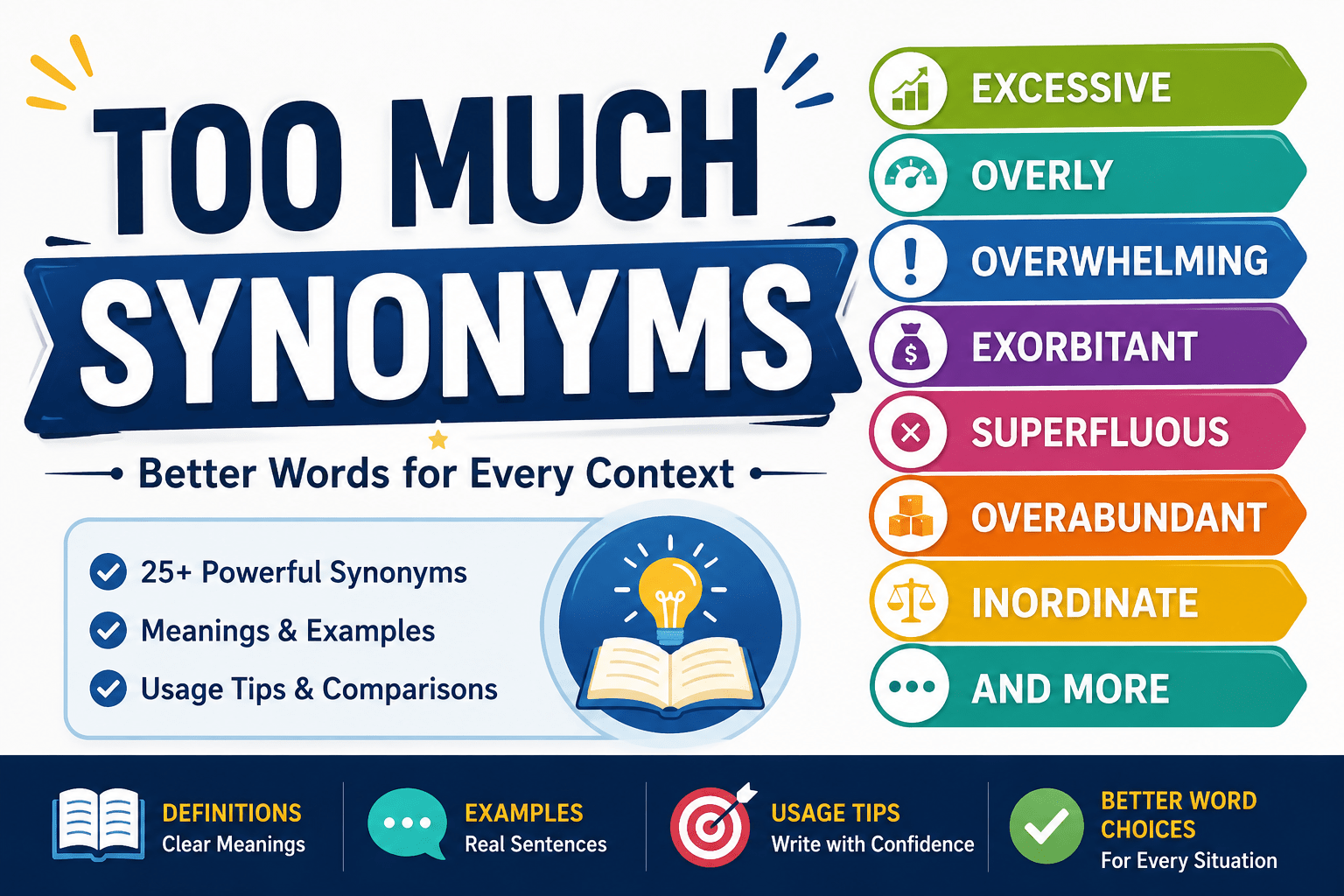
The most useful alternatives include excessive, excessively, overly, overabundant, excessive amounts, inordinate, immoderate, exorbitant, overwhelming, superfluous, surplus, and overdone. However, these words are not interchangeable in every context. The best choice depends on the noun, grammar, tone, and meaning you want to convey.
Quick Answer: What Are the Best Synonyms for “Too Much”?
The closest general alternatives to “too much” are excessive, excessively, overly, overmuch, inordinate, immoderate, and more than necessary. For specific contexts, exorbitant works well for prices, overwhelming for an amount that is difficult to handle, superfluous for something unnecessary, and overabundant for an unusually large supply. Merriam-Webster and other thesaurus sources also distinguish different senses of the phrase, so context matters.
What Does “Too Much” Mean?
Too much is a phrase used mainly to indicate an amount, degree, or extent that exceeds what is considered desirable, necessary, reasonable, or acceptable.
It is commonly used with uncountable nouns:
- too much water
- too much noise
- too much money
- too much work
- too much information
- too much pressure
It can also describe degree or intensity:
- She talks too much.
- The machine vibrates too much.
- He worries too much.
The key idea is excess beyond an appropriate limit.
Pronunciation
too much
- US: /tuː mʌtʃ/
- UK: /tuː mʌtʃ/
The Best “Too Much” Synonyms
| Word or Phrase | Relationship | Strength | Formality | Best Context |
|---|---|---|---|---|
| Excessive | Direct/near synonym | Strong | Neutral–formal | Amount, degree, behavior |
| Excessively | Direct alternative | Strong | Neutral–formal | Verbs and adjectives |
| Overly | Near synonym | Moderate | Neutral | Degree or quality |
| Overmuch | Direct synonym | Strong | Literary/formal | Formal or literary writing |
| Inordinate | Near synonym | Strong | Formal | Unusually large degree |
| Immoderate | Near synonym | Strong | Formal | Lack of restraint |
| Overabundant | Contextual alternative | Strong | Formal | Supplies and quantities |
| Surplus | Contextual alternative | Moderate | Neutral–formal | Extra quantity |
| Superfluous | Contextual alternative | Strong | Formal | Unnecessary excess |
| Exorbitant | Contextual alternative | Strong | Formal | Prices and costs |
| Overwhelming | Contextual alternative | Strong | Neutral | Amount that is difficult to handle |
| Overdone | Contextual alternative | Moderate | Neutral | Style, effort, presentation |
| Unreasonable | Contextual alternative | Strong | Neutral | Excess beyond what is acceptable |
| Undue | Contextual alternative | Moderate | Formal | Excessive or inappropriate degree |
| More than necessary | Direct phrase | Moderate | Neutral | Clear general writing |
1. Excessive
Excessive is probably the most useful one-word alternative when too much means more than is reasonable, necessary, or desirable.
Example:
Excessive noise can make it difficult to concentrate.
Use it for quantities, behavior, spending, force, emotion, or other things that go beyond a sensible limit.
2. Excessively
Excessively is the adverbial form and is useful when too much modifies a verb, adjective, or adverb.
Example:
The report is excessively long.
Compare:
The report contains too much information.
The report is excessively detailed.
The two sentences are similar, but the grammatical structure is different.
3. Overly
Overly means to an excessive degree and is especially common before adjectives and adverbs.
Example:
Try not to be overly critical.
The instructions are overly complicated.
It often sounds more restrained than excessively and is very natural in professional and academic writing.
4. Overmuch
Overmuch is a genuine synonym for too much, meaning more than necessary or appropriate. It is uncommon in everyday modern conversation and can sound literary or formal.
Example:
The policy should not be criticized overmuch.
For ordinary modern English, too much or excessively will usually sound more natural.
5. Inordinate
Inordinate describes something that is far greater than normal, reasonable, or appropriate.
Example:
The project required an inordinate amount of time.
This is particularly useful in formal, academic, and professional writing.
6. Immoderate
Immoderate emphasizes a lack of restraint or moderation.
Example:
Immoderate spending can create serious financial problems.
It works particularly well with concepts such as spending, drinking, eating, demands, criticism, and behavior.
7. Overabundant
Overabundant means more abundant than necessary or desirable.
Example:
The website contains an overabundant supply of information.
It is best suited to things that exist in large quantities rather than every possible use of too much.
8. Surplus
Surplus means an amount that is more than what is needed or used.
Example:
The company sold its surplus equipment.
Unlike excessive, surplus does not necessarily imply something negative. A surplus can simply be extra.
9. Superfluous
Superfluous means unnecessary or excessive because it adds nothing useful.
Example:
Remove any superfluous details from the report.
This is an excellent choice when too much means unnecessary rather than simply large in quantity.
10. Exorbitant
Use exorbitant when something, especially a price, fee, charge, or cost, is far higher than reasonable.
Example:
The hotel charged an exorbitant fee for parking.
You would not normally use exorbitant for ordinary quantities such as too much water.
11. Overwhelming
Overwhelming describes an amount, situation, or experience that is so great or intense that it becomes difficult to handle.
Example:
The amount of information was overwhelming.
This is stronger and more emotional than simply saying too much information.
12. Overdone
Overdone means carried too far, especially in style, decoration, humor, explanation, or effort.
Example:
The presentation felt a little overdone.
It is not a general synonym for too much, but it is highly useful when excess involves style or execution.
Too Much Synonyms by Context
A single replacement does not work equally well everywhere. Choose the word according to what is excessive.
For Too Much Money
Use:
- excessive spending
- extravagant spending
- exorbitant costs
- an unreasonable amount
- overspending
Example:
The company spent too much money on advertising.
Better in a formal context:
The company engaged in excessive spending on advertising.
For a price that is unreasonably high:
The supplier charged an exorbitant price.
For Too Much Work
Use:
- excessive workload
- an overwhelming workload
- an unreasonable workload
- an excessive amount of work
- an undue burden
Example:
The team has too much work.
More precise:
The team is facing an overwhelming workload.
For Too Much Information
Use:
- excessive information
- an overwhelming amount of information
- information overload
- unnecessary detail
- superfluous information
Example:
The article contains too much information.
If the problem is that readers cannot process it easily:
The article contains an overwhelming amount of information.
If the information is unnecessary:
The article contains too much superfluous detail.
For Too Much Food
Use:
- excessive food
- an excessive amount of food
- more food than necessary
- an abundance of food
Example:
We prepared too much food for the party.
Natural alternative:
We prepared more food than necessary for the party.
For Too Much Noise
Use:
- excessive noise
- unbearable noise
- overwhelming noise
- excessive volume
Example:
Excessive noise can interfere with concentration.
Here, excessive is much more natural than forcing a rare synonym into the sentence.
For Someone Who Talks Too Much
Instead of mechanically replacing too much, rewrite the sentence when necessary.
He talks too much.
Possible alternatives:
He talks excessively.
He is overly talkative.
He tends to talk at length.
He is extremely talkative.
These alternatives are not identical. Talkative describes a person’s tendency to talk a lot, while talk excessively emphasizes that the amount is considered excessive.
Formal Synonyms for “Too Much”
For academic, professional, or formal writing, consider:
- excessive
- excessively
- inordinate
- immoderate
- undue
- superfluous
- exorbitant
- overabundant
- more than necessary
Example
Informal:
The company spent too much money.
Formal:
The company incurred excessive expenses.
For an unnecessarily detailed report:
The report contains superfluous information.
For an unusually high cost:
The proposed fee is exorbitant.
The important point is that formal does not automatically mean better. Use the word that expresses the exact meaning.
Casual Alternatives to “Too Much”
In everyday English, simple phrases are often more natural:
- a lot
- way too much
- far too much
- more than enough
- more than necessary
- loads of
- tons of
- an awful lot of
Examples
That’s way too much food.
We have more than enough time.
She has a lot of work to finish.
Note that a lot is not always a true synonym for too much. A lot means a large amount, while too much normally implies that the amount exceeds an acceptable or desirable limit.
“Too Much” vs. “Excessive” vs. “Overly”
These three are closely related but grammatically different.
| Word | Typical Function | Example |
| Too much | Phrase | There is too much noise. |
| Excessive | Adjective | There is excessive noise. |
| Overly | Adverb | The instructions are overly complicated. |
Too much
More conversational and extremely flexible.
There is too much pressure on employees.
Excessive
More concise and often more formal.
There is excessive pressure on employees.
Overly
Usually modifies an adjective or adverb.
The policy is overly restrictive.
A common mistake is to assume that overly can replace too much everywhere. It cannot.
“Too Much” vs. “Too Many”
This distinction is important for English learners.
Use too much with uncountable nouns:
- too much water
- too much information
- too much money
- too much traffic
Use too many with countable plural nouns:
- too many books
- too many questions
- too many people
- too many mistakes
Incorrect:
There are too much people here.
Correct:
There are too many people here.
Common Mistakes with “Too Much” Synonyms
Mistake 1: Treating every related word as interchangeable
Words such as exorbitant, superfluous, overwhelming, and surplus describe different kinds of excess.
For example:
an exorbitant price
is natural, while:
an exorbitant amount of water
is usually unnatural.
Mistake 2: Using “overly” with nouns
Incorrect:
There is overly information.
Better:
There is too much information.
Or:
There is excessive information.
Mistake 3: Using formal vocabulary when simple English is better
Incorrect stylistically:
The child consumed an immoderate quantity of juice.
Natural:
The child drank too much juice.
Precise vocabulary is useful only when it improves the sentence.
Mistake 4: Assuming “a lot” means “too much”
These are not always equivalent.
She has a lot of experience.
This is normally positive or neutral.
She has too much experience for this position.
This suggests the amount is excessive or creates a problem.
Useful Collocations
Some alternatives become much more natural when paired with particular nouns.
| Phrase | Natural Alternative |
| too much money | excessive spending / exorbitant cost |
| too much work | excessive workload / overwhelming workload |
| too much information | information overload / excessive information |
| too much detail | unnecessary detail / superfluous detail |
| too much pressure | excessive pressure / undue pressure |
| too much time | an inordinate amount of time |
| too much noise | excessive noise |
| too much criticism | excessive criticism / undue criticism |
| too much demand | excessive demand |
| too much decoration | overdone decoration |
This illustrates why synonym selection should happen at the phrase level, not simply by replacing one word mechanically.
Antonyms of “Too Much”
The opposite depends on what you mean.
Useful contrasts include:
- too little
- insufficient
- inadequate
- limited
- scarce
- moderate
- reasonable
- just enough
- sufficient
Compare:
We have too much food.
We have too little food.
Or:
The company received excessive funding.
The company received insufficient funding.
FAQ
What is the closest synonym for “too much”?
Excessive is one of the closest general alternatives when too much means more than is reasonable, necessary, or desirable.
What is a formal word for “too much”?
Useful formal alternatives include excessive, inordinate, immoderate, undue, and superfluous, depending on the context.
What is another way to say “too much”?
You can say excessive, overly, far too much, more than necessary, overmuch, or an excessive amount, depending on the grammatical structure and context.
What is a strong synonym for “too much”?
Excessive, inordinate, exorbitant, and overwhelming can all express strong excess, but each has a different use. Exorbitant is especially associated with prices, while overwhelming suggests an amount that is difficult to handle.
Is “overly” a synonym for “too much”?
Sometimes. Overly means to an excessive degree and commonly modifies adjectives or adverbs, as in overly complicated or overly cautious. It cannot replace too much in every sentence.
Is “a lot” the same as “too much”?
No. A lot indicates a large amount but is often neutral or positive. Too much usually indicates that an amount exceeds an appropriate limit.
What is the synonym for “too much” in academic writing?
Excessive is often the safest choice, while inordinate, undue, superfluous, or immoderate may be more precise in particular contexts.
What is the opposite of “too much”?
Depending on context, the opposite can be too little, insufficient, inadequate, limited, or just enough.
Conclusion
Too much synonyms depend on exactly what kind of excess you mean. Excessive is the most versatile formal alternative, while overly works well before adjectives and adverbs. For specific situations, choose exorbitant for unreasonable prices, superfluous for unnecessary details, overwhelming for difficult-to-handle amounts, inordinate for unusually large degrees, and surplus for extra supply.
The most important rule is simple: do not automatically replace “too much”. Choose the word that describes the specific kind of excess you mean.

Daniel Carter is a professional content strategist and language enthusiast. He focuses on semantic SEO, keyword research, and creating structured vocabulary content that ranks well on search engines while remaining user-friendly.