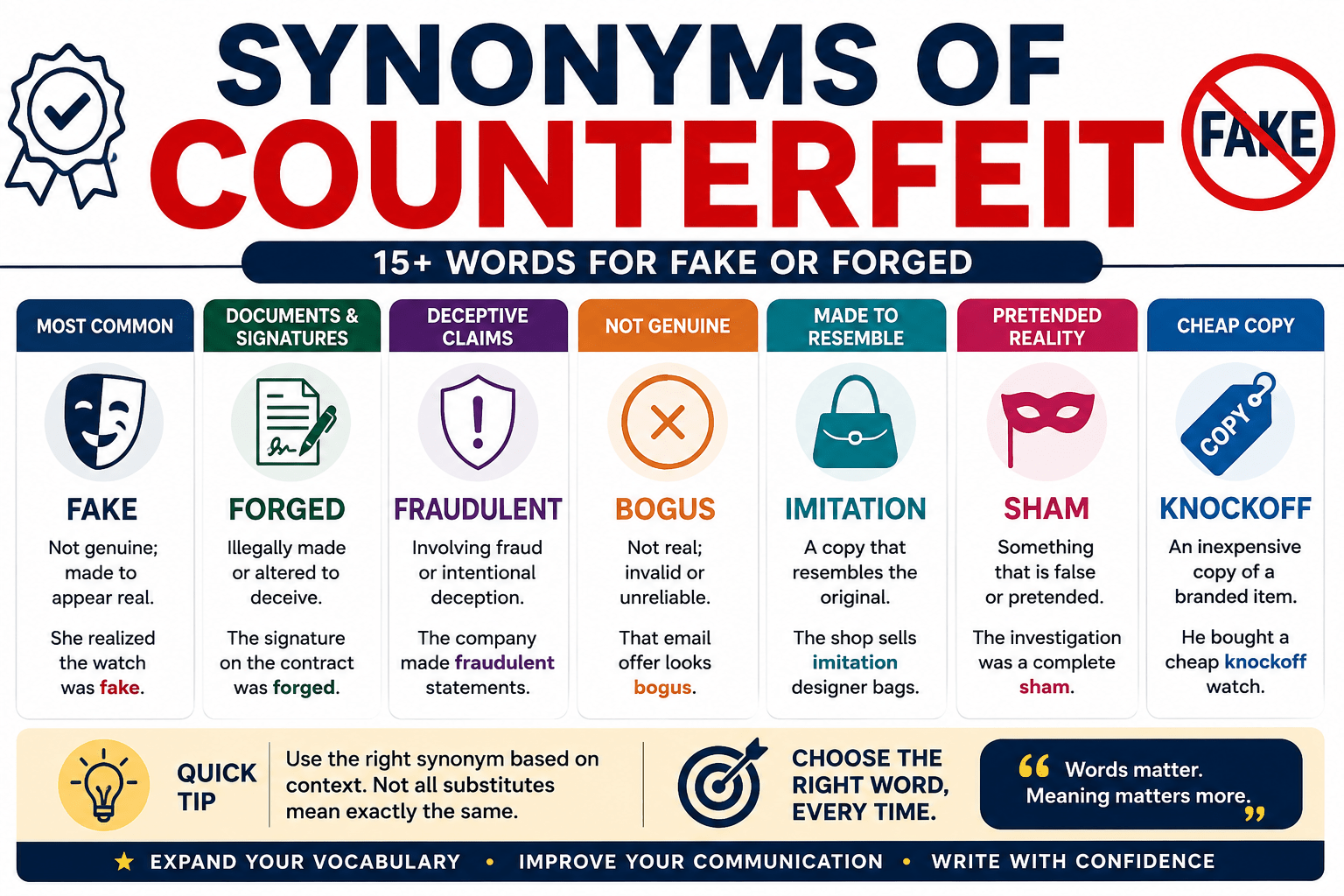
Finding the right synonym for counterfeit depends on what you are describing. Fake is the most common everyday alternative, while forged is more precise for illegally reproduced documents, signatures, or currency. Words such as imitation, bogus, sham, fraudulent, and knockoff overlap with counterfeit but carry different meanings and levels of formality.
This guide explains the closest synonyms, their nuances, and the contexts in which each word sounds most natural.
Quick Answer
The closest synonyms of counterfeit include fake, forged, fraudulent, bogus, sham, imitation, spurious, phony, and knockoff. However, they are not completely interchangeable. Fake is the broadest everyday alternative, forged emphasizes unauthorized reproduction, and knockoff usually describes an imitation of a branded product.
What Does “Counterfeit” Mean?
Counterfeit can function as an adjective, noun, or verb.
As an adjective, it describes something made to look genuine, usually with an intention to deceive. For example:
The store was selling counterfeit designer handbags.
As a noun, a counterfeit is something that is made to appear genuine but is not authentic:
The bank discovered several counterfeit bills.
As a verb, counterfeit means to imitate or reproduce something dishonestly, particularly something valuable such as money or official documents.
Pronunciation
- US: /ˈkaʊn.t̬ɚ.fɪt/
- UK: /ˈkaʊn.tə.fɪt/
Cambridge gives the same basic pronunciation distinction between American and British English.
The Closest Synonyms of Counterfeit
| Word | Relationship | Strength | Formality | Best Context |
|---|---|---|---|---|
| Fake | Direct synonym | Strong | Neutral | Everyday English |
| Forged | Near synonym | Strong | Formal | Documents, signatures, money |
| Fraudulent | Near synonym | Strong | Formal | Transactions, claims, activity |
| Bogus | Near synonym | Strong | Informal–neutral | Claims, credentials, products |
| Imitation | Near synonym | Moderate | Neutral | Products, art, objects |
| Sham | Near synonym | Strong | Neutral | Pretended or deceptive things |
| Spurious | Near synonym | Strong | Formal | Claims, evidence, reasoning |
| Phony | Near synonym | Moderate | Informal | People, claims, objects |
| Knockoff | Contextual alternative | Moderate | Informal | Branded products |
| Fictitious | Contextual alternative | Moderate | Formal | Names, identities, information |
| Inauthentic | Near synonym | Moderate | Formal | Objects, behavior, experiences |
| False | Contextual alternative | Moderate | Neutral | Statements, information |
| Fabricated | Contextual alternative | Strong | Neutral–formal | Stories, evidence, information |
| Deceptive | Contextual alternative | Strong | Neutral–formal | Appearances, claims, practices |
| Pretend | Contextual alternative | Moderate | Informal | Roles, behavior, situations |
The most important distinction is that counterfeit specifically emphasizes a close imitation of something genuine or valuable. Merriam-Webster distinguishes it from broader words such as fake and fraud.
1. Fake
Fake is the most common and flexible everyday synonym for counterfeit.
Best for: general conversation and informal writing.
The police found several fake watches in the warehouse.
Unlike counterfeit, fake does not always imply an intention to deceive. Something can be fake without necessarily being part of a deliberate fraud.
2. Forged
Forged is especially appropriate when something has been illegally reproduced or altered to appear authentic.
Best for: signatures, documents, checks, passports, currency, and official records.
The signature on the contract was forged.
Forged is more specific than fake because it often points to the act of unauthorized reproduction or alteration.
3. Fraudulent
Fraudulent describes something involving deception intended to gain an advantage or cause someone to believe something false.
Best for: transactions, claims, financial activity, documents, and business practices.
The company was accused of making fraudulent claims.
It is related to counterfeit, but it does not necessarily describe a physical imitation.
4. Bogus
Bogus means not genuine, valid, or trustworthy.
Best for: claims, credentials, offers, products, and information.
The website was promoting bogus investment opportunities.
It is more conversational than fraudulent and often sounds natural in journalism and everyday speech.
5. Imitation
Imitation refers to something made to resemble another thing.
Best for: products, designs, art, styles, and objects.
She bought an imitation leather jacket.
The important difference is that imitation does not automatically imply deception. An imitation may be openly presented as an imitation.
6. Sham
Sham describes something presented as genuine, legitimate, or meaningful when it is actually false or deceptive.
Best for: organizations, processes, agreements, relationships, and claims.
The investigation revealed that the competition was a sham.
It can describe something deceptive, but it is not normally the best replacement for counterfeit money or counterfeit currency.
7. Spurious
Spurious is a formal word meaning false, invalid, or apparently genuine but actually unfounded.
Best for: arguments, claims, evidence, conclusions, and reasoning.
The report was based on spurious evidence.
This is usually a poor substitute for counterfeit handbag, but it can be useful when discussing false claims or reasoning.
8. Phony
Phony is an informal alternative meaning fake, false, or not genuine.
Best for: people, identities, claims, credentials, and objects.
He gave the officer a phony identification card.
In American English, phony is particularly common in informal contexts.
9. Knockoff
A knockoff is an imitation, especially an inexpensive or unauthorized copy of a branded product.
Best for: clothing, handbags, watches, electronics, and other consumer goods.
She realized that the designer bag was a cheap knockoff.
Knockoff is much more informal than counterfeit and is strongly associated with consumer products.
10. Fictitious
Fictitious means invented rather than real.
Best for: names, characters, identities, accounts, addresses, and information.
The application contained a fictitious address.
It is not a general synonym for counterfeit because it usually describes something invented rather than a physical imitation of a genuine item.
11. Inauthentic
Inauthentic means not genuine, original, or sincere.
Best for: objects, experiences, behavior, communication, and cultural products.
The museum determined that the painting was inauthentic.
It is broader than counterfeit and does not necessarily imply that someone deliberately created a false copy.
12. False
False is a broad term for something that is not true, correct, or genuine.
Best for: statements, information, claims, and representations.
The document contained several false statements.
Because false is so broad, it is usually less precise than counterfeit when discussing fake physical goods.
13. Fabricated
Fabricated means deliberately invented, created, or falsified.
Best for: stories, evidence, records, information, and claims.
The witness admitted that the story was fabricated.
It can overlap with counterfeit in some contexts, but it generally emphasizes creation or invention, rather than imitation of a genuine object.
14. Deceptive
Deceptive describes something designed or likely to mislead someone.
Best for: appearances, advertising, claims, practices, and behavior.
The advertisement used deceptive marketing techniques.
It focuses on the misleading effect or intention, not necessarily on producing a fake object.
15. Pretend
Pretend means to act as though something is true when it is not.
Best for: behavior, roles, emotions, and situations.
The children used pretend money during the game.
This is generally not an appropriate synonym for counterfeit when discussing illegal copies or fake currency.
Counterfeit Synonyms by Context
For Money
The most precise alternatives are:
- fake money
- forged currency
- forged bills
- bogus notes
Forged is especially useful when emphasizing unauthorized reproduction.
The bank detected several forged bills.
For Branded Products
Natural choices include:
- fake
- knockoff
- imitation
- inauthentic
The website was selling counterfeit designer shoes.
The website was selling fake designer shoes.
The website was selling cheap knockoffs.
The final version is more informal and specifically suggests an imitation of a branded product.
For Documents
Prefer:
- forged
- fraudulent
- fake
Investigators discovered a forged passport.
Here, forged is considerably more precise than imitation.
For Claims or Information
Consider:
- false
- bogus
- spurious
- fabricated
- deceptive
The article relied on fabricated evidence.
Calling the evidence counterfeit would sound unusual unless the evidence itself was physically reproduced to imitate something genuine.
Counterfeit vs. Fake
Counterfeit and fake are sometimes interchangeable, but fake is broader.
Fake can refer to anything that is not genuine:
The signature was fake.
Counterfeit more strongly suggests a deliberate imitation of something genuine or valuable:
The bank discovered counterfeit currency.
So, use fake for everyday language and counterfeit when precision about an imitation or fraudulent replica matters.
Counterfeit vs. Forged
These words overlap, but their usual contexts differ.
| Word | Main Focus | Example |
|---|---|---|
| Counterfeit | Fake imitation of something genuine | counterfeit currency |
| Forged | Illegally reproduced or altered item | forged signature |
| Fake | Anything not genuine | fake watch |
| Imitation | Something made to resemble another | imitation leather |
A counterfeit watch is an unauthorized imitation of a genuine watch. A forged signature is an unauthorized reproduction of someone’s signature.
Counterfeit vs. Imitation
The distinction is important.
Imitation focuses on resemblance.
Counterfeit usually carries a stronger implication of deception or unauthorized reproduction.
Compare:
The store sells imitation leather bags.
This does not necessarily mean the seller is pretending they are genuine leather.
The store sells counterfeit designer bags.
This suggests unauthorized copies presented as genuine or intended to deceive buyers.
Counterfeit vs. Knockoff
A knockoff is generally an imitation of a branded or recognizable product and is an informal term.
He bought a knockoff designer watch.
Counterfeit is more precise and formal:
Customs officials seized counterfeit watches.
For professional, legal, or formal writing, counterfeit is usually the better choice.
Which Word Fits Best?
Instead of repeatedly using one generic synonym, match the word to the situation:
Use fake for general everyday language.
She realized the necklace was fake.
Choose fake for general everyday language.
The signature was forged.
For documents, signatures, and currency, forged is the more precise term.
He bought a cheap knockoff.
In informal descriptions of copied branded products, knockoff is commonly used.
The shop sells imitation jewelry.
When the focus is on resemblance rather than deception, imitation fits best.
The company submitted fraudulent documents.
For dishonest or deceptive activity, fraudulent is the stronger choice.
The conclusion was based on spurious evidence.
When describing false claims, evidence, or reasoning, spurious is appropriate.
The report contained fabricated data.
Common Mistakes with Counterfeit Synonyms
Mistake 1: Treating “imitation” as always meaning “counterfeit”
Not every imitation is counterfeit.
An imitation can be openly sold as an imitation. Counterfeit usually carries a stronger connection with deception or unauthorized copying.
Mistake 2: Using “forged” for every fake object
Forged is particularly natural for documents, signatures, records, and currency. It is not the universal replacement for counterfeit.
Mistake 3: Using “fabricated” for physical counterfeit goods
Fabricated commonly describes invented information, stories, evidence, or records. It does not normally mean a fake branded product.
Mistake 4: Assuming “fake” always means illegal
Fake is broader than counterfeit and does not necessarily indicate illegal activity or an intention to deceive.
Antonyms of Counterfeit
Useful opposites include:
- genuine
- authentic
- original
- legitimate
- real
- legitimate
- verified
For example:
The dealer confirmed that the painting was authentic.
Cambridge lists genuine and real as opposites of counterfeit.
FAQ
What is the closest synonym for counterfeit?
Fake is generally the closest everyday synonym. Forged can be more precise for documents, signatures, and currency.
What is another word for counterfeit?
Common alternatives include fake, forged, fraudulent, bogus, imitation, sham, phony, spurious, and knockoff.
What is a formal synonym for counterfeit?
Depending on context, forged, fraudulent, inauthentic, or spurious may work better than the informal fake.
What is the strongest synonym for counterfeit?
There is no single strongest synonym. Counterfeit itself is highly specific because it emphasizes an imitation intended to appear genuine. Forged is more precise in contexts involving documents, signatures, or currency.
Is “fake” the same as “counterfeit”?
Not always. Fake is broader and can describe anything that is not genuine. Counterfeit more specifically refers to a close imitation of something genuine or valuable, often involving deception.
What is the difference between counterfeit and imitation?
Imitation emphasizes resemblance, while counterfeit usually suggests an unauthorized imitation intended to appear genuine.
What is the difference between counterfeit and forged?
Counterfeit commonly describes fake goods, currency, or other valuable items. Forged is especially natural for documents, signatures, records, and currency that have been illegally reproduced or altered.
What is the opposite of counterfeit?
The clearest opposites are genuine, authentic, original, and real.
Conclusion
The best synonym for counterfeit depends on the context. Fake is the simplest everyday alternative, forged works best for unauthorized documents and signatures, knockoff suits informal descriptions of copied branded products, and imitation emphasizes resemblance without necessarily implying deception. For formal writing, choose more precise terms such as fraudulent, spurious, fabricated, or inauthentic when their specific meanings fit.

Emily Johnson is a linguistics graduate and vocabulary specialist. She writes detailed synonym explanations and helps readers understand subtle differences between words, improving both writing and speaking skills. Synonyms help express ideas more clearly and precisely in English.