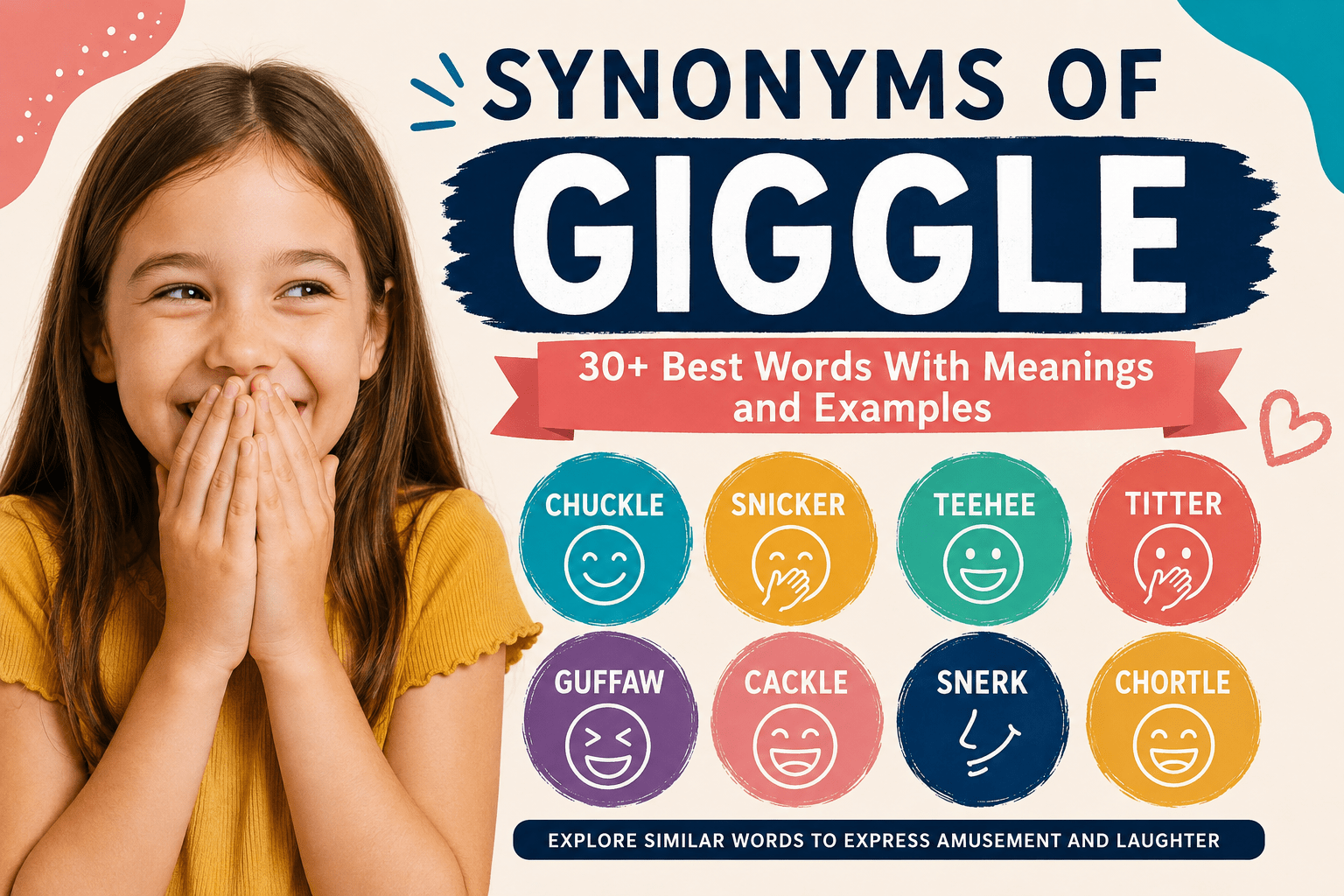
If you need a synonym for giggle, the best choice depends on why someone is laughing and how the laughter sounds. Common alternatives include laugh, chuckle, titter, snicker, snigger, chortle, cackle, and twitter. However, these words are not interchangeable in every situation. A chuckle is usually quiet and amused, while a titter can suggest nervousness or embarrassment, and a snicker may imply disrespect or amusement at someone else’s expense.
This guide explains the closest synonyms of giggle, how they differ, and which word sounds most natural in different contexts.
Quick Answer: What Are the Best Synonyms of Giggle?
The best synonyms and contextual alternatives for giggle include:
- Laugh — the broadest and most general alternative
- Chuckle — a quiet, restrained laugh
- Titter — a nervous, embarrassed, or suppressed laugh
- Snicker — a quiet laugh that can suggest disrespect or amusement at someone else’s expense
- Snigger — chiefly British; similar to snicker
- Chortle — a cheerful, hearty laugh
- Cackle — a loud, harsh, or uncontrolled laugh
- Twitter — a light, high-pitched laugh; relatively uncommon in modern everyday American English
- Guffaw — a loud, hearty laugh
- Tee-hee — an informal written representation of a small or playful laugh
Not all of these are exact replacements. Laugh is the safest general alternative, while words such as titter, snicker, and cackle add specific shades of meaning.
What Does “Giggle” Mean?
Giggle is both a verb and a noun.
As a verb, giggle means to laugh repeatedly in a quiet, uncontrolled way, often because something is silly, funny, embarrassing, or makes someone nervous. Cambridge describes it as laughing repeatedly in a quiet but uncontrolled way, while Oxford notes that it can happen because someone is embarrassed, nervous, or amused.
Example:
The students started to giggle when the teacher told the joke.
As a noun, giggle refers to the laugh itself:
She let out a nervous giggle.
The word often carries a sense of light, playful, nervous, or slightly silly laughter rather than a loud burst of amusement.
Best Synonyms of Giggle at a Glance
| Word | Relationship | Meaning | Best Context |
|---|---|---|---|
| Laugh | Broad synonym | To express amusement through laughter | General situations |
| Chuckle | Close synonym | To laugh quietly or softly | Mild amusement |
| Titter | Near synonym | A nervous, embarrassed, or suppressed laugh | Awkward situations |
| Snicker | Contextual synonym | A quiet laugh, often disrespectful | Mockery or private amusement |
| Snigger | Contextual synonym | Similar to snicker, especially in British English | Mockery or embarrassment |
| Chortle | Near synonym | A cheerful, hearty laugh | Strong amusement |
| Cackle | Near synonym | A loud, harsh, or uncontrolled laugh | Exaggerated or distinctive laughter |
| Guffaw | Related alternative | A loud, hearty laugh | Big, open laughter |
| Contextual alternative | A light, high-pitched laugh | Literary or descriptive writing | |
| Tee-hee | Informal alternative | A playful written representation of laughter | Informal dialogue or text |
Merriam-Webster and Collins both list many of these words in connection with giggle, while their definitions and examples show why they are not identical in meaning.
1. Laugh
Laugh is the broadest and most natural alternative to giggle. It describes the general act of expressing amusement through laughter.
Unlike giggle, laugh does not necessarily suggest that the laughter is quiet, nervous, high-pitched, or silly.
Example:
Everyone laughed at the comedian’s joke.
Choose “laugh” when:
You simply want to describe laughter without emphasizing its particular sound or emotional quality.
2. Chuckle
Chuckle usually describes a quiet or restrained laugh. It is one of the closest alternatives to giggle, but it often sounds more mature, controlled, or warmly amused.
Example:
He chuckled when he remembered the old story.
Giggle vs. chuckle
- Giggle: often playful, nervous, or silly
- Chuckle: usually quiet, gentle, and amused
Someone might giggle during an embarrassing moment but chuckle at a clever joke.
Merriam-Webster describes chuckle as a form of laughter and includes giggle among its related words.
3. Titter
Titter is especially useful when laughter is nervous, embarrassed, restrained, or slightly inappropriate.
Example:
She gave a nervous titter before answering the question.
It can also describe polite or suppressed laughter. Cambridge identifies titter as a synonym of giggle, particularly in British usage.
Choose “titter” when:
The person is trying to control their laughter or is laughing because they feel awkward or embarrassed.
4. Snicker
Snicker describes a quiet, often suppressed laugh. It can suggest that someone finds something funny in a mocking, mischievous, or disrespectful way.
Example:
The students snickered when their classmate made a mistake.
Giggle vs. snicker
A giggle can be innocent or playful. A snicker often has a negative or mischievous undertone.
That difference matters when choosing the word for professional or formal writing.
5. Snigger
Snigger has essentially the same core sense as snicker and is especially common in British English.
Example:
The children began to snigger at the embarrassing remark.
Collins lists snigger among the synonyms associated with giggle and notes its use for a quiet or disrespectful laugh.
Snicker vs. snigger
For American readers, snicker is generally the more familiar choice. Snigger is particularly associated with British English.
6. Chortle
Chortle means to laugh in a cheerful, pleased, or hearty way. It usually suggests stronger amusement than giggle.
Example:
Grandpa chortled at the ridiculous story.
Giggle vs. chortle
- Giggle → light, nervous, playful, or silly
- Chortle → hearty, cheerful, satisfied amusement
Use chortle when the laughter sounds more substantial and expressive.
Collins includes chortle among the words associated with giggle and gives examples involving hearty amusement.
7. Cackle
Cackle describes a loud, harsh, or distinctive laugh. It is not normally the best neutral replacement for giggle.
Example:
The old witch cackled loudly.
It can be used humorously or descriptively, but it often creates a particular image of the person’s laugh.
Choose “cackle” when:
You want the reader to notice the sound or unpleasant quality of the laughter.
8. Guffaw
A guffaw is a loud, hearty, uninhibited laugh.
Example:
He let out a loud guffaw when he heard the punchline.
A guffaw is therefore quite different from the typical quiet quality associated with giggle.
Giggle vs. guffaw
Giggle: quiet and often restrained
Guffaw: loud and uncontrolled
Merriam-Webster lists guffaw among related laughter terms, but it is better treated as a contextual alternative rather than an exact synonym.
9. Twitter
As a verb describing laughter, twitter can refer to a light, high-pitched, or fluttering laugh.
Example:
The children twittered with excitement.
This word is much less common in ordinary modern American conversation than laugh, giggle, or chuckle. It can work better in literary or descriptive writing.
Because twitter has several unrelated meanings, including the familiar social-media sense, context is especially important.
10. Tee-hee
Tee-hee is an informal expression representing a small, playful, often mischievous laugh.
Example:
“Tee-hee,” she said after hiding the surprise gift.
It works best in dialogue, informal writing, comics, or text-style communication. It is not a formal synonym for giggle.
Which Word Should I Use Instead of “Giggle”?
The right synonym depends on the situation.
Use “laugh” when:
You want the safest, most general word for laughter.
Use “chuckle” when:
The laughter is quiet, gentle, or restrained.
Use “titter” when:
The laughter is nervous, embarrassed, or suppressed.
Use “snicker” when:
The laughter is quiet and may involve mockery or disrespect.
Use “snigger” when:
You want the British-English equivalent of snicker.
Use “chortle” when:
The laughter is cheerful and hearty.
Use “cackle” when:
The laugh is loud, harsh, or distinctive.
Use “guffaw” when:
The person laughs loudly and openly.
Use “twitter” when:
You want a light, high-pitched, literary description.
Use “tee-hee” when:
You are writing informal dialogue or representing playful laughter.
Giggle vs. Chuckle vs. Titter vs. Snicker
These four words are among the easiest to confuse.
| Word | Typical quality | Emotional suggestion | Example |
|---|---|---|---|
| Giggle | Quiet, repeated | Playful, nervous, silly | She giggled at the joke. |
| Chuckle | Soft, restrained | Warm amusement | He chuckled at the memory. |
| Titter | Light, suppressed | Nervous or embarrassed | She tittered nervously. |
| Snicker | Quiet, suppressed | Often mocking or mischievous | They snickered at his mistake. |
The key difference is connotation. Giggle is often neutral or playful; chuckle is generally warm; titter often signals nervousness or embarrassment; and snicker can suggest ridicule. These distinctions are reflected across major dictionary and thesaurus sources.
Common Mistakes When Choosing a Synonym for Giggle
Mistake 1: Treating every laughter word as an exact synonym
Words such as guffaw and cackle describe particular types of laughter. They should not automatically replace giggle.
Mistake 2: Using “snicker” for innocent laughter
Snicker can suggest mockery or disrespect.
Better: The children giggled during the game.
Different meaning: The children snickered when another student fell.
Mistake 3: Using “chuckle” for loud laughter
A chuckle generally suggests quiet or restrained amusement. If someone laughs loudly, guffaw or simply laugh may be more appropriate.
Mistake 4: Assuming “titter” always means playful laughter
Titter frequently carries a sense of nervousness, embarrassment, or suppressed laughter.
Mistake 5: Using “tee-hee” in formal writing
Tee-hee is an informal representation of laughter and is unsuitable for most academic or professional writing.
Natural Examples of Giggle Synonyms
Playful
The children giggled as they hid behind the curtain.
Quiet amusement
She chuckled when she saw the old photograph.
Nervous laughter
He tittered nervously before giving his presentation.
Mocking laughter
The teenagers snickered at the unusual costume.
British English
The boys sniggered at the embarrassing comment.
Hearty amusement
She chortled with delight at the unexpected joke.
Loud laughter
He let out a huge guffaw.
Distinctive laughter
The character cackled dramatically.
These examples demonstrate why choosing a synonym based only on dictionary similarity can produce the wrong tone.
Antonyms of Giggle
The most useful opposites of giggle are words describing the absence of laughter or expressions of sadness.
Depending on the context, possible antonyms include:
- cry
- weep
- sob
- frown
- scowl
The best antonym depends on whether you are contrasting laughter with sadness or with a serious facial expression. Merriam-Webster lists several forms of crying and sadness among the antonyms or near-antonyms of giggle.
Frequently Asked Questions
What is the closest synonym for giggle?
Laugh is the broadest synonym, while chuckle is one of the closest alternatives when you mean a quiet, gentle laugh. Titter is closer when the laughter is nervous or embarrassed.
What is another word for giggle nervously?
Titter is one of the best choices for nervous or embarrassed laughter. You can also simply say laugh nervously when clarity is more important than vocabulary variety.
What is a formal synonym for giggle?
There is no single formal replacement that preserves every meaning of giggle. In formal writing, laugh, chuckle, or laugh softly may be more natural depending on the context.
Is “chuckle” the same as “giggle”?
Not exactly. Both describe relatively quiet laughter, but giggle often suggests nervousness, silliness, or playfulness, while chuckle generally suggests mild amusement.
What is the difference between giggle and titter?
A giggle is often playful or silly laughter, whereas a titter commonly suggests nervous, embarrassed, or suppressed laughter. Cambridge specifically lists titter as a synonym of giggle.
What is the difference between giggle and snicker?
A giggle can be innocent or playful. A snicker is usually a quiet laugh and may suggest mockery, mischief, or amusement at someone else’s expense.
Is “snigger” the same as “snicker”?
They are very close in meaning. Snicker is more common in American English, while snigger is especially associated with British English. Collins includes both among the words related to giggle.
Can “laugh” replace “giggle”?
Often, yes. Laugh is much broader, however, so it removes the specific suggestion of quiet, nervous, silly, or playful laughter that giggle can convey.
Conclusion
The best synonym for giggle depends on the type of laughter you want to describe. Laugh is the safest general alternative, chuckle works well for quiet amusement, titter emphasizes nervous or embarrassed laughter, and snicker/snigger can suggest mockery. For stronger or more distinctive laughter, chortle, cackle, and guffaw may be better choices.
Instead of choosing a synonym simply because it appears in a thesaurus, consider the sound, emotion, intensity, and context of the laughter. That is what makes the vocabulary choice accurate and natural.

Emily Johnson is a linguistics graduate and vocabulary specialist. She writes detailed synonym explanations and helps readers understand subtle differences between words, improving both writing and speaking skills. Synonyms help express ideas more clearly and precisely in English.