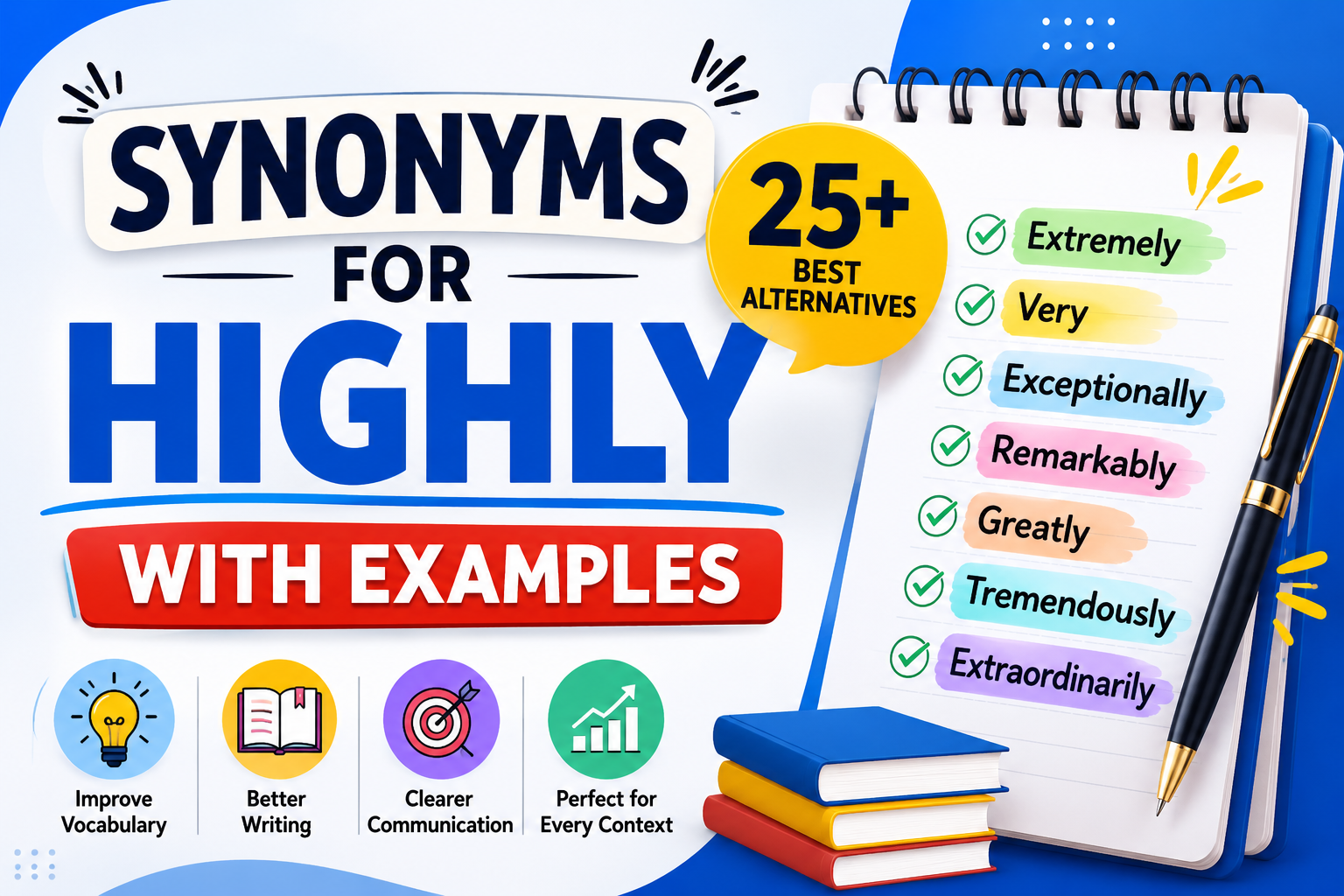
Finding the right synonym for highly depends on what you mean. In many sentences, highly means “very” or “to a great degree,” but it can also describe a high level or status, or express strong approval. That is why words such as extremely, greatly, exceptionally, remarkably, strongly, and well are not always interchangeable.
This guide explains the most useful synonyms for highly, shows where each one works naturally, and helps you choose the best alternative for formal, professional, academic, and everyday English.
Quick Answer: What Are the Best Synonyms for Highly?
The closest alternatives to highly include extremely, very, greatly, exceptionally, remarkably, incredibly, intensely, and particularly when the word means “to a very high degree.” However, the best replacement changes with context. For example, strongly works naturally with “recommend,” well works with “regarded,” and exceptionally is useful when emphasizing unusually high quality or ability.
Core Synonyms for Highly
| Word | Relationship | Meaning | Strength | Formality | Best Context |
|---|---|---|---|---|---|
| Extremely | Direct synonym | To a very great degree | Very strong | Neutral | Intensity, qualities, conditions |
| Very | Direct synonym | To a high degree | Moderate | Neutral | Everyday English |
| Greatly | Near synonym | To a great degree | Strong | Neutral–formal | Effects, changes, importance |
| Exceptionally | Near synonym | To an unusually high degree | Very strong | Neutral–formal | Ability, quality, performance |
| Remarkably | Near synonym | To a notably high degree | Strong | Neutral–formal | Achievement, qualities |
| Incredibly | Near synonym | To an extraordinary degree | Very strong | Neutral | Informal–neutral emphasis |
| Intensely | Contextual alternative | With great intensity | Very strong | Neutral | Feelings, reactions, experiences |
| Particularly | Contextual alternative | Especially or notably | Moderate–strong | Neutral | Emphasis and selection |
| Especially | Contextual alternative | More than others | Moderate | Neutral | Preference, importance |
| Considerably | Near synonym | By a substantial amount | Strong | Formal | Change, difference, quantity |
| Immensely | Near synonym | To an extremely great degree | Very strong | Neutral–formal | Gratitude, importance, enjoyment |
| Tremendously | Near synonym | To a very great degree | Very strong | Neutral | Success, impact, benefit |
| Supremely | Near synonym | At the highest level | Very strong | Formal/literary | Excellence, confidence |
| Profoundly | Contextual alternative | In a deep or significant way | Strong | Formal | Effects, beliefs, emotions |
| Strongly | Contextual alternative | With force or conviction | Strong | Neutral–formal | Recommendations, opinions |
| Deeply | Contextual alternative | In a profound or intense way | Strong | Neutral | Feelings, concern, commitment |
| Heavily | Contextual alternative | To a great extent or amount | Strong | Neutral | Dependence, taxation, reliance |
| Seriously | Contextual alternative | To a considerable or severe degree | Strong | Neutral | Problems, concerns, consequences |
| Well | Contextual alternative | In a favorable or respected way | Context-specific | Neutral | Regarded, respected, known |
| Favourably / Favorably | Contextual alternative | With approval | Strong | Formal | Reviews, opinions, assessments |
| Enthusiastically | Contextual alternative | With strong approval or excitement | Strong | Neutral | Recommendations, support |
| Wholeheartedly | Contextual alternative | With complete sincerity or support | Strong | Neutral | Recommendations, endorsement |
| Generously | Contextual alternative | In a large or abundant amount | Context-specific | Neutral | Pay, compensation |
| High-level | Related phrase | At an advanced or elevated level | Context-specific | Neutral–formal | Skills, discussions, positions |
| Superiorly | Generally not a recommended replacement | In a superior manner | — | — | Usually unnatural as a direct replacement |
Not every word above can replace highly in every sentence. That distinction matters because highly has several uses rather than one single meaning.
What Does “Highly” Mean?
Highly is an adverb pronounced /ˈhaɪli/ in both American and British English. It commonly means to a high degree, very, or at a high level. It can also express strong approval or indicate a high position, rank, or status.
For example:
- The treatment was highly effective.
- She is highly skilled.
- He is highly respected in his field.
- I highly recommend this restaurant.
- She is a highly paid consultant.
Because these examples represent different meanings, replacing highly requires attention to the phrase that follows it.
1. Extremely
Extremely is one of the closest synonyms for highly when the word means to a very great degree.
Example:
The new software is extremely efficient.
It works especially well with adjectives describing intensity, quality, difficulty, importance, or conditions.
Highly effective → Extremely effective
Highly unlikely → Extremely unlikely
Merriam-Webster lists extremely and very among the principal synonyms of highly in its “to a high degree” sense.
2. Very
Very is the simplest and most common alternative to highly when you simply want to express a high degree.
Highly successful → Very successful
Highly important → Very important
The difference is mainly stylistic. Highly can sound more polished or selective in certain professional expressions, while very is extremely common in everyday English.
Best choice: casual, general, and straightforward writing.
3. Greatly
Greatly means to a great degree or extent and is particularly natural when discussing effects, changes, importance, or feelings.
Example:
The new policy greatly improved customer satisfaction.
However, it does not replace highly naturally in every adjective phrase.
Natural:
greatly appreciated
Less natural:
greatly skilled
For the second sentence, highly skilled is much more idiomatic.
4. Exceptionally
Exceptionally means to an unusually high degree and often suggests that something stands out from the normal range.
Example:
She is an exceptionally talented designer.
This is stronger and more specific than simply saying very talented.
Use it when the quality, ability, performance, or result is noticeably above average.
Highly talented → Exceptionally talented
5. Remarkably
Remarkably emphasizes that something is unusual, impressive, or worthy of notice.
Example:
The team was remarkably successful despite limited resources.
It is particularly useful in professional, academic, and analytical writing.
Highly effective can sometimes become remarkably effective, but the meaning shifts slightly: remarkably emphasizes how notable the effectiveness is.
6. Incredibly
Incredibly is a strong intensifier meaning to an extraordinary degree.
Example:
The service was incredibly fast.
It is common in conversational and general writing. In formal academic writing, alternatives such as extremely, exceptionally, or considerably may sometimes be more restrained.
7. Intentionally Use “Intensely” for Intensity
Intensely is not a universal synonym for highly. It works when the emphasis is on strength or intensity, especially with emotions, experiences, or reactions.
Example:
She was intensely focused on the project.
It can also describe:
- intensely competitive
- intensely emotional
- intensely personal
- intensely debated
Do not use it merely because something is “very” strong. The underlying idea should involve intensity.
8. Particularly
Particularly means especially or to a notable degree.
Example:
This section is particularly useful for beginners.
The focus is often selective: one thing is being emphasized as more notable than others.
Compare:
The guide is highly useful.
This emphasizes a high degree of usefulness.
The final section is particularly useful.
This emphasizes that the final section stands out.
9. Especially
Especially is useful when highly is being used to highlight something as more notable, important, or relevant.
Example:
The advice is especially useful for new writers.
It is not always a direct replacement for highly, but it can be a better choice when the intended meaning is “particularly” or “above all.”
10. Considerably
Considerably means by a substantial amount or to a substantial degree.
It is especially useful for measurable changes or differences.
Example:
The revised process is considerably more efficient.
Natural combinations include:
- considerably higher
- considerably lower
- considerably greater
- considerably more expensive
- considerably more effective
It is generally more analytical and formal than very.
11. Immensely
Immensely means to an extremely great degree.
It often works with emotions, gratitude, enjoyment, value, or importance.
Examples:
We are immensely grateful for your support.
The experience was immensely valuable.
It is stronger and more expressive than ordinary very.
12. Tremendously
Tremendously expresses a very high degree and often emphasizes a positive effect, achievement, or benefit.
Example:
The new strategy tremendously improved productivity.
It can sound more enthusiastic than greatly or considerably, so choose it according to tone.
Context-Specific Alternatives to “Highly”
Some of the best replacements are not traditional one-word synonyms. They are natural alternatives for specific phrases.
Highly Recommended
Instead of:
I highly recommend this book.
You can say:
- I strongly recommend this book.
- I wholeheartedly recommend this book.
- I enthusiastically recommend this book.
- I thoroughly recommend this book.
Strongly recommend is the most natural general alternative.
Oxford specifically gives highly recommend as an example of highly expressing strong approval.
Highly Respected
Instead of:
She is a highly respected professor.
You can use:
- widely respected
- deeply respected
- greatly respected
- well respected
- esteemed
Well respected and widely respected are particularly natural depending on whether you mean general reputation or broad recognition.
Highly Regarded
Instead of:
The restaurant is highly regarded.
Natural alternatives include:
- well regarded
- widely admired
- greatly respected
- held in high regard
- favorably viewed
Collins specifically distinguishes the approval-related sense of highly, giving alternatives such as favourably, well, warmly, and enthusiastically for expressions such as think highly of.
Highly Skilled
Instead of:
She is a highly skilled developer.
You can say:
- exceptionally skilled
- extremely skilled
- very skilled
- expert
- highly proficient
The best replacement depends on whether you want to emphasize degree or expertise.
She is exceptionally skilled at front-end development.
She is an expert in front-end development.
These are not identical constructions, but both can communicate the underlying idea more precisely.
Highly Successful
Possible alternatives include:
- extremely successful
- exceptionally successful
- remarkably successful
- very successful
- hugely successful
Exceptionally successful emphasizes unusually high achievement, while hugely successful is more conversational.
Highly Effective
Natural alternatives include:
- extremely effective
- exceptionally effective
- remarkably effective
- very effective
- particularly effective
The right option depends on whether you are emphasizing intensity, unusual performance, or a specific context.
Highly Paid
Highly paid has a different meaning from simply “very.”
It refers to receiving a high salary or compensation.
Natural alternatives include:
- well paid
- high earning
- generously compensated
- highly compensated
For example:
She is a highly paid consultant.
→
She is a well-paid consultant.
Cambridge and Oxford both use highly paid to illustrate the high-level or high-amount sense of highly.
Which Word Should You Use Instead of “Highly”?
A simple decision guide can make the choice easier.
Choose “extremely” when:
You mean to a very great degree.
The test was highly difficult.
→ The test was extremely difficult.
Choose “very” when:
You want the simplest everyday alternative.
She is highly intelligent.
→ She is very intelligent.
Choose “exceptionally” when:
Something is unusually good, capable, or impressive.
He is exceptionally talented.
Choose “remarkably” when:
You want to emphasize that something is notable or surprising.
The treatment was remarkably effective.
Choose “greatly” when:
You are talking about an effect, change, appreciation, or degree.
Her work greatly influenced the field.
Choose “strongly” when:
You are recommending, supporting, opposing, or expressing an opinion.
I strongly recommend this course.
Choose “well” when:
The phrase expresses reputation or approval.
She is well regarded by her colleagues.
Choose “particularly” when:
You want to emphasize one thing as especially notable.
This method is particularly useful for beginners.
Highly vs. Extremely
Highly and extremely overlap when both mean “to a very high degree.”
The product is highly effective.
The product is extremely effective.
However, highly has additional uses that extremely does not naturally cover.
For example:
She is highly respected.
Here, highly contributes to the idea of strong approval or reputation.
She is extremely respected.
This is possible in some contexts, but it is less idiomatic and does not preserve the same conventional expression.
Similarly:
I highly recommend it.
is natural, whereas:
I extremely recommend it.
is not natural English.
Bottom line: use extremely for degree and intensity; retain highly in established expressions involving recommendation, reputation, rank, or approval.
Highly vs. Very
Very is broader and more common in everyday English.
highly successful
very successful
Both are natural.
But highly often appears in established combinations:
- highly skilled
- highly qualified
- highly effective
- highly competitive
- highly respected
- highly recommended
- highly unlikely
- highly significant
So although very can replace highly in many sentences, it should not automatically replace it in every phrase.
Highly vs. Greatly
The distinction is mainly grammatical and contextual.
Highly commonly modifies adjectives and certain participles:
highly effective
highly qualified
highly successful
Greatly frequently modifies verbs or expressions involving degree and effect:
greatly improved
greatly appreciated
greatly influenced
Therefore:
The changes greatly improved efficiency.
sounds natural.
But:
The changes highly improved efficiency.
does not.
Choosing between the two requires more than matching dictionary definitions; collocation matters.
Common Mistakes With Synonyms for “Highly”
Mistake 1: Treating every intensifier as interchangeable
Words such as extremely, greatly, and intensely overlap with highly, but their grammatical patterns differ.
Mistake 2: Saying “extremely recommend”
This is unnatural.
Use:
I highly recommend this course.
or:
I strongly recommend this course.
Mistake 3: Replacing “highly paid” with “extremely paid”
That does not work.
Use:
well paid
or:
highly compensated
Mistake 4: Using “intensely” for every strong adjective
Intensely suggests intensity rather than simply a high degree.
intensely emotional
is natural.
intensely successful
is generally less natural than:
highly successful
Mistake 5: Assuming “highly” always means “very”
Sometimes it expresses approval, status, rank, or level rather than simple intensity. Oxford identifies three major uses: “very,” “at or to a high standard, level or amount,” and “with great respect or praise.”
Frequently Asked Questions
What is the best synonym for highly?
Extremely is one of the closest general synonyms when highly means “to a very great degree.” However, there is no single best replacement for every sentence. Strongly works better with “recommend,” well with “regarded,” and exceptionally when emphasizing unusually high quality or ability.
What is a formal synonym for highly?
Depending on context, formal alternatives include greatly, considerably, exceptionally, remarkably, profoundly, and favorably. The correct choice depends on the construction. For example, “greatly appreciated” is natural, while “highly skilled” is usually preferable to a more formal-sounding substitute.
What is another word for highly recommended?
Common alternatives include strongly recommended, enthusiastically recommended, wholeheartedly recommended, and widely recommended. Strongly recommended is generally the most natural direct alternative when expressing a strong recommendation.
What is another word for highly respected?
Useful alternatives include well respected, widely respected, greatly respected, deeply respected, and esteemed. “Widely respected” emphasizes broad recognition, while “esteemed” is concise and somewhat more formal.
What is another word for highly skilled?
Depending on the context, you can use exceptionally skilled, extremely skilled, very skilled, highly proficient, or expert. “Expert” is especially useful when you want to describe someone as having advanced knowledge rather than simply emphasizing the degree of skill.
Is “very” a synonym for “highly”?
Yes, in many contexts. Both can mean “to a high degree.” For example, highly effective and very effective can express similar meanings. However, highly is part of many established expressions where very does not work as naturally, such as highly recommended and highly regarded.
Is “extremely” stronger than “highly”?
Often, extremely sounds stronger because it explicitly emphasizes an extreme degree. However, strength depends on the adjective and context. “Highly effective” does not necessarily mean exactly the same thing as “extremely effective,” and highly can also express meanings unrelated to simple intensity.
Can I use “greatly” instead of “highly”?
Sometimes, but not everywhere. Greatly is especially natural with verbs and expressions such as greatly improved, greatly appreciated, and greatly influenced. Highly is more natural in combinations such as highly effective, highly skilled, and highly successful.
Conclusion
The best synonym for highly depends on what you are trying to express. For general intensity, extremely and very are useful choices. Exceptionally and remarkably emphasize unusually high quality, while greatly works especially well with effects and changes. For recommendations, strongly is often the best alternative; for reputation, well or widely may sound more natural.
The key is not to replace highly mechanically. Choose the alternative that matches the meaning, grammar, collocation, tone, and context of the sentence.

Daniel Carter is a professional content strategist and language enthusiast. He focuses on semantic SEO, keyword research, and creating structured vocabulary content that ranks well on search engines while remaining user-friendly.