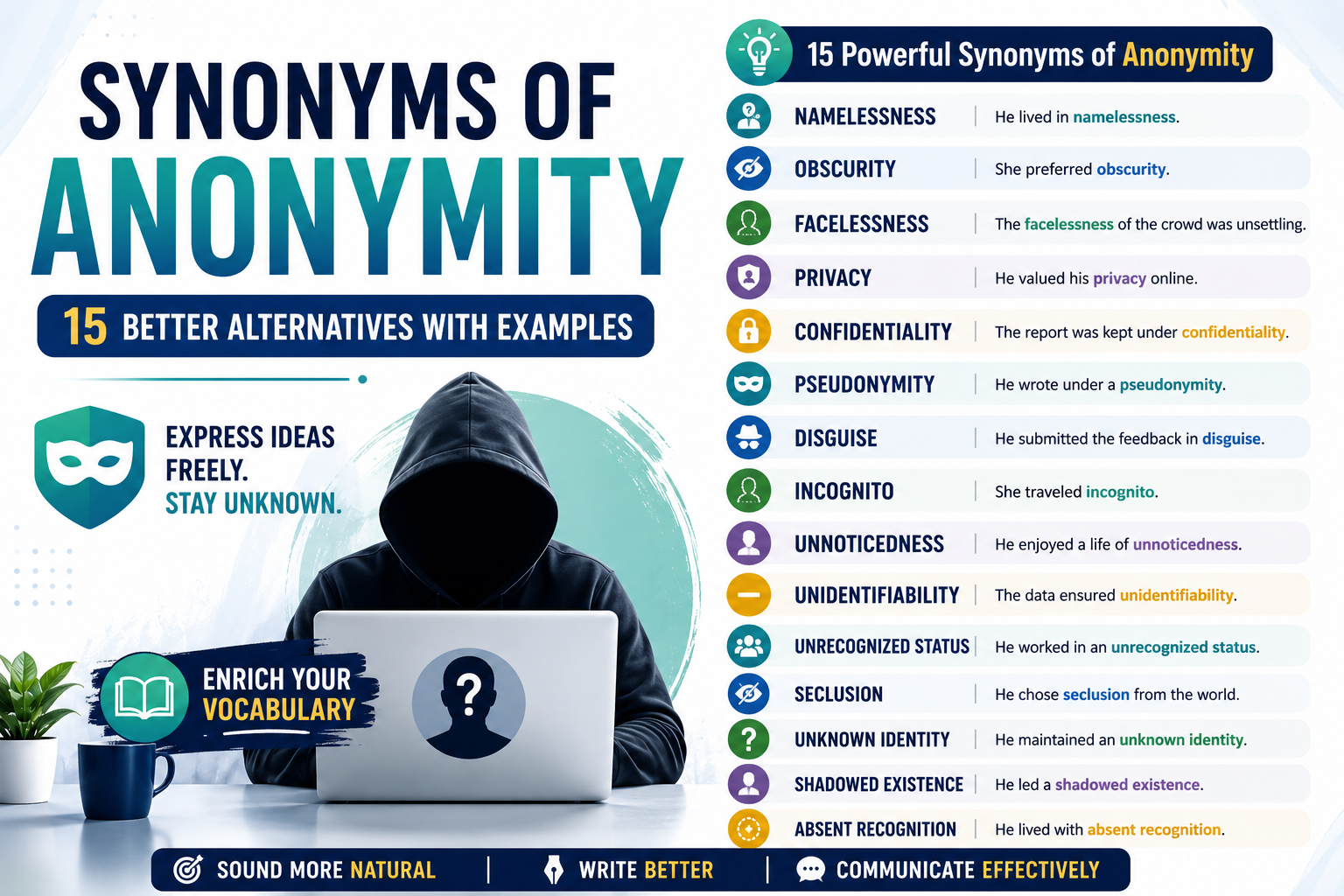
When you need a different way to say anonymity, the best choice depends on what you mean. Namelessness is the closest direct alternative when someone’s name is unknown or deliberately withheld. Obscurity works when the emphasis is on being unknown or unnoticed, while facelessness can suggest a lack of individual identity. Other words, such as privacy, confidentiality, and pseudonymity, are related but have more specific meanings.
This guide explains the most useful synonyms of anonymity, shows where each one fits, and helps you choose the most natural word for your sentence.
Quick Answer: What Are the Best Synonyms of Anonymity?
The closest synonyms of anonymity include namelessness, obscurity, facelessness, and inconspicuousness. However, they are not interchangeable in every situation. Namelessness most directly describes having no known or disclosed name, while obscurity emphasizes being unknown or unnoticed. Privacy concerns control over personal information, and pseudonymity means using a name or identity different from one’s real one.
Core Synonyms of Anonymity
| Word | Relationship | Meaning | Best Context | Formality |
|---|---|---|---|---|
| Namelessness | Direct synonym | The state of having no known or disclosed name | People, authors, sources | Formal |
| Obscurity | Near synonym | The state of being unknown or unnoticed | People, places, reputation | Neutral |
| Facelessness | Near synonym | Lack of an identifiable or distinctive identity | Organizations, groups, media | Neutral |
| Invisibility | Contextual alternative | A condition of not being seen, noticed, or recognized | Social or figurative contexts | Neutral |
| Inconspicuousness | Contextual alternative | The quality of attracting little attention | People, objects, activities | Formal |
| Unremarkability | Contextual alternative | Lack of distinctive or notable qualities | Places, things, appearances | Formal |
| Characterlessness | Contextual alternative | Lack of distinctive individual character | Places, designs, people | Formal |
| Unsингularity / Unsингularity | Contextual alternative | Lack of distinctive individuality | Literary or formal contexts | Formal |
| Privacy | Related concept | Freedom from unwanted attention or disclosure | Personal information, life | Neutral |
| Confidentiality | Related concept | Protection of information from unauthorized disclosure | Business, legal, research | Formal |
| Secrecy | Related concept | The practice or condition of keeping something hidden | Information, plans, identities | Neutral |
| Pseudonymity | Specialized alternative | Use of a pseudonym instead of a real name | Online identity, publishing | Formal |
| Unknownness | Near synonym | The state of not being known | General or abstract contexts | Neutral |
| Insignificance | Loose contextual alternative | Lack of importance or prominence | Reputation, public attention | Formal |
| Silence | Contextual/loose alternative | Absence of speech or disclosure | Specific situations only | Neutral |
Important: The table intentionally distinguishes genuine synonyms from related or contextual alternatives. A word should not be treated as a direct synonym simply because it appears in a thesaurus.
What Does Anonymity Mean?
Anonymity is the condition of being anonymous—specifically, when someone’s name is unknown, undisclosed, or not publicly associated with them. Cambridge defines it as a situation in which someone’s name is not given or known.
Merriam-Webster similarly defines anonymity as the quality or state of being anonymous and also records a second noun sense referring to an anonymous person.
For example:
The journalist agreed to protect the source’s anonymity.
Here, anonymity means that the source’s identity or name will not be revealed.
The word is a noun. Its related forms include anonymous and anonymously.
Pronunciation
- US: /ˌæn.əˈnɪm.ə.t̬i/
- UK: /ˌæn.ɒnˈɪm.ə.ti/
1. Namelessness
Namelessness is one of the closest direct synonyms for anonymity.
It emphasizes the absence of a known, stated, or recognized name. Collins specifically lists namelessness as a synonym of anonymity in the sense of remaining unnamed.
Example:
The author’s namelessness added to the mystery surrounding the book.
Choose “namelessness” when:
You specifically mean that a person’s name is unknown or withheld.
2. Obscurity
Obscurity is a useful near-synonym, but its meaning is broader than anonymity.
It usually describes a state of being unknown, unnoticed, or unimportant in the public eye. Merriam-Webster lists obscurity among the principal synonyms of anonymity.
Example:
The artist lived in obscurity for many years before becoming famous.
Someone can be obscure without being anonymous. For example, a person may be completely identifiable but simply not well known.
Choose “obscurity” when:
The main idea is being unknown or unnoticed, rather than specifically having your identity concealed.
3. Facelessness
Facelessness emphasizes the absence of an identifiable or distinctive individual identity.
Example:
The protesters maintained a sense of facelessness by wearing identical clothing.
The word can carry a negative or impersonal tone, especially when describing large institutions, corporations, or groups.
Choose “facelessness” when:
You want to emphasize lack of individual identity or personality.
4. Invisibility
Invisibility can overlap with anonymity when someone deliberately avoids being noticed or recognized.
However, it literally refers to being unable to be seen, so it is not a direct replacement in every sentence.
Example:
The author valued the invisibility that came with publishing without a public profile.
Choose “invisibility” when:
The emphasis is on not being noticed, seen, or recognized, rather than simply having no name.
5. Inconspicuousness
Inconspicuousness means attracting little attention.
It can describe a person who blends into a crowd, but it does not necessarily mean that the person’s identity is unknown.
Example:
He preferred the inconspicuousness of a small town to the attention of a major city.
Choose “inconspicuousness” when:
The main idea is avoiding attention.
6. Unremarkability
Unremarkability refers to a lack of distinctive or notable qualities.
Collins identifies unremarkability as one of the senses associated with anonymity when describing something that lacks distinctive character.
Example:
The building’s unremarkability made it difficult to distinguish from its neighbors.
This meaning is quite different from anonymous authorship.
Choose “unremarkability” when:
You mean ordinary, indistinctive, or not especially noticeable.
7. Characterlessness
Characterlessness describes something that lacks distinctive qualities or individuality.
Collins includes it among the synonyms associated with anonymity in the sense of something being unremarkable or lacking character.
Example:
Critics complained about the characterlessness of the new development.
This is particularly useful when discussing places, designs, or artistic work.
8. Unsingularity
Unsingularity means a lack of individuality or distinctiveness.
It is considerably less common than anonymity, namelessness, or obscurity, so it is generally not the best everyday replacement.
Example:
The unsingularity of the design made the building difficult to identify.
Choose “unsingularity” when:
You need a formal or literary term for lack of distinctiveness.
Anonymity vs. Privacy
These words are related but are not synonyms.
Anonymity concerns whether someone’s identity or name is known.
Privacy concerns control over personal information, activities, or personal space.
For example:
The survey protects participants’ anonymity.
This means their identities are not revealed.
She values her privacy.
This means she wants control over access to her personal life or information.
A person can have privacy without being anonymous.
Best rule: Use anonymity for hidden identity; use privacy for protection from unwanted access or disclosure.
Anonymity vs. Confidentiality
Confidentiality is also related but more specific.
Confidentiality means that information is expected to be kept private and not disclosed to unauthorized people.
Example:
The lawyer promised confidentiality.
This does not necessarily mean the lawyer’s client is anonymous. The client’s identity may be fully known while the information remains confidential.
Simple distinction
- Anonymity = the identity is hidden or unknown.
- Confidentiality = information is protected from disclosure.
Anonymity vs. Secrecy
Secrecy means keeping information, actions, or facts hidden.
Anonymity specifically concerns identity.
For example:
The donor requested anonymity.
The donor’s identity is hidden.
The company operated in secrecy.
The company’s activities were kept hidden.
Someone can be anonymous without keeping everything about themselves secret.
Anonymity vs. Pseudonymity
This is an especially important distinction in online writing, publishing, and technology.
Pseudonymity means using a pseudonym rather than one’s real name. Merriam-Webster defines it as the use of a pseudonym or the state of being signed with one.
For example:
The author published the novel under a pseudonym.
The author is not necessarily anonymous. Readers may eventually discover the author’s real identity.
The difference
Anonymity: “You don’t know who I am.”
Pseudonymity: “You know me by a different name.”
This distinction is particularly important when discussing online identities.
Anonymity vs. Obscurity
These words are close, but they describe different ideas.
| Anonymity | Obscurity |
|---|---|
| Identity is unknown or withheld | Someone or something is not well known |
| Focuses on identity | Focuses on public awareness |
| Can be deliberate | Often simply a condition |
| Common with sources, donors, authors | Common with people, artists, places, ideas |
Example of anonymity:
The witness spoke on the condition of anonymity.
Example of obscurity:
The novelist remained in obscurity for decades.
The novelist could have been completely identifiable while still being obscure.
Best Synonym for Anonymity in Different Contexts
Choosing the right alternative becomes easier when you identify the context first.
For an unnamed person
Use namelessness.
The witness sought namelessness to avoid unwanted attention.
For someone who is not famous
Use obscurity.
The writer spent years in obscurity.
For avoiding attention
Use inconspicuousness.
He enjoyed the inconspicuousness of traveling alone.
For an impersonal group or organization
Use facelessness.
The company’s bureaucratic facelessness frustrated customers.
For personal information
Use privacy.
She was concerned about her online privacy.
For protected information
Use confidentiality.
The agreement requires strict confidentiality.
For an alternative identity
Use pseudonymity.
The writer’s online pseudonymity allowed him to separate his professional and personal lives.
Common Collocations With Anonymity
Anonymity appears naturally in several common expressions. Collins lists collocations including cloak of anonymity, complete anonymity, condition of anonymity, donor anonymity, online anonymity, maintain anonymity, preserve anonymity, request anonymity, and seek anonymity.
Some especially useful combinations are:
- complete anonymity
- relative anonymity
- online anonymity
- condition of anonymity
- request anonymity
- maintain anonymity
- preserve anonymity
- protect anonymity
- guarantee anonymity
- seek anonymity
- cloak of anonymity
Examples
The witness spoke on the condition of anonymity.
The website allows users to maintain a degree of online anonymity.
The researcher promised to preserve participants’ anonymity.
The donor requested complete anonymity.
These phrases are often more natural than replacing anonymity with a loosely related word.
Common Mistakes With Synonyms of Anonymity
Mistake 1: Treating privacy as an exact synonym
Privacy and anonymity overlap, but they are not identical.
Use anonymity when identity is hidden.
Use privacy when personal information or personal life is protected.
Mistake 2: Using obscurity to mean hidden identity
Incorrect idea: “The witness requested obscurity.”
If the witness wants their identity withheld, anonymity is much more natural.
Mistake 3: Assuming pseudonymity means complete anonymity
A pseudonym can conceal someone’s real name from the public without making the person completely untraceable.
Mistake 4: Using silence as a direct synonym
Silence means an absence of sound, speech, or communication. Merriam-Webster lists it among words similar to anonymity, but it does not normally replace anonymity in ordinary sentences.
Mistake 5: Using invisibility literally
Invisibility can be metaphorical, but it does not normally mean that someone’s identity is anonymous.
What Is the Closest Synonym for Anonymity?
Namelessness is generally the closest direct synonym when anonymity means the state of having no known or disclosed name. Collins explicitly lists namelessness as a synonym in this sense.
However, obscurity may be better when the intended meaning is simply being unknown or unnoticed.
What Is a Formal Synonym for Anonymity?
Depending on the context, formal alternatives include:
- namelessness
- pseudonymity
- inconspicuousness
- confidentiality — when information is being protected
- obscurity — when referring to lack of public recognition
The correct choice depends on the exact meaning rather than formality alone.
What Is Another Word for Remaining Anonymous?
Natural alternatives include:
- remaining unnamed
- keeping one’s identity private
- withholding one’s name
- concealing one’s identity
- maintaining anonymity
- preserving anonymity
For professional or journalistic writing, maintaining anonymity and withholding one’s identity are particularly natural.
Antonyms of Anonymity
The opposite of anonymity is not always one single word. Depending on context, useful antonyms include:
- recognition
- fame
- visibility
- publicity
- identification
- prominence
- notoriety
- celebrity
For example:
The author moved from anonymity to international recognition.
The exact opposite depends on whether the contrast concerns identity, public attention, or fame.
FAQ About Synonyms of Anonymity
Is “privacy” a synonym for anonymity?
Not exactly. Privacy means freedom from unwanted access, attention, or disclosure, while anonymity specifically concerns keeping someone’s identity or name unknown. The two often overlap, particularly online, but they are not interchangeable in every sentence.
What is the closest synonym for anonymity?
Namelessness is one of the closest direct synonyms because it describes the condition of having no known or disclosed name. Obscurity is also closely related but usually emphasizes being unknown or unnoticed rather than having a concealed identity.
Is “obscurity” the same as anonymity?
No. Obscurity means being little known or noticed, whereas anonymity means having an unknown or undisclosed identity. A person can be obscure while still being fully identifiable.
Is “secrecy” a synonym for anonymity?
Not exactly. Secrecy involves keeping information, activities, or facts hidden. Anonymity specifically relates to hiding or not knowing someone’s identity.
What is the difference between anonymity and pseudonymity?
Anonymity means the person’s real identity is unknown or withheld. Pseudonymity means the person uses a different name or pseudonym. Someone using a pseudonym may still be identifiable to certain people.
What is a synonym for anonymity in professional writing?
The best choice depends on context. Namelessness works for an undisclosed name, confidentiality for protected information, obscurity for lack of recognition, and pseudonymity for an identity represented by a pseudonym.
Can “facelessness” mean anonymity?
Sometimes. Facelessness can suggest a lack of recognizable individual identity, especially when discussing institutions, groups, or crowds. However, it often carries a stronger sense of impersonality than ordinary anonymity.
What is the opposite of anonymity?
Common opposites include recognition, identification, visibility, publicity, fame, and prominence. The best antonym depends on whether the contrast is about being identified, noticed, or publicly recognized.
Conclusion
The best synonym for anonymity depends on the specific idea you want to express. Namelessness is the closest choice when someone’s name is unknown or withheld. Obscurity is better for someone or something that is little known, while facelessness emphasizes a lack of individual identity. Privacy, confidentiality, secrecy, and pseudonymity are useful related terms, but each has a distinct meaning.

Emily Johnson is a linguistics graduate and vocabulary specialist. She writes detailed synonym explanations and helps readers understand subtle differences between words, improving both writing and speaking skills. Synonyms help express ideas more clearly and precisely in English.