Finding the right synonym for intact depends on what you want to emphasize. Intact usually describes something that remains complete, undamaged, unbroken, or in its original condition. For example, a building can survive a storm intact, a reputation can remain intact, and an object can arrive undamaged.
Words such as whole, complete, entire, undamaged, unbroken, unharmed, untouched, unimpaired, and unscathed overlap with intact, but they are not interchangeable in every sentence. The best choice depends on whether you are emphasizing completeness, physical condition, lack of injury, or preservation of the original state.
This guide explains the closest synonyms for intact, how they differ, and which alternative sounds most natural in different contexts.
Quick Answer
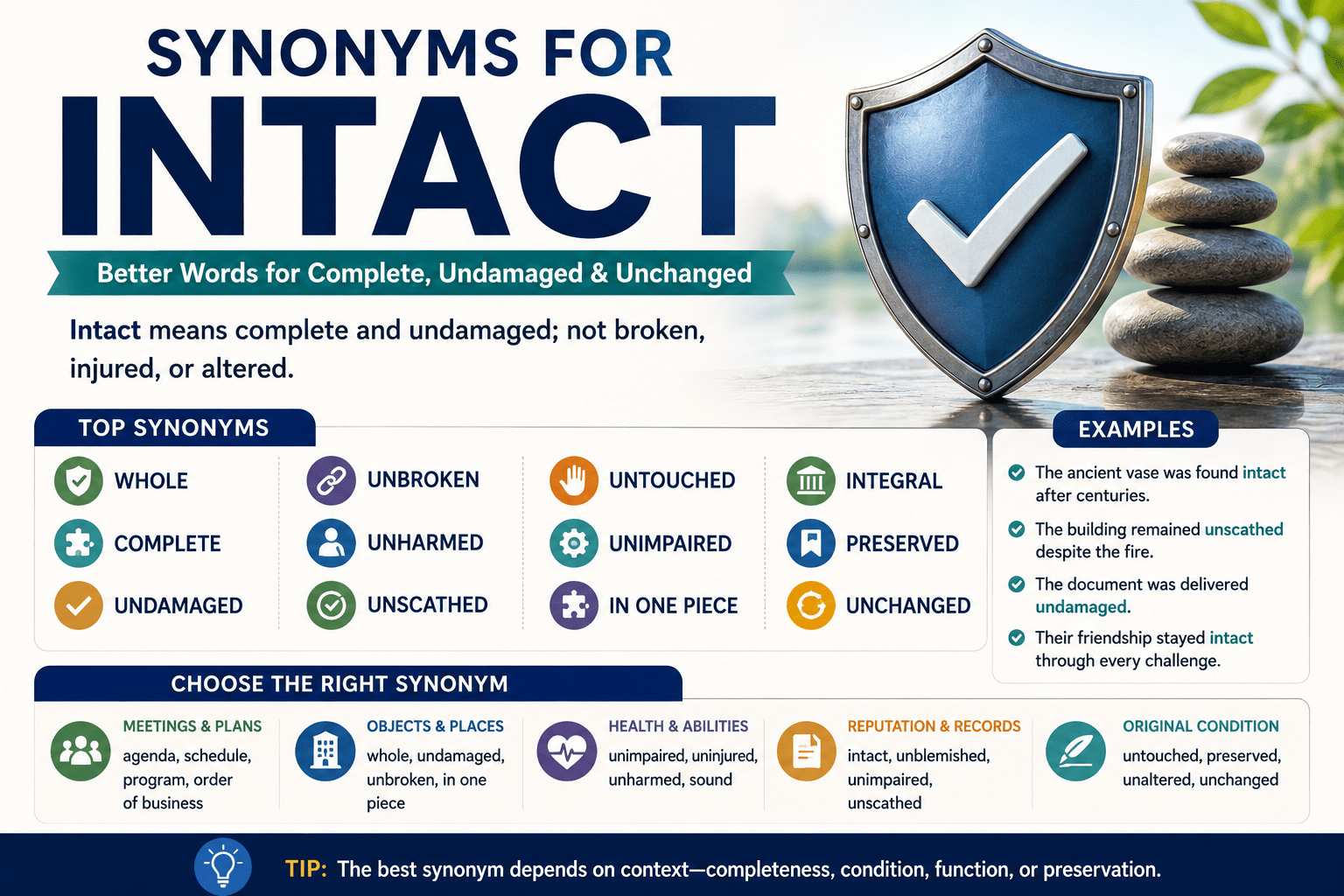
The closest synonyms for intact include whole, entire, complete, undamaged, unbroken, untouched, unimpaired, unharmed, uninjured, and in one piece. However, the best alternative depends on context. Undamaged emphasizes freedom from physical damage, whole emphasizes completeness, untouched emphasizes lack of interference, and unimpaired emphasizes preserved function or condition.
What Does “Intact” Mean?
Intact is an adjective meaning complete and in its original or undamaged condition. It can describe physical objects, structures, systems, relationships, reputations, records, and other things that have remained whole or unimpaired. Cambridge gives examples involving an altar that survived bombing, a mammoth skull, a reputation, and an undefeated record.
Pronunciation:
- US: /ɪnˈtækt/
- UK: /ɪnˈtækt/
For example:
The package arrived intact despite the long journey.
Here, intact means the package arrived without being damaged or broken.
The word can also describe something abstract:
Her reputation remained intact after the controversy.
In this sentence, intact means the reputation was not seriously damaged.
Best Synonyms for Intact
| Word or phrase | Relationship | Main meaning | Best context |
|---|---|---|---|
| whole | Direct synonym | Complete; with all parts | Objects, groups, people |
| entire | Near synonym | Complete as a whole | Collections, texts, groups |
| complete | Near synonym | Having all necessary parts | Objects, systems, information |
| undamaged | Direct/contextual | Not physically damaged | Objects, buildings, goods |
| unbroken | Direct/contextual | Not broken or interrupted | Objects, surfaces, records, continuity |
| untouched | Contextual alternative | Not altered, handled, or affected | Places, objects, conditions |
| unimpaired | Contextual alternative | Functioning without loss | Abilities, systems, health |
| unharmed | Contextual alternative | Not injured or damaged | People, animals, things |
| uninjured | Contextual alternative | Not physically injured | People and animals |
| unscathed | Near synonym | Not harmed by a damaging event | People, places, reputations |
| integral | Near synonym | Necessary and still present as part of a whole | Systems, structures, components |
| sound | Contextual alternative | In good condition | Structures, objects, arguments |
| in one piece | Natural phrase | Still whole rather than broken | Objects, people after an event |
| preserved | Contextual alternative | Kept in its existing condition | Historical objects, traditions |
| unmarred | Contextual alternative | Without visible damage or blemish | Surfaces, beauty, landscapes |
| unblemished | Contextual alternative | Without marks, flaws, or damage | Records, reputations, surfaces |
| unaltered | Contextual alternative | Not changed | Texts, designs, plans, conditions |
| unchanged | Contextual alternative | Remaining the same | Opinions, conditions, situations |
Cambridge lists undamaged, in one piece, whole, unbroken, integral, complete, entire, perfect, untouched, unimpaired, unharmed, unhurt, uninjured, sound, and safe among words related to intact. Merriam-Webster particularly highlights entire, whole, complete, and perfect, while explaining their differences.
The Closest Synonyms
1. Whole
Whole is one of the closest everyday alternatives to intact. It emphasizes that something has all its parts and has not been broken or divided.
Example:
Fortunately, the vase remained whole after the fall.
Intact can sound slightly more focused on preservation after an event, while whole emphasizes completeness.
Merriam-Webster notes that whole suggests a completeness that can be sought, gained, or regained.
2. Entire
Entire emphasizes the complete extent of something rather than specifically emphasizing that it escaped damage.
She read the entire report in one sitting.
You can sometimes substitute intact for entire, but not always. For example, the entire report means the full report, whereas the report remained intact suggests that it was preserved without being damaged, altered, or diminished.
3. Complete
Complete means that all necessary parts are present or that something has reached its full state.
The collection remained complete despite the move.
Use complete when the main idea is that nothing essential is missing. Use intact when preservation of the existing state is more important.
4. Undamaged
Undamaged is often the best synonym when you specifically mean that something suffered no physical damage.
The equipment was delivered undamaged.
This is more precise than intact when physical damage is the central concern.
5. Unbroken
Unbroken is particularly useful when something could literally or figuratively be broken.
The seal remained unbroken.
It can also describe continuity:
The team’s winning streak remained unbroken.
However, unbroken does not always convey the broader sense of intact.
Context-Specific Alternatives
For Physical Objects
Use:
- undamaged
- unbroken
- whole
- unmarred
- in one piece
- unscathed
The antique mirror arrived undamaged.
The package was still in one piece.
For Buildings and Structures
Use:
- undamaged
- sound
- unscathed
- whole
- preserved
The old bridge remained intact after the earthquake.
The historic building was remarkably unscathed.
For Function or Performance
Use:
- unimpaired
- sound
- fully functioning
- complete
The patient’s hearing remained unimpaired.
Here, unimpaired is more precise than whole because the emphasis is on retained function.
For Reputation or Relationships
Use:
- undamaged
- unharmed
- unimpaired
- unblemished
- unscathed
- preserved
Her professional reputation remained intact.
His reputation emerged unscathed from the controversy.
For reputations, unscathed often emphasizes surviving a damaging event, while unblemished emphasizes an absence of stains, faults, or negative marks.
For Original Conditions
Use:
- untouched
- unaltered
- unchanged
- preserved
- original
The manuscript was found intact.
The manuscript had remained unaltered for centuries.
The second sentence focuses specifically on the absence of changes.
Which Word Should I Use?
Choose undamaged when:
You mean that something has not suffered physical damage.
The furniture arrived undamaged.
Choose whole when:
You want to emphasize that all parts remain together.
The sculpture was recovered whole.
Choose complete when:
You mean that no necessary part is missing.
The original collection is still complete.
Choose untouched when:
You mean that something has not been handled, changed, or affected.
The room was left untouched.
Choose unimpaired when:
You are emphasizing preserved ability, function, or quality.
The system remained fully unimpaired after the outage.
Choose unscathed when:
Something has survived a difficult or damaging event without apparent harm.
The village emerged largely unscathed from the storm.
Choose unbroken when:
The emphasis is specifically on something not being broken or interrupted.
The seal remained unbroken.
Intact vs. Whole
These words overlap strongly, but they are not identical.
| Intact | Whole |
|---|---|
| Emphasizes preservation | Emphasizes completeness |
| Often implies survival without damage | Often means all parts are present |
| Works well for physical and abstract things | Often more concrete or general |
| “The building remained intact.” | “The building remained whole.” |
Simple rule: Use intact when something has survived without losing its original condition; use whole when you mainly want to say that it remains complete.
Merriam-Webster makes a similar distinction, explaining that intact particularly implies retention of something in its natural or original state.
Intact vs. Complete
Complete means that all necessary parts are present. Intact suggests that those parts have remained preserved or undamaged.
The machine is complete.
This tells us that all necessary components are present.
The machine survived the fire intact.
This tells us that the machine retained its condition despite the fire.
So complete answers “Is everything there?” while intact often answers “Did it remain preserved?”
Intact vs. Undamaged
These are very close when talking about physical objects.
The package arrived intact.
The package arrived undamaged.
Both suggest that the package survived transportation without problems.
However, undamaged specifically emphasizes the absence of damage. Intact can also mean that something remains complete, unchanged, or unimpaired.
That is why we can naturally say:
Their friendship remained intact.
But Their friendship remained undamaged sounds unusual.
Intact vs. Unbroken
Unbroken is narrower than intact.
The glass remained unbroken.
This specifically means it did not break.
The glass remained intact.
This can mean it remained whole and undamaged more generally.
Unbroken can also describe continuity:
The tradition has continued unbroken for generations.
Intact does not always carry this meaning.
Natural Collocations With “Intact”
Some common combinations make the meaning of intact especially clear:
- remain intact
- keep intact
- leave intact
- survive intact
- preserve intact
- remain largely intact
- remain fully intact
- reputation intact
- structure intact
- system intact
- record intact
- relationship intact
- original condition intact
- skin intact
- membrane intact
For example:
The historic structure remained largely intact.
She left the original design intact.
The player finished the season with his record intact.
Merriam-Webster’s usage examples show intact naturally occurring with friendship, reputation, characteristics, team composition, and physical objects.
Common Mistakes With “Intact”
1. Writing “in tact”
The standard word is intact, written as one word.
❌ The package arrived in tact.
✅ The package arrived intact.
2. Treating “complete” and “intact” as identical
They overlap, but complete focuses on having all necessary parts, while intact often emphasizes preservation without damage or alteration.
3. Using “perfect” as a universal replacement
Perfect is related to intact, but it adds the idea of excellence or absence of faults. Merriam-Webster specifically distinguishes perfect from intact on this point.
The package arrived intact.
does not necessarily mean:
The package was perfect.
4. Using “untouched” when something was simply undamaged
An object can be undamaged but still have been handled.
The package arrived undamaged.
does not necessarily mean:
The package remained untouched.
Antonyms of Intact
Common opposites include:
- damaged
- broken
- impaired
- injured
- incomplete
- fragmented
- shattered
- marred
- harmed
- altered
The best antonym depends on the context. Damaged is appropriate for physical condition, incomplete for missing parts, and impaired for reduced function. Cambridge lists impaired, damaged, injured, marred, broken, and shattered among antonyms of intact.
A Note on the Origin of “Intact”
Intact comes through Middle English from Latin intactus, meaning essentially “untouched.” The word combines in- (“not”) with tactus, the past participle of Latin tangere, “to touch.” Its English use dates back to the 15th century.
That origin helps explain why modern intact still carries the important idea of something remaining untouched, complete, or undiminished.
FAQ
What is the closest synonym for intact?
Whole is one of the closest general synonyms for intact. Undamaged is often better when the emphasis is physical condition, while complete is better when the emphasis is on having all necessary parts. Merriam-Webster identifies whole, entire, and complete among the principal synonyms of intact.
What is another word for intact when something is not damaged?
The most natural choices are undamaged, unharmed, unbroken, uninjured, and unscathed. For a physical object, undamaged is usually the most direct replacement.
What is a formal synonym for intact?
Depending on the context, unimpaired, integral, unaltered, preserved, or unblemished can work in formal writing. There is no single formal synonym that fits every use of intact.
Is “whole” the same as “intact”?
Not exactly. Whole primarily emphasizes completeness, whereas intact often emphasizes that something has remained complete and in its original or undamaged state. The two can be interchangeable in many physical contexts, but not in every sentence.
Is “complete” a synonym for intact?
Yes, in some contexts. Complete emphasizes that all required parts are present, while intact often emphasizes preservation without damage, alteration, or loss. For example, a collection can be complete, while a building can remain intact after an earthquake.
What is the difference between intact and undamaged?
Undamaged specifically means not harmed or physically damaged. Intact has a broader meaning and can describe something that remains complete, unchanged, unimpaired, or in its original state.
What is the opposite of intact?
Common opposites include damaged, broken, impaired, incomplete, injured, and altered. The appropriate opposite depends on what intact means in the sentence.
Can intact describe abstract things?
Yes. Intact commonly describes abstract things such as reputations, relationships, records, traditions, beliefs, and systems.
The merger left the company’s core identity intact.
Here, intact means that the identity was preserved rather than physically undamaged.
Conclusion
The best synonym for intact depends on the specific meaning you want to express. Choose whole for completeness, undamaged for freedom from physical damage, complete when no essential part is missing, unbroken when something has not been broken, untouched when it has not been altered or affected, and unimpaired when its function remains unaffected.
The key distinction is simple: intact often combines completeness with preservation of the original or undamaged state. Choosing the alternative that matches that nuance will make your writing more precise and natural.

Emily Johnson is a linguistics graduate and vocabulary specialist. She writes detailed synonym explanations and helps readers understand subtle differences between words, improving both writing and speaking skills. Synonyms help express ideas more clearly and precisely in English.