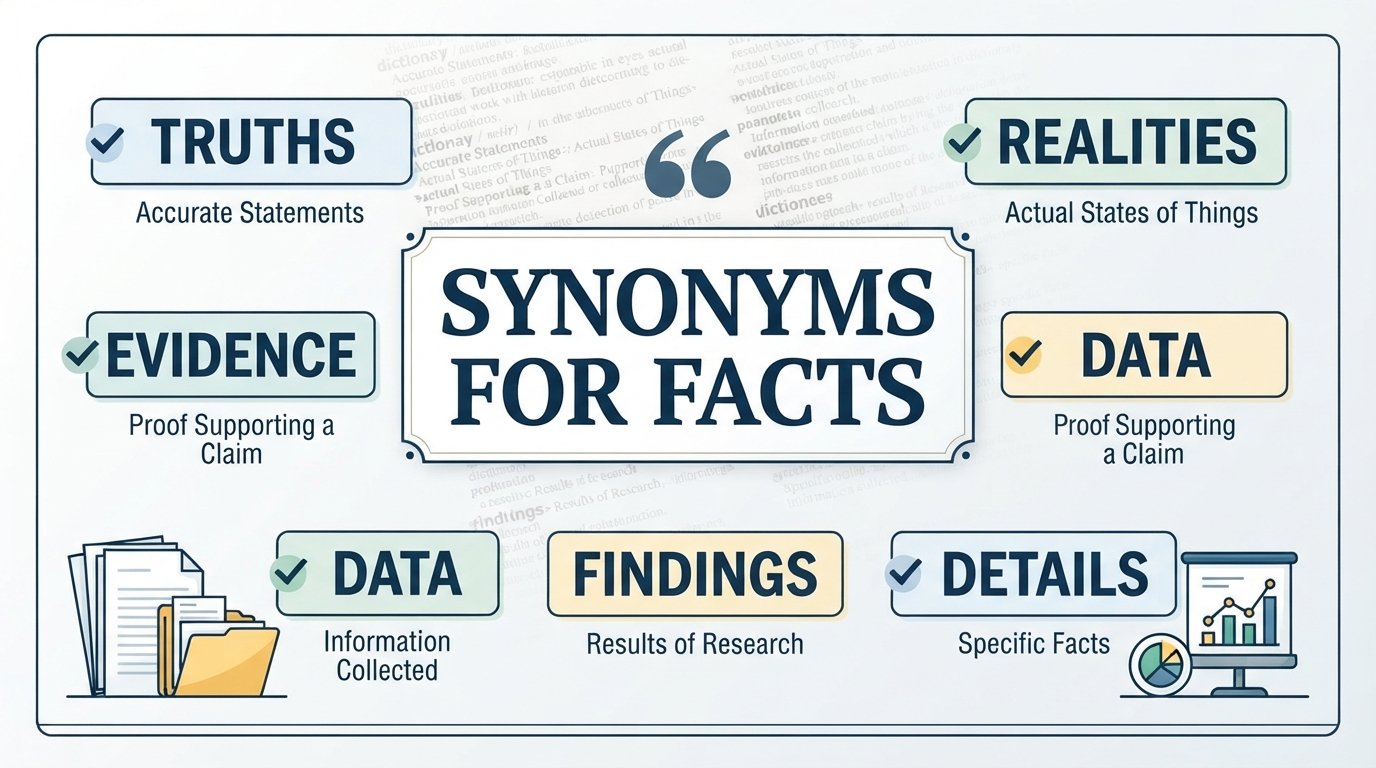
Finding the right synonym for facts depends on what you mean by the word. Sometimes facts means things that are objectively true. In other contexts, you may mean supporting evidence, numerical data, specific details, research findings, or established information.
Words such as truths, realities, evidence, data, details, findings, figures, records, and information can work in appropriate contexts, but they are not interchangeable in every sentence.
Quick Answer
The closest synonyms for facts include truths, realities, certainties, and verities when you mean things that are true.
For evidence-based or professional writing, findings, data, figures, records, details, or evidence may be better depending on context. Choose the replacement according to the exact meaning you want to express.
Best Synonyms for Facts at a Glance
| Word | Relationship | Meaning | Best Context | Formality |
|---|---|---|---|---|
| truths | Close synonym | Things that are true | General writing | Neutral |
| realities | Near synonym | Things that actually exist or happen | General, analytical | Neutral |
| certainties | Near synonym | Things regarded as definitely true | Argument, discussion | Neutral |
| verities | Near synonym | Established truths | Literary, formal | Formal |
| evidence | Contextual alternative | Information supporting a conclusion | Research, legal, academic | Formal |
| data | Contextual alternative | Collected information, often numerical | Science, business, research | Formal |
| findings | Contextual alternative | Results discovered through investigation | Research, reports | Formal |
| figures | Contextual alternative | Numerical facts or statistics | Business, finance, journalism | Formal |
| details | Contextual alternative | Specific pieces of information | General writing | Neutral |
| records | Contextual alternative | Documented information | History, business, administration | Neutral/Formal |
| information | Related/contextual | Knowledge or facts communicated about something | General | Neutral |
| proof | Contextual alternative | Evidence establishing that something is true | Mathematics, argument, law | Neutral/Formal |
| statistics | Contextual alternative | Numerical facts representing data | Research, reports | Formal |
| knowledge | Related word | Information understood or possessed | Education, general writing | Neutral |
| observations | Contextual alternative | Things noticed or recorded | Science, analysis | Formal |
Important: data, evidence, information, and details are not exact synonyms of facts. They overlap with the concept of facts in particular contexts.
What Does “Facts” Mean?
A fact is something that is true or can be established as true. The plural facts refers to multiple pieces of objectively true or verifiable information.
For example:
The report contains several important facts about climate change.
Here, facts refers to information presented as objectively true.
The meaning changes slightly depending on context. In a research paper, facts may refer to established findings. In a news report, they may be verified details. A legal context, facts are matters established through evidence or records.
That is why choosing a synonym requires more than finding a word with a similar dictionary definition.
1. Truths
Truths is one of the closest alternatives when facts means things that are genuinely true.
The article separates established truths from personal opinions.
Use truths when the emphasis is on truth rather than simply information.
Best for: general writing, philosophy, discussion, factual claims.
2. Realities
It refers to things that actually exist or happen, especially when contrasting them with assumptions, appearances, or expectations.
The report examines the economic realities facing small businesses.
Realities can sound more analytical than facts.
Best for: essays, journalism, analysis, social commentary.
3. Certainties
Certainties refers to things considered definitely true or unquestionable.
The investigation revealed few certainties about what happened.
This word is stronger than facts because it emphasizes confidence or lack of doubt.
Best for: analytical and argumentative writing.
4. Verities
Verities means established or fundamental truths. It is considerably more formal and less common than facts.
The novel challenges several accepted social verities.
Use it selectively. It can sound literary or academic.
Best for: formal, literary, philosophical writing.
5. Evidence
It is information or material used to support the truth of a claim.
The researchers presented evidence supporting their conclusion.
Evidence is not the same as facts. Evidence can help establish facts, whereas a fact is something established as true.
Best for: scientific, academic, legal, and investigative contexts.
Facts vs Evidence
| Facts | Evidence |
|---|---|
| Things established as true | Material supporting a conclusion |
| State what is true | Helps demonstrate what is true |
| Can be supported by evidence | Can consist of observations, records, data, or other material |
6. Data
Data refers to collected information, often numerical or systematically recorded.
The researchers analyzed data from 5,000 participants.
You should not automatically replace facts with data. A fact can be expressed through data, but data may require interpretation before it establishes a particular fact.
Best for: science, research, technology, statistics, business, and analytics.
7. Findings
Findings refers to information or conclusions discovered through research, investigation, or examination.
The study’s findings were published in a medical journal.
This is particularly useful when facts means what an investigation discovered.
Best for: research papers, reports, studies, journalism, professional writing.
8. Figures
Figures can mean numerical facts or statistics.
The latest figures show a significant increase in exports.
This is especially natural when discussing financial, economic, demographic, or statistical information.
Best for: business, economics, finance, journalism.
9. Details
Details refers to specific pieces of information about something.
The witness provided important details about the incident.
Use details when the focus is on specific information, rather than objective truth itself.
Best for: everyday writing, journalism, reports, descriptions.
10. Records
Records refers to documented information preserved in written, digital, or other forms.
Historical records provide valuable information about the period.
It is useful when the facts exist in documents or official sources.
Best for: history, administration, business, law, research.
11. Information
Information is a broad term for facts, knowledge, or details communicated about a subject.
The website provides useful information about the program.
Although information is closely related to facts, the two are not identical. Information can include opinions, instructions, descriptions, or other material that is not necessarily factual.
Best for: general communication and informational writing.
12. Proof
Proof refers to evidence or reasoning that establishes something as true.
The experiment provided proof of the hypothesis.
Use proof only where the context supports the stronger meaning of establishing truth.
Best for: mathematics, formal arguments, scientific or legal contexts where something is demonstrated conclusively.
13. Statistics
Statistics refers to numerical information, especially figures that describe a population, trend, or phenomenon.
The statistics reveal a sharp decline in unemployment.
Use this instead of facts only when the facts are specifically quantitative.
14. Observations
Observations are things noticed, measured, or recorded during examination.
The scientist documented several unusual observations.
This word is especially appropriate when facts come from direct examination.
Best for: science, research, experiments, and analysis.
Context-Specific Synonyms for Facts
The best alternative changes according to what kind of facts you are discussing.
For research
Use:
- findings
- data
- observations
- results
- evidence
The researchers published their findings.
For numbers and statistics
Use:
- figures
- statistics
- data
- measurements
The latest figures indicate stronger economic growth.
For specific information
Use:
- details
- information
- particulars
The report includes details of the investigation.
For documented facts
Use:
- records
- documentation
- documented information
Historical records confirm the date of the event.
For things that are objectively true
Use:
- truths
- realities
- certainties
- verities
The essay distinguishes established truths from assumptions.
For supporting material
Use:
- evidence
- proof
- documentation
The prosecution presented additional evidence.
Which Word Should I Use Instead of “Facts”?
The easiest way to choose is to identify what kind of facts you mean.
Choose “truths” when you simply mean things that are true.
For “realities,” the emphasis is on actual conditions that contrast with assumptions or appearances.
When the information supports a claim or conclusion, “evidence” is the more precise choice.
The term “data” works best for systematically collected information, especially numbers.
In research or investigation contexts, “findings” refers to information discovered through the process.
Use “figures” when you are referring specifically to numerical facts or statistics.
For specific pieces of information, “details” is usually the most natural option.
The word “records” fits information that has been documented and preserved.
When evidence establishes something as true, “proof” is the stronger term.
As a broad, neutral term for communicated knowledge or facts, “information” is often the best choice.
Facts vs. Truths
Facts are established pieces of information or matters that are true. Truths emphasizes the quality of being true.
Compare:
The report contains several important facts.
The philosopher discusses several fundamental truths.
The first sounds informational. The second has a more philosophical or conceptual tone.
Facts vs. Information
These words overlap, but they are not interchangeable.
Facts are information presented as objectively true.
Information is a broader category that can include facts, descriptions, instructions, opinions, and other communicated material.
For example:
The article contains useful information.
does not necessarily mean:
The article contains only facts.
Facts vs. Data
Data is collected information, often in a structured or numerical form. Facts are established truths.
The survey produced useful data.
The survey established several important facts.
Data may contribute to establishing facts, but the terms describe different concepts.
Facts vs. Evidence
Evidence supports a claim, while a fact is something established as true.
The photographs provided evidence.
The photographs confirmed several facts about the incident.
This distinction is especially important in academic, legal, and investigative writing.
Common Mistakes When Choosing a Synonym for Facts
1. Treating “information” as an exact synonym
Information is broader than facts. Not everything communicated as information is necessarily factual.
2. Using “data” for every type of fact
Data works best for collected or systematically recorded information. It is not a natural replacement in every sentence.
3. Confusing evidence with facts
Evidence can support or establish facts, but it is not necessarily itself a fact.
4. Using “proof” too casually
Proof suggests that something has been demonstrated or established. In many contexts, evidence is the more accurate word.
5. Using “verities” in ordinary conversation
Verities is legitimate, but it is uncommon and formal. Facts or truths will usually sound more natural.
FAQ: Synonyms for Facts
What is the closest synonym for facts?
Truths is one of the closest general alternatives when facts means things that are true. Depending on context, realities or certainties can also work, but each carries a slightly different emphasis.
What is another word for facts in academic writing?
Depending on meaning, use evidence, findings, data, observations, results, or established truths. Findings is particularly useful for information discovered through research.
What is a formal synonym for facts?
Verities, certainties, findings, evidence, and documented information can work in formal contexts, but they are not interchangeable. Verities is more literary, while findings and evidence are common in academic writing.
What is another word for facts and information?
Details can work when you mean specific pieces of information. Data works for systematically collected information, while evidence is appropriate when the information supports a claim.
Is “data” a synonym for “facts”?
Not exactly. Data means collected information, often numerical or structured. Data can provide evidence for facts, but the two words have different meanings.
Is “evidence” the same as “facts”?
No. Evidence is information or material used to support a conclusion or establish something as true. A fact is something established as true.
What is a synonym for facts in a report?
The best choice depends on the report. Findings works for research results, figures for numerical information, details for specific information, records for documented material, and evidence for supporting material.
What is a synonym for facts in an essay?
Truths, realities, evidence, findings, or details may work depending on the sentence. In academic essays, evidence is especially useful when discussing material that supports an argument.
Conclusion
The best synonym for facts depends on the precise meaning you want to convey. Truths is a close general alternative, while realities emphasizes actual conditions. For specialized contexts, evidence supports claims, data describes collected information, findings reports research discoveries, figures refers to numerical information, and details highlights specific information.
The key is not to choose the word that merely looks similar in a thesaurus. Choose the word that accurately matches the meaning, context, register, and collocation of your sentence.

Emily Johnson is a linguistics graduate and vocabulary specialist. She writes detailed synonym explanations and helps readers understand subtle differences between words, improving both writing and speaking skills. Synonyms help express ideas more clearly and precisely in English.