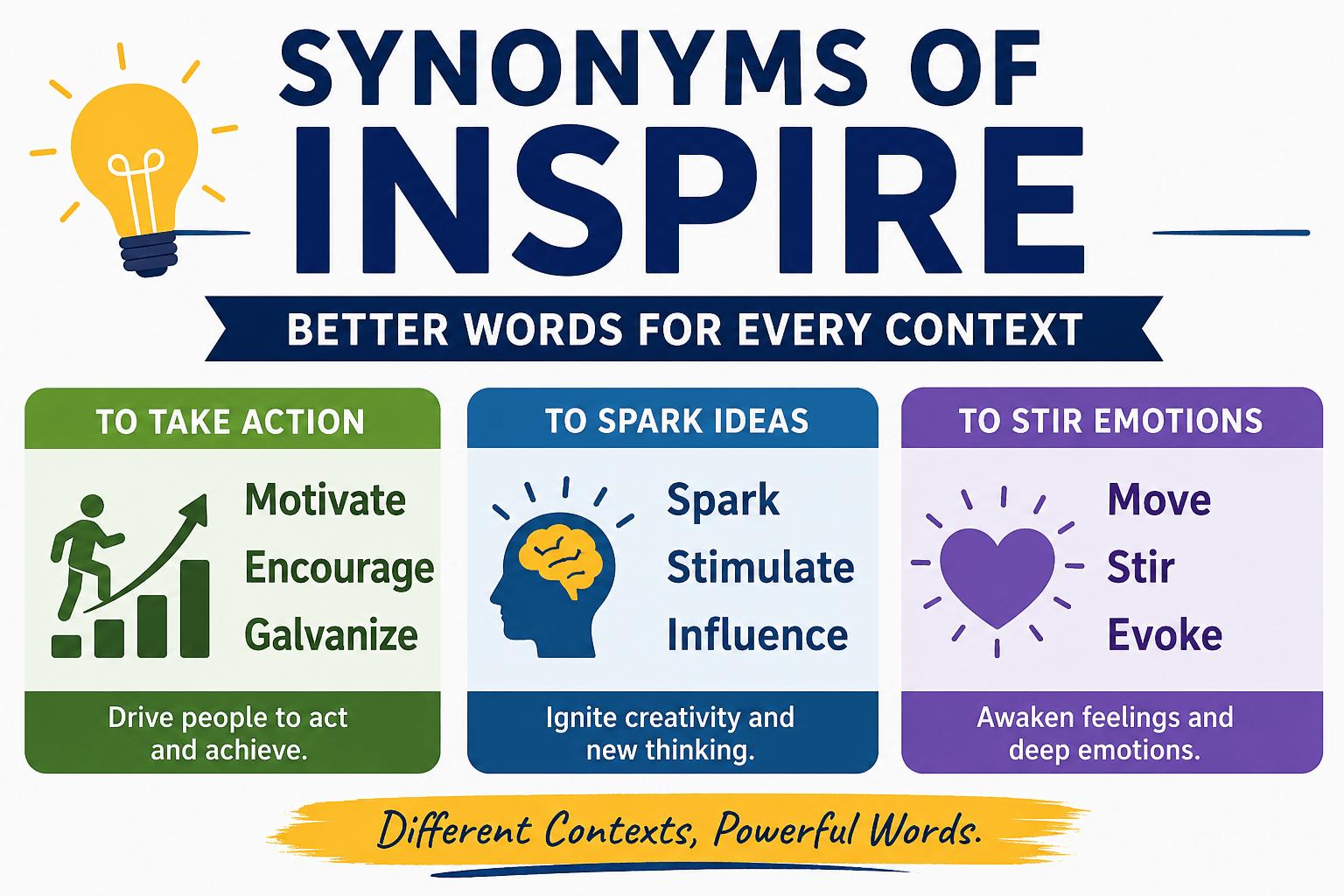
Finding the right synonym for inspire depends heavily on what you mean. For encouraging someone to take action, motivate, encourage, or galvanize may work better. When something gives you a creative idea, spark, stimulate, or influence can be more precise. To describe an emotional reaction, move, stir, or evoke may be the better choice.
The important point is that inspire has several related meanings, so there is no single replacement that works perfectly in every sentence. The best synonym depends on whether the emphasis is on action, creativity, emotion, confidence, or influence.
Quick Answer: What Are the Best Synonyms of Inspire?
The closest everyday synonyms of inspire include motivate, encourage, stimulate, influence, move, prompt, spur, hearten, energize, and encourage. More specific alternatives include galvanize for urgent action, spark for ideas or creativity, embolden for confidence, and evoke for feelings or responses. The right choice depends on which sense of inspire you intend.
What Does “Inspire” Mean?
Inspire is primarily a verb. In modern English, it commonly means to cause someone to feel motivated, confident, enthusiastic, or ready to act; to provide an idea for creative work; or to cause a particular feeling or reaction.
For example:
- Her teacher inspired her to become a scientist.
→ gave her the desire or motivation to act. - The landscape inspired his painting.
→ provided the idea or creative stimulus. - His honesty inspired confidence.
→ caused people to feel confidence.
These different senses explain why motivate, spark, and evoke can all relate to inspire without being interchangeable in every sentence.
Pronunciation
- UK: /ɪnˈspaɪə(r)/
- US: /ɪnˈspaɪər/
Word Origin
Inspire comes through Middle English and Old French from Latin inspirare, meaning “to breathe or blow into.” Its early figurative English sense involved divine or supernatural influence; the modern meanings developed from this idea of something being breathed or infused into a person.
The Best Synonyms of Inspire at a Glance
| Word | Relationship | Strength | Formality | Best Context |
|---|---|---|---|---|
| Motivate | Near synonym | Strong | Neutral | Encouraging action or effort |
| Encourage | Near synonym | Moderate–strong | Neutral | Giving support or confidence |
| Stimulate | Near synonym | Moderate–strong | Formal/neutral | Ideas, thought, creativity |
| Influence | Near synonym | Moderate | Neutral/formal | Affecting choices, ideas, behavior |
| Move | Near synonym | Strong | Neutral | Producing an emotional response |
| Prompt | Contextual alternative | Moderate | Neutral/formal | Causing an action or response |
| Spur | Contextual alternative | Strong | Neutral | Pushing someone toward action |
| Hearten | Near synonym | Moderate | Neutral/literary | Giving courage or hope |
| Galvanize | Contextual alternative | Very strong | Formal/neutral | Urgent or collective action |
| Embolden | Contextual alternative | Strong | Formal | Giving someone confidence to act |
| Energize | Near synonym | Strong | Neutral | Increasing enthusiasm or energy |
| Invigorate | Near synonym | Strong | Formal | Renewing energy or enthusiasm |
| Animate | Near synonym | Moderate–strong | Formal/literary | Giving energy or enthusiasm |
| Stir | Near synonym | Moderate | Neutral/literary | Awakening emotions or thoughts |
| Spark | Contextual alternative | Strong | Neutral | Starting an idea, interest, or movement |
| Ignite | Contextual alternative | Very strong | Neutral/literary | Starting intense enthusiasm or action |
| Arouse | Contextual alternative | Moderate–strong | Formal | Causing a feeling, interest, or reaction |
| Evoke | Contextual alternative | Moderate | Formal/neutral | Bringing a feeling, memory, or response to mind |
| Incite | Contextual alternative | Very strong | Formal | Provoking action, often negative or controversial |
| Impel | Near synonym | Very strong | Formal | Driving someone toward action |
| Rally | Contextual alternative | Strong | Neutral | Bringing people together for a cause |
| Fortify | Contextual alternative | Strong | Formal | Strengthening confidence, resolve, or morale |
| Reinforce | Near synonym | Moderate | Formal/neutral | Strengthening an existing belief or behavior |
| Cultivate | Contextual alternative | Moderate | Formal | Developing interest, ability, or motivation |
Important: these are not interchangeable in every sentence. Inspire itself covers several meanings, while many alternatives emphasize only one of them.
Closest Synonyms of Inspire
1. Motivate
Meaning: To give someone a reason, desire, or incentive to act.
How it differs: Motivate is more directly connected with action and goals than inspire. It does not necessarily imply admiration, creativity, or emotional elevation.
Best used for: Work, study, achievement, goals, performance, and behavior.
Example:
The coach motivated the players to keep training after the defeat.
Compare:
The coach inspired the players.
This sounds broader and potentially more emotional. Motivated focuses more directly on getting them to act.
2. Encourage
Meaning: To give someone confidence, support, or hope.
How it differs: Encourage often suggests support from another person, while inspire can involve admiration, creativity, emotion, or a powerful example.
Example:
Her parents encouraged her to apply for the scholarship.
Natural collocations:
- encourage someone to try
- encourage students to participate
- encourage growth
- encourage creativity
3. Stimulate
Meaning: To cause increased interest, thought, activity, or development.
How it differs: Stimulate is particularly useful when something activates thought or creativity rather than simply motivating a person.
Example:
The discussion stimulated new ideas about sustainable design.
It works especially well in academic, professional, scientific, and creative contexts.
4. Influence
Meaning: To affect someone’s thoughts, behavior, decisions, or development.
How it differs: Influence is much broader and more neutral than inspire. A person can influence someone negatively as well as positively.
Example:
Her research influenced a new generation of environmental scientists.
Use influence when the emphasis is on lasting effect, rather than emotional motivation.
5. Move
Meaning: To affect someone emotionally.
How it differs: Move is ideal when inspire means touch emotionally, rather than motivate someone to act.
Example:
The singer’s performance moved the entire audience.
You would not normally replace this with motivate:
The singer’s performance motivated the entire audience.
That changes the meaning considerably.
More Precise Alternatives to Inspire
Spur
Spur means to push or encourage someone toward action.
The criticism spurred him to improve his performance.
It is often more forceful than encourage and can imply that a particular event prompted action.
Prompt
Prompt emphasizes causing something to happen.
The report prompted the government to review the policy.
It is usually more neutral and cause-and-effect oriented than inspire.
Hearten
Hearten means to make someone feel more hopeful, confident, or courageous.
The team’s early success heartened its supporters.
This is particularly appropriate for morale and emotional encouragement.
Embolden
Embolden means to give someone greater confidence or courage to do something.
Her success emboldened other young entrepreneurs to take risks.
It is stronger and more specific than encourage.
Galvanize
Galvanize means to cause people to take action, particularly quickly or collectively.
The devastating report galvanized the community into action.
This is one of the strongest choices when inspire refers to urgent collective action.
Impel
Impel means to drive or strongly motivate someone toward an action.
A desire to help others impelled her to become a doctor.
It is formal and emphasizes a strong force behind the action.
Context-Specific Alternatives
Some words are useful substitutes for inspire only in particular situations.
For creativity and ideas
Use:
- spark
- stimulate
- prompt
- influence
- ignite
The museum’s collection sparked several ideas for her next project.
The novel inspired his screenplay.
Both are possible, but spark strongly emphasizes the starting point of an idea.
For confidence
Use:
- encourage
- embolden
- hearten
- reassure
- fortify
Her mentor’s advice encouraged her to apply.
His success emboldened the younger members of the team.
For emotions
Use:
- move
- stir
- evoke
- arouse
The documentary moved viewers around the world.
The photograph evoked memories of childhood.
For action
Use:
- motivate
- spur
- prompt
- galvanize
- impel
The speech motivated employees to work toward the new target.
The announcement galvanized supporters into action.
Synonym Strength: From Gentle Influence to Strong Action
These labels are editorial guidance rather than scientific measurements, but they help show the differences in force.
| Word | Approximate Strength | Main Emphasis |
|---|---|---|
| Encourage | Moderate | Support and confidence |
| Influence | Moderate | General effect |
| Stimulate | Moderate–strong | Thought or activity |
| Motivate | Strong | Desire to act |
| Spur | Strong | Push toward action |
| Embolden | Strong | Courage and confidence |
| Energize | Strong | Enthusiasm and energy |
| Impel | Very strong | Powerful drive to act |
| Galvanize | Very strong | Urgent collective action |
| Ignite | Very strong | Sudden intense enthusiasm or activity |
Which Word Should I Use Instead of “Inspire”?
The easiest way to choose is to identify what the subject actually does.
Use motivate when:
You mean make someone want to act or achieve something.
The bonus motivated employees to meet their targets.
Use encourage when:
You mean give someone support or confidence.
Her teacher encouraged her to enter the competition.
Use stimulate when:
You mean generate thought, interest, creativity, or activity.
The lecture stimulated a lively debate.
Use galvanize when:
You mean cause people to take strong or urgent collective action.
The crisis galvanized volunteers across the city.
Use spark when:
You mean start an idea, interest, conversation, or creative process.
The photograph sparked an idea for her next novel.
Use move when:
You mean affect someone emotionally.
His story moved everyone in the room.
Use embolden when:
You mean give someone courage or confidence to take a risk.
The early victory emboldened the team.
Use evoke when:
You mean bring a feeling, memory, or response to mind.
The old song evoked memories of childhood.
Inspire vs. Motivate vs. Encourage vs. Influence
These four words overlap, but they are not identical.
| Word | Core Idea | Typical Emphasis |
|---|---|---|
| Inspire | Cause enthusiasm, ideas, feelings, or desire to act | Broad and often positive |
| Motivate | Give a reason or desire to act | Goals and action |
| Encourage | Give support or confidence | Reassurance and support |
| Influence | Affect thoughts, behavior, or decisions | General effect |
Consider:
The teacher inspired her students.
This suggests a broad positive effect.
The teacher encouraged her students to apply for scholarships.
The emphasis is support and confidence.
The teacher influenced her students’ career choices.
The emphasis is lasting effect rather than immediate motivation.
Natural Collocations with “Inspire”
Some combinations are especially common and useful:
- inspire confidence
- inspire trust
- inspire loyalty
- inspire hope
- inspire creativity
- inspire action
- inspire change
- inspire people
- inspire students
- inspire a generation
- inspire someone to act
- inspire someone to pursue a goal
- be inspired by an artist
- be inspired by an experience
- be inspired by nature
Oxford specifically illustrates patterns such as inspire somebody to do something, inspire something, and inspire somebody with something.
Choosing alternatives for common phrases
| Original phrase | Strong alternative | Why |
|---|---|---|
| inspire confidence | build confidence | More natural when confidence develops gradually |
| inspire action | prompt action | Emphasizes cause and response |
| inspire creativity | stimulate creativity | Emphasizes activating creative thought |
| inspire people | motivate people | Better when action is the focus |
| inspire hope | instill hope | Emphasizes putting hope into someone’s mind |
| inspire a movement | galvanize a movement | Stronger emphasis on collective action |
| inspire memories | evoke memories | More precise for bringing memories to mind |
Common Mistakes with Synonyms of Inspire
1. Treating every related word as interchangeable
Words such as motivate, influence, encourage, evoke, and stimulate overlap with inspire, but their meanings are not identical.
Better approach: Identify the intended sense first.
2. Using “incite” as a general positive synonym
Incite means to encourage or provoke action, but it often carries a negative or controversial implication.
The speech incited violence.
This is very different from:
The speech inspired the audience.
Use incite carefully.
3. Using “evoke” when motivation is intended
The teacher evoked students to study harder. ❌
Evoke does not normally mean “motivate someone to take action.”
Better:
The teacher inspired the students to study harder.
The teacher motivated the students to study harder.
4. Using “influence” when a stronger emotional meaning is intended
Her courage influenced me to keep going.
This is grammatically possible, but:
Her courage inspired me to keep going.
sounds more natural when admiration and emotional motivation are central.
5. Assuming “inspire” always means “motivate”
It does not. Inspire can also mean to provide the idea for creative work or to cause a feeling or reaction. Oxford, Cambridge, and Merriam-Webster all distinguish these broader senses.
Examples in Real-World Writing
Workplace
Her leadership inspired the team to tackle the project with renewed confidence.
More precise alternatives:
Her leadership motivated the team to meet the deadline.
Her leadership galvanized the team into action.
The first emphasizes broad inspiration, the second goal-oriented motivation, and the third urgent action.
Academic Writing
The study inspired further research into renewable energy.
Possible alternative:
The study prompted further research into renewable energy.
Here, prompted can be more precise because the emphasis is on one study causing subsequent research.
Creative Writing
The experience inspired her to write a novel.
Possible alternatives:
The experience sparked the idea for her novel.
The experience influenced her writing.
Each changes the emphasis slightly: sparked highlights the beginning of the idea, while influenced highlights the broader effect.
Everyday Conversation
That documentary really inspired me to volunteer.
Natural alternatives:
That documentary really motivated me to volunteer.
That documentary encouraged me to volunteer.
The original is often the most natural choice when emotional impact and action are both present.
Antonyms of Inspire
The best antonym depends on which sense of inspire you mean.
| Inspire | Possible Antonym | Meaning |
|---|---|---|
| motivate | discourage | Reduce willingness to act |
| encourage | dishearten | Reduce confidence or hope |
| inspire enthusiasm | dampen | Reduce enthusiasm |
| inspire action | deter | Prevent or discourage action |
| inspire interest | bore | Fail to maintain interest |
| inspire confidence | undermine | Weaken confidence |
There is therefore no single opposite of inspire that works in every context.
FAQ
What is another word for inspire?
Common alternatives include motivate, encourage, stimulate, influence, move, prompt, spur, and energize. The best choice depends on whether you mean motivating action, generating an idea, or causing an emotional response.
What is the closest synonym for inspire?
Motivate and encourage are among the closest alternatives when inspire means giving someone the desire or confidence to act. However, neither covers every meaning of inspire.
What is a strong synonym for inspire?
Galvanize, impel, embolden, and ignite can be stronger alternatives in particular contexts. Galvanize is especially useful for urgent collective action, while impel emphasizes a powerful drive toward action.
What is a formal synonym for inspire?
Depending on context, formal alternatives include stimulate, influence, impel, evoke, arouse, and galvanize. None is universally interchangeable with inspire, so the intended meaning matters.
What is a professional alternative to inspire?
In professional writing, motivate, encourage, stimulate, influence, prompt, and galvanize can be useful. For example, “The initiative motivated employees” is more specific than “The initiative inspired employees” when measurable action is the focus.
What is the difference between inspire and motivate?
Inspire has a broader emotional and creative range. Motivate more specifically means giving someone a reason, desire, or incentive to act. A person can be inspired by a role model, artwork, speech, or experience, while motivation usually focuses more directly on action or goals.
What is the difference between inspire and encourage?
Encourage emphasizes support, reassurance, or confidence. Inspire can involve encouragement but may also suggest admiration, creativity, emotional impact, or a powerful influence.
What is the difference between inspire and influence?
Influence means affecting someone’s thoughts, behavior, decisions, or development and can be positive, negative, or neutral. Inspire generally carries a more positive sense of enthusiasm, creativity, admiration, or motivation.
Conclusion
The best synonym for inspire depends on the meaning you want to emphasize. Use motivate for action and goals, encourage for support and confidence, stimulate for ideas and creativity, influence for broad effects, move for emotional impact, spark for new ideas, and galvanize for powerful collective action.
Rather than replacing inspire mechanically, choose the word that expresses the specific kind of influence you mean. That produces more precise, natural English.

Emily Johnson is a linguistics graduate and vocabulary specialist. She writes detailed synonym explanations and helps readers understand subtle differences between words, improving both writing and speaking skills. Synonyms help express ideas more clearly and precisely in English.