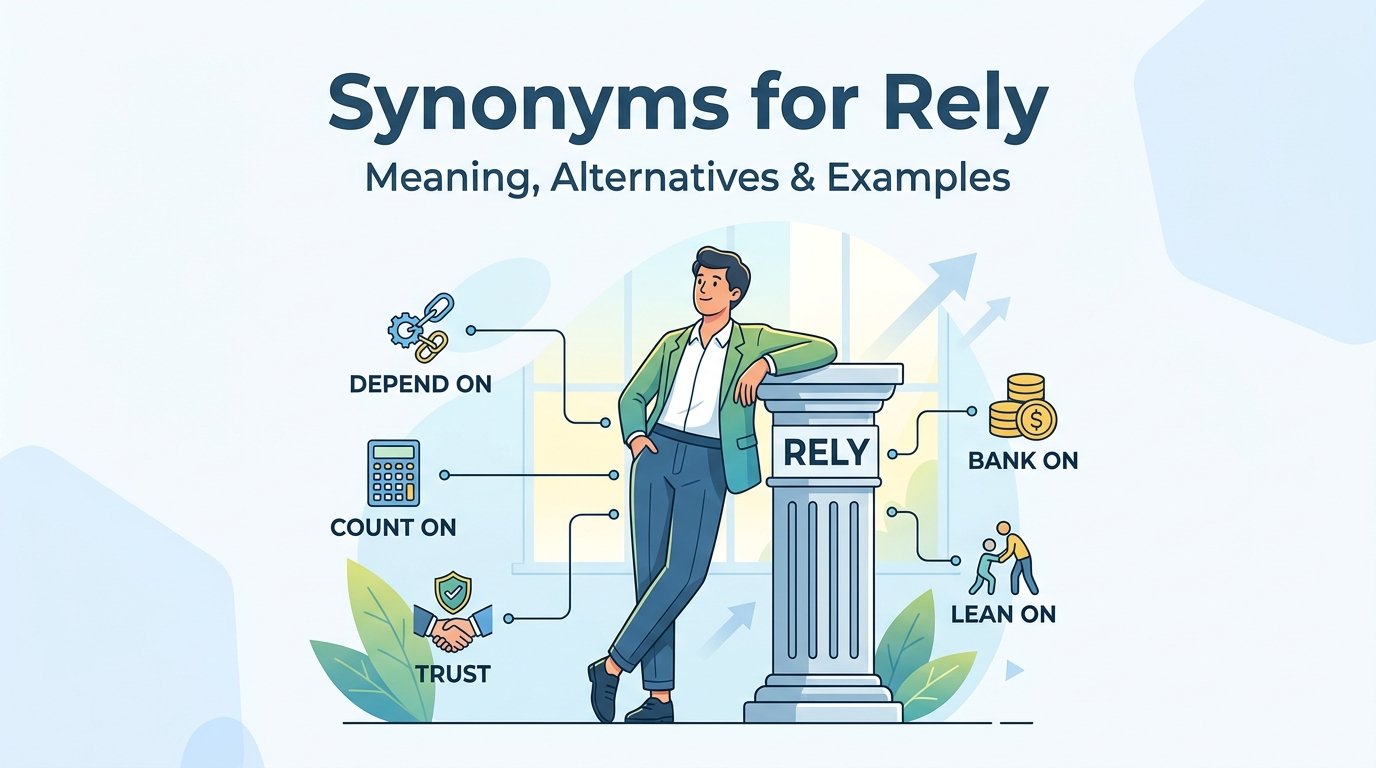
If you need synonyms for rely, the best choice depends on what you mean. Depend on is usually the closest general alternative, while count on emphasizes confidence that someone or something will come through.
Trust focuses more strongly on confidence in a person, judgment, source, or result. Other alternatives, such as bank on, lean on, rest on, and hinge on, work naturally in more specific contexts.
Quick Answer: What Are the Best Synonyms for Rely?
The closest synonyms for rely on include depend on, count on, trust, lean on, bank on, and place your trust in. However, they are not interchangeable in every sentence.
Use depend on for general dependence, count on for confident expectation, trust for confidence in someone or something, and bank on when you strongly expect a particular outcome.
Core Synonyms for Rely
| Word or phrase | Relationship | Main meaning | Best context | Register |
|---|---|---|---|---|
| depend on | Direct synonym | Need or depend upon someone or something | General use | Neutral |
| count on | Near synonym | Expect someone or something to be dependable | People, promises, outcomes | Neutral |
| trust | Near synonym | Have confidence in someone or something | People, judgment, information | Neutral |
| lean on | Contextual alternative | Depend on someone for support | Emotional or practical support | Informal/neutral |
| bank on | Contextual alternative | Depend on or confidently expect something | Expected outcomes | Informal |
| rest on | Contextual alternative | Be based or dependent on something | Decisions, evidence, conditions | Formal/neutral |
| hinge on | Contextual alternative | Depend critically on one condition | Outcomes, decisions | Neutral/formal |
| be dependent on | Direct/near equivalent | Need something for support or continuation | Formal or technical writing | Formal |
| place one’s trust in | Contextual alternative | Put confidence in someone or something | People, institutions, decisions | Formal |
| have faith in | Near synonym | Believe strongly in someone or something | People, principles, outcomes | Neutral |
| look to | Contextual alternative | Turn to someone for help or guidance | People, authorities, resources | Neutral/formal |
| put one’s faith in | Contextual alternative | Depend on strong belief or confidence | People, ideas, outcomes | Neutral |
| be contingent on | Related/contextual | Depend on a particular condition | Academic, legal, business | Formal |
| be determined by | Related/contextual | Have an outcome controlled by a factor | Results, decisions | Formal |
| be based on | Related/contextual | Derive support or foundation from something | Evidence, reasoning, decisions | Neutral/formal |
| rest upon | Contextual alternative | Depend upon a foundation or condition | Formal writing | Formal |
| depend upon | Direct synonym | Rely on | Formal writing | Formal |
The strongest general substitutes are depend on, count on, and trust, but their meanings overlap only partially. Cambridge defines rely on/upon in terms of both needing someone or something for support or success and trusting someone or something to behave as expected.
What Does “Rely” Mean?
Rely is a verb that usually appears as rely on or rely upon. It has two closely connected meanings.
First, it can mean to need someone or something for support, help, supply, or successful operation:
The company relies on skilled employees to deliver its services.
Second, it can mean to trust or have confidence that someone or something will behave as expected:
You can rely on Maria to finish the report on time.
Cambridge recognizes both of these uses, which explains why different synonyms become appropriate in different contexts.
Pronunciation
Rely: /rɪˈlaɪ/
The stress falls on the second syllable: re-LY.
1. Depend On
Depend on is generally the closest synonym for rely on.
Use it when someone or something needs another person, resource, or condition for support, success, or functioning.
Small businesses often depend on loyal customers.
The project depends on adequate funding.
Rely on and depend on can often substitute for each other. Oxford specifically defines depend on/upon in one sense as relying on someone or something and being able to trust them.
Best choice: Use depend on when you want a straightforward, neutral expression of dependence.
2. Count On
Count on emphasizes confidence or expectation.
You can count on James to keep his promise.
We are count oning the delivery to arrive tomorrow.
The more natural grammatical form is:
We are counting on the delivery arriving tomorrow.
Compared with rely on, count on often sounds slightly more conversational and emphasizes the expectation that something will happen or someone will do what is needed.
Choose “count on” when: you want to emphasize confidence in a person’s action or an expected result.
3. TrustTrust overlaps with rely on, but the two expressions emphasize different ideas.
For example, you can say, “I trust her judgment.”
When dependence is the main idea, “I rely on her judgment when I need advice” is more appropriate.
The word trust primarily expresses confidence in someone’s honesty, judgment, ability, or reliability.Rely on more directly expresses dependence or expectation.
Oxford notes an important distinction: trust can naturally describe confidence in a person’s judgment or advice, whereas depend on can describe dependence on someone’s support.
Choose “trust” when: confidence is more important than dependence.
4. Lean On
Lean on means to depend on someone for support, especially emotional or practical support.
She leaned on her friends during a difficult period.
The team leaned on its most experienced players.
It can be literal or figurative, but the figurative use is especially common.
Choose “lean on” when: someone provides support that another person depends on.
Because it often sounds conversational, it is less suitable than depend on in highly formal writing.
5. Bank On
Bank on means to rely on something happening or someone doing something, usually with a strong expectation.
We are banking on good weather for the outdoor event.
Don’t bank on getting a last-minute ticket.
It is more informal than rely on.
Choose “bank on” when: you want to emphasize a confident expectation, particularly about an uncertain future event.
6. Rest On / Rest Upon
Rest on can mean that something depends on a particular foundation, condition, fact, or decision.
The success of the proposal rests on accurate financial data.
The argument rests upon several assumptions.
This expression is particularly useful in formal, academic, analytical, and professional writing.
Choose “rest on” when: you are describing what a conclusion, argument, decision, or outcome is based on.
7. Hinge On
Hinge on means to depend heavily or critically on one particular factor.
The final decision hinges on the results of the investigation.
Our plans hinge on whether the funding is approved.
This is stronger and more specific than ordinary rely on because it suggests that the outcome could change depending on one crucial condition.
Choose “hinge on” when: one factor is especially decisive.
8. Be Dependent On
Be dependent on is a formal and explicit way to express dependence.
The region is heavily dependent on agriculture.
The project’s success is dependent on adequate funding.
It is useful in academic, business, scientific, and technical writing.
Choose “be dependent on” when: you need a formal description of a dependency relationship.
9. Place Your Trust In
Place your trust in emphasizes deliberately giving someone or something your confidence.
The community placed its trust in the new leadership.
This phrase is more formal and expressive than simply saying rely on.
Choose “place your trust in” when: confidence or faith is the central idea.
10. Have Faith In
Have faith in means to believe strongly in someone’s ability, character, or potential, or in the likelihood of a positive outcome.
Her parents have faith in her abilities.
Unlike depend on, this expression does not necessarily imply practical dependence.
Choose “have faith in” when: belief and confidence matter more than actual dependence.
11. Look To
Look to can mean turning to someone or something for help, guidance, leadership, or a solution.
The organization looks to its experts for guidance.
Consumers often look to independent reviews before making a purchase.
Choose “look to” when: the idea is seeking assistance, direction, or expertise.
12. Be Contingent On
Be contingent on is a formal expression meaning that something depends on a particular condition being satisfied.
The agreement is contingent on regulatory approval.
The funding is contingent upon meeting the stated requirements.
This is not a universal replacement for rely on. It is a contextual alternative used primarily when a condition determines whether something can happen.
Choose “be contingent on” when: writing about conditions, contracts, plans, policies, or formal decisions.
Rely Synonyms by Context
When You Rely on a Person
The most natural choices include:
- depend on
- count on
- trust
- lean on
- look to
- place your trust in
Examples:
I rely on my brother for advice.
I depend on my brother for advice.
I trust my brother’s judgment.
These sentences overlap, but they do not communicate exactly the same idea.
Depend on emphasizes need.
Trust emphasizes confidence.
Count on emphasizes expectation.
Lean on emphasizes support.
When You Rely on Information
Use:
- rely on
- depend on
- trust
- base something on
- draw on
Examples:
The researchers relied on historical records.
The researchers based their conclusions on historical records.
We cannot rely on outdated information.
Here, trust can work when the issue is whether the information is credible, while rely on emphasizes using it as a dependable basis.
When an Outcome Relies on Something
Useful alternatives include:
- depend on
- hinge on
- rest on
- be contingent on
- be determined by
Examples:
Success depends on careful preparation.
Success hinges on careful preparation.
The decision rests on the available evidence.
Approval is contingent on meeting the requirements.
These are related but not identical. Hinge on suggests a crucial determining factor, while rest on often highlights the foundation supporting an argument or decision.
Rely vs Depend
Rely and depend are often interchangeable, especially when followed by on.
We rely on public transportation.
We depend on public transportation.
Both are natural.
The distinction becomes clearer in context. Depend on can emphasize a condition of need or necessity, while rely on frequently emphasizes confidence that someone or something can be trusted to provide what is needed. Cambridge lists depend among the principal synonyms of rely, while Oxford describes depend on as relying on someone or something and being able to trust them.
Which should you choose?
Choose “rely on” when dependable support or expected performance is the focus.
Choose “depend on” when the relationship of need or necessity is more important.
Rely vs Trust
These words overlap, but they are not complete synonyms.
I trust her advice.
I rely on her advice.
The first sentence emphasizes confidence in the quality or honesty of the advice. The second emphasizes using the advice as a dependable source.
A useful rule is:
Trust = confidence.
Rely = dependable use or dependence.
Oxford’s usage guidance makes a similar distinction between trusting a person’s judgment and depending on someone’s support.
Rely vs Count On
Count on is usually more conversational.
You can rely on me.
You can count on me.
Both mean that the speaker will be dependable.
However, count on can more strongly suggest an expectation:
We’re counting on you to finish the presentation.
This is why count on is especially common when talking about promises, plans, deadlines, and expected actions.
Common Mistakes With Rely
1. Forgetting “on” or “upon”
The standard construction is:
rely on someone
or:
rely upon someone
Not:
rely someone
2. Treating “trust” and “rely” as identical
They overlap, but trust centers on confidence, while rely can express practical dependence.
3. Using “bank on” in formal writing
Bank on is natural in conversation but may sound too informal for academic or highly formal contexts.
Use depend on, rely on, or be contingent on when appropriate.
4. Using “hinge on” for ordinary dependence
Hinge on suggests that a particular factor is crucial to the outcome.
The decision hinges on funding.
This is different from simply saying:
The team relies on funding.
5. Assuming every thesaurus entry is a direct synonym
Words such as bet, reckon, believe, rest, hinge, and lean can overlap with rely in particular contexts, but they should not automatically replace rely everywhere. Major thesaurus resources themselves present a mixture of closely related words and context-dependent alternatives.
Antonyms of Rely
The best opposite depends on the intended meaning.
For not depending on others, useful opposites include:
- be independent
- stand on one’s own
- act independently
- self-sufficient
For not trusting someone or something, possible opposites include:
- distrust
- doubt
- disbelieve
- question
These are not interchangeable opposites in every context.
Frequently Asked Questions
What is the closest synonym for rely?
Depend on is usually the closest general synonym for rely on. Count on and trust are also close, but they emphasize different aspects of the meaning. Depend on highlights dependence, count on highlights expectation, and trust highlights confidence.
What is another word for rely on someone?
Depending on the context, alternatives include depend on, count on, trust, lean on, look to, and place your trust in. Use depend on for general dependence, count on for expected support or action, and lean on when emotional or practical support is involved.
Is “depend on” the same as “rely on”?
Often, yes. Both can describe needing or depending on someone or something. However, rely on can place slightly more emphasis on confidence that the person or thing will perform as expected. Oxford and Cambridge both treat the expressions as closely overlapping.
Is “trust” a synonym for “rely”?
Sometimes, but not always. Trust focuses on confidence in someone or something, whereas rely can also mean depending on someone or something for practical support. For example, you can trust someone’s judgment without necessarily relying on that person for financial support.
What is a formal synonym for rely?
Good formal alternatives include depend on, be dependent on, rest on, rest upon, and be contingent on, depending on context. Be contingent on is especially useful when an outcome depends on a specific condition.
What is a casual synonym for rely?
Count on, lean on, and bank on can sound more conversational than rely on. Their meanings differ, so choose according to context rather than formality alone.
What is the difference between “rely on” and “count on”?
Both can express confidence that someone or something will be dependable. Rely on is broader and can describe practical dependence, while count on often emphasizes expectation.
Can I say “rely upon” instead of “rely on”?
Yes. Rely upon is grammatically correct and has the same basic meaning as rely on. However, rely on is generally the more common everyday form. Cambridge lists both forms.
Conclusion
The best synonym for rely on depends on the precise idea you want to express. Depend on is the strongest general substitute. Choose count on when you mean confidently expect, trust when confidence is central, lean on for support, bank on for an expected outcome, rest on for a foundation, and hinge on when one factor is crucial.

Michael Thompson is an English language specialist and experienced editor who focuses on vocabulary development and clear communication. He creates high-quality synonym guides, word comparisons, and writing tips to help students and professionals express their ideas more effectively. His work combines linguistic knowledge with practical SEO strategies to make learning both useful and engaging.