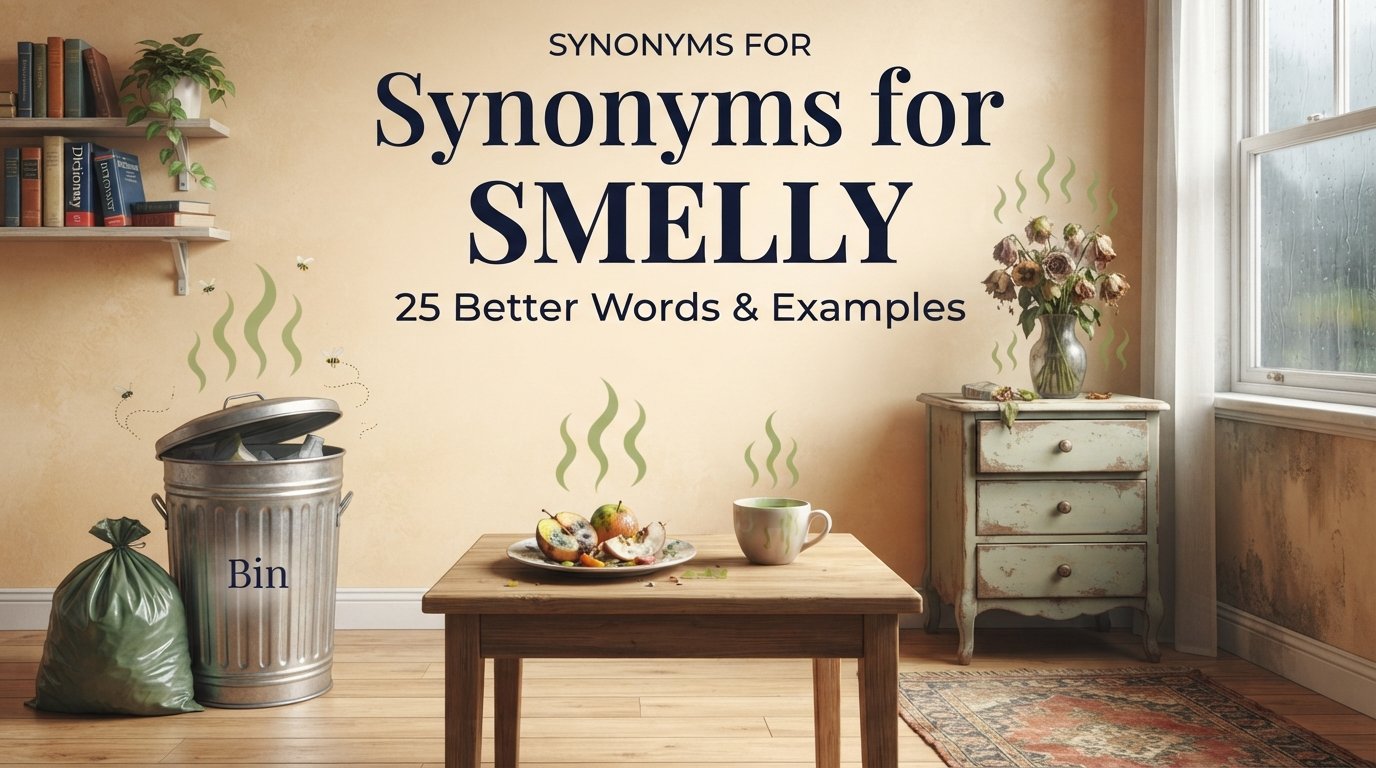
If you need a better word than smelly, the best choice depends on the kind of unpleasant odor you mean. Common synonyms include stinky, stinking, foul, foul-smelling, fetid, malodorous, reeking, putrid, rank, and noisome. More specific words such as rancid and musty describe particular types of unpleasant smells rather than every situation.
Quick Answer: What Are the Best Synonyms for Smelly?
The closest everyday alternatives to smelly are stinky, stinking, foul-smelling, foul, malodorous, fetid, reeking, and rank. Stinky is informal, while malodorous is formal. Fetid and putrid are stronger and often suggest a particularly unpleasant or decomposing smell. Rancid is best for spoiled fatty foods, oils, or fats.
25 Synonyms for Smelly
| Word | Relationship | Best use | Register / tone |
|---|---|---|---|
| Stinky | Direct synonym | Everyday unpleasant smells | Informal |
| Stinking | Direct synonym | Strongly unpleasant odor | Neutral |
| Foul-smelling | Direct synonym | Clear description of bad odor | Neutral |
| Foul | Near synonym | Offensive or unpleasant smells | Neutral |
| Malodorous | Direct synonym | Formal descriptions of bad odors | Formal |
| Fetid | Near synonym | Extremely unpleasant smells | Formal/literary |
| Reeking | Near synonym | Something strongly giving off a bad smell | Neutral |
| Rank | Near synonym | Strong, offensive odor | Neutral/literary |
| Putrid | Contextual alternative | Decay and decomposition | Strong/formal |
| Rancid | Contextual alternative | Spoiled fats, oils, or food | Neutral |
| Noisome | Near synonym | Offensive or harmful smells | Formal/literary |
| Pungent | Near synonym | Strong, penetrating odors | Neutral |
| Musty | Contextual alternative | Old, damp, stale smells | Neutral |
| Fusty | Contextual alternative | Stale, stuffy, old smells | Neutral |
| Funky | Contextual alternative | Strong or unusual smell | Informal |
| Whiffy | Contextual alternative | Noticeably smelly | Informal, especially British |
| Pongy | Contextual alternative | Noticeably unpleasant smell | Informal/British |
| Niffy | Contextual alternative | Slightly unpleasant smell | Informal/British |
| Off | Contextual alternative | Food that smells or tastes spoiled | Informal |
| Rotten | Near synonym | Decay or spoiled material | Neutral |
| Rotting | Contextual alternative | Material actively undergoing decay | Neutral |
| Noxious | Related/near synonym | Harmful or offensive fumes | Formal |
| Skunky | Contextual alternative | Strong smell resembling a skunk | Informal |
| Ill-smelling | Direct synonym | Something having a bad odor | Neutral |
| Evil-smelling | Direct synonym | Extremely unpleasant odor | Literary/formal |
Several of these relationships are supported by major dictionary thesauri, although they are not interchangeable in every context. Cambridge, Collins, and Merriam-Webster all distinguish among terms such as stinking, fetid, malodorous, foul, reeking, rancid, putrid, and musty.
What Does Smelly Mean?
Smelly is an adjective meaning having an unpleasant or bad smell. It is a broad, everyday word that can describe people, animals, food, rooms, clothing, garbage, drains, or other things that produce an unpleasant odor. Collins gives the closely related sense of something having an unpleasant smell or, in British English, a strong or nasty smell.
Examples:
- The kitchen became smelly after the garbage was left overnight.
- His gym shoes were extremely smelly.
- The old basement had a smelly, damp atmosphere.
Because smelly is broad, a more precise synonym can make your writing much stronger.
The Best Synonym Depends on the Context
Use “stinky” for casual everyday language
Stinky is one of the most natural informal alternatives to smelly.
The kids complained about the stinky socks.
It works well in conversation and informal writing but may sound too casual in formal or academic prose.
Use “foul-smelling” for clear, neutral writing
Foul-smelling directly communicates that something has an unpleasant odor.
The workers discovered foul-smelling water near the drainage system.
It is useful when clarity matters more than stylistic sophistication.
Use “malodorous” for formal writing
Malodorous means having an unpleasant or offensive smell and is much more formal than smelly.
The report identified malodorous emissions near the facility.
It works particularly well in technical, environmental, scientific, or professional contexts. Cambridge and Collins list malodorous among the established alternatives associated with smelly and stinking.
Use “fetid” for an intensely unpleasant smell
Fetid suggests a particularly offensive or foul odor.
The alley was filled with the fetid smell of decaying waste.
It is stronger and more formal than ordinary smelly.
Use “reeking” when something strongly gives off an odor
Reeking emphasizes that an object, place, or person is strongly emitting a smell.
The garbage bin was reeking after several days in the heat.
The word often suggests an unmistakably powerful bad smell.
Use “putrid” when decomposition is involved
Putrid is especially appropriate when something is decomposing or rotten.
The abandoned building smelled of putrid food.
It is considerably stronger than smelly. Cambridge connects putrid with things that are spoiled, rotten, decomposing, or decaying.
Use “rancid” for spoiled fats and oils
Rancid should not be treated as a universal synonym for smelly. It is especially associated with food containing fats or oils that have deteriorated.
The butter had a rancid smell.
The nuts tasted rancid.
Calling a damp basement rancid would usually be unnatural.
Use “musty” for old, damp, stale smells
Musty describes a particular type of stale smell, often associated with old buildings, closed rooms, books, clothing, or damp places.
The old library had a musty smell.
Thus, musty is more specific than smelly.
Use “pungent” for a strong, penetrating odor
Pungent describes a smell that is particularly strong or sharp.
The pungent smell of vinegar filled the kitchen.
Unlike fetid or putrid, pungent does not necessarily mean disgusting or rotten. A pungent smell can simply be powerful.
Smelly vs. Stinky
Smelly and stinky are very close in meaning.
The main difference is register:
- smelly — neutral, everyday
- stinky — more informal and often more expressive
Compare:
The refrigerator is smelly.
The refrigerator is stinky.
Both are natural, but stinky sounds more conversational. Merriam-Webster lists stinky among the similar words for smelly.
Smelly vs. Fetid
Both describe unpleasant smells, but fetid is stronger and more formal.
Smelly:
The bathroom was smelly.
Fetid:
A fetid odor came from the stagnant water.
Use fetid when you want to emphasize an offensive, unpleasant odor rather than simply report that something smells bad.
Smelly vs. Putrid
These words should not always be treated as interchangeable.
Smelly simply means unpleasant-smelling.
Putrid strongly suggests decay or decomposition.
The trash was smelly.
The meat had become putrid.
If decomposition is central to the meaning, putrid is more precise.
Smelly vs. Rancid
Rancid has a narrower meaning.
Use rancid particularly for fats, oils, butter, nuts, meat, or other food products that have deteriorated.
The oil smelled rancid.
You would normally not use rancid simply because someone’s shoes smell bad.
Smelly vs. Musty
Musty describes an old, stale, damp smell.
The basement smelled musty.
The word often creates a specific image of poor ventilation, age, dampness, or long confinement.
Therefore:
- smelly room = broad
- musty room = old, stale, or damp-smelling
Strongest Words for a Very Bad Smell
When you need stronger language than smelly, consider:
- Fetid — intensely unpleasant
- Putrid — associated with decay
- Reeking — strongly emitting a bad odor
- Rank — strongly offensive
- Noxious — unpleasant and potentially harmful
- Foul — strongly offensive or disgusting
- Malodorous — formal term for an unpleasant odor
Do not assume that the strongest word is always the best word. Precision matters more than intensity.
Formal Synonyms for Smelly
For professional, academic, or technical writing, these are usually more suitable:
- malodorous
- fetid
- foul-smelling
- ill-smelling
- noxious — when harmful fumes or substances are involved
- putrid — when decomposition is relevant
For example:
The laboratory detected malodorous compounds in the sample.
This sounds more precise than:
The laboratory detected smelly compounds in the sample.
Informal Synonyms for Smelly
For conversation and casual writing, use:
- stinky
- funky
- whiffy
- pongy
- niffy
Some of these are regional. Collins, for example, identifies whiffy and pongy as British informal terms.
Synonyms for Smelly Food
The best word depends on why the food smells bad.
- Rancid — spoiled fats or oils
- Putrid — decomposing food
- Rotten — spoiled or decayed food
- Off — informal term for food that is no longer fresh
- Foul-smelling — general unpleasant odor
- Pungent — very strong smell, not necessarily bad
Example:
The butter smelled rancid.
The meat had a putrid odor.
The milk tasted off.
Synonyms for Smelly Rooms or Buildings
For places, these are especially useful:
- musty — old, damp, stale
- fusty — stale or stuffy
- foul-smelling — generally unpleasant
- fetid — extremely unpleasant
- stuffy — poorly ventilated rather than necessarily smelly
- reeking — strongly filled with a bad smell
Example:
The abandoned house had a musty smell.
This is more informative than simply saying:
The abandoned house was smelly.
Common Mistakes With Smelly Synonyms
1. Treating every related word as an exact synonym
Words such as dirty, disgusting, and rotten can occur in contexts involving bad smells, but they do not simply mean smelly.
2. Using “rancid” for every unpleasant odor
Rancid is associated especially with spoiled fats, oils, and foods.
3. Using “pungent” to mean disgusting
A pungent smell is strong or penetrating. It is not necessarily unpleasant.
4. Using “noxious” when you only mean smelly
Noxious can imply that something is harmful, poisonous, or injurious, so it carries more meaning than smelly.
5. Using formal vocabulary in casual conversation
Words such as malodorous and fetid are accurate but can sound overly formal in ordinary conversation.
Antonyms of Smelly
Depending on context, useful opposites include:
- fragrant
- pleasant-smelling
- sweet-smelling
- fresh-smelling
- aromatic
- perfumed
The exact antonym depends on what kind of smell you mean. Cambridge lists fragrant, sweet-smelling, and fresh-smelling among opposites of smelly.
FAQ About Synonyms for Smelly
What is the best synonym for smelly?
Stinky is one of the best informal synonyms, while foul-smelling is a clear neutral alternative. For formal writing, malodorous works well. If the smell comes from decomposition, putrid or fetid may be more precise.
What is a stronger word for smelly?
Fetid, putrid, reeking, and rank can express a particularly unpleasant smell. The best choice depends on the source and type of odor.
What is a polite way to say smelly?
Has an unpleasant odor or has a strong odor is usually more tactful than stinky or foul. For example: “The room has an unpleasant odor.”
Is “stinky” the same as “smelly”?
They are very close, but stinky is more informal and expressive. Smelly is more neutral and broadly suitable.
What is a formal word for smelly?
Malodorous is one of the clearest formal alternatives. Fetid is also formal but usually conveys a particularly offensive smell.
What is the difference between fetid and putrid?
Fetid emphasizes an extremely unpleasant smell. Putrid more strongly suggests decay or decomposition. A decomposing animal, for example, may be described as putrid.
Is “rancid” a synonym for smelly?
Only in certain contexts. Rancid specifically describes the unpleasant smell or taste produced when fats or oils have deteriorated. It is not a general replacement for smelly.
What is another word for a smelly room?
Musty, fusty, foul-smelling, or stuffy may work depending on the cause. Musty is especially appropriate when the room smells old, damp, or stale.
Conclusion
The best synonym for smelly depends on the exact odor you want to describe. Use stinky for casual language, foul-smelling for straightforward description, malodorous for formal writing, fetid for an intensely unpleasant odor, putrid for decay, rancid for spoiled fats or oils, and musty for old or damp smells. Choosing the precise word makes your writing more natural, specific, and expressive.

Michael Thompson is an English language specialist and experienced editor who focuses on vocabulary development and clear communication. He creates high-quality synonym guides, word comparisons, and writing tips to help students and professionals express their ideas more effectively. His work combines linguistic knowledge with practical SEO strategies to make learning both useful and engaging.