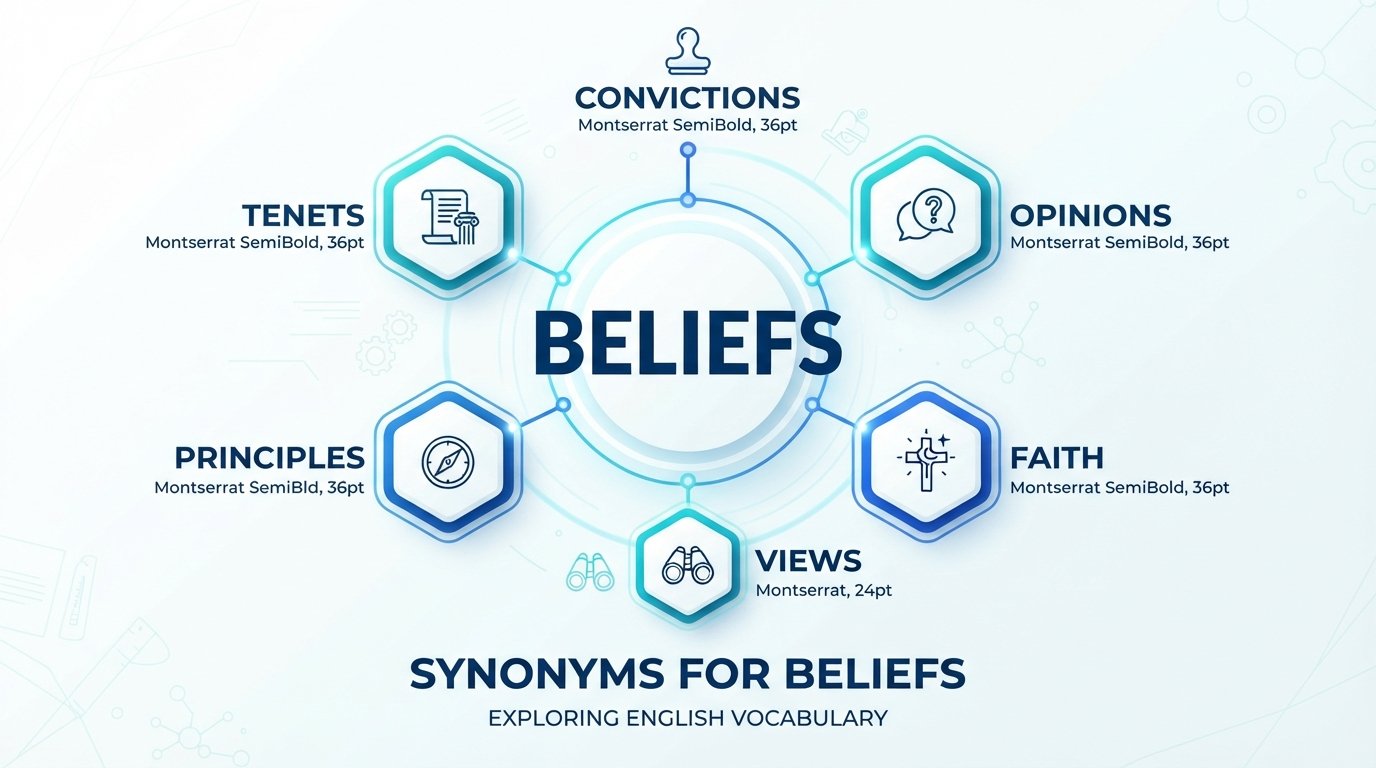
Finding the right synonym for beliefs depends on what you mean. If you are talking about something a person accepts as true, convictions, opinions, views, and credences may work. For religious or spiritual ideas, faiths, doctrines, creeds, and tenets can be more precise. For broader systems of thought, words such as philosophies, ideologies, and worldviews may be better choices. Not all of these words are interchangeable, so context matters.
Quick Answer: What Are the Best Synonyms for Beliefs?
The closest alternatives to beliefs include convictions, opinions, views, faiths, credences, principles, tenets, doctrines, and creeds. However, each word emphasizes something different. Convictions suggest strongly held beliefs, while opinions are usually personal judgments. Faiths often involve religion or strong trust, whereas doctrines, creeds, and tenets usually describe organized or established belief systems.
Closest Synonyms for Beliefs
| Word | Relationship | Meaning | Best Context |
|---|---|---|---|
| Convictions | Near synonym | Strongly held beliefs | Personal, political, moral |
| Faiths | Near synonym | Strong religious belief or a system of religious belief | Religious, spiritual |
| Credences | Near synonym | Acceptance that something is true | Formal, academic |
| Certainties | Near synonym | Things regarded as unquestionably true | Strongly held ideas |
| Conceptions | Near synonym | Ideas or understandings of something | Academic, formal |
| Notions | Near synonym | Ideas or beliefs, sometimes tentative | Everyday, informal |
| Assumptions | Near synonym | Ideas accepted as true without full proof | Academic, analytical |
| Sentiments | Near synonym | Attitudes or feelings toward an issue | Formal, political |
Common Alternatives to Beliefs
| Word | Relationship | Meaning | Best Context |
|---|---|---|---|
| Opinions | Contextual alternative | Ideas or judgments considered true | Everyday, academic |
| Views | Contextual alternative | Personal ways of thinking about something | General, professional |
| Ideas | Broad alternative | Thoughts or concepts | General |
| Thoughts | Broad alternative | Ideas held in the mind | Casual |
| Perspectives | Contextual alternative | Particular ways of viewing an issue | Professional, academic |
| Standpoints | Contextual alternative | Positions from which something is considered | Formal, academic |
| Expectations | Contextual alternative | Beliefs about what will happen | Personal, professional |
| Assurances | Contextual alternative | Grounds for confidence or certainty | Formal, professional |
Formal and Systematic Alternatives
| Word | Relationship | Meaning | Best Context |
|---|---|---|---|
| Principles | Contextual alternative | Fundamental rules or standards guiding thought or conduct | Moral, ethical |
| Tenets | Contextual alternative | Core beliefs of a group or system | Religious, philosophical |
| Doctrines | Contextual alternative | Established body of teachings or beliefs | Religious, political, academic |
| Creeds | Contextual alternative | Formal statements of beliefs | Religious, organizational |
| Credos | Contextual alternative | Guiding beliefs or principles | Personal, organizational |
| Philosophies | Related/contextual | Systems of ideas about life or knowledge | Philosophical, personal |
| Ideologies | Related/contextual | Organized systems of ideas and beliefs | Political, social |
| Worldviews | Related/contextual | Broad ways of understanding the world | Cultural, philosophical |
Beliefs Related to Values and Morality
| Word | Relationship | Meaning | Best Context |
|---|---|---|---|
| Values | Related/contextual | Principles about what is important or desirable | Personal, social |
| Morals | Related/contextual | Ideas about right and wrong | Ethical |
| Ethics | Related/contextual | Principles governing right and wrong conduct | Professional, academic |
| Ideals | Related/contextual | Standards or principles regarded as desirable | Personal, social |
Cultural, Religious, and Traditional BeliefsClosest Synonyms for Beliefs
| Word | Relationship | Meaning | Best Context |
|---|---|---|---|
| Convictions | Near synonym | Strongly held beliefs | Personal, political, moral |
| Faiths | Near synonym | Strong religious belief or a system of religious belief | Religious, spiritual |
| Credences | Near synonym | Acceptance that something is true | Formal, academic |
| Certainties | Near synonym | Things regarded as unquestionably true | Strongly held ideas |
| Conceptions | Near synonym | Ideas or understandings of something | Academic, formal |
| Notions | Near synonym | Ideas or beliefs, sometimes tentative | Everyday, informal |
| Assumptions | Near synonym | Ideas accepted as true without full proof | Academic, analytical |
Common Alternatives to Beliefs
| Word | Relationship | Meaning | Best Context |
|---|---|---|---|
| Opinions | Contextual alternative | Ideas or judgments considered true | Everyday, academic |
| Views | Contextual alternative | Personal ways of thinking about something | General, professional |
| Ideas | Broad alternative | Thoughts or concepts | General |
| Thoughts | Broad alternative | Ideas held in the mind | Casual |
| Perspectives | Contextual alternative | Particular ways of viewing an issue | Professional, academic |
| Standpoints | Contextual alternative | Positions from which something is considered | Formal, academic |
| Expectations | Contextual alternative | Beliefs about what will happen | Personal, professional |
| Sentiments | Near synonym | Attitudes or feelings toward an issue | Formal, political |
Formal and Organizational Beliefs
| Word | Relationship | Meaning | Best Context |
|---|---|---|---|
| Principles | Contextual alternative | Fundamental rules or standards guiding thought or conduct | Moral, ethical |
| Tenets | Contextual alternative | Core beliefs of a group or system | Religious, philosophical |
| Doctrines | Contextual alternative | Established body of teachings or beliefs | Religious, political, academic |
| Creeds | Contextual alternative | Formal statements of beliefs | Religious, organizational |
| Credos | Contextual alternative | Guiding beliefs or principles | Personal, organizational |
| Philosophies | Related/contextual | Systems of ideas about life or knowledge | Philosophical, personal |
| Ideologies | Related/contextual | Organized systems of ideas and beliefs | Political, social |
| Worldviews | Related/contextual | Broad ways of understanding the world | Cultural, philosophical |
Cultural, Religious, and Traditional Beliefs
| Word | Relationship | Meaning | Best Context |
|---|---|---|---|
| Faiths | Near synonym | Strong religious belief or a system of religious belief | Religious, spiritual |
| Traditions | Related/contextual | Beliefs or practices passed through generations | Cultural, religious |
| Lore | Related/contextual | Traditional knowledge, stories, and beliefs | Cultural, historical |
| Dogmas | Strong contextual alternative | Beliefs treated as unquestionably true | Religious, ideological |
Beliefs About Morality and Values
| Word | Relationship | Meaning | Best Context |
|---|---|---|---|
| Values | Related/contextual | Principles about what is important or desirable | Personal, social |
| Morals | Related/contextual | Ideas about right and wrong | Ethical |
| Ethics | Related/contextual | Principles governing right and wrong conduct | Professional, academic |
| Ideals | Related/contextual | Standards or principles regarded as desirable | Personal, social |
Closest Synonyms for Beliefs
These words are the closest alternatives to beliefs when you mean ideas or convictions that a person accepts as true. The best choice depends on how strongly the idea is held and the context in which it is used.
| Word | Relationship | Meaning | Best Context |
|---|---|---|---|
| Convictions | Near synonym | Strongly held beliefs | Personal, political, moral |
| Faiths | Near synonym | Strong religious belief or a system of religious belief | Religious, spiritual |
| Credences | Near synonym | Acceptance that something is true | Formal, academic |
| Certainties | Near synonym | Things regarded as unquestionably true | Strongly held ideas |
| Conceptions | Near synonym | Ideas or understandings of something | Academic, formal |
| Notions | Near synonym | Ideas or beliefs, sometimes tentative | Everyday, informal |
| Assumptions | Near synonym | Ideas accepted as true without full proof | Academic, analytical |
Common Alternatives to Beliefs
In everyday and professional English, several words can replace beliefs when you are referring to someone’s ideas, judgments, or ways of thinking. These alternatives are not always exact synonyms, so context matters.
| Word | Relationship | Meaning | Best Context |
|---|---|---|---|
| Opinions | Contextual alternative | Ideas or judgments considered true | Everyday, academic |
| Views | Contextual alternative | Personal ways of thinking about something | General, professional |
| Ideas | Broad alternative | Thoughts or concepts | General |
| Thoughts | Broad alternative | Ideas held in the mind | Casual |
| Perspectives | Contextual alternative | Particular ways of viewing an issue | Professional, academic |
| Standpoints | Contextual alternative | Positions from which something is considered | Formal, academic |
| Expectations | Contextual alternative | Beliefs about what will happen | Personal, professional |
| Sentiments | Near synonym | Attitudes or feelings toward an issue | Formal, political |
Formal and Organizational Beliefs
When beliefs refer to an established system of ideas, rules, or teachings, more specific vocabulary is often appropriate. These terms are particularly useful in academic, religious, political, and organizational writing.
| Word | Relationship | Meaning | Best Context |
|---|---|---|---|
| Principles | Contextual alternative | Fundamental rules or standards guiding thought or conduct | Moral, ethical |
| Tenets | Contextual alternative | Core beliefs of a group or system | Religious, philosophical |
| Doctrines | Contextual alternative | Established body of teachings or beliefs | Religious, political, academic |
| Creeds | Contextual alternative | Formal statements of beliefs | Religious, organizational |
| Credos | Contextual alternative | Guiding beliefs or principles | Personal, organizational |
| Philosophies | Related/contextual | Systems of ideas about life or knowledge | Philosophical, personal |
| Ideologies | Related/contextual | Organized systems of ideas and beliefs | Political, social |
| Worldviews | Related/contextual | Broad ways of understanding the world | Cultural, philosophical |
Cultural, Religious, and Traditional Beliefs
Some alternatives to beliefs are specifically associated with religion, culture, traditions, or inherited knowledge. Choose these words when the belief is connected to a community, tradition, or system of thought.
| Word | Relationship | Meaning | Best Context |
|---|---|---|---|
| Faiths | Near synonym | Strong religious belief or a system of religious belief | Religious, spiritual |
| Traditions | Related/contextual | Beliefs or practices passed through generations | Cultural, religious |
| Lore | Related/contextual | Traditional knowledge, stories, and beliefs | Cultural, historical |
| Dogmas | Strong contextual alternative | Beliefs treated as unquestionably true | Religious, ideological |
Beliefs About Morality and Values
When beliefs concern what people consider right, wrong, important, or desirable, words such as values, morals, and ethics can be more precise. These terms describe principles that influence decisions and behavior.
| Word | Relationship | Meaning | Best Context |
|---|---|---|---|
| Values | Related/contextual | Principles about what is important or desirable | Personal, social |
| Morals | Related/contextual | Ideas about right and wrong | Ethical |
| Ethics | Related/contextual | Principles governing right and wrong conduct | Professional, academic |
| Ideals | Related/contextual | Standards or principles regarded as desirable | Personal, social |
Other Contextual Alternatives
Some words overlap with beliefs only in particular situations. They can be useful when you want to describe confidence, expectations, viewpoints, or positions rather than beliefs themselves.
| Word | Relationship | Meaning | Best Context |
|---|---|---|---|
| Assurances | Contextual alternative | Grounds for confidence or certainty | Formal, professional |
| Expectations | Contextual alternative | Beliefs about what will happen | Personal, professional |
| Perspectives | Contextual alternative | Particular ways of viewing an issue | Professional, academic |
| Standpoints | Contextual alternative | Positions from which something is considered | Formal, academic |
Merriam-Webster’s current thesaurus likewise lists terms such as faiths, convictions, principles, tenets, credences, doctrines, philosophies, and dogmas, while also separating opinion-related vocabulary such as views, notions, ideas, and perspectives.
What Does “Beliefs” Mean?
Beliefs are ideas, convictions, or propositions that a person or group accepts as true. The word can describe religious beliefs, political beliefs, personal beliefs, cultural beliefs, or an individual’s understanding of how something works.
For example:
- Her beliefs shaped the way she raised her children.
- The community has strong religious beliefs.
- His political beliefs changed over time.
- Their beliefs about education influenced the school’s policies.
Merriam-Webster defines belief both as a mental state involving trust or confidence and as something accepted or considered to be true. It also recognizes a more specific sense involving conviction in the truth of a statement or the reality of something.
The Closest Synonyms for Beliefs
1. Convictions
Convictions are strongly held beliefs, particularly beliefs that a person feels firmly committed to.
Example:
Her political convictions remained unchanged despite criticism.
Choose “convictions” when you want to emphasize strength, certainty, or personal commitment.
2. Opinions
Opinions are views or judgments that someone holds to be true or reasonable. They are often less strongly held than convictions.
Example:
People have different opinions about the policy.
Choose “opinions” when you mean personal judgments rather than deeply rooted belief systems.
3. Views
Views are someone’s particular opinions or ways of thinking about an issue.
Example:
His views on education have changed considerably.
“Views” is especially natural in everyday and professional writing.
4. Faiths
Faiths can refer to strong religious belief or to particular religious systems.
Example:
People from different faiths attended the ceremony.
However, faith has several meanings, including religious belief, firm belief without proof, trust, and loyalty. It is therefore not a universal replacement for beliefs.
5. Credences
Credences refer to beliefs or acceptance that something is true.
Example:
The new evidence gave credence to his theory.
This is considerably more formal than beliefs and is common in academic or analytical writing.
6. Certainties
Certainties suggests ideas regarded as completely or unquestionably true.
Example:
In science, few conclusions should be treated as absolute certainties.
Use this word when the emphasis is on certainty, not merely belief.
Synonyms for Religious Beliefs
When beliefs refers specifically to religion, more precise vocabulary is available.
Faith
Use faith for religious belief, especially belief and trust in God or religious doctrines.
Her faith has always been an important part of her life.
Doctrine
Use doctrine for an established body of teachings or beliefs.
The doctrine has been debated by scholars for centuries.
Creed
Use creed for a formal statement or system of religious beliefs.
The members recited their creed together.
Tenet
Use tenet for an individual principle or belief that forms part of a larger system.
Equality is a central tenet of the organization.
Dogma
Use dogma for a belief treated as authoritative or unquestionable, often with a critical implication.
The movement rejected the political dogma of the previous generation.
These distinctions matter because faith, doctrine, creed, tenet, and dogma are related to beliefs but do not mean exactly the same thing. Merriam-Webster’s thesaurus specifically places doctrine, tenet, dogma, and creed among words related to belief systems.
Synonyms for Personal Beliefs
For an individual’s personal beliefs, these choices are usually the most useful:
- convictions — strong personal beliefs
- opinions — personal judgments
- views — personal ways of thinking
- principles — beliefs that guide conduct
- values — ideas about what is important or desirable
- perspectives — ways of interpreting an issue
- notions — ideas, sometimes uncertain or informal
- ideals — standards or principles considered desirable
Example
Instead of:
My beliefs about success have changed.
You could write:
My views on success have changed.
Or:
My perspective on success has changed.
Or:
My convictions about what makes a successful life have changed.
The best choice depends on the intended meaning.
Synonyms for Strong Beliefs
When you want to emphasize that someone believes something very firmly, use:
- convictions
- certainties
- faith
- certitudes
- deep convictions
- firm convictions
- strongly held views
For example:
She has strong beliefs about environmental protection.
can become:
She has strong convictions about environmental protection.
Here, convictions is more precise because it emphasizes firmly held beliefs.
Beliefs vs Opinions
These words overlap, but they are not always interchangeable.
| Beliefs | Opinions |
|---|---|
| Can be deeply rooted | Often represent personal judgments |
| May involve religion or worldview | Usually concern a particular issue |
| Can be strongly held | May be relatively flexible |
| Often shape identity or conduct | Often express an evaluation or viewpoint |
Compare:
His beliefs about religion are deeply rooted.
with:
His opinion about the new religious policy is critical.
The first concerns a broader system of belief. The second expresses a judgment about a specific issue.
Beliefs vs Convictions
Beliefs is the broader and more neutral word.
Convictions emphasizes strength and firmness.
She has religious beliefs.
She has strong moral convictions.
The second sentence highlights commitment rather than simply describing what she believes.
Beliefs vs Principles
Principles are not always synonyms for beliefs.
A belief is something a person or group accepts as true.
A principle is a fundamental rule, standard, or idea that can guide behavior or judgment.
For example:
He believes that everyone deserves equal treatment.
Equality is one of his guiding principles.
The first expresses a belief; the second describes a principle derived from or reflected in his broader outlook.
Beliefs vs Values
Values concern what a person considers important, desirable, or worthwhile.
Beliefs are broader and can concern what someone thinks is true.
For example:
Her beliefs include the idea that education transforms communities.
Her values include equality, honesty, and compassion.
Cambridge’s thesaurus groups values, ideals, standards, moral code, and ethics within a related semantic area, but these should not automatically be presented as direct synonyms of beliefs.
Beliefs vs Philosophy
Philosophy can describe a system of ideas or a general approach to life, but it is broader than beliefs.
His beliefs about education are traditional.
His educational philosophy emphasizes independent thinking.
Use philosophy when the ideas form a broader, organized approach or outlook.
Beliefs vs Ideology
Ideology refers to an organized system of ideas and beliefs, often associated with political or social thought.
The movement’s ideology influenced its policies.
You would not normally replace every use of beliefs with ideology. The latter suggests a more structured system.
Beliefs vs Tenets
A tenet is a particular belief or principle that is considered important within a system.
Compassion is a central tenet of the organization.
Thus, beliefs can refer to the overall collection, while tenets often identify its individual core principles.
Common Collocations With “Beliefs”
Natural phrases include:
- religious beliefs
- personal beliefs
- political beliefs
- moral beliefs
- cultural beliefs
- traditional beliefs
- spiritual beliefs
- strongly held beliefs
- deeply held beliefs
- shared beliefs
- core beliefs
- personal belief system
- beliefs about society
- beliefs about education
- beliefs about religion
- beliefs and values
- beliefs and principles
These combinations are useful because the best synonym often depends on the noun that follows.
For example:
religious beliefs → faith, doctrines, creeds, tenets
political beliefs → convictions, views, ideology
moral beliefs → convictions, principles, values
personal beliefs → convictions, views, opinions
cultural beliefs → traditions, customs, worldview, lore
Common Mistakes When Choosing a Synonym for Beliefs
Mistake 1: Treating every related word as an exact synonym
Words such as values, morals, traditions, ethics, and customs can be closely connected to beliefs, but they introduce additional meanings. Cambridge’s thesaurus organizes these terms under related semantic areas rather than treating every entry as a universal replacement.
Mistake 2: Using “faith” for every type of belief
Faith often carries religious or strong-trust implications. It is not always appropriate for ordinary opinions or assumptions.
Mistake 3: Using “opinion” for deeply rooted convictions
An opinion can be relatively casual or changeable, while a conviction usually suggests a stronger commitment.
Mistake 4: Using “dogma” neutrally
Dogma can carry a critical implication because it often describes a belief accepted as authoritative or unquestionable.
Mistake 5: Confusing a belief with a belief system
A tenet can be one core belief within a system, while a doctrine, creed, ideology, or philosophy can describe a broader organized system.
Which Word Should I Use?
Use this quick guide:
- Choose “convictions” when the beliefs are strongly held.
- Choose “opinions” for personal judgments or views.
- Choose “views” for general or professional discussion.
- Choose “faiths” for religious belief systems.
- Choose “credences” in formal or intellectual contexts.
- Choose “principles” when beliefs guide behavior.
- Choose “values” when discussing what someone considers important.
- Choose “tenets” for individual core beliefs within a system.
- Choose “doctrines” for established bodies of teaching.
- Choose “creeds” for formal statements of belief.
- Choose “ideologies” for organized political or social systems of ideas.
- Choose “worldviews” for broad ways of understanding life and reality.
- Choose “assumptions” when something is accepted without complete proof.
- Choose “dogmas” when emphasizing rigid or unquestioned beliefs.
Frequently Asked Questions
What is another word for beliefs?
The best general alternatives are convictions, opinions, views, faiths, credences, and principles, depending on context. For organized belief systems, doctrines, creeds, tenets, ideologies, or philosophies may be more precise.
What is a strong synonym for beliefs?
Convictions is one of the strongest general alternatives when you mean firmly held beliefs. Certainties can suggest an even higher level of confidence, while faith can imply strong religious or trust-based belief.
What is a synonym for religious beliefs?
Depending on context, useful alternatives include faith, doctrines, creeds, tenets, and religious convictions. These words differ in meaning, so the best choice depends on whether you mean a religious system, a specific teaching, or personal religious commitment.
Are beliefs and opinions synonyms?
They can overlap, but they are not identical. Opinions usually refer to personal judgments or views, while beliefs can include deeply held religious, moral, political, cultural, or personal ideas about what is true.
What is a synonym for strongly held beliefs?
Convictions is usually the most natural choice. Other possibilities include firm beliefs, deep convictions, certainties, and strongly held views, depending on the sentence.
What is a synonym for beliefs and values?
There is no single perfect replacement because the two concepts overlap but are distinct. Principles, ideals, worldview, philosophy, or guiding principles may work when you want to describe the broader ideas that shape someone’s outlook and behavior.
What is a formal word for beliefs?
Depending on meaning, convictions, credences, doctrines, tenets, principles, or conceptions can provide a more formal alternative. Credence is particularly useful when discussing acceptance that a proposition is true.
Are values, morals, and ethics synonyms for beliefs?
Not exactly. They are related concepts. Values concern what people consider important, morals concern ideas about right and wrong, and ethics generally concerns principles governing conduct. They can form part of someone’s beliefs but should not automatically replace beliefs.
Conclusion
The best synonym for beliefs depends on the meaning you want to emphasize. Convictions works for strongly held beliefs, opinions and views work for personal judgments, and faith is especially useful for religious or deeply trusted beliefs. For organized systems, consider doctrines, creeds, tenets, philosophies, or ideologies.
The key is not to choose the longest or most sophisticated synonym. Choose the word that preserves the original meaning while making the context more precise.

Daniel Carter is a professional content strategist and language enthusiast. He focuses on semantic SEO, keyword research, and creating structured vocabulary content that ranks well on search engines while remaining user-friendly.