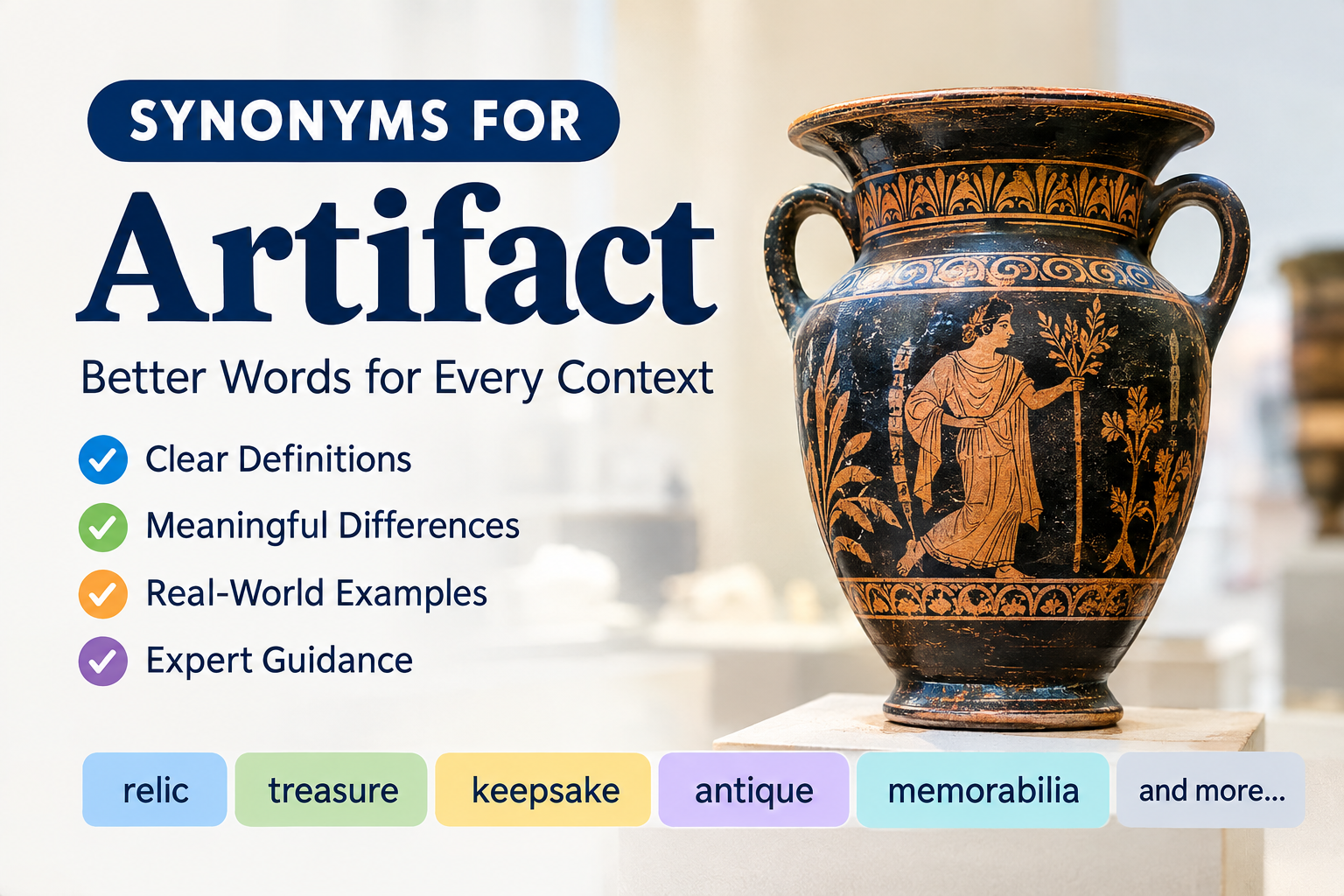
The best synonyms for artifact depend on what you mean. For an ancient human-made object, relic, antique, antiquity, and historical object can work in appropriate contexts. Archaeological find is useful when emphasizing discovery, while heirloom or memento may fit objects preserved for personal or cultural reasons. In science and technology, however, artifact can have a specialized meaning that requires different alternatives.
Quick Answer: What Are the Best Synonyms for Artifact?
The closest alternatives to artifact include relic, antiquity, antique, historical object, archaeological find, object, and remnant, but they are not interchangeable in every sentence. Use relic for something surviving from an earlier period, antique for an old collectible object, and archaeological find when emphasizing an object discovered through excavation or research. In science or technology, artifact may instead mean an unintended result or distortion.
What Does “Artifact” Mean?
Artifact is a noun referring most commonly to an object made or modified by humans, especially one that has historical or cultural significance. Museums and archaeologists commonly use the word for tools, ornaments, weapons, pottery, and other objects recovered from earlier periods. Cambridge gives the example of objects such as tools or decorations that are especially historically interesting.
The word also has specialized meanings. In science, an artifact can be something produced by the method or conditions of an experiment rather than something naturally present in the subject being studied. In imaging and technology, it can refer to an unwanted defect or distortion introduced during processing.
The spelling artefact is chiefly associated with British English, while artifact is the standard American spelling.
Pronunciation
- US: /ˈɑr.t̬ə.fækt/
- UK: /ˈɑː.tə.fækt/
Best Synonyms for Artifact at a Glance
| Word | Relationship | Meaning | Best Context |
|---|---|---|---|
| relic | Near synonym | Something surviving from an earlier time | Ancient or historical objects |
| antiquity | Near synonym | An ancient object or the ancient past | Archaeology, history |
| antique | Near synonym | An old object valued for age or craftsmanship | Collecting, furniture, decorative objects |
| historical object | Contextual alternative | An object associated with history | General historical writing |
| archaeological find | Contextual alternative | An object discovered through archaeology | Excavation and research |
| remnant | Contextual alternative | Something left from an earlier period | Remains, fragments, traces |
| vestige | Contextual alternative | A surviving trace or indication of something past | Formal or academic writing |
| antiquities | Contextual alternative | Ancient objects collectively | Museums, archaeology |
| heirloom | Contextual alternative | An object passed through generations | Family history |
| memento | Contextual alternative | Something kept as a reminder | Personal or commemorative contexts |
| keepsake | Contextual alternative | An object retained for sentimental reasons | Personal contexts |
| handiwork | Related word | Something made by hand | Craftsmanship |
| craft | Related word | An object or activity involving skilled making | Art and making |
| object | Broader term | A physical thing | General writing |
| distortion | Specialized alternative | An unwanted alteration or defect | Scientific/technical contexts |
Not all of these are direct synonyms. The distinction matters because a relic, for example, usually emphasizes survival from the past, whereas artifact emphasizes human making or modification.
15 Useful Alternatives to “Artifact”
1. Relic
Relic is one of the strongest alternatives when an artifact is being discussed as something that has survived from an earlier historical period.
Example:
The museum displayed a Roman relic discovered near the ancient settlement.
Choose relic when historical survival matters more than the object’s function or manufacture.
2. Antiquity
Antiquity can refer to an ancient object, but it also refers to ancient times as a historical period. That makes it broader and less interchangeable with artifact.
Example:
The collection contains several antiquities from ancient Egypt.
Use antiquity when the object is particularly old or when discussing ancient civilizations.
3. Antique
An antique is an old object, typically valued because of its age, rarity, craftsmanship, or collectible status.
Example:
The dealer specializes in antique furniture.
An antique does not have to be an archaeological artifact. A centuries-old chair may be an antique without normally being called an archaeological artifact.
4. Historical Object
Historical object is a clear, descriptive alternative when you want to emphasize an object’s connection to history.
Example:
The museum preserves several historical objects from the colonial period.
It is useful in educational and general writing because it is immediately understandable.
5. Archaeological Find
Archaeological find emphasizes the discovery of an object rather than simply its existence.
Example:
The excavation produced an important archaeological find.
Use this phrase when discussing excavation, fieldwork, archaeological research, or discovery.
6. Remnant
A remnant is something left behind from an earlier time, larger whole, or previous condition.
Example:
The stone wall is a remnant of the ancient settlement.
It can describe an artifact, but it is broader because a remnant may be a fragment, structure, material, or trace rather than a complete human-made object.
7. Vestige
Vestige is a formal word for something that remains as a trace or surviving indication of something earlier.
Example:
The inscription is a vestige of the region’s medieval culture.
It works especially well in academic or historical prose, but it is not a universal replacement for artifact.
8. Antiquities
Antiquities refers collectively to ancient objects or works, particularly those of historical or archaeological interest.
Example:
The museum houses a valuable collection of Egyptian antiquities.
Use the plural when discussing collections of ancient objects.
9. Heirloom
An heirloom is an object passed down through a family or generation.
Example:
The silver bowl became a treasured family heirloom.
It can overlap with artifact when the object has cultural or historical significance, but its defining idea is inheritance.
10. Memento
A memento is something kept as a reminder of a person, event, place, or experience.
Example:
The old medal became a memento of his grandfather’s military service.
It is appropriate when the object’s sentimental or commemorative purpose matters.
11. Keepsake
A keepsake is something retained because it has sentimental value.
Example:
She kept the handwritten letter as a keepsake.
Unlike artifact, the word does not imply archaeological or historical importance.
12. Object
Object is a broad and neutral alternative.
Example:
The archaeologist carefully examined the object.
It is useful when the specific identity of the artifact is unknown, but it loses the historical and cultural meaning carried by artifact.
13. Historical Remains
Historical remains can describe surviving physical evidence from the past.
Example:
The site contains important historical remains.
This phrase is especially useful when referring to fragments, structures, objects, or other surviving evidence collectively.
14. Handiwork
Handiwork emphasizes something produced through human skill or manual craftsmanship.
Example:
The carved box is an example of the artisan’s handiwork.
It is usually better for discussing craftsmanship than archaeology.
15. Distortion
In technical contexts, distortion can be an appropriate alternative when artifact means an unwanted alteration introduced by a process.
Example:
The image contains distortion caused by the compression process.
This is not a synonym for the historical-object meaning of artifact. It belongs to the specialized scientific and technological sense.
Which Word Should I Use?
Choose “relic” when:
You want to emphasize that something has survived from an earlier period.
The temple contains several ancient relics.
Choose “antique” when:
The object is old and has value as a collectible or piece of craftsmanship.
She bought an antique table.
Choose “antiquity” when:
You are discussing ancient objects or the ancient world in a historical or archaeological context.
The gallery specializes in Greek antiquities.
Choose “archaeological find” when:
The important point is that an object was discovered during archaeological work.
Researchers announced an important archaeological find.
Choose “heirloom” when:
The object has been passed down through a family.
The necklace is a family heirloom.
Choose “memento” when:
The object is kept as a reminder of a person, place, or event.
He kept the ticket as a memento.
Choose “vestige” when:
You want formal language for something surviving as a trace of the past.
The ruins are a vestige of the former empire.
Choose “distortion” when:
Artifact refers to an unwanted effect created by imaging, processing, measurement, or another technical procedure.
The unusual pattern was a distortion caused by the scanning process.
Artifact vs. Relic
Both words can describe objects associated with the past, but their emphasis differs.
| Artifact | Relic |
|---|---|
| Emphasizes human manufacture or modification | Emphasizes survival from the past |
| Common in archaeology and anthropology | Common in historical and religious contexts |
| Can refer to relatively recent objects | Usually suggests something surviving from an earlier period |
| Can have technical meanings | Usually refers to a physical historical or sacred object |
Example:
A stone tool is an archaeological artifact.
The ancient sword is a relic of a vanished kingdom.
A relic can be an artifact, but not every artifact is best described as a relic.
Artifact vs. Antique
These words overlap but are not interchangeable.
An artifact is generally discussed because of its human manufacture, cultural significance, archaeological context, or historical value.
An antique is generally discussed because of its age and collectible, decorative, or monetary value.
Compare:
The excavation uncovered a Bronze Age artifact.
The shop sells antique furniture.
Calling the Bronze Age object an antique would be possible in some broad contexts, but artifact is much more precise in archaeological writing.
Artifact vs. Antiquity
Antiquity has two important uses: it can describe ancient times, and it can refer to an ancient object or objects.
The study focuses on trade routes in antiquity.
The museum displays several Greek antiquities.
By contrast, artifact specifically identifies a human-made or human-modified object in its principal historical sense.
Artifact vs. Archaeological Find
These terms focus on different things.
Artifact identifies the object.
Archaeological find emphasizes its discovery.
The bronze artifact was discovered during the excavation.
The bronze object was an important archaeological find.
The second phrase is especially useful when the discovery itself is newsworthy.
Artifact in Science and Technology
One of the most important distinctions is that artifact does not always mean an ancient object.
In scientific research, an artifact can be something introduced by the experimental method rather than something genuinely present in the subject. In digital imaging, an artifact can be an unwanted visual defect caused by capture, compression, processing, or another technical operation. Merriam-Webster and Cambridge both recognize these specialized senses.
Depending on the exact context, possible alternatives include:
- distortion
- anomaly
- spurious signal
- processing error
- unwanted effect
- measurement error
These are contextual alternatives, not universal synonyms.
For example:
The scan contained several image artifacts.
can become:
The scan contained several image distortions.
But replacing artifact with relic would obviously change the meaning completely.
Common Mistakes With “Artifact” Synonyms
Mistake 1: Treating “antique” as a universal synonym
An antique is old and generally valued as a collectible or object of craftsmanship. An artifact is defined more strongly by human making, historical or cultural significance, or specialized technical use.
Mistake 2: Calling every old object a relic
Relic usually carries an idea of something surviving from an earlier period. A modern historical object does not automatically become a relic.
Mistake 3: Using “memento” for archaeological objects
A memento is kept as a reminder. It does not inherently have archaeological or historical significance.
Mistake 4: Using “vestige” for every artifact
A vestige is a surviving trace or indication. It may be an object, but it can also be a remnant, feature, or evidence of something that once existed.
Mistake 5: Ignoring the technical meaning
In scientific and technological writing, artifact can refer to an unwanted effect introduced by a process. Substituting a historical word such as relic creates a completely different meaning.
Common Collocations With “Artifact”
Some of the most natural phrases include:
- ancient artifact
- archaeological artifact
- historical artifact
- cultural artifact
- prehistoric artifact
- religious artifact
- museum artifact
- digital artifact
- scientific artifact
- image artifact
- artifact discovered at an excavation
- artifact from the ancient world
The best alternative changes according to the collocation.
For example:
- ancient artifact → ancient relic may work
- museum artifact → museum object may work, depending on context
- family artifact → family heirloom may be more natural if inheritance is important
- image artifact → image distortion may be appropriate
- cultural artifact → cultural object may work, but the meaning becomes broader
Are “Artifact” and “Artefact” Different?
No. Artifact and artefact are spelling variants of the same word.
Artifact is the standard American spelling, while artefact is chiefly British. Cambridge and Merriam-Webster both identify artefact as the British form.
Examples:
The museum acquired a new artifact. — American English
The museum acquired a new artefact. — British English
Antonyms of Artifact
There is no single perfect antonym for every meaning of artifact.
For the historical-object sense, the clearest conceptual opposite is often natural object or naturally occurring object, because an artifact is human-made or human-modified.
For example:
The archaeologist distinguished human-made artifacts from naturally occurring stones.
In the technical sense, the opposite may depend on what the artifact represents. A genuine signal, natural feature, or authentic measurement may contrast with an artifact.
Frequently Asked Questions
What is the closest synonym for artifact?
Relic is often one of the closest alternatives when artifact refers to an old historical object. However, the two words are not identical. Artifact emphasizes human manufacture or modification, while relic emphasizes survival from an earlier period.
What is another word for an ancient artifact?
Depending on context, good alternatives include relic, antiquity, archaeological find, historical object, and ancient object. Relic is especially natural when the object’s survival from the past is important.
Is “relic” the same as “artifact”?
Not exactly. A relic is usually something surviving from an earlier time, while an artifact is a human-made or human-modified object. A relic can be an artifact, but the words emphasize different characteristics.
Is “antique” a synonym for artifact?
Sometimes, but not always. Antique emphasizes age and collectible or decorative value. Artifact emphasizes human manufacture, historical or cultural significance, or a specialized scientific or technological meaning.
What is the British synonym for artifact?
The British spelling is artefact, not a different synonym. Both words have the same basic meaning. Cambridge identifies artefact as mainly British and artifact as the usual American spelling.
What is a synonym for artifact in science?
The answer depends on the field. Possible contextual alternatives include distortion, anomaly, spurious signal, processing error, or unwanted effect. In scientific writing, these should only be used when they accurately describe the specific type of artifact.
What is a synonym for artifact in archaeology?
Useful alternatives include relic, antiquity, archaeological find, historical object, and ancient object. However, artifact remains the more precise general term for a human-made or human-modified object studied archaeologically.
Can “object” replace “artifact”?
Sometimes. Object is a much broader term and can describe almost any physical thing. It works when historical or cultural significance is not important, but it loses some of the specific meaning carried by artifact.
Conclusion
The best synonym for artifact depends on the context. Use relic when emphasizing survival from the past, antique for an old collectible object, antiquity for ancient objects or the ancient world, and archaeological find when the discovery is central. Heirloom, memento, and keepsake work when inheritance or sentimental value matters. In science and technology, artifact has a separate specialized meaning, so alternatives such as distortion or anomaly may be more appropriate.
The key is not to choose the word that merely looks similar in a thesaurus. Choose the word that preserves the meaning, context, tone, and purpose of the original sentence.

Michael Thompson is an English language specialist and experienced editor who focuses on vocabulary development and clear communication. He creates high-quality synonym guides, word comparisons, and writing tips to help students and professionals express their ideas more effectively. His work combines linguistic knowledge with practical SEO strategies to make learning both useful and engaging.