Looking for a synonym for “described”? Start by considering the original meaning. From there, choose a word that best matches the context and intended meaning. You might be describing something visually, giving a detailed account, explaining its qualities, summarizing an event, or identifying someone by certain characteristics. Words such as depicted, portrayed, characterized, detailed, outlined, recounted, and defined overlap with described, but each has its own typical use.
Quick Answer
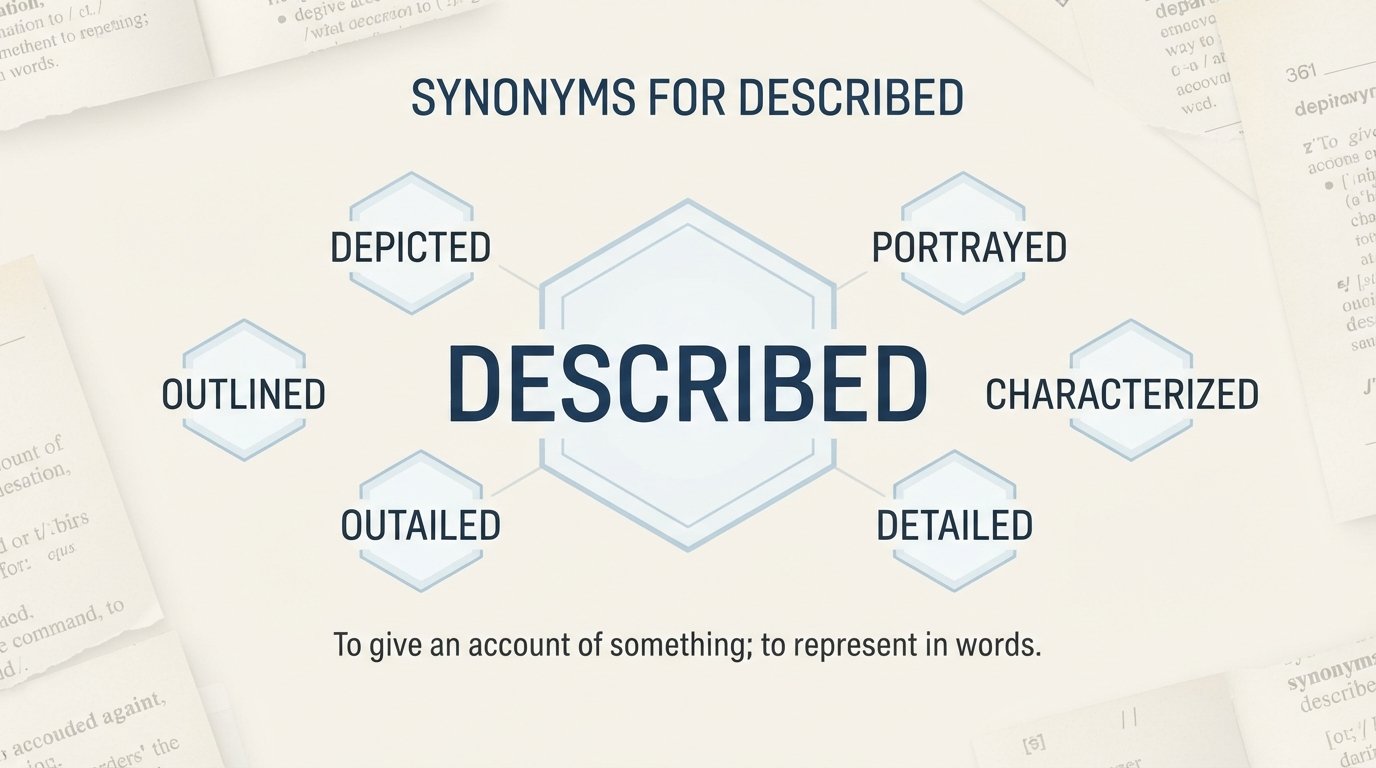
The closest synonyms for described include depicted, portrayed, characterized, illustrated, detailed, outlined, defined, recounted, narrated, and represented. However, they are not always interchangeable. Use depicted for visual representation, characterized for qualities or traits, detailed for specific information, and recounted or narrated for events or stories.
Best Synonyms for Described
| Word | Relationship | Meaning | Best Context | Formality |
|---|---|---|---|---|
| depicted | Direct/near synonym | Represented something in words, images, or another form | Scenes, people, situations, art | Neutral |
| portrayed | Direct/near synonym | Represented someone or something in a particular way | People, characters, situations | Neutral |
| characterized | Near synonym | Described by distinctive qualities or traits | People, periods, conditions | Neutral/Formal |
| illustrated | Near synonym | Made an idea clear through examples or representation | Ideas, concepts, points | Neutral |
| detailed | Contextual alternative | Gave specific information | Processes, events, features | Neutral |
| outlined | Contextual alternative | Presented the main points without full detail | Plans, arguments, procedures | Neutral/Formal |
| defined | Contextual alternative | Stated the meaning or essential nature | Terms, concepts, boundaries | Neutral/Formal |
| recounted | Contextual alternative | Told what happened | Events, experiences, stories | Neutral |
| narrated | Contextual alternative | Told a story or sequence of events | Stories, films, experiences | Neutral/Formal |
| represented | Near synonym | Stood for or presented something in a particular form | Ideas, people, data, concepts | Formal |
| sketched | Contextual alternative | Gave a brief or rough description | Ideas, plans, situations | Neutral |
| summarized | Contextual alternative | Gave the main points briefly | Reports, articles, events | Neutral |
| reported | Contextual alternative | Gave information about something | News, findings, incidents | Neutral/Formal |
| related | Contextual alternative | Told or communicated an account | Experiences, events | Neutral |
| specified | Contextual alternative | Stated something precisely | Requirements, details, conditions | Formal |
Merriam-Webster’s thesaurus similarly groups words such as depicted, portrayed, characterized, illustrated, defined, recounted, summarized, sketched, represented, and narrated under different senses of described.
What Does “Described” Mean?
Described is the past tense and past participle of describe. In its most common sense, it means to give an account or representation of someone or something using words.
For example:
The witness described the suspect as tall and thin.
It can also mean giving a more detailed account:
She described everything that happened during the meeting.
Another use is to identify something by its qualities:
The region was described as one of the country’s most beautiful areas.
The word can therefore cover several related functions, which explains why its best synonym changes according to context.
15+ Useful Alternatives to Described
1. Depicted
Depicted is one of the closest alternatives when something is represented visually or vividly.
- The painting depicted a quiet village.
- The novel depicted life during wartime.
Best choice: visual scenes, people, situations, artwork, or vivid representations.
2. Portrayed
This word emphasizes the way a person, character, situation, or subject is represented.
- The film portrayed the leader as courageous.
- The article portrayed the town as a welcoming community.
Portrayed can suggest a particular interpretation or presentation.
3. Characterized
Use characterized when the description focuses on the qualities or defining features of someone or something.
- The decade was characterized by rapid technological change.
- She was characterized as thoughtful and reliable.
This is especially useful in academic and professional writing.
4. Detailed
Detailed means that specific information was provided.
- The report detailed the company’s financial problems.
- The guide detailed the steps required to complete the process.
Choose it when completeness and specific information matter.
5. Outlined
Outlined means that the main points were presented without necessarily giving every detail.
- The manager outlined the new strategy.
- The report outlined several possible solutions.
Don’t use outlined when you mean an exhaustive description.
6. Defined
Defined works when something is described by explaining its meaning, boundaries, or essential characteristics.
- The policy defined acceptable workplace behavior.
- The term was defined in the introduction.
It is more precise than described in many technical contexts.
7. Illustrated
Illustrated can mean that an idea was made clearer through an example, image, or demonstration.
- The professor illustrated the concept with a simple example.
- The diagram illustrated how the system works.
It is not always a direct substitute for described.
8. Recounted
Use recounted when someone tells what happened, particularly when relating a past experience or event.
- She recounted her experience during the interview.
- The historian recounted the events leading to the conflict.
9. Narrated
Narrated is particularly appropriate for stories and sequences of events.
- The documentary was narrated by a well-known actor.
- He narrated what happened after the accident.
10. Represented
Represented emphasizes presenting something in a particular form.
- The graph represented the changes in population.
- The novel represented rural life realistically.
11. Sketched
Sketched suggests a brief, general, or incomplete description.
- The speaker sketched the history of the organization.
- She sketched a possible plan for the project.
12. Summarized
Use summarized when the original information is condensed into its main points.
- The report summarized the findings.
- He summarized what happened during the meeting.
13. Reported
Reported is useful when information is communicated as an account of an event, finding, or situation.
- The newspaper reported the incident.
- Researchers reported significant improvements.
14. Related
Related can mean told or communicated an account of something.
- He related his experience to the committee.
- She related the story in considerable detail.
15. Specified
Specified is stronger and more precise than described when particular requirements or details are explicitly stated.
- The contract specified the required conditions.
- The instructions specified the maximum weight.
Synonyms for Described by Context
The easiest way to choose the right alternative is to ask what kind of description you are giving.
For a Person
Use:
- characterized
- portrayed
- depicted
- represented
- identified
Example:
The witness described the man as nervous.
Possible alternatives:
The witness characterized the man as nervous.
The article portrayed him as an ambitious entrepreneur.
These alternatives change the emphasis slightly.
For a Scene or Appearance
Use:
- depicted
- portrayed
- pictured
- sketched
- rendered
Example:
The author described the village beautifully.
More specific:
The author depicted the village beautifully.
For an Event
Use:
- recounted
- narrated
- reported
- related
- chronicled
Example:
She described what happened after the accident.
More naturally in a storytelling context:
She recounted what happened after the accident.
For a Process
Use:
- detailed
- outlined
- explained
- specified
- set out
Example:
The manual described how to install the software.
If the manual gives the main steps:
The manual outlined how to install the software.
If it gives extensive information:
The manual detailed how to install the software.
For an Idea or Concept
Use:
- defined
- explained
- illustrated
- outlined
- characterized
For example:
The professor described the theory.
Depending on the intended meaning:
The professor defined the theory.
The professor explained the theory.
The professor illustrated the theory with an example.
These are related but not identical actions.
Which Word Should I Use?
Choose depicted when:
The emphasis is on representation, especially visual or vivid representation.
Choose portrayed when:
You want to emphasize how a person, character, or situation was presented.
Choose characterized when:
You are identifying the qualities or features that define someone or something.
Choose detailed when:
You want to emphasize specific or extensive information.
Choose outlined when:
You are presenting the main points rather than every detail.
Choose defined when:
You are explaining the meaning, nature, or boundaries of something.
Choose illustrated when:
An example, image, or demonstration makes an idea clearer.
Choose recounted when:
Someone is telling about events or a personal experience.
Choose narrated when:
The description takes the form of a story or sequence of events.
Choose summarized when:
The information has been shortened to its essential points.
Described vs. Depicted
Described is broader. It can refer to almost any verbal account.
Depicted focuses more strongly on representation, particularly visual or vivid representation.
Compare:
The journalist described the neighborhood.
This simply means the journalist gave information about it.
The photograph depicted the neighborhood after the storm.
Here, depicted emphasizes representation.
Rule: Use described for general accounts and depicted when representation is central.
Described vs. Portrayed
Portrayed often suggests that someone or something is presented in a particular way.
The biography described the scientist’s career.
The film portrayed the scientist as an unconventional genius.
The second sentence emphasizes the particular image or interpretation presented.
Described vs. Characterized
These words overlap, but characterized is more specific.
The writer described the city.
This could involve appearance, history, atmosphere, or many other details.
The writer characterized the city as energetic and unpredictable.
Here, the focus is on its defining qualities.
Described vs. Detailed
Detailed emphasizes the amount and specificity of information.
The report described the problem.
The report detailed the causes of the problem.
The second sentence tells the reader that the account contains specific information about the causes.
Described vs. Outlined
The distinction is mainly about level of detail.
The manager described the new project.
The manager outlined the new project.
The second sentence suggests a broad presentation of its principal features rather than a full account.
Common Mistakes With Synonyms for Described
1. Treating every thesaurus entry as an exact synonym
Words such as depicted, explained, outlined, and reported can overlap with described, but their meanings are not identical.
2. Using “depicted” in every situation
❌ She depicted what she did yesterday.
✓ She described what she did yesterday.
Depicted is generally more natural when representation or imagery is involved.
3. Using “outlined” for exhaustive detail
❌ The report outlined every minor technical specification.
✓ The report detailed every minor technical specification.
Outlined normally suggests the principal points.
4. Confusing “described” with “explained”
You can describe what something is like without explaining why it works.
She described the machine’s appearance.
She explained how the machine operates.
5. Changing a word when “described” is already best
Synonyms are not automatically better. If described communicates the intended meaning clearly and naturally, there is no reason to replace it simply to avoid repetition.
Common Collocations With Described
Some natural patterns include:
- described as
- described in detail
- described accurately
- described clearly
- described briefly
- described vividly
- described the situation
- described the event
- described the process
- described the person
- described the experience
- described the scene
The phrase “described as” deserves special attention because it often means that someone or something was characterized as having a particular quality or identity:
The city was described as one of the safest in the region.
Depending on the context, alternatives include characterized as, portrayed as, identified as, labeled as, or referred to as. These are not interchangeable in every sentence.
Antonyms of Described
There is no single perfect antonym for every sense of described. Depending on the context, contrasting ideas include:
- concealed
- hidden
- obscured
- withheld
- misrepresented
- distorted
- suppressed
For example:
The report described the problem clearly.
The contrasting idea could be:
The report concealed the problem.
Misrepresented and distorted are particularly useful when information is presented inaccurately rather than simply omitted.
Frequently Asked Questions
What is the closest synonym for described?
There is no single synonym that works in every context. Depicted, portrayed, characterized, and represented are among the closest alternatives, while detailed, outlined, recounted, and summarized become better choices in specific situations.
What is another word for described in detail?
Good alternatives include detailed, elaborated on, specified, and explained, depending on the sentence. Detailed is usually the most direct choice when emphasizing extensive or specific information.
What is another word for described a person?
Depending on the intended meaning, use characterized, portrayed, depicted, represented, or identified. Characterized is particularly useful when focusing on a person’s qualities or traits.
What is another word for described an event?
Useful alternatives include recounted, narrated, reported, related, and chronicled. Recounted is natural for personal experiences, while reported works well for factual or journalistic accounts.
Is “depicted” a synonym for “described”?
Yes, in some contexts. Depicted means represented or presented, often visually or vividly. It can substitute for described when the focus is on representation, but it is not appropriate for every general verbal description.
Is “portrayed” the same as “described”?
They overlap but are not identical. Described is broader, whereas portrayed often emphasizes the particular way a person, character, or situation is presented.
What is a formal synonym for described?
Depending on context, formal alternatives include characterized, delineated, defined, specified, represented, and outlined. The correct choice depends on what kind of description is being given.
What is the difference between described and explained?
Described tells the reader what something is like or what happened. Explained focuses on making something understandable, often by giving reasons, causes, or processes.
Conclusion
The best synonym for described depends on the purpose of the description. Use depicted for representation, portrayed for presentation from a particular perspective, characterized for defining qualities, detailed for extensive information, outlined for main points, and recounted for past events. The key is not to find the most complicated replacement—it is to choose the word that expresses the exact meaning you intend.
Merriam-Webster’s current thesaurus supports this context-dependent approach by separating several senses of described and associating different alternatives with each sense.

Daniel Carter is a professional content strategist and language enthusiast. He focuses on semantic SEO, keyword research, and creating structured vocabulary content that ranks well on search engines while remaining user-friendly.