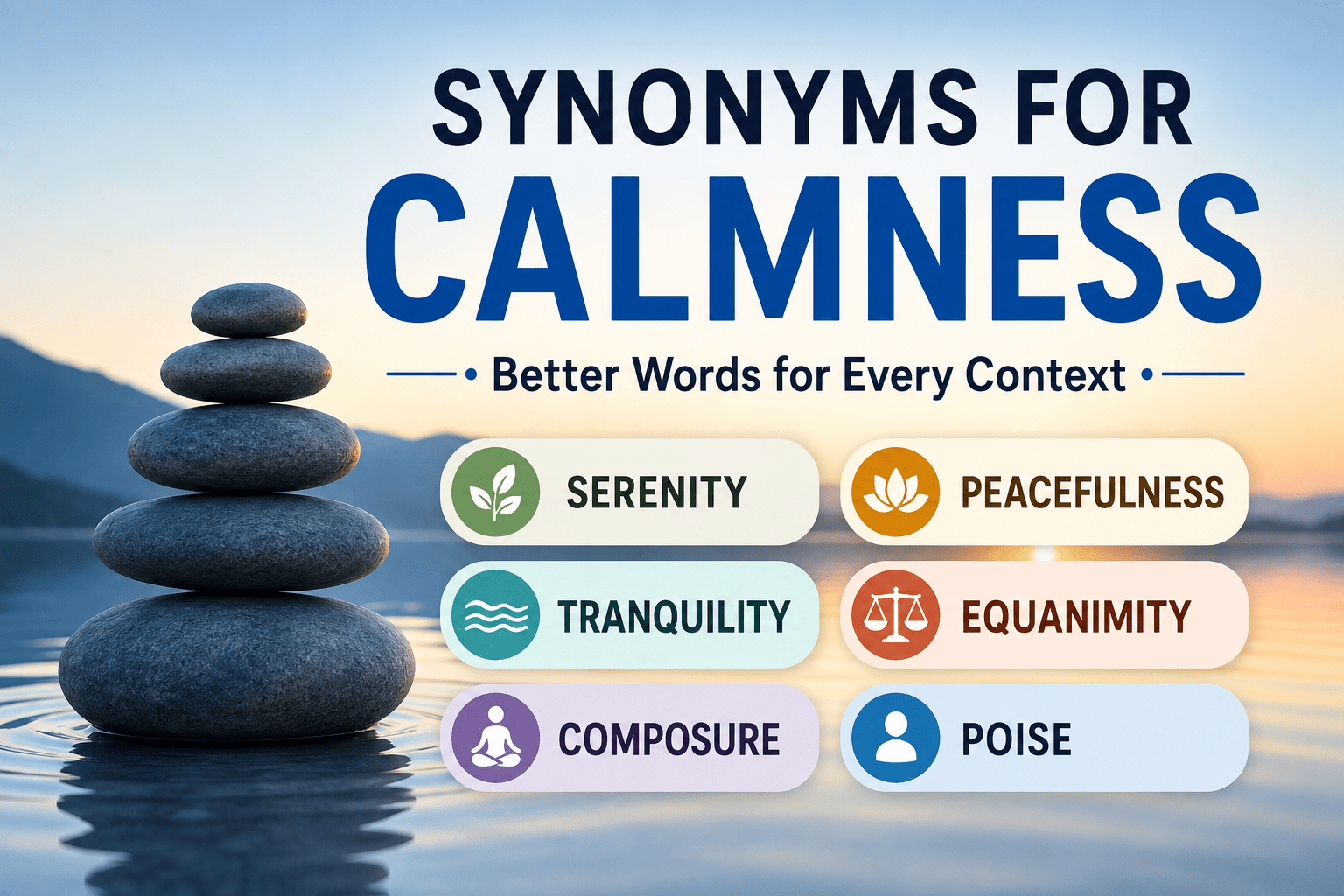
Looking for the right synonym for calmness depends on what kind of calm you mean. Serenity suggests deep inner peace, tranquility often describes a peaceful environment or state, while composure refers more specifically to emotional control, especially in difficult situations. Other alternatives such as equanimity, poise, peacefulness, placidity, quietude, and repose add their own shades of meaning.
This guide separates close synonyms from contextual alternatives so you can choose a word that sounds natural rather than simply replacing calmness with the nearest thesaurus entry.
Quick Answer
The closest synonyms for calmness include serenity, tranquility, peacefulness, composure, equanimity, poise, placidity, quietude, stillness, and repose. The best choice depends on context: use composure for emotional self-control, serenity for inner peace, tranquility for peaceful surroundings, and equanimity for remaining calm under pressure.
What Does “Calmness” Mean?
Calmness is the quality or state of being calm. It can refer to freedom from disturbance, peacefulness, or a controlled emotional state. Merriam-Webster defines it broadly as “the quality or state of being calm,” while its thesaurus separates related uses involving restfulness, composure, and peacefulness.
Part of speech: noun
Two important senses of calmness
1. Peaceful or undisturbed condition
The calmness of the lake made the morning feel almost unreal.
Here, calmness refers to an absence of movement, noise, or disturbance.
2. Emotional self-control
Her calmness during the emergency reassured everyone.
Here, the word describes someone’s ability to remain emotionally controlled.
This distinction matters because serenity may be ideal for inner peace, whereas composure is usually better when describing controlled behavior during a difficult situation.
The Best Synonyms for Calmness
| Word | Relationship | Main Meaning | Strength | Best Context |
|---|---|---|---|---|
| Serenity | Near synonym | Deep peacefulness | Strong | Inner peace, atmosphere |
| Tranquility | Near synonym | Peaceful, undisturbed state | Strong | Places, situations, mind |
| Peacefulness | Direct/near synonym | Freedom from disturbance | Moderate | General calm |
| Composure | Contextual alternative | Emotional self-control | Strong | Stressful situations |
| Equanimity | Near synonym | Even-tempered calm | Strong | Pressure, adversity |
| Poise | Contextual alternative | Controlled confidence | Strong | People, behavior |
| Placidity | Near synonym | Gentle, undisturbed calm | Moderate | Temperament, surroundings |
| Quietude | Contextual alternative | Quiet and stillness | Moderate | Literary, peaceful settings |
| Stillness | Contextual alternative | Lack of movement or sound | Moderate | Nature, places |
| Repose | Contextual alternative | Restful tranquility | Moderate | Literary, restful settings |
| Coolness | Contextual alternative | Calm under pressure | Strong | Difficult situations |
| Self-possession | Contextual alternative | Control over one’s emotions | Strong | Formal/professional writing |
Major dictionaries support many of these relationships, while also distinguishing between calmness as peacefulness and calmness as composure.
Closest Synonyms for Calmness
1. Serenity
Meaning: A deep state of peacefulness and inner calm.
How it differs: Serenity often has a more profound, positive, or contemplative quality than ordinary calmness.
Best used for: Inner states, peaceful surroundings, reflective writing.
Example:
She felt a profound sense of serenity while walking through the quiet garden.
Register: Neutral to literary.
2. Tranquility
Meaning: A peaceful state free from noise, disturbance, or agitation.
How it differs: Tranquility is especially natural when describing places, environments, or an undisturbed mental state.
Example:
The remote village offered a welcome sense of tranquility.
Register: Neutral to formal.
Tranquility is a well-established synonym of calmness in major thesaurus sources.
3. Peacefulness
Meaning: A state characterized by peace and an absence of disturbance.
How it differs: This is one of the safest general alternatives to calmness, particularly when describing an environment or atmosphere.
Example:
The peacefulness of the countryside was exactly what she needed.
Register: Neutral.
4. Composure
Meaning: The ability to remain calm and controlled, especially in a stressful situation.
How it differs: Unlike calmness, composure strongly emphasizes emotional self-control.
Example:
He maintained his composure despite the unexpected criticism.
Best context: People under pressure, workplace situations, emergencies, public speaking.
Register: Neutral to formal.
5. Equanimity
Meaning: Mental balance and an even-tempered response, especially when facing difficulty.
How it differs: Equanimity is more formal and often suggests calm acceptance of adversity.
Example:
She accepted the disappointing result with remarkable equanimity.
Register: Formal.
6. Poise
Meaning: Calm confidence and controlled behavior.
How it differs: Poise adds an element of confidence, dignity, or social control that calmness does not necessarily imply.
Example:
The candidate answered the difficult questions with impressive poise.
Register: Neutral to formal.
7. Placidity
Meaning: A peaceful, gentle, or undisturbed quality.
How it differs: Placidity often describes a temperament, appearance, or environment that is naturally quiet and untroubled.
Example:
The placidity of the lake contrasted sharply with the stormy sky.
Register: Formal/literary.
8. Quietude
Meaning: A state of quietness and peaceful stillness.
How it differs: Quietude is more literary than everyday calmness and often evokes a secluded or reflective atmosphere.
Example:
He went to the countryside to enjoy a few days of quietude.
Register: Literary/formal.
Calmness by Context
For a person under pressure
Use:
- composure
- equanimity
- poise
- self-possession
- coolness
Best general choice: composure
She maintained her composure during the difficult interview.
For inner peace
Use:
- serenity
- peacefulness
- tranquility
- equanimity
Best choice when emphasizing deep inner peace: serenity
Meditation gave him a greater sense of serenity.
For a peaceful place
Use:
- tranquility
- peacefulness
- quietude
- stillness
- repose
The garden was filled with an atmosphere of tranquility.
For a quiet natural environment
Use:
- stillness
- tranquility
- quietude
- placidity
The stillness of the forest was broken only by birdsong.
Which Word Should I Use?
Use serenity when:
You want to emphasize deep, peaceful calm.
Use tranquility when:
You want to describe a peaceful environment or undisturbed state.
Use composure when:
Someone remains emotionally controlled during pressure.
Use equanimity when:
Someone accepts difficulty or adversity without becoming emotionally disturbed.
Use poise when:
Calmness is combined with confidence and controlled behavior.
Use peacefulness when:
You need a straightforward, general word for a peaceful state.
Use stillness when:
The emphasis is specifically on the absence of movement or sound.
Use quietude when:
You want a more literary word for peaceful quiet.
Calmness vs. Serenity
These words overlap, but they are not identical.
| Calmness | Serenity |
|---|---|
| Broad term | More specific |
| Can mean emotional control | Usually suggests deep peace |
| Works in stressful situations | Often suggests an undisturbed inner state |
| Neutral | More positive or contemplative |
Calmness: She showed remarkable calmness during the crisis.
Serenity: The meditation room gave her a feeling of serenity.
Calmness vs. Composure
Calmness is broader. Composure specifically concerns maintaining emotional control.
His calmness made the room feel peaceful.
His composure impressed everyone during the interrogation.
A person can have composure without necessarily creating a peaceful atmosphere.
Calmness vs. Tranquility
Tranquility is particularly natural for peaceful surroundings and states free from disturbance.
We enjoyed the calmness of the evening.
We enjoyed the tranquility of the countryside.
The second sentence gives a stronger impression of a peaceful environment.
Calmness vs. Equanimity
Equanimity is more formal and emphasizes an even emotional response to difficult circumstances.
She handled the criticism with calmness.
She handled the criticism with equanimity.
The second version more strongly suggests emotional balance and acceptance.
Natural Collocations
Some alternatives work better with particular nouns.
| Phrase | Natural Alternative |
|---|---|
| calmness under pressure | composure / equanimity |
| calmness of the lake | stillness / placidity |
| calmness of the countryside | tranquility / peacefulness |
| calmness of mind | serenity / equanimity |
| calmness during a crisis | composure / self-possession |
| calmness and peace | serenity / tranquility |
| calmness of the atmosphere | peacefulness / tranquility |
| calmness in behavior | poise / composure |
This phrase-level distinction is important because a theoretically related synonym may still sound unnatural in a particular collocation.
Formal Synonyms for Calmness
For academic, professional, or formal writing, consider:
- composure
- equanimity
- self-possession
- serenity
- tranquility
- poise
- placidity
- imperturbability
For example:
The manager demonstrated remarkable composure during the negotiations.
is generally more natural in professional writing than:
The manager demonstrated remarkable quietude during the negotiations.
Common Mistakes
1. Treating every synonym as interchangeable
Serenity, composure, and stillness overlap with calmness, but they describe different aspects of it.
2. Using “poise” when confidence is not involved
Poise commonly suggests controlled, confident behavior, not simply an absence of emotional disturbance.
3. Using “stillness” for emotional control
❌ He showed stillness during the heated argument.
✅ He showed composure during the heated argument.
Stillness generally describes physical movement, sound, or an atmosphere.
4. Using “peace” as an exact replacement everywhere
Peace overlaps with calmness, but it can refer to broader ideas such as harmony, absence of conflict, or a state between opposing groups. It is therefore better treated as a broader contextual alternative rather than a universal replacement.
5. Confusing calmness with indifference
Words such as impassivity or indifference can imply a lack of emotional response. That is not necessarily the positive, controlled calmness expressed by composure or equanimity.
Antonyms of Calmness
The appropriate opposite depends on the context.
Emotional opposites
- agitation
- anxiety
- nervousness
- discomposure
- panic
- distress
Environmental opposites
- turbulence
- commotion
- disturbance
- turmoil
- unrest
- chaos
Merriam-Webster lists words such as agitation, anxiety, uneasiness, and discomposure among antonyms or near-antonyms of calmness.
FAQ
What is the closest synonym for calmness?
There is no single perfect replacement because calmness has several senses. Peacefulness is a strong general alternative, while serenity works especially well for inner peace and composure for emotional control.
What is a strong word for calmness?
Serenity, tranquility, equanimity, and composure are strong choices, depending on context. Equanimity is particularly effective when describing calmness during adversity.
What is a formal synonym for calmness?
Formal alternatives include equanimity, composure, self-possession, imperturbability, and placidity. The most natural choice depends on the sentence.
What is another word for calmness under pressure?
Composure, equanimity, poise, self-possession, and coolness can describe calmness under pressure. Composure is probably the most broadly useful choice.
What is the difference between serenity and calmness?
Calmness is a broad term for a peaceful or controlled state. Serenity usually suggests a deeper, more settled sense of inner peace.
What is the difference between tranquility and calmness?
Tranquility emphasizes peace and freedom from disturbance, especially in places or surroundings. Calmness can also describe a person’s emotional state.
What is the best synonym for calmness in professional writing?
Composure is usually the most natural choice when describing a professional’s behavior under pressure. Equanimity works well when the writing is more formal.
Conclusion
The best synonym for calmness depends on the kind of calm you want to express. Use peacefulness for a general peaceful state, serenity for deep inner peace, tranquility for peaceful surroundings, composure for emotional control, equanimity for calm acceptance under pressure, and poise for calm confidence.
The key is not to choose the most sophisticated-looking word. Choose the word that expresses the specific kind of calmness your sentence actually means.

Sarah Williams is an ESL teacher and content writer with a passion for simplifying English vocabulary. She creates easy-to-understand synonym guides and learning resources that help beginners and intermediate learners build strong language skills.