Looking for the right synonym for inquiry can be surprisingly tricky because inquiry has more than one important meaning. It can refer to a question or request for information, as in “We received an inquiry about pricing,” or to a systematic investigation, as in “The committee launched an inquiry into the incident.” Cambridge and Merriam-Webster both distinguish these uses.
That means the best alternative depends on what you actually mean. Question and query usually work when someone wants information, while investigation, examination, or probe are more appropriate when people are trying to discover facts. This guide separates the strongest alternatives by meaning, tone, and context so you can choose a word that sounds natural rather than simply replacing inquiry with the first thesaurus entry you find.
Quick Answer: What Are the Best Synonyms for Inquiry?
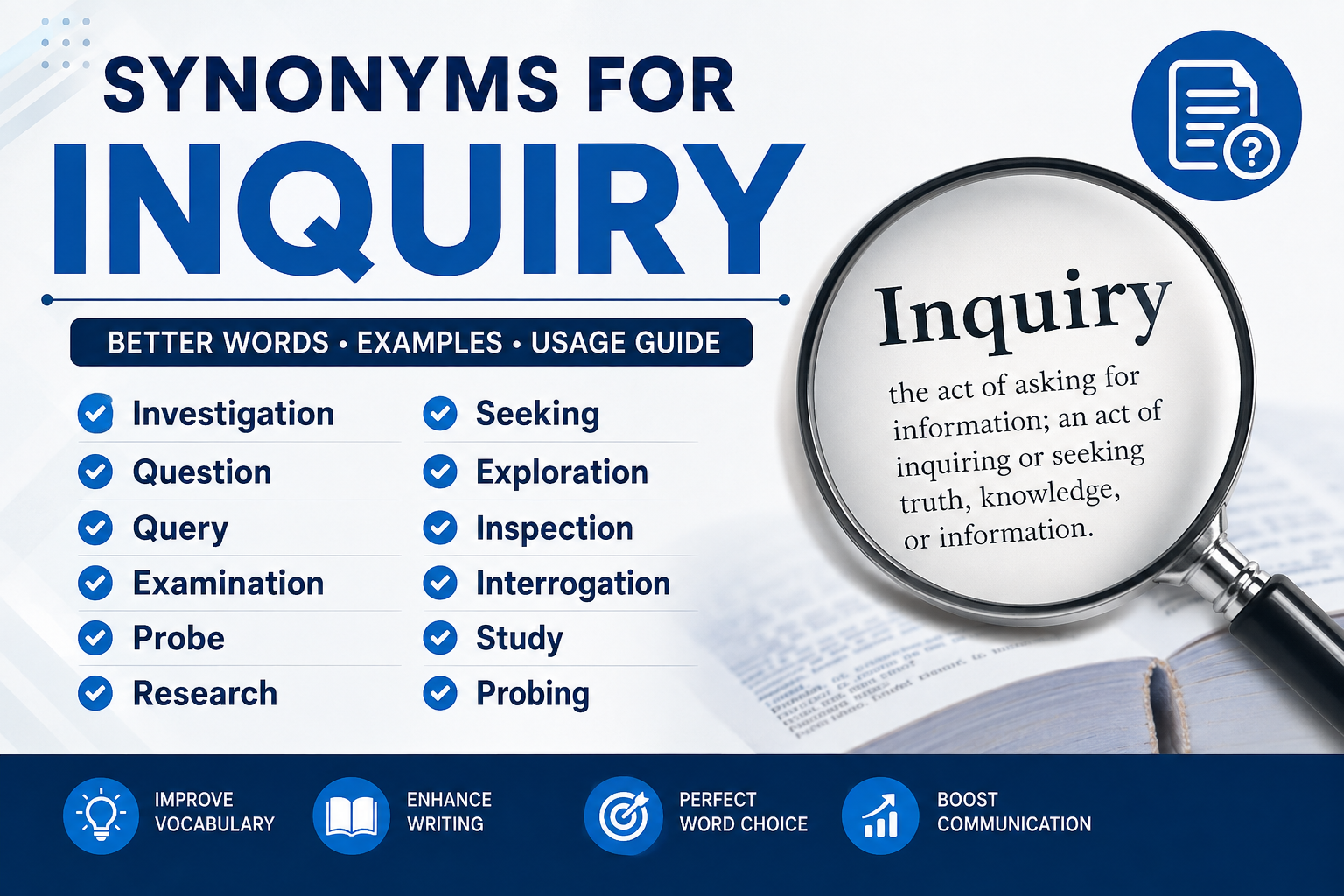
The closest synonyms for inquiry depend on its sense. For a request for information, the best alternatives include question, query, request for information, and questioning. For an investigation, strong alternatives include investigation, examination, probe, scrutiny, research, study, and exploration. Inquest is more specialized and usually refers to an official investigation, especially into a death.
Core Synonyms for Inquiry
| Word | Relationship | Meaning | Strength | Formality | Best Context |
|---|---|---|---|---|---|
| Question | Direct synonym in one sense | Something asked to obtain information | Neutral | Neutral | Everyday questions, information requests |
| Query | Near/direct synonym | A question or request for information | Neutral | Neutral–formal | Business, customer service, writing |
| Investigation | Direct synonym in investigative sense | Systematic effort to discover facts | Strong | Neutral–formal | Police, legal, organizational matters |
| Examination | Near synonym | Careful consideration or investigation | Moderate–strong | Formal | Evidence, procedures, subjects |
| Probe | Contextual synonym | A focused or searching investigation | Strong | Neutral–formal | Controversies, journalism, official investigations |
| Scrutiny | Contextual synonym | Very close and critical examination | Strong | Formal | Decisions, conduct, documents |
| Research | Contextual synonym | Systematic study to discover knowledge | Strong | Neutral–formal | Academic and scientific work |
| Study | Near synonym | Detailed investigation or consideration | Moderate | Neutral | Academic, professional, general contexts |
| Exploration | Contextual synonym | Investigation intended to discover or understand something | Moderate | Neutral | Ideas, subjects, possibilities |
| Inspection | Contextual synonym | Careful examination, often for condition or compliance | Moderate | Formal | Buildings, equipment, records |
| Survey | Contextual synonym | Systematic collection or examination of information | Moderate | Neutral–formal | Research, public opinion, markets |
| Inquest | Specialized synonym | Official investigation, especially into a death | Strong | Formal | Legal and official contexts |
| Interrogation | Contextual synonym | Intensive questioning to obtain information | Strong | Formal | Police, military, criminal contexts |
| Questioning | Near synonym | The act or process of asking questions | Moderate | Neutral | Interviews, investigations, discussions |
| Search | Contextual alternative | An attempt to find information, facts, or answers | Moderate | Neutral | General research and investigation |
Merriam-Webster lists investigation, examination, exploration, study, probe, and research among the principal synonyms associated with the investigative sense of inquiry, while Cambridge similarly groups investigation, examination, questioning, probe, study, research, and related terms.
What Does “Inquiry” Mean?
Inquiry is a noun with two major uses.
1. Inquiry as a question or request for information
In this sense, an inquiry is an act of asking for information.
- “I sent an inquiry about the course fees.”
- “The company received several inquiries about its new service.”
- “She made an inquiry about the delivery date.”
Here, question, query, or request for information may be suitable alternatives. Cambridge specifically gives inquiry the sense of asking for information and uses examples involving inquiries about prices and services.
2. Inquiry as an investigation
An inquiry can also mean an organized effort to discover facts, determine what happened, or establish the truth.
- “The government ordered an inquiry into the accident.”
- “The board conducted an inquiry into the allegations.”
- “The inquiry found evidence of serious misconduct.”
In this sense, investigation, examination, probe, scrutiny, or inquest may be more precise depending on the situation.
The Best Synonyms for Inquiry by Context
1. Question
Use question when inquiry means something asked to obtain information.
Example:
“I have a question about the application process.”
This is usually more natural in everyday English than inquiry.
Compare:
“I have an inquiry about the application process.”
This is grammatical, but it sounds more formal or businesslike.
Best for: everyday conversation, interviews, classroom discussions, information requests.
2. Query
Query is one of the closest alternatives when inquiry means a request for information.
Example:
“The support team responded to my query within a few hours.”
It is especially common in business, customer service, technical communication, and formal writing.
Choose “query” when: you want a concise, professional term for a question or request for information.
3. Investigation
Investigation is the strongest general alternative when inquiry means a systematic effort to discover facts.
Example:
“The company launched an investigation into the complaint.”
The word often suggests a more deliberate and organized process than a simple inquiry.
Best for: police work, workplace issues, legal matters, financial misconduct, and official investigations.
4. Examination
Examination emphasizes careful consideration or inspection.
Example:
“A detailed examination of the records revealed several inconsistencies.”
It can overlap with inquiry, but it is not interchangeable in every context.
Best for: evidence, documents, procedures, records, academic subjects, and technical matters.
5. Probe
Probe describes a focused or searching investigation.
Example:
“The newspaper conducted a probe into the allegations.”
It often has a more investigative or probing tone than the neutral inquiry.
Best for: scandals, controversies, journalism, corporate misconduct, and official investigations.
6. Scrutiny
Scrutiny emphasizes close and critical examination rather than simply looking for information.
Example:
“The proposal came under intense scrutiny.”
It is therefore not a universal synonym for inquiry. It works particularly well when something is being examined carefully or critically.
Best for: decisions, policies, financial records, behavior, proposals, and public actions.
7. Research
Research refers to systematic study intended to establish facts, develop knowledge, or understand a subject.
Example:
“The researchers conducted an inquiry into the causes of the disease.”
Possible replacement:
“The researchers conducted research into the causes of the disease.”
The two overlap, but research generally points more strongly toward organized knowledge-gathering, especially in academic and scientific settings.
8. Study
Study is a broad and flexible word for detailed investigation or consideration.
Example:
“The committee commissioned a study of housing conditions.”
It is often less formal or institutionally charged than inquiry.
Best for: academic research, reports, social issues, policies, markets, and general investigation.
9. Exploration
Exploration emphasizes discovering or investigating something that is not yet fully understood.
Example:
“The paper offers an exploration of the relationship between language and identity.”
It works particularly well for ideas, subjects, possibilities, and intellectual investigation.
10. Inspection
Inspection means careful examination, usually to check condition, quality, compliance, or correctness.
Example:
“The building passed its safety inspection.”
It is therefore a contextual alternative, not a universal synonym.
Use inspection for buildings, machinery, documents, facilities, procedures, and other things that can be checked systematically.
11. Survey
A survey is a systematic collection or examination of information.
Example:
“The organization conducted a survey of customer satisfaction.”
It can overlap with inquiry in research contexts, but a survey usually involves a particular method of gathering information.
12. Inquest
Inquest is a specialized term for an official investigation, especially one concerned with determining the circumstances or cause of a death.
Example:
“The coroner opened an inquest into the man’s death.”
It should not normally replace inquiry in ordinary requests for information.
13. Interrogation
Interrogation involves intensive or formal questioning, particularly when trying to obtain information from a person.
Example:
“The suspect was taken in for interrogation.”
It has a much stronger and more confrontational implication than inquiry.
Which Word Should I Use?
A simple rule can make the choice much easier:
Choose “question” when:
You simply want to ask something.
“I have a question about the assignment.”
Choose “query” when:
You want a professional term for a request for information.
“Please contact us if you have any queries.”
Choose “investigation” when:
You are systematically trying to establish facts.
“An investigation into the incident is underway.”
Choose “probe” when:
The investigation is especially searching, focused, or investigative.
“The newspaper launched a probe into the allegations.”
Choose “scrutiny” when:
The emphasis is on close or critical examination.
“The decision faced intense scrutiny.”
Choose “research” when:
The goal is to develop knowledge or establish information systematically.
“Her research examines language acquisition.”
Choose “inspection” when:
You are checking something carefully for condition, quality, or compliance.
“The equipment underwent a safety inspection.”
Choose “inquest” when:
You mean an official investigation, particularly concerning a death.
“The inquest examined the circumstances surrounding the death.”
Inquiry vs. Question
These words overlap, but they are not identical in every context.
| Inquiry | Question |
|---|---|
| Often more formal | Usually more everyday |
| Can mean an investigation | Usually something asked |
| Common in business and official contexts | Common in conversation and education |
| “We received an inquiry about pricing.” | “I have a question about pricing.” |
| “The committee opened an inquiry.” | This meaning does not normally work |
Bottom line: Use question for an ordinary request for information; use inquiry when you want a more formal expression or when you mean an organized investigation.
Inquiry vs. Query
Query is one of the closest alternatives to inquiry when both refer to a request for information.
“We received an inquiry about the product.”
“We received a query about the product.”
Both work, especially in professional communication.
However, query is also widely used in computing and databases, where it has a specialized technical meaning. Inquiry does not normally carry that technical sense.
Best choice: Use query for concise professional or technical questions; use inquiry when you want a broader, more formal term.
Inquiry vs. Investigation
This distinction is especially important.
An inquiry can be an investigation, but it can also simply be a request for information.
An investigation specifically emphasizes the process of examining facts to discover what happened or determine the truth.
Compare:
“I sent an inquiry about the price.”
You could not naturally replace inquiry with investigation here.
But:
“The committee launched an inquiry into the allegations.”
can often become:
“The committee launched an investigation into the allegations.”
Merriam-Webster defines inquiry in one sense as a systematic investigation and lists investigation among its principal synonyms.
Inquiry vs. Examination
Examination focuses on carefully looking at or considering something.
Inquiry is broader and can refer either to asking for information or investigating a matter.
Compare:
“The committee conducted an inquiry into the incident.”
“The committee conducted an examination of the evidence.”
The first emphasizes the broader investigative process; the second emphasizes careful consideration of the evidence.
Common Mistakes With Inquiry Synonyms
Mistake 1: Treating every related word as a perfect synonym
Words such as audit, questionnaire, survey, inspection, interrogation, and inquest can be associated with inquiry, but they have specialized meanings.
For example, a questionnaire is a set of questions used to collect information. It is not simply another word for every kind of inquiry.
Mistake 2: Using “investigation” for a simple question
“I sent an investigation about the price.”
This is incorrect in normal usage.
Better:
“I sent an inquiry about the price.”
or:
“I sent a query about the price.”
Mistake 3: Using “interrogation” as a polite alternative
Interrogation implies intensive questioning and can sound confrontational.
Instead of:
“I have an interrogation about your services.”
use:
“I have an inquiry about your services.”
Mistake 4: Assuming “scrutiny” always means inquiry
Scrutiny means close examination, often with a critical element.
“The proposal came under scrutiny.”
It does not simply mean “question.”
Mistake 5: Confusing “inquiry” with “inquisition”
Inquisition has a much more specialized historical and modern sense and can carry negative or intimidating associations. It should not normally be used as a casual replacement for inquiry.
Formal and Professional Alternatives to Inquiry
If you are writing a business email, report, or professional document, these choices can work particularly well:
- Query — for a request for information
- Request for information — very explicit and professional
- Investigation — for systematic fact-finding
- Examination — for careful analysis
- Review — when evaluating something
- Probe — for a focused investigation
- Scrutiny — for close or critical examination
For example:
“Thank you for your inquiry.”
could become:
“Thank you for your query.”
or, when appropriate:
“Thank you for your request for information.”
The best option depends on the exact situation rather than on formality alone.
Synonyms for “Inquiry” in Different Contexts
Inquiry about a product or service
Best choices:
query, question, request for information
“We received several customer queries about the new service.”
Inquiry into misconduct
Best choices:
investigation, probe, examination
“The company ordered an investigation into the allegations.”
Scientific inquiry
Best choices:
research, study, investigation, exploration
“Scientific inquiry depends on systematic observation and testing.”
Official inquiry
Best choices:
investigation, examination, inquest, probe
“The government established an official inquiry into the incident.”
Customer inquiry
Best choices:
query, question, request
“Our team responds to customer queries within one business day.”
Academic inquiry
Best choices:
research, investigation, study, exploration
“The course encourages independent inquiry and critical thinking.”
Related Words That Are Not Always Exact Synonyms
Some vocabulary is closely connected to inquiry without being interchangeable in every sentence.
- Questionnaire — a structured set of questions
- Audit — a systematic examination, often of accounts or compliance
- Review — an evaluation or reconsideration
- Assessment — an evaluation of quality, performance, or value
- Interview — a structured conversation used to obtain information
- Hearing — a formal proceeding in which evidence or arguments may be presented
- Poll — a method of collecting opinions or votes
- Analysis — detailed examination of something by breaking it into parts
These are better treated as related or contextual terms, rather than universal synonyms for inquiry.
Antonyms of Inquiry
There is no single perfect antonym for every sense of inquiry. The opposite depends on the idea being contrasted.
For the search for information or knowledge, possible contrasts include:
- ignorance
- unawareness
- disinterest
For an investigative process, a contrasting concept might be:
- neglect
- disregard
- assumption
These are contextual opposites rather than strict dictionary antonyms.
FAQ: Synonyms for Inquiry
What is the closest synonym for inquiry?
There is no single best synonym because inquiry has two major senses. Question or query is closest when it means a request for information, while investigation is usually closest when it means systematic fact-finding.
What is a formal synonym for inquiry?
For a request for information, query or request for information can work well. For an official investigation, investigation, examination, probe, or inquest may be appropriate depending on the context.
Is “query” a synonym for “inquiry”?
Yes, when both mean a question or request for information. For example, “a customer inquiry” and “a customer query” can often refer to the same thing. Query also has specialized meanings in computing, so it is not interchangeable with inquiry in every context.
Is “investigation” the same as “inquiry”?
Not always. Inquiry can mean either a request for information or an investigation. Investigation specifically emphasizes systematic examination to discover facts or establish what happened.
What is another word for a customer inquiry?
Good choices include customer query, customer question, request for information, and customer request. In business English, query is particularly natural.
What is another word for an official inquiry?
Depending on the situation, use investigation, official investigation, examination, probe, or inquest. Inquest is more specialized and is especially associated with official investigations into deaths.
What is a synonym for “inquiry into”?
The best alternatives include investigation into, examination of, probe into, scrutiny of, and research into, depending on what is being investigated. For example, “an inquiry into corruption” can naturally become “an investigation into corruption.”
Is “question” always a synonym for “inquiry”?
No. Question works when inquiry means a request for information, but it does not normally replace inquiry when the latter means a formal or systematic investigation.
Conclusion
The best synonym for inquiry depends on what you mean.
If you mean a request for information, choose question, query, or request for information. If you mean a systematic investigation, choose investigation, examination, probe, scrutiny, research, or another context-specific alternative.
The most important distinction is this: inquiry is broader than many of its synonyms. Instead of replacing it mechanically, identify whether you are asking for information, examining evidence, conducting research, or carrying out an official investigation. Once you identify the intended sense, choosing the natural alternative becomes much easier.

Daniel Carter is a professional content strategist and language enthusiast. He focuses on semantic SEO, keyword research, and creating structured vocabulary content that ranks well on search engines while remaining user-friendly.