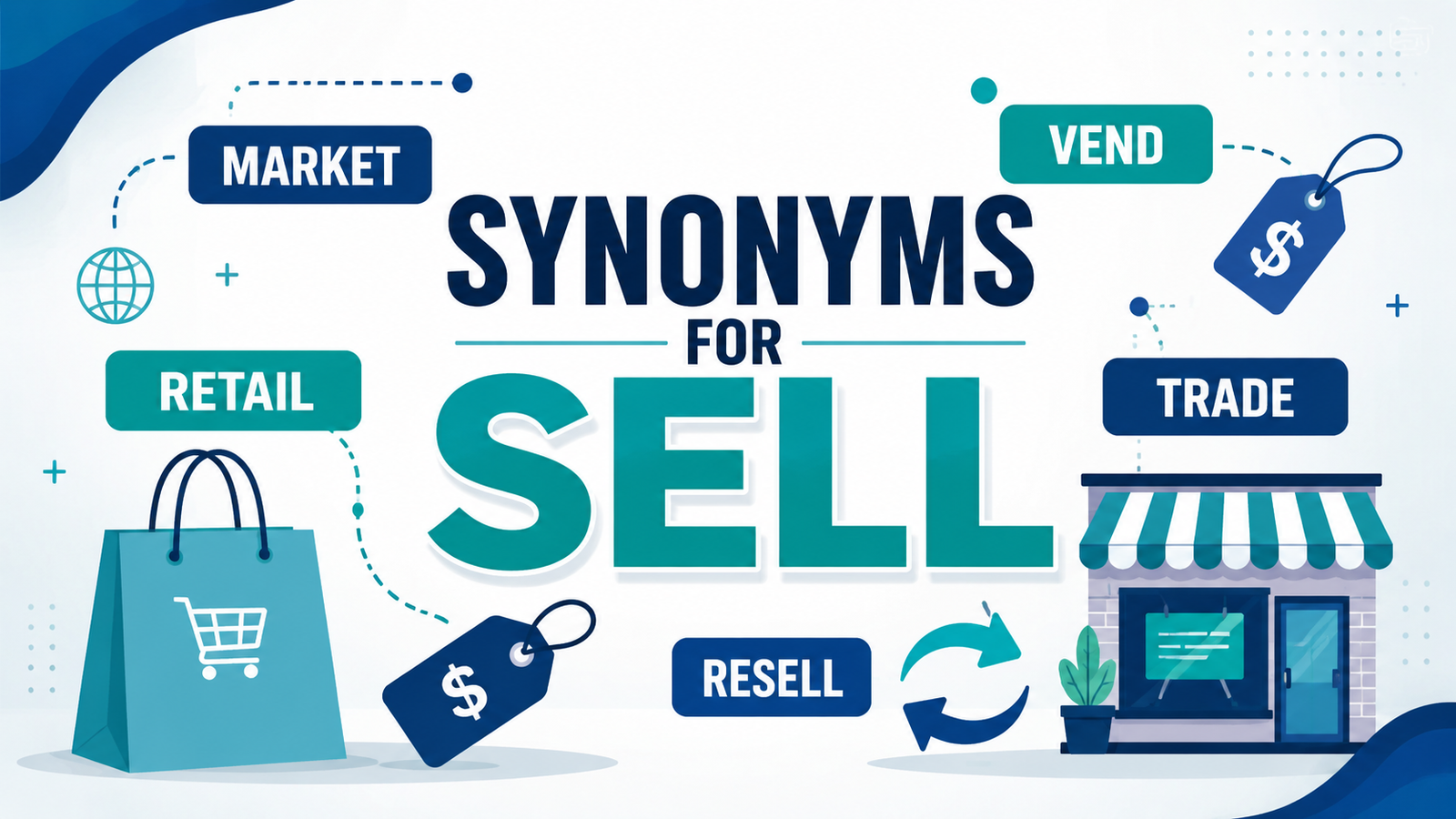
Finding the right synonym for sell is not always as simple as replacing it with another word meaning “exchange something for money.” Sell has several meanings, and the best alternative changes with the context. For example, retail works well for selling goods directly to customers, vend emphasizes offering goods for sale, market focuses on promoting or positioning something for buyers, and peddle can suggest persistent or low-status selling.
This guide separates genuine synonyms from near-synonyms and context-specific alternatives so you can choose the word that sounds natural rather than simply picking the longest thesaurus list.
Quick Answer: What Are the Best Synonyms for Sell?
The closest and most useful synonyms for sell include market, retail, vend, trade, deal in, merchandise, distribute, exchange, and resell. However, they are not interchangeable in every sentence. Use retail for selling directly to consumers, market when emphasizing promotion or commercial positioning, vend for formally offering goods for sale, and deal in when describing a business that regularly handles a particular type of product. Merriam-Webster and Cambridge both identify several of these as context-dependent alternatives.
Core Synonyms for Sell
| Word | Relationship | Meaning | Strength / Tone | Best Context |
|---|---|---|---|---|
| market | Near synonym | Offer and promote something for sale | Neutral/professional | Products, services, brands |
| retail | Contextual synonym | Sell directly to consumers | Neutral/professional | Shops, consumer goods |
| vend | Near synonym | Offer goods for sale | Formal/less common | Goods, machines, products |
| trade | Near synonym | Exchange goods or services | Neutral | Commerce, goods, commodities |
| deal in | Contextual alternative | Regularly buy, sell, or handle a type of product | Neutral | Businesses and specialized goods |
| merchandise | Contextual synonym | Promote or arrange goods for sale | Business-oriented | Retail and product presentation |
| distribute | Near synonym | Supply goods across customers, stores, or markets | Neutral/professional | Supply chains |
| resell | Direct/contextual | Sell something previously purchased | Neutral | Products, tickets, property |
| peddle | Contextual synonym | Sell, often by going from place to place | Often disapproving | Street or persistent selling |
| hawk | Contextual synonym | Try aggressively to sell something | Often negative | Street selling, aggressive sales |
| wholesale | Contextual alternative | Sell goods in bulk, usually to businesses | Professional | Commercial distribution |
| export | Contextual alternative | Sell or send goods to another country | Neutral | International commerce |
| auction | Contextual alternative | Sell to the highest bidder | Neutral | Art, property, collectibles |
| sell off | Phrasal alternative | Sell something, often quickly or because it is no longer wanted | Neutral to negative | Assets, stock, businesses |
| promote | Related/contextual | Encourage interest or demand | Neutral/professional | Products, services, campaigns |
| advertise | Related/contextual | Publicize something to attract buyers | Neutral | Products and services |
| pitch | Contextual alternative | Present something persuasively to gain a sale | Informal/business | Sales presentations |
| offer | Near synonym | Make something available for purchase | Neutral | Products, services, prices |
| barter | Contextual alternative | Exchange goods or services without ordinary monetary payment | Neutral | Informal or traditional trade |
| exchange | Near synonym | Give something and receive something of value in return | Neutral | Goods, money, property |
Not every word in this table can replace sell in every sentence. That distinction matters. A thesaurus may list dozens of related words, but context determines whether a replacement is genuinely natural. Merriam-Webster, for example, lists market, retail, distribute, merchandise, exchange, and deal in among its alternatives, while Cambridge separates alternatives according to specific selling situations.
What Does “Sell” Mean?
As a verb, sell most commonly means to give something to another person in exchange for money.
She decided to sell her old laptop.
The store sells fresh bread every morning.
Cambridge defines the basic commercial sense as giving something to another person in return for money.
But sell has several additional meanings. It can mean to:
- offer goods or services for purchase
- successfully make a sale
- persuade someone to accept an idea or proposal
- promote or cause something to be purchased
- exchange something for value
- betray someone for personal gain in expressions such as sell someone out
Merriam-Webster recognizes these distinct senses, including commercial selling, persuasion, promotion, and betrayal.
That is why there is no single perfect synonym for sell.
The Most Useful Synonyms Explained
1. Market
Market is one of the best alternatives when the emphasis is on promoting, positioning, or making a product attractive to potential buyers.
The company markets its software to small businesses.
You can also say:
The company sells its software to small businesses.
But the emphasis changes. Sell focuses on the transaction; market focuses more on the process of creating demand and reaching customers.
Best for: products, services, brands, campaigns, software, businesses.
2. Retail
Retail means selling goods directly to consumers rather than primarily selling them in bulk to other businesses.
The company manufactures shoes and retails them through its website.
It is especially useful in business and commerce writing.
Choose retail when: the important detail is that goods are being sold to end consumers.
Cambridge specifically gives retail as an alternative to sell in this commercial sense.
3. Vend
Vend means to sell or offer something for sale. It is grammatical and legitimate, but it is less common in everyday American English than sell.
The machine vends snacks and drinks.
You may also encounter vending machine, which is much more common than the verb itself.
Best for: machines, commercial contexts, and formal descriptions.
4. Trade
Trade emphasizes an exchange rather than simply the act of selling.
The company trades in agricultural commodities.
It can also describe exchanging one thing for another:
They traded their old car for a newer model.
Because trade focuses on exchange, it is not always a direct substitute for sell.
5. Deal In
Deal in is especially useful for describing a person or business that regularly buys, sells, or handles a particular type of product.
The store deals in rare books.
This sounds natural in professional or descriptive writing.
Cambridge gives deal in as an alternative to sell and uses it specifically for businesses specializing in particular goods.
6. Merchandise
Merchandise is strongly associated with retail and commercial presentation. It can mean to promote or prepare goods for sale.
The store carefully merchandises its new collection.
It is more specialized than sell, so it should not be used as a universal replacement.
Best for: retail, product presentation, merchandising, commercial strategy.
7. Distribute
Distribute means to supply or deliver goods across a network of stores, customers, regions, or markets.
The company distributes medical equipment throughout the country.
The difference is important:
- sell = complete or attempt a commercial transaction
- distribute = supply goods through a distribution network
A company can distribute a product without personally selling it to the final customer.
8. Resell
Resell means to sell something that was previously purchased.
He buys used phones and resells them online.
This is a particularly useful word in e-commerce, secondhand markets, tickets, collectibles, and online marketplaces.
9. Peddle
Peddle means to sell goods, traditionally by traveling from place to place. In modern English it can also suggest persistent, aggressive, or questionable selling.
Street vendors peddled souvenirs to tourists.
The word can have a negative or disapproving tone, particularly when used figuratively:
The website was accused of peddling misinformation.
Cambridge labels peddle as mainly disapproving in its thesaurus entry.
10. Hawk
Hawk means to try to sell something, often loudly, actively, or aggressively.
Vendors hawked snacks outside the stadium.
Like peddle, it can carry a negative or informal tone.
Hawk is therefore usually a poor choice for polished corporate writing unless the tone is intentional.
11. Wholesale
Wholesale describes selling goods in relatively large quantities, usually to retailers or other businesses.
The manufacturer wholesales its products to independent retailers.
It is not a general synonym for sell because it specifies the commercial level at which the transaction occurs.
12. Export
Export is appropriate when goods are sold or sent from one country to another.
The company exports textiles to Europe.
It is more specific than sell because it identifies an international destination.
13. Auction
Auction means selling something through a process in which buyers compete, commonly by making bids.
The gallery auctioned the painting for $2 million.
Use auction when the method of selling matters.
14. Sell Off
Sell off is a phrasal verb meaning to sell something, often quickly, cheaply, or because it is no longer wanted.
The company decided to sell off several unprofitable divisions.
It often implies disposal rather than ordinary sales activity.
Cambridge specifically lists sell off among context-specific alternatives to sell.
15. Pitch
Pitch is common in sales and business contexts. It means presenting an idea, product, service, or proposal persuasively in an attempt to gain a customer or investor.
The salesperson pitched the new software to several companies.
It is not identical to sell, but it is a useful contextual alternative when persuasion is central.
Synonyms for “Sell” by Context
For selling products
Use:
- sell
- market
- retail
- vend
- merchandise
- resell
The company markets its products internationally.
For selling goods as a business
Use:
- deal in
- trade in
- retail
- wholesale
- distribute
They deal in antique furniture.
For street or aggressive selling
Use:
- peddle
- hawk
- vend
Vendors were hawking souvenirs outside the arena.
Be aware that peddle and hawk can sound disapproving.
For international selling
Use:
- export
- trade
- distribute
The company exports coffee to several countries.
For selling an idea
The meaning changes significantly here. Sell can mean persuade someone to accept or believe in something.
She sold the board on her proposal.
Possible contextual alternatives include:
- persuade
- convince
- pitch
- promote
- advocate for
But these are not exact synonyms in every sentence.
He pitched the idea to investors.
Here, pitched describes presenting the idea, while sold can imply that he successfully persuaded the investors of its value.
Which Word Should I Use?
Choose market when:
You are talking about promoting and positioning a product or service for potential customers.
Choose retail when:
You mean selling goods directly to consumers.
Choose vend when:
You want a formal or specialized word for offering goods for sale.
Choose deal in when:
A business regularly handles a particular type of product.
Choose trade when:
The emphasis is on commercial exchange.
Choose resell when:
Something is being sold again after its original purchase.
Choose peddle when:
The selling involves going around offering goods, especially with a potentially negative tone.
Choose hawk when:
Someone is actively or aggressively trying to sell something.
Choose distribute when:
The emphasis is on supplying goods through a network rather than making the final sale.
Choose pitch when:
Someone is presenting an idea or offer persuasively.
Sell vs. Market
These words overlap, but they emphasize different actions.
| Sell | Market |
| Focuses on the transaction | Focuses on promotion and demand |
| Usually involves a buyer and seller | May happen before a purchase |
| Can describe completing a sale | Describes reaching and influencing customers |
| Very broad | More business/marketing-specific |
We sell accounting software to small companies.
We market accounting software through social media and email campaigns.
A company can market a product without making a sale, but a completed sale necessarily involves the commercial act of selling.
Sell vs. Retail
Sell is general. Retail is specific.
The company sells electronics.
The company retails electronics directly to consumers.
Use retail when the business relationship with the end consumer matters.
Sell vs. Trade
Sell normally involves receiving money in exchange for something.
Trade emphasizes exchange and does not necessarily require a conventional cash sale.
I sold my bicycle for $300.
I traded my bicycle for a guitar.
The second sentence describes an exchange rather than an ordinary sale.
Sell vs. Peddle
Both can mean offering goods for money, but their tone differs.
The company sells handmade jewelry.
A street vendor peddles handmade jewelry.
Sell is neutral. Peddle can suggest informal, persistent, or disreputable selling. Cambridge explicitly marks peddle as mainly disapproving in this context.
Sell vs. Promote
Promote means encouraging interest, awareness, or demand. It does not necessarily mean completing a transaction.
The company promoted its new product online.
The company sold 5,000 units online.
Promotion can lead to selling, but the two actions are not identical.
Common Mistakes With Synonyms for Sell
Mistake 1: Treating every thesaurus entry as interchangeable
Words such as export, wholesale, auction, distribute, retail, and peddle describe particular kinds of selling. They should not automatically replace sell.
Mistake 2: Using “market” when you mean a completed transaction
The store marketed me a phone.
This is unnatural. Market usually describes promoting or positioning something, not simply completing a sale.
Better:
The store sold me a phone.
Mistake 3: Using “peddle” in formal business writing
We peddle enterprise software to financial institutions.
Grammatically possible, but peddle may make the company sound informal or even disreputable.
Better:
We provide or sell enterprise software to financial institutions.
Mistake 4: Assuming “trade” always means “sell”
Trade focuses on exchange. It may involve money, but it can also describe exchanging one item for another.
Mistake 5: Confusing “sell” with “advertise”
Advertising is a way of promoting a product. It does not necessarily result in a sale.
Common Collocations With Sell
Some phrases are much more natural with sell than with its alternatives:
- sell a product
- sell a service
- sell goods
- sell merchandise
- sell online
- sell directly to customers
- sell at a profit
- sell for $50
- sell at a discount
- sell a business
- sell property
- sell shares
- sell tickets
- sell an idea
- sell someone on a proposal
For example:
The company sells software online.
If the focus is on promotion, however:
The company markets software online.
If the focus is on supplying retailers:
The company distributes software through authorized partners.
This is why choosing a synonym should begin with the intended meaning, not simply the dictionary definition.
Antonyms of Sell
The most obvious antonym of sell is buy when talking about a commercial transaction.
She sold the car.
He bought the car.
Other opposites depend on the sense:
- buy — acquire something through a purchase
- keep — retain something instead of selling it
- withdraw — remove something from sale
- refuse — decline an offer or transaction
Because sell has several meanings, its opposite also depends on context.
Pronunciation of Sell
Sell is pronounced:
- US: /sel/
- UK: /sel/
The past tense and past participle are sold /soʊld/. Cambridge lists /sel/ for both US and UK pronunciation.
Word Origin
Sell is an old English word. Merriam-Webster traces the verb to Middle English sellan, from Old English, with related forms in other Germanic languages. Its first known use in the verb sense dates to before the 12th century.
Frequently Asked Questions
What is the closest synonym for sell?
There is no single synonym that works in every context. Market, retail, vend, trade, and deal in are among the closest alternatives for commercial meanings, but each emphasizes something different. For ordinary everyday transactions, sell remains the most natural and general choice.
What is a professional synonym for sell?
In professional writing, market, retail, distribute, trade, deal in, or commercialize may work depending on the intended meaning. Market is especially useful when discussing promotion, while distribute is better when discussing supply channels.
What is another word for selling products?
Depending on the context, you can use marketing, retailing, merchandising, vending, distributing, wholesaling, or trading. These words describe different aspects or methods of commercial activity, so they should not be treated as exact substitutes in every sentence.
What is a synonym for sell an idea?
Depending on the context, useful alternatives include persuade, convince, pitch, promote, and advocate for. Pitch emphasizes presenting the idea, while persuade emphasizes changing someone’s mind. Sell an idea can include both presentation and successful persuasion.
Is “market” the same as “sell”?
No. The words overlap, but market usually emphasizes promoting, positioning, and creating demand for something, while sell emphasizes the commercial transaction. A business can market a product for weeks without making a sale.
Is “retail” a synonym for sell?
Retail is a context-specific synonym for sell. It means selling goods directly to consumers, so it is more precise than the general verb sell.
Is “peddle” a negative word?
It can be. Peddle may suggest informal, persistent, or questionable selling, especially in figurative expressions such as “peddle misinformation.” Cambridge labels the selling sense as mainly disapproving.
What is the difference between sell and trade?
Sell normally means transferring something in exchange for money. Trade emphasizes an exchange and can involve money or another item. Selling is therefore one type of commercial exchange, while trading can be broader.
Conclusion
The best synonym for sell depends on what you actually mean. Use market when promotion and demand are central, retail for direct consumer sales, deal in for businesses specializing in particular goods, vend for offering goods for sale, resell for selling something again, and peddle or hawk when the selling is informal or aggressive.

Sarah Williams is an ESL teacher and content writer with a passion for simplifying English vocabulary. She creates easy-to-understand synonym guides and learning resources that help beginners and intermediate learners build strong language skills.