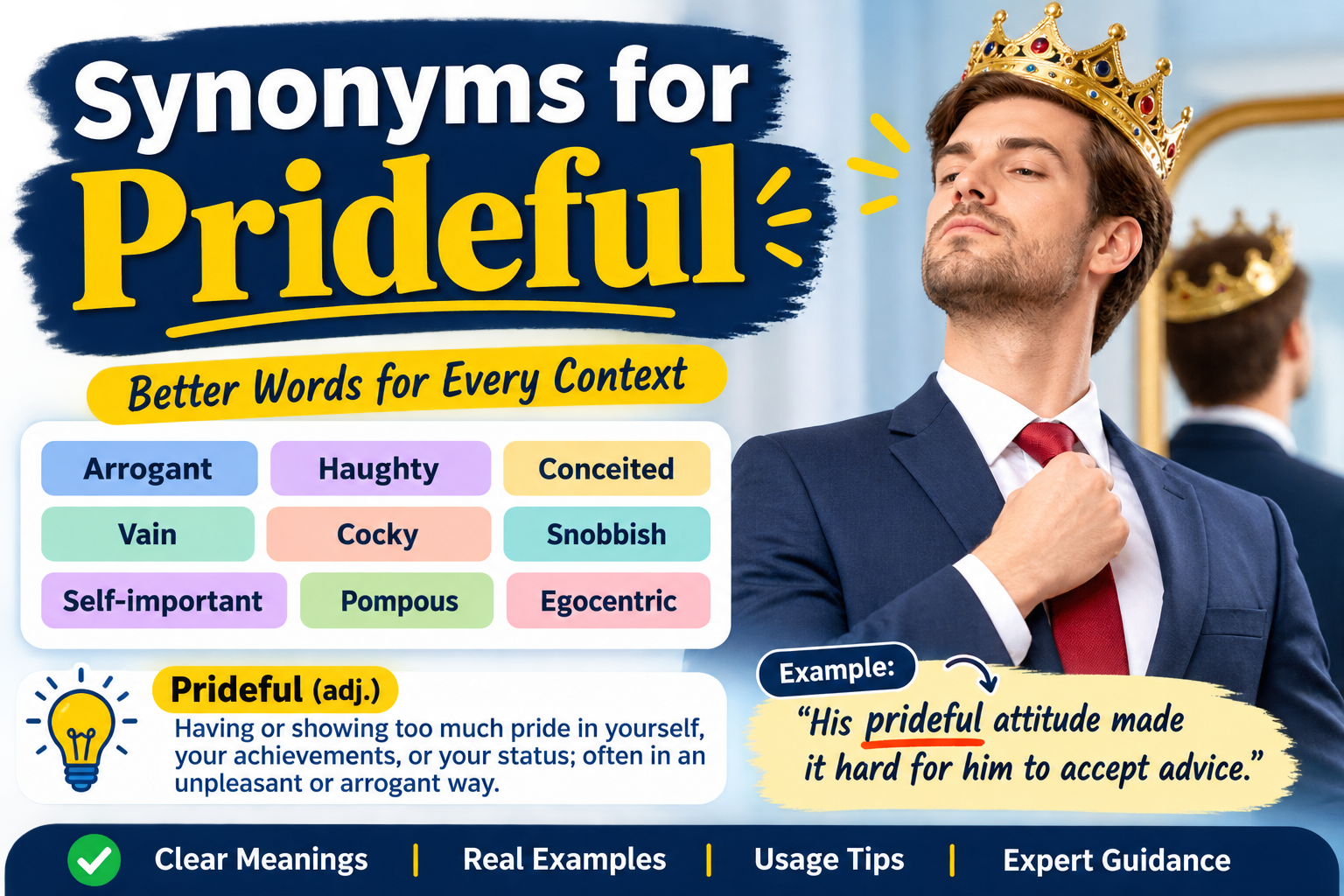
Finding the right synonym for prideful depends on what kind of pride you mean. If you mean someone who thinks they are better than others, words such as arrogant, conceited, haughty, smug, vain, and self-important are strong alternatives. If you mean feeling genuine satisfaction in an achievement, proud, pleased, satisfied, exultant, or elated may be more appropriate.
The distinction matters because prideful can carry either a negative or positive meaning. Cambridge defines it both as showing the belief that you are better or more important than others and as feeling pleasure or satisfaction because of an achievement. Merriam-Webster likewise gives both negative and positive senses.
This guide separates the most useful alternatives by meaning, tone, strength, and context so you can choose the word that actually fits your sentence.
Quick Answer: What Are the Best Synonyms for Prideful?
The best synonym depends on the intended meaning:
- Arrogant — thinks too highly of oneself and may look down on others.
- Conceited — has an excessively high opinion of one’s abilities or qualities.
- Haughty — behaves as though superior to other people.
- Smug — overly pleased with oneself, often in an irritating way.
- Vain — excessively concerned with one’s appearance, qualities, or achievements.
- Self-important — considers oneself more important than one really is.
- Egotistical — excessively focused on one’s own importance or abilities.
- Boastful — openly talks about one’s achievements or qualities.
- Proud — can be either positive or negative, depending on context.
- Exultant — extremely joyful and proud because of success or victory.
Merriam-Webster lists proud, arrogant, haughty, and smug among the principal synonyms of prideful, while Cambridge’s thesaurus includes words such as conceited, vain, self-important, pompous, arrogant, haughty, and boastful.
Prideful Synonyms at a Glance
| Word | Relationship | Meaning | Tone | Best Context |
|---|---|---|---|---|
| Proud | Near/direct synonym | Feeling satisfaction or pride | Neutral to positive/negative | Achievements, family, identity |
| Arrogant | Strong synonym | Believing oneself superior | Negative | Personality, behavior |
| Conceited | Strong synonym | Excessively impressed with oneself | Negative | Abilities, appearance, personality |
| Haughty | Strong synonym | Acting superior to others | Negative, formal | Behavior, manner |
| Smug | Near synonym | Too pleased with oneself | Negative | Attitude, expression |
| Vain | Near synonym | Excessively concerned with oneself | Negative | Appearance, achievements |
| Self-important | Near synonym | Thinking oneself unusually important | Negative | Personality, workplace |
| Egotistical | Near synonym | Excessively focused on one’s ego | Negative | Personality, conversation |
| Boastful | Contextual alternative | Frequently talking about achievements | Negative | Speech, writing, behavior |
| Self-satisfied | Near synonym | Pleased with oneself, often excessively | Usually negative | Attitude, expression |
| Vainglorious | Strong/less common synonym | Excessively proud of achievements | Strong negative | Formal or literary writing |
| Disdainful | Contextual alternative | Showing contempt for others | Negative | Attitude toward people |
| Supercilious | Contextual alternative | Acting superior and contemptuous | Strong negative, formal | Manner, speech |
| Exultant | Positive/contextual alternative | Extremely joyful because of success | Positive | Victory, achievement |
| Elated | Positive/contextual alternative | Extremely happy or excited | Positive | Success, good news |
The important point is that these words are not interchangeable in every sentence. A word such as boastful describes how pride is expressed, while haughty emphasizes an attitude of superiority. Exultant, by contrast, is appropriate when pride is connected with great happiness or triumph.
What Does Prideful Mean?
Prideful is an adjective meaning full of pride. In negative contexts, it can describe someone who considers themselves superior to other people. In positive contexts, it can describe genuine satisfaction or pleasure in an achievement.
For example:
- Negative: His prideful attitude made it difficult for him to accept criticism.
- Positive: She felt prideful after seeing her daughter graduate.
Because the word has these two possible directions, context is essential.
Prideful vs. Proud
Proud is generally the safer and more neutral word when you mean legitimate satisfaction or pleasure.
- I am proud of my team’s achievement. — positive
- He was too prideful to admit that he was wrong. — negative
Cambridge specifically identifies proud as a synonym of prideful in its positive sense.
The Best Synonyms for Prideful
1. Arrogant
Arrogant is one of the closest choices when prideful describes someone who believes they are superior to others.
Best for: personality, behavior, attitude, speech
Example:
His arrogant attitude made the rest of the team uncomfortable.
Choose arrogant when the problem is not simply being proud but believing you are better than other people.
2. Conceited
Conceited describes someone who has an excessively favorable opinion of themselves, particularly their abilities, appearance, or qualities.
Best for: personality, appearance, intelligence, abilities
Example:
She was too conceited to consider anyone else’s opinion.
Conceited is particularly useful when the person’s pride is centered on themselves.
3. Haughty
Haughty means behaving as though you are superior to other people.
Best for: manners, behavior, facial expressions, social interactions
Example:
He gave the waiter a haughty look.
This word is more formal and literary than arrogant. Cambridge includes haughty among the words associated with the negative sense of prideful.
4. Smug
Smug describes someone who is excessively pleased with themselves or their situation, often in an irritating way.
Best for: attitude, facial expression, reactions to success
Example:
He looked smug after proving everyone else wrong.
Choose smug when the person’s self-satisfaction is especially noticeable or irritating.
5. Vain
Vain is commonly used when someone’s pride is connected to their appearance, qualities, achievements, or how other people view them.
Best for: appearance, reputation, accomplishments
Example:
He was too vain to leave the house without checking his appearance several times.
Someone can be prideful without being vain. Vain focuses more specifically on excessive admiration of oneself.
6. Self-Important
Self-important describes someone who believes they are more important than they really are.
Best for: workplace behavior, social situations, personality
Example:
His self-important manner annoyed his colleagues.
This is a useful choice when the person’s pride is connected to status or perceived importance.
7. Egotistical
Egotistical describes someone who is excessively focused on their own importance, abilities, or achievements.
Best for: personality, conversation, leadership behavior
Example:
His egotistical behavior made every conversation about himself.
It is stronger and more specifically ego-focused than the neutral sense of prideful.
8. Boastful
Boastful describes someone who talks too much about their achievements, abilities, or possessions.
Best for: speech, writing, self-promotion
Example:
His boastful comments quickly became tiresome.
Use boastful when pride is being expressed openly. Someone can be prideful without boasting.
9. Self-Satisfied
Self-satisfied means excessively pleased with oneself or one’s situation.
Best for: attitude, expression, behavior
Example:
The self-satisfied manager refused to consider the team’s concerns.
It overlaps strongly with smug, although self-satisfied can sound somewhat more neutral or descriptive.
10. Vainglorious
Vainglorious means excessively proud of one’s achievements or qualities.
Best for: formal, literary, or strongly critical writing
Example:
The vainglorious ruler surrounded himself with people who constantly praised him.
This is a less common word, so it is usually not the best everyday replacement for prideful.
Positive Synonyms for Prideful
Not every use of prideful is negative. If you mean feeling genuine satisfaction or happiness because of an achievement, choose a more clearly positive word.
Proud
Proud is the most natural choice.
She was proud of what her students accomplished.
Pleased
Pleased is milder and emphasizes satisfaction rather than ego.
He was pleased with the team’s progress.
Satisfied
Satisfied focuses on contentment with a result.
She was satisfied with the quality of her work.
Exultant
Exultant describes intense happiness and pride, especially following victory or success.
The exultant players celebrated their championship.
Elated
Elated means extremely happy or excited. It can accompany pride but does not specifically mean pride.
He was elated after receiving the award.
Therefore, elated is better treated as a contextual alternative rather than a direct synonym of prideful.
Negative Synonyms for Prideful
When prideful means excessively proud or superior, these are usually the strongest choices:
- Arrogant
- Conceited
- Haughty
- Smug
- Self-important
- Egotistical
- Vain
- Boastful
- Supercilious
- Vainglorious
These words differ in what they emphasize.
- Arrogant → superiority
- Conceited → excessive self-opinion
- Haughty → superior behavior
- Smug → irritating self-satisfaction
- Vain → excessive self-admiration
- Boastful → talking about one’s achievements
- Supercilious → superiority combined with contempt
- Vainglorious → excessive pride in achievements
Which Word Should I Use Instead of Prideful?
Choose arrogant when:
The person believes they are better than other people.
His arrogant attitude made him difficult to work with.
Choose conceited when:
The person thinks extremely highly of their own abilities or qualities.
She is too conceited to admit she needs help.
Choose haughty when:
The person’s behavior or manner communicates superiority.
He responded with a haughty smile.
Choose smug when:
The person seems excessively pleased with themselves.
He looked smug after winning the argument.
Choose vain when:
The pride centers on appearance, qualities, or admiration.
She is vain about her appearance.
Choose boastful when:
The person openly talks about their accomplishments.
His boastful stories annoyed everyone at dinner.
Choose proud when:
You mean legitimate satisfaction rather than arrogance.
Her parents were proud of her achievement.
Choose exultant when:
The person is extremely happy because of a victory or success.
The exultant fans celebrated late into the night.
Prideful vs. Arrogant
Prideful and arrogant overlap when pride becomes excessive, but arrogant is more specifically associated with an inflated sense of superiority.
| Prideful | Arrogant |
|---|---|
| Can be positive or negative | Usually negative |
| Can mean simply full of pride | Strongly suggests superiority |
| Depends heavily on context | More consistently critical |
| Can describe achievement-related pride | Often describes personality or behavior |
Example:
She felt prideful after completing the difficult project.
Here, arrogant would change the meaning.
But:
His prideful attitude made him dismissive of others.
In this sentence, arrogant could be a natural replacement.
Prideful vs. Conceited
Both words can describe excessive self-regard.
Prideful is broader, while conceited specifically emphasizes an excessively high opinion of oneself.
He was prideful about his success.
He was conceited about his intelligence.
The second sentence makes the person’s inflated self-opinion more explicit.
Prideful vs. Haughty
Haughty is especially useful when pride is displayed through behavior toward other people.
She was prideful about her accomplishments.
She gave the other guests a haughty look.
The first emphasizes pride; the second emphasizes a superior attitude toward others.
Prideful vs. Smug
Smug focuses on self-satisfaction.
He was prideful about his performance.
He looked smug after predicting the outcome correctly.
Someone who is smug usually appears overly satisfied with themselves, often in a way others find irritating.
Prideful vs. Vain
Vain is more closely associated with excessive admiration of one’s appearance, abilities, or qualities.
He was prideful about his team’s success.
He was vain about his appearance.
The two words can overlap, but vain gives the reader a more specific reason for the person’s self-regard.
Prideful Synonyms by Context
For a Prideful Person
Best choices:
- arrogant
- conceited
- haughty
- smug
- self-important
- egotistical
Example:
The arrogant executive refused to listen to criticism.
For Prideful Behavior
Best choices:
- arrogant
- haughty
- supercilious
- self-important
- disdainful
Example:
His haughty behavior alienated his coworkers.
For a Prideful Attitude
Best choices:
- arrogant
- conceited
- smug
- self-satisfied
- self-important
Example:
Her self-important attitude prevented productive discussion.
For Pride in an Achievement
Use:
- proud
- pleased
- satisfied
- delighted
- exultant
Example:
The students were proud of their final project.
For Someone Who Talks About Their Achievements
Use:
- boastful
- bragging
- self-promoting
- vainglorious
Example:
His boastful comments distracted from the team’s achievement.
Common Mistakes When Choosing a Synonym for Prideful
Mistake 1: Treating Every Related Word as an Exact Synonym
Words such as confident, successful, and dignified can be associated with pride, but they do not necessarily mean prideful.
For example:
She is confident in her abilities.
This does not imply arrogance.
Calling her arrogant would add a negative judgment that confident does not contain.
Mistake 2: Using “Boastful” for Every Kind of Pride
Someone can feel proud without telling everyone about it.
Proud describes the feeling; boastful describes a tendency to talk about one’s accomplishments.
Mistake 3: Using “Haughty” in Casual Situations
Haughty is perfectly valid but has a more formal or literary flavor. In everyday conversation, arrogant, conceited, or stuck-up may sound more natural depending on the context.
Mistake 4: Assuming “Prideful” Is Always Negative
It is not. Cambridge explicitly records both a disapproving sense and a sense involving pleasure and satisfaction.
Therefore:
She felt prideful after graduating.
can express positive pride, while:
He was too prideful to apologize.
expresses excessive pride.
Mistake 5: Using “Confident” as a Direct Replacement
Confident generally describes belief in one’s abilities. It does not inherently suggest that someone thinks they are better than others.
She is confident.
does not mean:
She is arrogant.
That difference is important when selecting a synonym.
Related Words That Are Not Exact Synonyms
Some vocabulary is semantically related to prideful but should not automatically be presented as a synonym.
- Confident — belief in one’s abilities
- Dignified — having or showing a composed, worthy manner
- Ambitious — strongly wanting achievement or success
- Successful — having achieved a desired result
- Self-respecting — having respect for oneself
- Independent — not relying heavily on others
- Dominant — exercising control or influence
- Superior — higher in quality, status, or position; can describe an attitude when used about a person
These words may fit particular contexts, but substituting them for prideful can change the meaning.
Antonyms of Prideful
The best antonym depends on which sense of prideful you mean.
For excessive pride or arrogance:
- humble
- modest
- unassuming
- unpretentious
- meek
For healthy self-confidence or legitimate pride, the opposite may instead involve:
- ashamed
- embarrassed
- insecure
- self-doubting
Cambridge lists humble, unassuming, modest, unobtrusive, meek, and related words as antonyms for its negative prideful sense.
Pronunciation of Prideful
Prideful
- US IPA: /ˈpraɪd.fəl/
- UK IPA: /ˈpraɪd.fəl/
Cambridge gives the same basic pronunciation for both US and UK English.
The word is pronounced approximately like:
PRIDE-ful
Frequently Asked Questions About Prideful Synonyms
What is the closest synonym for prideful?
Proud is the closest general synonym when prideful means feeling satisfaction or pleasure. For the negative sense, arrogant, haughty, conceited, and smug are among the closest choices. The best option depends on whether the sentence emphasizes pride, superiority, self-admiration, or self-satisfaction.
Is “prideful” the same as “arrogant”?
Not always. Prideful can describe legitimate satisfaction or pride, while arrogant normally describes an exaggerated sense of superiority. For example, someone can be prideful about graduating without being arrogant.
What is a positive synonym for prideful?
Proud is usually the most natural positive alternative. Depending on the context, pleased, satisfied, delighted, exultant, or elated may also work. These alternatives are not identical, so choose based on whether you want to emphasize pride, satisfaction, or intense happiness.
What is a negative synonym for prideful?
Common negative alternatives include arrogant, conceited, haughty, smug, vain, self-important, egotistical, and boastful. Each emphasizes a different aspect of excessive pride.
What is a synonym for a prideful person?
Arrogant, conceited, haughty, smug, self-important, and egotistical are strong choices. If the person frequently talks about their accomplishments, boastful may be more precise.
What is a formal word for prideful?
Haughty, supercilious, and vainglorious can work in formal or literary writing, although they are not interchangeable. Haughty emphasizes superiority, supercilious often adds contempt toward others, and vainglorious emphasizes excessive pride in achievements.
Is “confident” a synonym for prideful?
Not exactly. Confident describes belief in one’s abilities, whereas prideful can imply excessive self-regard. Confidence can be healthy; pridefulness can be positive or negative depending on context.
What is the difference between prideful and conceited?
Prideful is broader and can refer to either positive or excessive pride. Conceited specifically describes someone who has an excessively favorable opinion of themselves. Therefore, conceited is usually more clearly negative.
Final Takeaway
The best synonym for prideful depends on the kind of pride you want to describe.
Use proud for genuine satisfaction or accomplishment. Choose arrogant when someone considers themselves superior to others, conceited when they think excessively highly of themselves, haughty for superior behavior, smug for irritating self-satisfaction, vain for excessive self-admiration, and boastful when pride is expressed through talking about achievements.
The key is not simply finding a word that appears in a thesaurus. It is choosing the word that preserves the meaning, tone, and context of your original sentence.

Emily Johnson is a linguistics graduate and vocabulary specialist. She writes detailed synonym explanations and helps readers understand subtle differences between words, improving both writing and speaking skills. Synonyms help express ideas more clearly and precisely in English.