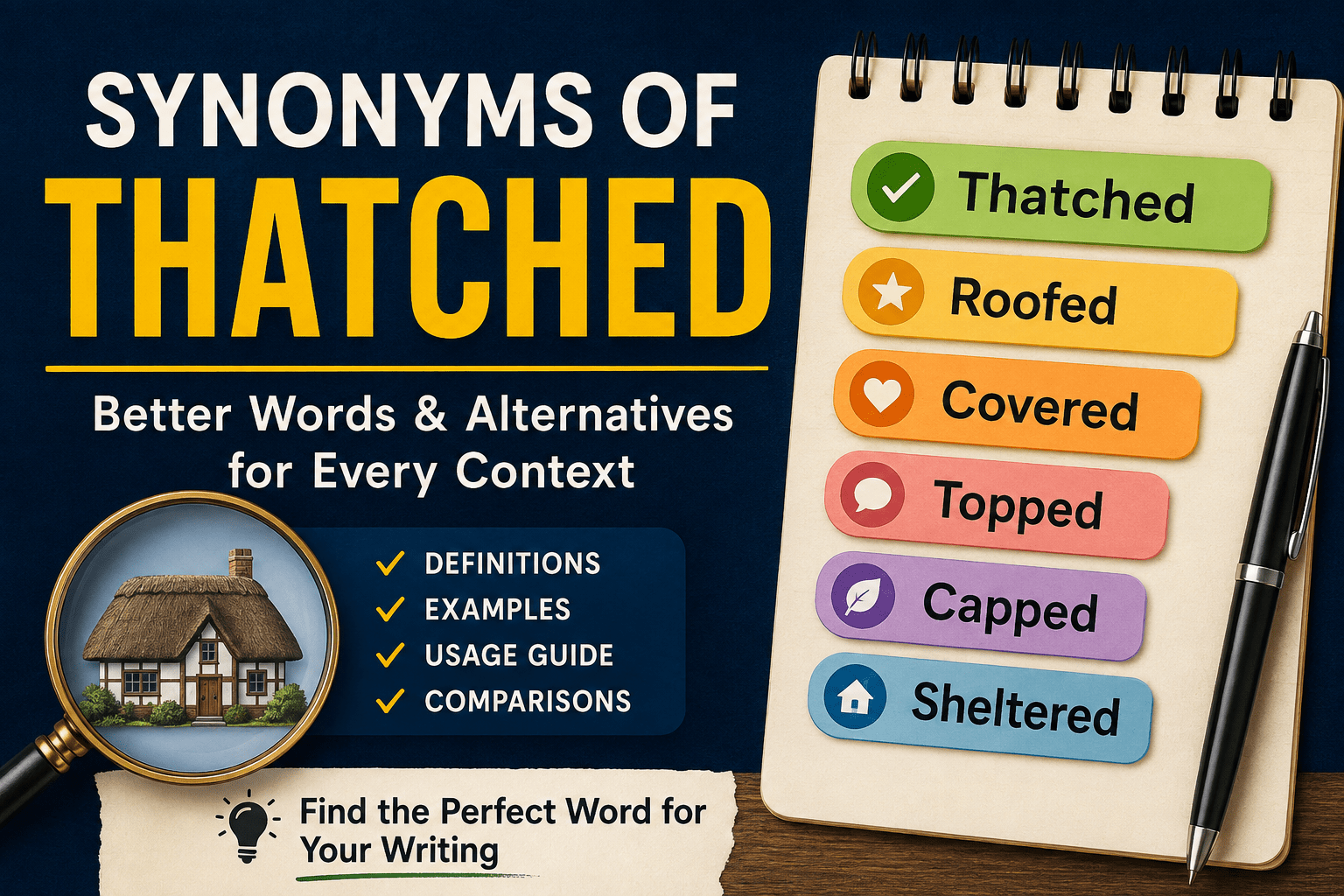
If you are looking for synonyms of “thatched,” the closest alternatives depend heavily on what you are describing. Thatched specifically refers to something—usually a roof or building—covered with thatch, traditionally made from materials such as straw or reeds.
There is an important distinction here: English does not have a large set of perfect one-word synonyms for thatched. Words such as straw-roofed, reed-roofed, thatch-covered, and straw-covered can work naturally in particular contexts, but they may emphasize the material rather than the general method of roofing.
This guide separates close synonyms from contextual alternatives so you can choose the most natural word for your sentence.
Quick Answer: What Are the Best Synonyms of “Thatched”?
The closest alternatives to thatched include thatch-covered, straw-roofed, reed-roofed, straw-covered, and reed-covered, depending on the context. However, these are mostly contextual alternatives rather than perfect synonyms. Thatched is the broadest and most natural term when describing a roof made with thatch.
What Does “Thatched” Mean?
Thatched is an adjective meaning covered with thatch, especially when referring to a roof or building. A thatched roof is traditionally made from materials such as straw or reeds.
Part of speech
Thatched is an adjective.
Pronunciation
US/UK IPA: /θætʃt/
Examples
- They stayed in a thatched cottage in the countryside.
- The village is famous for its thatched roofs.
- We passed an old thatched house on the way to the coast.
The related verb thatch means to cover something, especially a roof, with thatch. Merriam-Webster defines thatch as covering with or as if with thatch.
The Best Synonyms and Alternatives for “Thatched”
Because thatched describes a particular roofing material and construction method, some alternatives are more precise than others.
| Word or Phrase | Relationship | Best Context | Nuance |
|---|---|---|---|
| thatch-covered | Near synonym | Roofs, structures | Emphasizes the thatch covering |
| straw-roofed | Contextual alternative | Buildings and cottages | Specifies straw as the material |
| reed-roofed | Contextual alternative | Buildings and roofs | Specifies reeds |
| straw-covered | Contextual alternative | Roofs or structures | Focuses on straw covering |
| reed-covered | Contextual alternative | Roofs or structures | Focuses on reed covering |
| thatch-roofed | Very close alternative | Buildings and roofs | Explicitly identifies a thatch roof |
| roofed with thatch | Paraphrase | Formal or explanatory writing | Clear and precise |
| covered with thatch | Paraphrase | General description | Natural explanatory alternative |
An important distinction
Terms such as straw-roofed and reed-roofed should not automatically be treated as perfect synonyms.
A roof can be thatched with different plant materials, including straw and reeds. Cambridge specifically describes a thatched roof as one made from straw or reeds.
Therefore:
Thatched = the broad term
Straw-roofed = specifically emphasizes straw
Reed-roofed = specifically emphasizes reeds
This distinction is particularly useful for precise writing.
1. Thatch-Covered
Relationship: Near synonym
Meaning: Covered with thatch.
Best used for: Roofs, huts, cottages, shelters, and other structures.
Example:
The family restored the old thatch-covered cottage.
How it differs from “thatched”:
Thatch-covered is more explicitly descriptive. It tells the reader that the surface is covered with thatch, whereas thatched is the conventional adjective.
In ordinary English, thatched cottage sounds more natural than thatch-covered cottage.
2. Straw-Roofed
Relationship: Contextual alternative
Meaning: Having a roof made or covered with straw.
Best used for: Cottages, houses, huts, rural buildings, and traditional structures.
Example:
A row of straw-roofed cottages lined the narrow village road.
How it differs from “thatched”:
Straw-roofed identifies the material more specifically. It is therefore useful when you know that straw, rather than another thatching material, is being used.
Do not use it when the roofing material is unknown.
3. Reed-Roofed
Relationship: Contextual alternative
Meaning: Having a roof made or covered with reeds.
Example:
The lakeside cabins had distinctive reed-roofed shelters.
How it differs from “thatched”:
Reed-roofed is more specific. A reed roof can be a form of thatched roofing, but reed-roofed tells the reader exactly what material is being emphasized.
4. Straw-Covered
Relationship: Contextual alternative
Meaning: Covered with straw.
Example:
The travelers rested beside a small straw-covered shelter.
This phrase can work when the important detail is the straw covering rather than the traditional roofing technique.
However, straw-covered is broader than thatched. It should not automatically replace thatched in every sentence.
5. Reed-Covered
Relationship: Contextual alternative
Meaning: Covered with reeds.
Example:
The traditional building had a reed-covered roof.
This is useful when the material matters more than the general description of the roof.
6. Thatch-Roofed
Relationship: Very close alternative
Meaning: Having a roof made from thatch.
Example:
We stayed in a small thatch-roofed cabin near the river.
This expression is understandable and precise, although thatched roof and thatched cottage are generally more idiomatic in ordinary English.
For polished writing, prefer:
a thatched cottage
over:
a thatch-roofed cottage
unless you specifically want to emphasize the roof.
7. Roofed With Thatch
Relationship: Paraphrase
Meaning: Having a roof constructed or covered with thatch.
Example:
The traditional houses were roofed with thatch.
This is particularly useful when you want a descriptive sentence rather than an adjective.
Compare:
The village contained several thatched houses.
The village contained several houses roofed with thatch.
Both communicate essentially the same idea, but the second version is more explicit.
8. Covered With Thatch
Relationship: Paraphrase
Meaning: Having a surface covered with thatch.
Example:
The shelter was covered with thatch to protect it from the rain.
This is a useful alternative when you want to avoid repeatedly using thatched.
It is also more flexible grammatically because it can describe a particular surface or structure without requiring the adjective thatched.
Closest Synonyms of “Thatched”
If you need the closest possible alternatives, the following are the most useful:
- Thatch-covered
- Thatch-roofed
- Roofed with thatch
- Covered with thatch
These preserve the central idea most closely.
By contrast, straw-roofed and reed-roofed are better described as material-specific alternatives because they narrow the meaning.
Context-Specific Alternatives
For a cottage
Most natural:
thatched cottage
Possible alternative:
straw-roofed cottage
Example:
We photographed a charming thatched cottage surrounded by wildflowers.
For a roof
Most natural:
thatched roof
Possible alternatives:
straw roof
reed roof
roof made of thatch
Cambridge defines thatched roof specifically as a roof made from straw or reeds.
For a hut
Natural options include:
thatched hut
straw-roofed hut
hut roofed with thatch
Example:
The fishermen lived in a simple thatched hut near the shore.
For a traditional building
Use:
thatched building
when the roofing style is the important feature.
If the material is known, you can be more specific:
reed-roofed building
Thatched vs. Straw-Roofed
These expressions are closely related but not identical.
| Feature | Thatched | Straw-roofed |
| General meaning | Covered with thatch | Roofed with straw |
| Material specificity | Broader | Specific to straw |
| Commonness | Very natural | Natural in suitable contexts |
| Best use | General description | When straw matters |
| Exact replacement? | — | Not always |
Example
They bought a thatched cottage.
This does not necessarily tell us exactly which thatching material was used.
They bought a straw-roofed cottage.
This specifically identifies straw.
Thatched vs. Reed-Roofed
The same principle applies to reed-roofed.
The village has many thatched houses.
This describes the traditional roofing generally.
The village has many reed-roofed houses.
This specifies that reeds are the roofing material.
Choose reed-roofed when the material is known and relevant. Otherwise, thatched is usually the better general term.
Which Word Should I Use?
A simple decision guide can make the choice easier.
Use “thatched” when:
You want the standard, natural adjective for a roof or building covered with thatch.
They restored a beautiful thatched cottage.
Use “thatch-covered” when:
You want to emphasize the physical covering.
The small shelter was thatch-covered.
Use “straw-roofed” when:
You specifically know that straw is the roofing material.
The village contained several straw-roofed houses.
Use “reed-roofed” when:
You specifically know that reeds are used.
The island is known for its reed-roofed huts.
Use “roofed with thatch” when:
You want an explicit descriptive construction.
The old farmhouse was roofed with thatch.
Use “covered with thatch” when:
You want a straightforward paraphrase.
The shelter was covered with thatch.
Common Mistakes With “Thatched” Synonyms
Mistake 1: Treating “straw-roofed” as a perfect synonym
Not always correct:
The building was straw-roofed.
If you only know that the building was thatched, you may not know whether straw was specifically used.
Better:
The building was thatched.
Mistake 2: Using “straw” for every thatched roof
Thatch can involve different plant materials. Cambridge specifically identifies straw or reeds in its explanation of a thatched roof.
So avoid assuming:
thatched = straw
A more accurate relationship is:
straw can be a thatching material, but “thatched” is the broader description.
Mistake 3: Calling unrelated roof types synonyms
Words such as:
- tiled
- slate
- shingled
- metal-roofed
- flat-roofed
are not synonyms of thatched.
They describe different roofing materials or styles.
A thesaurus-style list can sometimes place roofing-related terms near one another, but semantic association does not make them synonyms.
Mistake 4: Using “thatch” as a direct adjective replacement
Thatch is primarily a noun and verb, while thatched functions as an adjective.
Compare:
a thatched roof ✓
a thatch roof — possible in some constructions, but less standard than thatched roof
The grammatical form matters when choosing an alternative.
Natural Collocations With “Thatched”
The most useful way to learn thatched is through natural phrases.
Common collocations
- thatched roof
- thatched cottage
- thatched house
- thatched hut
- thatched building
- thatched shelter
- thatched cabin
- traditional thatched house
- old thatched cottage
- beautiful thatched roof
Examples
The village is famous for its thatched cottages.
Rain fell heavily on the thatched roof.
They restored the old thatched house.
We spent the night in a small thatched hut.
These phrase-level patterns are generally more useful to learners than memorizing isolated synonyms.
Etymology of “Thatched”
The word comes from the verb thatch, which has Old English roots. WordReference traces thatch through Middle English forms to Old English theccan, meaning “to cover” or “hide.”
Merriam-Webster likewise connects the modern verb thatch with the idea of covering a structure with thatch.
The historical connection helps explain why the modern word refers both to the material and to the act of covering a roof with that material.
Antonyms of “Thatched”
There is no single perfect antonym for thatched, because the opposite depends on what you are contrasting.
Possible contextual opposites include:
- unroofed — lacking a roof
- bare — lacking the covering being discussed
- untopped — not covered or capped in a particular way
If you are comparing roofing materials, however, terms such as tiled, slate-roofed, or metal-roofed are better described as contrasting roofing types, not strict antonyms.
FAQ About Synonyms of “Thatched”
What is another word for “thatched”?
The closest alternatives include thatch-covered, thatch-roofed, roofed with thatch, and covered with thatch. Material-specific alternatives include straw-roofed and reed-roofed.
What is the closest synonym for “thatched”?
Thatch-covered is one of the closest descriptive alternatives because it preserves the central idea of being covered with thatch.
However, thatched itself is usually the most natural and concise choice.
Is “straw-roofed” a synonym for “thatched”?
It can be a contextual alternative, but it is more specific. Straw-roofed tells the reader that straw is the material, whereas thatched is broader.
Is “reed-roofed” the same as “thatched”?
Not exactly. A reed roof can be a type of thatched roof, but reed-roofed specifically identifies reeds as the material.
What is another word for “thatched roof”?
Depending on the context, you can say thatch roof, roof made of thatch, roof covered with thatch, straw roof, or reed roof. The last two are appropriate only when the material is specifically known.
What is a formal synonym for “thatched”?
There is no particularly formal one-word replacement that is universally better than thatched. In formal writing, roofed with thatch or covered with thatch can provide a precise descriptive alternative.
What is the opposite of “thatched”?
There is no universal direct antonym. If you are contrasting roofing styles, you might use tiled, slate-roofed, or metal-roofed, depending on the intended contrast.
Is “thatch-covered” natural English?
Yes. Thatch-covered is understandable and grammatically natural, although thatched is usually more concise and idiomatic in expressions such as thatched cottage and thatched roof.
Conclusion
The best synonyms of “thatched” are not a long list of interchangeable words. The most accurate alternatives are thatch-covered, thatch-roofed, roofed with thatch, and covered with thatch. Straw-roofed and reed-roofed are useful when you want to identify the specific material.

Sarah Williams is an ESL teacher and content writer with a passion for simplifying English vocabulary. She creates easy-to-understand synonym guides and learning resources that help beginners and intermediate learners build strong language skills.