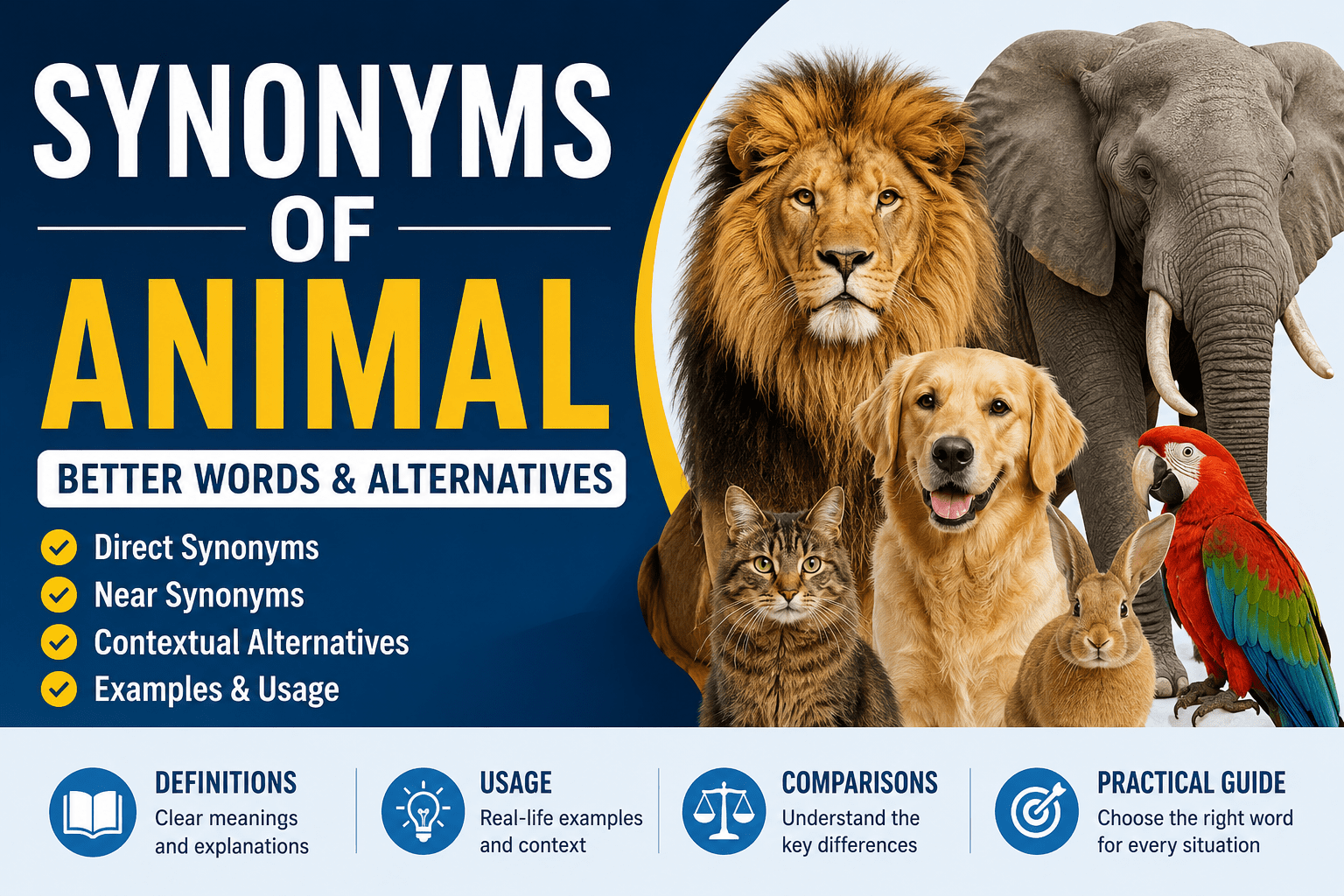
Looking for the best synonyms of animal? The closest everyday alternatives include creature, beast, critter, brute, and, in specific contexts, pet, livestock, mammal, or vertebrate. However, these words are not interchangeable in every sentence. Creature is usually the safest neutral replacement, while beast can suggest a wild or large animal and critter is informal. Choosing the right synonym depends on meaning, context, tone, and whether you are talking about one animal, a group, or a particular biological category.
Quick Answer: What Are the Best Synonyms of Animal?
The most useful synonyms and near-synonyms for animal include:
- Creature — the closest general and neutral alternative
- Beast — often suggests a wild, large, or powerful animal
- Critter — informal, especially in American English
- Brute — usually emphasizes size, strength, or roughness
- Pet — an animal kept for companionship
- Mammal — a specific biological category
- Vertebrate — an animal with a backbone
- Livestock — farm animals kept for agricultural purposes
- Fauna — the animals of a particular region or environment
- Carnivore — an animal that primarily eats meat
- Herbivore — an animal that primarily eats plants
- Invertebrate — an animal without a backbone
The best choice depends on what you mean. For a simple replacement in ordinary writing, creature is usually the safest option. Merriam-Webster lists creature and beast among the principal noun synonyms of animal.
What Does Animal Mean?
As a noun, animal generally refers to a living organism belonging to the animal kingdom. In ordinary usage, it commonly means a nonhuman animal such as a dog, cat, horse, bird, or wild mammal. In scientific contexts, however, animal has a broader biological meaning.
The word also has other noun senses. It can refer to a person considered mainly in terms of physical or nonrational behavior, or to someone strongly associated with a particular activity, as in a political animal or a party animal.
Because animal has several meanings, there is no single synonym that works perfectly in every context.
Best Synonyms of Animal at a Glance
| Word | Relationship | Meaning / Nuance | Formality | Best Context |
|---|---|---|---|---|
| Creature | Direct synonym | A living being, especially an animal | Neutral | General writing |
| Beast | Near synonym | Often a wild, large, or powerful animal | Neutral–literary | Wild animals |
| Critter | Near synonym | An informal word for an animal | Informal | Conversation |
| Brute | Near synonym | A strong or rough animal; can also describe a person | Neutral–negative | Strength or roughness |
| Pet | Contextual alternative | An animal kept for companionship | Neutral | Domestic animals |
| Mammal | Related/narrower | An animal belonging to the mammal class | Formal/scientific | Biology |
| Vertebrate | Related/narrower | An animal with a backbone | Formal/scientific | Biology |
| Livestock | Contextual alternative | Farm animals kept for agricultural use | Neutral | Farming |
| Fauna | Contextual alternative | Animals of a particular region or environment | Formal | Ecology/writing |
| Carnivore | Related/narrower | An animal that eats mainly meat | Scientific | Diet/zoology |
| Herbivore | Related/narrower | An animal that eats mainly plants | Scientific | Diet/zoology |
| Invertebrate | Related/narrower | An animal without a backbone | Scientific | Biology |
Not every word in this table is a strict synonym. For example, mammal and vertebrate identify narrower biological categories, while pet describes an animal according to its relationship with humans.
1. Creature
Creature is probably the most versatile general synonym for animal. It can refer to almost any living animal and often sounds natural in both everyday and descriptive writing.
Example:
The forest was home to many fascinating creatures.
Choose “creature” when: you want a neutral, broad alternative to animal.
It can also sound slightly more literary or expressive than animal, especially in phrases such as sea creature or mythical creature.
2. Beast
Beast can refer to an animal, particularly one that is large, wild, dangerous, or powerful. It can also have a negative figurative meaning when applied to a person.
Example:
The explorers encountered a dangerous beast in the forest.
Compared with animal, beast is more vivid and often carries a stronger emotional or literary tone.
Choose “beast” when: you want to emphasize wildness, strength, size, or danger.
Collins also lists beast among the principal alternatives for animal.
3. Critter
Critter is an informal word for an animal. It is especially common in conversational American English.
Example:
There was a little critter hiding under the porch.
It can sound friendly, humorous, folksy, or casual.
Choose “critter” when: writing informally or reproducing conversational speech.
Avoid it in formal scientific or academic writing.
4. Brute
Brute can describe an animal, especially one that is large, strong, or difficult to control. It can also describe a person who behaves violently or without sensitivity.
Example:
The enormous brute pulled against the rope.
Unlike creature, brute is not a neutral replacement for every use of animal. It often adds a sense of physical strength or roughness.
Choose “brute” when: the animal’s power, size, or rough nature matters.
5. Pet
Pet is not a direct synonym for every animal. It refers specifically to an animal kept by people for companionship or enjoyment.
Example:
Her dog is a beloved family pet.
You could not normally replace animal with pet in:
The zoo contains hundreds of animals.
A pet is therefore best treated as a contextual alternative, not a universal synonym.
6. Mammal
Mammal is a biological category, not a general replacement for animal.
Dogs, cats, whales, elephants, and humans are mammals, but birds, reptiles, insects, and fish are not mammals.
Example:
The blue whale is the largest known mammal.
Choose “mammal” when: you specifically mean an animal belonging to the mammalian class.
7. Vertebrate
A vertebrate is an animal with a backbone or spinal column.
Example:
The researchers studied several vertebrate species.
This term is more precise than animal and belongs mainly to scientific or educational contexts.
It should not be used as a universal synonym because many animals, including insects and many other invertebrates, are not vertebrates.
8. Livestock
Livestock refers to farm animals kept for agricultural purposes, such as cattle, sheep, goats, and pigs.
Example:
The farmer moved the livestock into the shelter before the storm.
It is useful when the context involves agriculture, farming, food production, or animal husbandry.
Do not use “livestock” for a wild animal or a household pet.
9. Fauna
Fauna is a more formal term referring collectively to the animals of a particular region, habitat, period, or environment.
Example:
The island has a remarkable variety of native fauna.
Because fauna is generally collective, it does not work as a simple one-for-one replacement in every sentence.
Instead of:
I saw a fauna in the forest.
say:
I saw an animal in the forest.
or:
The forest has diverse fauna.
10. Carnivore
A carnivore is an animal that eats primarily meat.
Example:
Lions are well-known carnivores.
This is a narrower term than animal, so it should be used only when diet is relevant.
11. Herbivore
A herbivore is an animal that primarily eats plants.
Example:
Deer are herbivores that feed on vegetation.
Like carnivore, this is a category rather than a general synonym for animal.
12. Invertebrate
An invertebrate is an animal without a backbone.
Examples include insects, spiders, worms, and many marine animals.
Example:
The researchers discovered several unusual marine invertebrates.
It is a useful scientific alternative only when the lack of a backbone is relevant.
Which Word Should I Use Instead of “Animal”?
The safest choice depends on your sentence.
Choose “creature” when:
You need a general, neutral alternative.
The strange creature disappeared into the bushes.
Choose “beast” when:
You want to emphasize wildness, size, power, or danger.
A huge beast emerged from the cave.
Choose “critter” when:
You want an informal, conversational tone.
Some little critter got into the garage.
Choose “brute” when:
You want to emphasize physical strength or roughness.
The powerful brute dragged the heavy load.
Choose “pet” when:
The animal is kept for companionship.
Their dog is a much-loved pet.
Choose “mammal” when:
You are discussing biological classification.
The dolphin is a marine mammal.
Choose “vertebrate” when:
You specifically mean an animal with a backbone.
Humans are vertebrates.
Choose “livestock” when:
You are talking about farm animals.
The farmer protects the livestock from predators.
Choose “fauna” when:
You are describing the animal life of a place or environment.
The region is known for its diverse fauna.
Animal vs. Creature
Animal and creature are often interchangeable, but creature can be broader and more expressive.
Compare:
The zoo has many animals.
The zoo has many creatures.
The first is straightforward and neutral. The second can sound more descriptive or expressive.
Best general replacement: creature
Animal vs. Beast
Both can refer to nonhuman animals, but their tone differs.
| Word | Typical Tone | Example |
|---|---|---|
| Animal | Neutral | We saw an animal near the road. |
| Beast | Stronger, vivid, sometimes literary | A wild beast charged through the forest. |
Animal is the better default. Beast is useful when the writer wants stronger imagery or wants to emphasize wildness or power.
Animal vs. Brute
These words are not equivalent in tone.
Animal is usually neutral when referring to a nonhuman animal.
Brute often emphasizes strength, physicality, or roughness and can also be insulting when used for a person.
The animal escaped from the enclosure.
The huge brute broke through the barrier.
The second sentence gives the animal a stronger sense of physical force.
Animal vs. Fauna
These words differ grammatically and conceptually.
Animal normally refers to an individual or to animals generally.
Fauna refers collectively to the animal life of a particular area or environment.
The forest contains many animals.
The forest has diverse fauna.
Use fauna in ecological, scientific, descriptive, or formal contexts.
Animal vs. Livestock
Livestock is much narrower.
The farm has several animals.
This could include many kinds of animals.
The farm has several livestock.
This specifically points to farm animals kept for agricultural purposes.
Therefore, livestock is a contextual alternative, not a complete synonym.
Animal as an Adjective
One important point is easy to miss: animal can also function as an adjective.
For example:
Human beings have both intellectual and animal needs.
In this sense, animal can refer to the physical or bodily side of human nature.
For this adjective sense, different alternatives become relevant, including:
- physical
- bodily
- corporeal
- carnal
- fleshly
- sensual
Merriam-Webster specifically distinguishes this adjective sense from the noun meaning and notes differences among animal, carnal, fleshly, and sensual.
For example:
The novel explores the animal side of human nature.
could become:
The novel explores the physical side of human nature.
But physical is not a synonym for animal when animal means a living nonhuman creature.
This is why identifying the part of speech is essential before choosing a synonym.
Common Mistakes With Animal Synonyms
1. Treating every related word as a synonym
Words such as mammal, carnivore, and vertebrate are related to animals but represent narrower biological categories.
2. Using “pet” for every domestic animal
A farm animal is not automatically a pet.
3. Using “beast” in formal scientific writing
Beast is vivid and useful in descriptive writing, but animal or a precise biological term is usually better in scientific contexts.
4. Using “critter” in formal writing
Critter is informal and conversational.
5. Confusing “fauna” with a single animal
Fauna normally describes the animal life of a region, habitat, or period collectively.
6. Ignoring the adjective sense
If animal describes physical or bodily characteristics, noun synonyms such as creature and beast will not work.
Antonyms and Contrasting Concepts
There is no single universal antonym for animal, because its opposite depends on the sense being used.
In ordinary classification, plant can contrast with animal:
The ecosystem contains both plants and animals.
In philosophical or figurative contexts, animal may contrast with concepts such as human, intellectual, or spiritual, depending on the intended meaning.
The contrast should therefore be chosen according to context rather than treated as a fixed one-word opposite.
Frequently Asked Questions
What is the closest synonym for animal?
Creature is generally the closest broad, neutral synonym for animal. It can replace animal naturally in many everyday contexts, although the two words are not identical in every use.
What is another word for animal?
Common alternatives include creature, beast, critter, and brute. More specific contextual terms include pet, livestock, mammal, vertebrate, carnivore, herbivore, and fauna.
Is “creature” a synonym for animal?
Yes. Creature is one of the closest general synonyms for animal. It can refer to a living being, particularly an animal, and often works naturally where animal would appear.
Is “beast” another word for animal?
Yes, in some contexts. Beast can mean an animal, but it often suggests something wild, large, powerful, or frightening. It therefore has a stronger tone than the neutral word animal.
Is “critter” a synonym for animal?
Yes, but critter is informal. It is especially useful in casual American English and can sound friendly or humorous.
What is a formal word for animal?
There is no single formal replacement that works in every context. Creature can be neutral, while scientific writing may use more precise terms such as vertebrate, mammal, fauna, or organism, depending on the intended meaning.
What is the difference between animal and fauna?
Animal can refer to an individual animal or animals generally. Fauna usually refers collectively to the animals of a particular region, habitat, geological period, or environment.
Can “mammal” replace “animal”?
Only when the animal in question is a mammal and that narrower meaning is intended. Mammal is a biological category, so it cannot replace animal in every context.
Conclusion
The best synonym for animal depends on what you want to communicate. Creature is usually the safest neutral alternative, beast adds a sense of wildness or power, and critter gives an informal conversational tone. Words such as pet, livestock, mammal, vertebrate, carnivore, herbivore, and fauna are more specific and should be used only when their additional meaning fits the context.
The key is not to choose the word that merely looks similar in a thesaurus. Choose the word that preserves the meaning, tone, grammatical role, and context of your original sentence.

Emily Johnson is a linguistics graduate and vocabulary specialist. She writes detailed synonym explanations and helps readers understand subtle differences between words, improving both writing and speaking skills. Synonyms help express ideas more clearly and precisely in English.