Finding the right synonym for list depends on what you mean by the word. A list can be a written record of items, names, tasks, or information, but it can also mean the act of putting things into a list. Cambridge defines the noun as a record of pieces of information and the verb as the act of making or adding something to a list.
That difference matters because catalog, register, inventory, roster, index, enumerate, and itemize are not interchangeable in every situation. The best choice depends on what is being recorded, how it is organized, and how formal the context is.
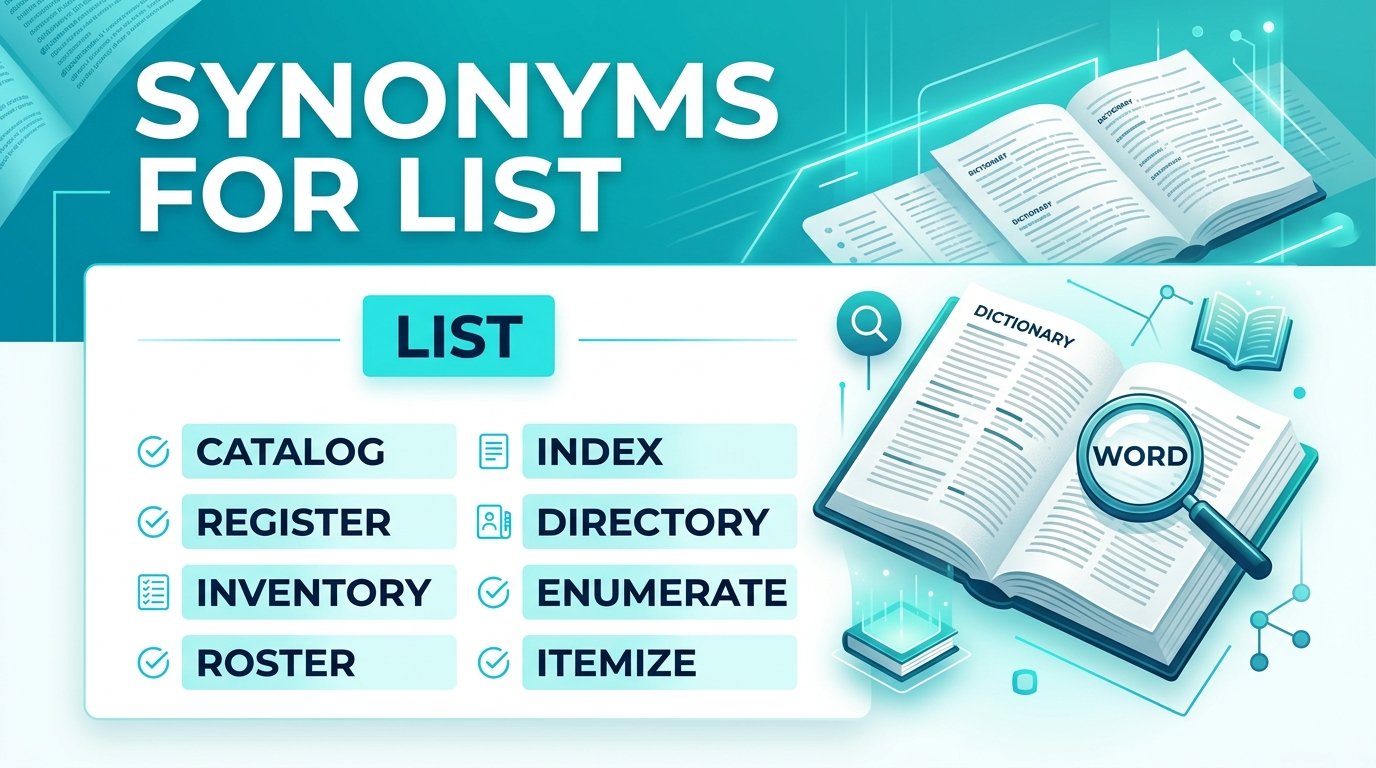
Quick Answer: What Are the Best Synonyms for List?
The closest and most useful synonyms for list include record, listing, catalog, catalogue, register, inventory, roster, index, directory, schedule, checklist, lineup, enumeration, and roll. For the verb list, useful alternatives include enumerate, itemize, record, catalog, register, specify, detail, and tabulate. The right choice depends on context: use roster for people, inventory for goods, index for reference information, and enumerate for formally naming items one by one.
Best Synonyms for List at a Glance
| Word | Relationship | Meaning | Best Context |
|---|---|---|---|
| record | Direct/near synonym | Written information kept for reference | Records, information, history |
| listing | Direct synonym | A set of items that have been listed | General lists, advertisements |
| catalog | Near synonym | Organized collection or list of items | Products, books, collections |
| catalogue | Near synonym | British spelling of catalog | Books, products, collections |
| register | Contextual alternative | Official or formal record | Names, births, registrations |
| inventory | Contextual alternative | Detailed record of goods or property | Stock, supplies, assets |
| roster | Contextual alternative | List of people assigned to a group or duty | Employees, teams, schedules |
| index | Contextual alternative | Organized reference list | Books, databases, subjects |
| directory | Contextual alternative | List arranged to help locate people or organizations | Contacts, businesses |
| schedule | Contextual alternative | Organized list of planned events or activities | Meetings, classes, travel |
| checklist | Contextual alternative | List used to verify completion | Tasks, procedures |
| lineup | Contextual alternative | Ordered group of people or things | Sports, performers, events |
| enumeration | Near synonym | Formal act or result of counting/listing | Academic and formal writing |
| roll | Contextual alternative | Official list of names | Attendance, membership |
| itemization | Near synonym | Detailed listing of individual items | Costs, charges, expenses |
What Does “List” Mean?
As a noun, list generally means a set or record of items, names, or pieces of information arranged together. For example:
I made a list of books I want to read.
A list can be organized alphabetically, chronologically, numerically, by category, or simply in the order in which information occurs.
As a verb, list means to make a list or include something in one. For example:
Please list your qualifications on the application.
The verb also has other specialized meanings, including financial and nautical uses, so context is important. Cambridge, for example, separately identifies the stock-market meaning of list.
30+ Synonyms and Alternatives for List
1. Record
Record is one of the broadest alternatives to list. It emphasizes information that has been written down or preserved rather than simply arranged as a series.
Example:
The database contains a record of all previous transactions.
Use record when preserving information is more important than simply presenting items.
2. Listing
Listing refers to an individual entry or collection of entries that have been listed.
Example:
The website contains a complete listing of available apartments.
It is especially natural for advertisements, directories, online marketplaces, and published information.
3. Catalog
A catalog is an organized collection of items, often with descriptions or identifying information.
Example:
The museum published a catalog of its latest exhibition.
Use catalog when the list is systematic and usually more detailed than an ordinary list. Collins also identifies list, directory, index, inventory, record, and related terms as alternatives to catalog.
4. Catalogue
Catalogue is the standard British spelling of catalog.
Example:
The university library has an online catalogue of its books.
The meaning is essentially the same; the spelling differs by variety of English.
5. Register
A register is usually an official or formal record.
Example:
Her name appears on the electoral register.
It is stronger and more institutional than the everyday word list.
6. Inventory
An inventory is a detailed record of goods, supplies, equipment, or other assets.
Example:
The manager checked the inventory before placing a new order.
Do not use inventory for every ordinary list. It specifically suggests an organized record of possessions, stock, or resources.
7. Roster
A roster is a list of people, especially people belonging to a team, organization, or group.
Example:
The coach announced the final roster for the tournament.
Best for: employees, athletes, members, personnel, and assigned groups.
8. Index
An index is an organized reference list designed to help someone find information.
Example:
Check the index at the back of the book.
It differs from a general list because its main purpose is usually navigation or retrieval.
9. Directory
A directory is an organized list that helps people locate information about people, organizations, businesses, or resources.
Example:
You can find the company’s phone number in the business directory.
10. Schedule
A schedule is a list or plan showing events, activities, or tasks according to time.
Example:
The conference schedule includes three workshops.
Use schedule when time and planned activities are central.
11. Checklist
A checklist is a list used to make sure that required tasks or items have been completed.
Example:
The pilot reviewed the preflight checklist.
It is more specific than list because it normally implies verification.
12. Lineup
A lineup is an arranged group of people or things, particularly performers, athletes, or scheduled participants.
Example:
The festival has an impressive lineup of musicians.
It often suggests an organized selection rather than a simple collection.
13. Enumeration
Enumeration is a formal noun referring to the act of listing or counting items individually.
Example:
The report provides an enumeration of the major risks.
It is more formal than list and is common in academic, technical, legal, and analytical writing.
14. Roll
A roll is an official list of names.
Example:
The teacher called the roll before starting the lesson.
Common expressions include attendance roll and honor roll.
15. Itemization
Itemization means presenting individual items separately and clearly.
Example:
The invoice included an itemization of all charges.
It is particularly useful for expenses, costs, bills, and detailed accounts.
Synonyms for “List” as a Verb
The best verb alternatives are different from the best noun alternatives.
Enumerate
Enumerate means to name or specify items individually, often in a formal or systematic way.
The report enumerates the main causes of the problem.
This is one of the strongest formal alternatives to list. Thesaurus sources similarly place list, itemize, count, number, and specify among alternatives for enumerate.
Itemize
Itemize means to list individual items separately, especially when details matter.
Please itemize your travel expenses.
Use it particularly for costs, charges, components, or detailed information.
Specify
Specify means to state something precisely rather than merely put it into a list.
The instructions specify the required materials.
It is therefore a near-synonym, not a universal replacement for list.
Detail
Detail means to give specific information about something.
The report details the steps taken by the organization.
It works when list means providing individual pieces of information, but it can imply explanation as well as enumeration.
Catalog
As a verb, catalog means to record or organize items systematically.
The researchers cataloged every specimen.
It is especially suitable for collections, archives, products, and research material.
Tabulate
Tabulate means to arrange information systematically, often in rows and columns.
The researchers tabulated the survey results.
It is more technical than ordinary list.
Register
Register means to officially record someone or something.
The company registered all participants.
It should not be used as a general replacement for list because it carries an official-record sense.
Which Word Should I Use Instead of “List”?
Choose “catalog” when:
You are referring to an organized collection of products, books, works, or other items.
The store published a catalog of new products.
Choose “register” when:
The record is official or administrative.
Her name was added to the register.
Choose “inventory” when:
You are recording goods, equipment, supplies, or assets.
We completed an inventory of the warehouse.
Choose “roster” when:
You are listing people who belong to a team, organization, or assignment.
The manager reviewed the staff roster.
Choose “index” when:
The list helps readers locate information.
Look up the term in the index.
Choose “directory” when:
The list provides contact or location information.
I found the company in an online directory.
Choose “checklist” when:
The purpose is to verify tasks or requirements.
Use the checklist before submitting the application.
Choose “schedule” when:
The items are planned according to time.
Check the class schedule for tomorrow.
Choose “enumerate” when:
You are formally naming items one by one.
The paper enumerates several possible explanations.
Choose “itemize” when:
You want to show individual components or costs.
Please itemize the expenses.
List vs. Catalog
List is the broader and more general word.
A list can contain almost anything:
a list of names
a list of ideas
a list of tasks
A catalog normally implies a more organized collection, often with descriptions or identifying information.
a product catalog
a library catalog
a catalog of paintings
So, every catalog can function as a list, but not every list is a catalog.
List vs. Inventory
These words overlap when goods or possessions are being recorded.
A list can simply name the items:
Here is a list of equipment.
An inventory normally implies a systematic record of available goods, supplies, or assets:
The warehouse inventory shows 2,000 units in stock.
Use inventory when ownership, stock, quantity, or resources are important.
List vs. Register
A register usually has an official or administrative character.
The names are on the guest list.
The names are entered in the official register.
The first is ordinary and informal. The second suggests an authoritative record.
List vs. Roster
A roster specifically focuses on people associated with a team, organization, duty, or assignment.
The school published a list of participants.
The school published the tournament roster.
The second sounds more specialized because roster naturally relates to organized groups.
List vs. Enumerate
These words are especially important when list is a verb.
List is neutral and common:
The article lists five reasons.
Enumerate is more formal and emphasizes naming items individually:
The article enumerates five reasons.
For everyday writing, list is usually the more natural choice. For formal analytical or academic writing, enumerate may be appropriate when systematic identification is important.
List vs. Itemize
Itemize is more specific than list.
List the required documents.
Itemize the expenses.
The first simply asks someone to name the documents. The second asks for individual expense details.
Common Mistakes With List Synonyms
Mistake 1: Using “inventory” for every list
An inventory usually concerns goods, resources, equipment, or assets. It is not a universal synonym.
Mistake 2: Calling “schedule” a general synonym
A schedule is specifically associated with planned activities or times.
Mistake 3: Using “roster” for objects
A roster normally names people belonging to a team, organization, or assigned group.
Mistake 4: Using “enumerate” in casual writing unnecessarily
Enumerate is grammatically correct, but it is more formal than list. In everyday communication, list is often more natural.
Mistake 5: Treating “index” and “list” as identical
An index is usually designed to help users find information. A simple list does not necessarily have that purpose.
Mistake 6: Assuming every thesaurus entry is interchangeable
Thesaurus resources can group words by related meanings and contexts. For example, Thesaurus.com separates noun and verb senses of list and includes words such as record, tabulation, inventory, directory, schedule, and enumeration. The presence of a word on a thesaurus page does not mean it will fit naturally into every sentence.
Common Collocations With List
Some common phrases use list so naturally that replacing it may actually make the sentence worse.
- make a list
- create a list
- compile a list
- provide a list
- complete a list
- check a list
- checklist
- shopping list
- guest list
- waiting list
- price list
- to-do list
- mailing list
- list of names
- list of items
- list of requirements
For example, compile a list of requirements is usually more natural than forcing a synonym such as compile a catalog of requirements.
Antonyms of List
There is no single perfect antonym for list because the word has several meanings.
When list means organize or record information, possible opposites include:
- omit
- exclude
- withhold
- conceal
- disorganize
However, these are contextual opposites rather than universal antonyms. The opposite of list depends on whether you mean recording, including, organizing, or naming information.
Frequently Asked Questions
What is the best synonym for list?
There is no single best synonym in every context. Record and listing are broad alternatives, while catalog, register, inventory, roster, index, directory, and schedule are more context-specific. For the verb, enumerate and itemize are useful formal alternatives.
What is a formal word for list?
Enumerate is a formal verb meaning to name or specify items individually. Enumeration is the corresponding formal noun. Register can also be appropriate when the list is an official record.
What is another word for a list of names?
Depending on the context, use roster, register, roll, directory, or directory of names. A roster works particularly well for teams or employees, while a register suggests an official record.
What is another word for a list of items?
Catalog, inventory, listing, record, or inventory can work depending on what the items are. Use inventory for goods or assets and catalog for an organized collection.
What is another word for list in an essay?
In most cases, simply keep list. If the context is formal, alternatives such as enumerate, specify, detail, or identify may work. The best choice depends on whether you are naming, explaining, or identifying information.
Is “catalog” a synonym for “list”?
Yes, in some contexts. A catalog is a type of organized list, usually involving products, books, collections, or other systematically recorded items. It is more specific than the general word list.
Is “enumerate” the same as “list”?
Often, but not perfectly. Both can mean naming items one by one. Enumerate is more formal and can emphasize systematic identification, while list is neutral and much more common in everyday English.
What is the difference between a list and an inventory?
A list is a general record of items or information. An inventory is a more specialized record of goods, supplies, property, or assets, often maintained to track what is available.
Conclusion
The best synonym for list depends on what you are actually describing. Use catalog for an organized collection, register for an official record, inventory for goods or assets, roster for people in an organized group, index for reference information, directory for contact information, and schedule for time-based plans.
For the verb, enumerate and itemize are useful when you want a more formal or precise alternative. In ordinary writing, however, list is often the clearest and most natural choice.

Michael Thompson is an English language specialist and experienced editor who focuses on vocabulary development and clear communication. He creates high-quality synonym guides, word comparisons, and writing tips to help students and professionals express their ideas more effectively. His work combines linguistic knowledge with practical SEO strategies to make learning both useful and engaging.