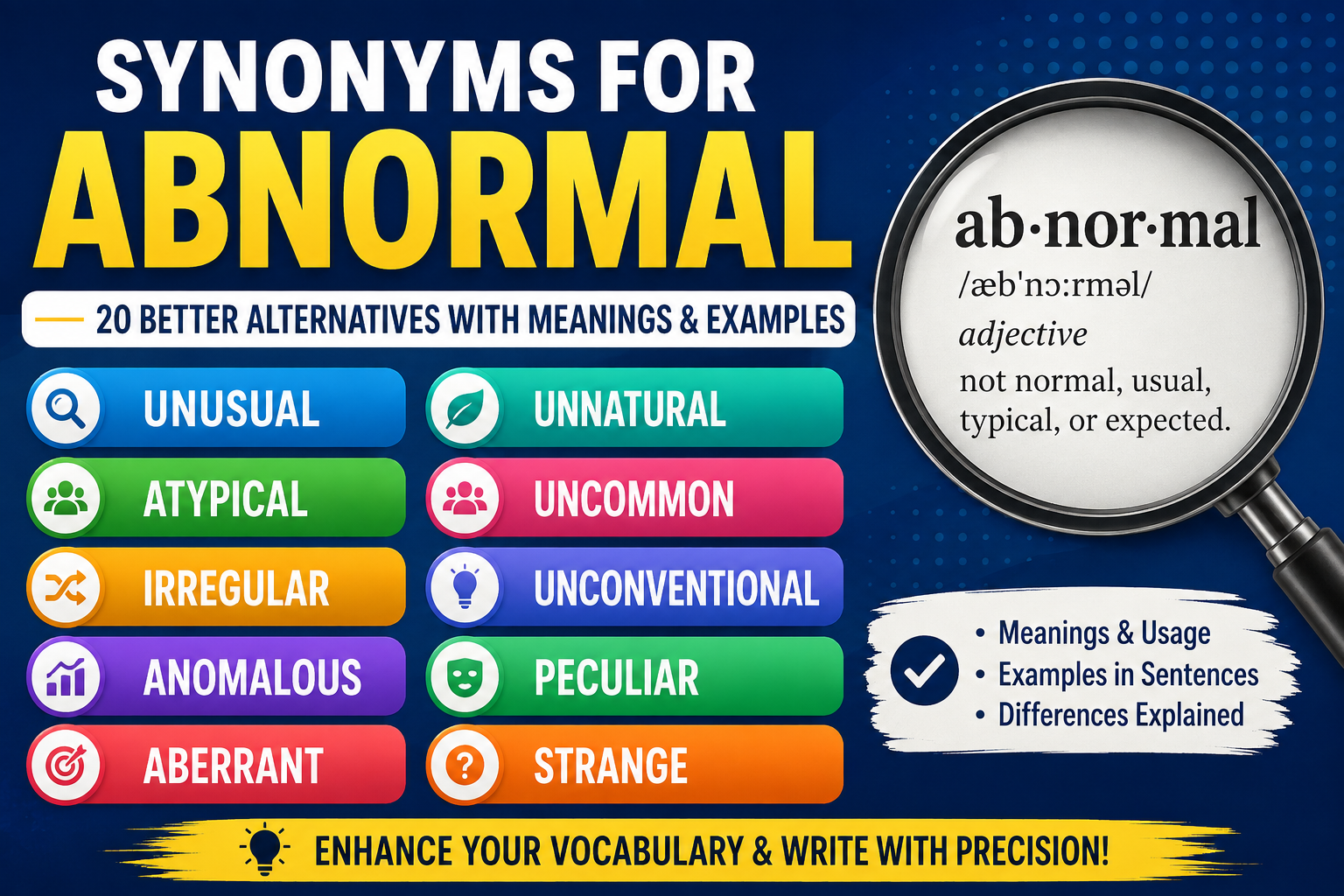
When you need a different way to say abnormal, the best choice depends on what you mean. Unusual is usually the closest everyday alternative, while atypical works well when something differs from what is normally expected. Words such as irregular, anomalous, aberrant, unnatural, peculiar, and unconventional add more specific shades of meaning.
This guide explains the most useful synonyms for abnormal, how they differ, and when to use each one naturally.
Quick Answer: What Are the Best Synonyms for Abnormal?
The closest general synonyms for abnormal include unusual, atypical, irregular, anomalous, aberrant, unnatural, uncommon, strange, peculiar, odd, unconventional, and deviant.
However, they are not all interchangeable. Unusual is the safest general replacement, atypical is neutral and often useful in formal writing, irregular emphasizes a departure from a pattern or standard, and anomalous is especially useful for technical or analytical contexts. Major thesaurus sources similarly group these words with abnormal.
20 Synonyms for Abnormal
| Word | Relationship | Meaning | Best Context |
|---|---|---|---|
| Unusual | Direct synonym | Not common or expected | Everyday English |
| Atypical | Direct/near synonym | Not representative of the usual type | Formal, academic |
| Irregular | Near synonym | Not following a normal pattern or rule | Patterns, schedules, behavior |
| Anomalous | Near synonym | Different from what is expected or standard | Technical, academic |
| Aberrant | Near synonym | Departing significantly from an expected standard | Scientific, formal |
| Unnatural | Contextual synonym | Contrary to what is considered natural | Nature, behavior, appearance |
| Uncommon | Near synonym | Not frequently encountered | Everyday and formal |
| Unconventional | Contextual synonym | Different from accepted customs or methods | Ideas, methods, behavior |
| Strange | Contextual synonym | Unfamiliar or difficult to explain | Everyday English |
| Peculiar | Contextual synonym | Noticeably unusual or distinctive | People, behavior, situations |
| Odd | Contextual synonym | Slightly strange or unexpected | Informal English |
| Eccentric | Contextual synonym | Unconventional in personality or behavior | People, habits |
| Bizarre | Strong synonym | Very strange or difficult to believe | Events, behavior, situations |
| Deviant | Contextual synonym | Departing from an accepted norm | Formal, behavioral contexts |
| Exceptional | Context-dependent | Outside the normal range; often unusually good | Performance, ability |
| Extraordinary | Context-dependent | Far beyond what is usual or expected | Events, achievements |
| Rare | Related alternative | Occurring infrequently | Events, conditions |
| Unique | Related alternative | One of a kind or unlike anything else | Objects, qualities, situations |
| Quirky | Informal alternative | Unusually distinctive in an amusing way | Personality, style |
| Freakish | Strong, often negative | Extremely unusual or unnatural-looking | Appearance, events |
The distinction matters: dictionaries may list many of these words together, but their meanings and connotations are not identical. Cambridge, for example, includes unnatural, atypical, unusual, irregular, aberrant, deviant, anomalous, and uncommon among its related words for abnormal.
What Does Abnormal Mean?
Abnormal is an adjective meaning not normal, usual, typical, or expected. It can describe something that departs from an accepted standard, pattern, or condition.
For example:
- The machine produced an abnormal sound.
- The researchers noticed an abnormal pattern in the data.
- The weather was abnormal for that time of year.
- The doctor investigated an abnormal test result.
The word itself is not always strongly negative. Its tone depends heavily on the noun it modifies and the context in which it appears.
1. Unusual
Unusual is generally the best everyday synonym for abnormal.
It means something is different from what is common, expected, or normally encountered. Unlike some stronger alternatives, unusual is relatively neutral.
Example:
It was unusual to see the restaurant completely empty on a Friday night.
Choose “unusual” when: you simply want to say that something is not common or expected.
2. Atypical
Atypical means not typical of a particular group, category, or pattern.
It is especially useful in formal, academic, professional, and analytical writing.
Example:
The patient showed an atypical response to the treatment.
Choose “atypical” when: something differs from the normal example or expected type without necessarily implying that it is strange.
Abnormal vs. atypical
- Abnormal: outside what is considered normal.
- Atypical: not representative of what is typical.
Atypical is often more neutral and precise.
3. Irregular
Irregular describes something that does not follow a normal pattern, rule, shape, schedule, or sequence.
Examples:
- The building has an irregular shape.
- The company experienced irregular payments.
- The machine began making irregular movements.
Choose “irregular” when: the abnormality involves a pattern, sequence, frequency, shape, or established rule.
4. Anomalous
Anomalous means different from what is normal, expected, or established.
It is particularly useful in scientific, technical, academic, and analytical contexts.
Example:
The researchers discovered an anomalous result that required further investigation.
Choose “anomalous” when: something stands out from an expected pattern or dataset.
Abnormal vs. anomalous
Abnormal is broader and more common. Anomalous often suggests a specific deviation from an established pattern or expectation.
5. Aberrant
Aberrant describes something that departs from an accepted or expected standard, course, or pattern.
Example:
The study detected an aberrant pattern in the experimental data.
The word is more formal than unusual and is common in scientific and technical writing.
Choose “aberrant” when: you want to emphasize a significant departure from an established norm.
6. Unnatural
Unnatural means contrary to what is considered natural or normal.
Examples:
- The painting used an unnatural combination of colors.
- His movements looked stiff and unnatural.
- The artificial light created an unnatural appearance.
Choose “unnatural” when: the emphasis is on something seeming contrary to nature, natural behavior, or normal appearance.
7. Uncommon
Uncommon means not frequently found, seen, or experienced.
Example:
It is uncommon for the lake to freeze this early in the year.
It is often milder than abnormal.
Choose “uncommon” when: you mainly mean that something is infrequent rather than defective or wrong.
8. Unconventional
Unconventional means different from traditional, customary, or generally accepted ways of doing something.
Example:
She took an unconventional approach to solving the problem.
This word can be positive, neutral, or negative depending on context.
Choose “unconventional” when: the difference concerns customs, methods, ideas, styles, or behavior.
9. Strange
Strange is a common everyday word for something unfamiliar, unusual, or difficult to explain.
Example:
There was a strange noise coming from the basement.
Choose “strange” when: you want natural conversational English rather than technical or formal vocabulary.
10. Peculiar
Peculiar describes something noticeably unusual, distinctive, or odd.
Example:
There was a peculiar smell coming from the kitchen.
It can describe something that is simply distinctive, although it can also suggest that something is strange.
Choose “peculiar” when: something catches your attention because of an unusual quality.
11. Odd
Odd is a short, natural, and relatively informal alternative to abnormal.
Example:
That is an odd way to solve the problem.
It often suggests that something feels slightly strange rather than seriously abnormal.
Choose “odd” when: you are speaking casually and the difference is noticeable but not necessarily serious.
12. Eccentric
Eccentric is mainly used for people, personalities, habits, or behavior that are unconventional or unusually distinctive.
Example:
The professor was known for his eccentric habits.
You generally would not use eccentric as a replacement for every use of abnormal.
Choose “eccentric” when: the unusual quality is associated with a person’s personality, behavior, or lifestyle.
13. Bizarre
Bizarre means extremely strange or unusual.
Example:
The police received a bizarre explanation for what happened.
It is considerably stronger than unusual.
Choose “bizarre” when: something is so strange that it attracts strong attention or seems difficult to believe.
14. Deviant
Deviant describes something that departs from an accepted standard, norm, or expected behavior.
Example:
The researchers examined deviant behavior within the group.
Because deviant can carry a strong negative judgment, it should be used carefully.
Choose “deviant” when: the context specifically concerns deviation from an established social, behavioral, statistical, or technical norm.
15. Exceptional
Exceptional can sometimes describe something outside the normal range, but it is often positive.
Example:
She delivered an exceptional performance.
This is why exceptional is not a universal replacement for abnormal.
Choose “exceptional” when: the unusual quality is outstanding, remarkable, or better than normal.
16. Extraordinary
Extraordinary means very unusual or far beyond what is ordinary.
Example:
The athlete showed extraordinary endurance.
Like exceptional, it frequently has a positive meaning.
Choose “extraordinary” when: something is unusually remarkable rather than simply outside the norm.
17. Rare
Rare means something occurs infrequently.
Example:
Such a combination of weather conditions is rare.
Rare and abnormal overlap when something unusual is also uncommon, but they are not identical.
Choose “rare” when: frequency is the main point.
18. Unique
Unique means one of a kind or unlike anything else.
Example:
The building has a unique architectural design.
It should not automatically replace abnormal. Something can be unique without being abnormal.
Choose “unique” when: you want to emphasize distinctiveness or individuality.
19. Quirky
Quirky is an informal word for something unusually distinctive, especially a person’s behavior, personality, style, or design.
Example:
The café has a quirky interior filled with vintage furniture.
It is often playful or mildly positive.
Choose “quirky” when: the unusual quality is charming, amusing, or distinctive rather than seriously concerning.
20. Freakish
Freakish means extremely unusual or unnatural-looking and often carries a negative or dramatic tone.
Example:
The storm produced a freakish combination of weather conditions.
Choose “freakish” when: the unusual nature is extreme and you intentionally want a stronger, more dramatic expression.
Which Synonym Should You Use?
The easiest way to choose is to identify why something is abnormal.
Choose “unusual” when:
You simply mean something is not common or expected.
The restaurant had an unusual menu.
Choose “atypical” when:
You mean something does not represent the usual type or pattern.
The patient displayed an atypical response.
Choose “irregular” when:
You are describing a break from a pattern, sequence, rule, or schedule.
The machine showed irregular movement.
Choose “anomalous” when:
Something differs from an established pattern, especially in technical or analytical writing.
The researchers recorded an anomalous result.
Choose “aberrant” when:
The deviation from the expected standard is especially clear or significant.
The test revealed an aberrant pattern.
Choose “unconventional” when:
The difference involves methods, ideas, customs, or behavior.
They adopted an unconventional strategy.
Choose “strange” or “odd” when:
You want natural everyday language.
That seems strange.
Choose “bizarre” when:
Something is extremely strange.
It was a bizarre coincidence.
Choose “eccentric” when:
You are describing a person’s unusual personality or behavior.
He has an eccentric sense of humor.
Choose “rare” when:
You mean something does not happen often.
Such an event is rare.
Abnormal Synonyms by Context
Synonyms for Abnormal Behavior
Depending on the intended meaning, useful choices include:
- unusual
- strange
- odd
- eccentric
- unconventional
- deviant
- aberrant
Example:
The psychologist noticed unusual behavior.
If the behavior specifically violates an accepted norm, deviant may be more precise. If it is simply distinctive, eccentric or quirky may be better.
Synonyms for Abnormal Results
For test results, measurements, or data, consider:
- atypical
- anomalous
- irregular
- aberrant
- unusual
Example:
The laboratory reported an anomalous result.
In analytical writing, anomalous often communicates the idea of a result that does not fit the expected pattern.
Synonyms for an Abnormal Situation
Useful alternatives include:
- unusual
- extraordinary
- unexpected
- strange
- exceptional
- unprecedented
Example:
The company faced an unusual situation.
Synonyms for an Abnormal Appearance
Depending on what you mean:
- unusual
- peculiar
- strange
- unnatural
- bizarre
- atypical
Example:
The sculpture had a peculiar appearance.
Synonyms for an Abnormal Pattern
The strongest choices are usually:
- irregular
- anomalous
- aberrant
- atypical
- unusual
Example:
The software detected an irregular pattern in the data.
Abnormal vs. Unusual
Abnormal and unusual are close, but abnormal can more strongly suggest that something falls outside an accepted standard of normality.
The weather was unusual.
This simply means the weather was not typical.
The test result was abnormal.
This may suggest that the result differed from an expected or accepted range.
Use “unusual” for a neutral statement about rarity or difference. Use “abnormal” when deviation from a normal standard is important.
Abnormal vs. Atypical
Both words describe something that differs from what is normally expected.
Atypical usually emphasizes that something is not representative of the typical example or category.
Abnormal is broader and can suggest a departure from a normal condition or accepted standard.
The case was atypical for this age group.
The test showed an abnormal result.
For professional and academic writing, atypical can sometimes be a more precise and neutral choice.
Abnormal vs. Irregular
Irregular is best when there is a recognizable pattern, rule, or sequence.
The patient’s schedule was irregular.
The machine produced irregular movements.
Abnormal is broader:
The machine produced an abnormal sound.
Not every abnormal thing is irregular, and not every irregular thing is abnormal.
Abnormal vs. Anomalous
Anomalous is especially useful when something differs from an established pattern or expectation.
The result was abnormal.
The result was anomalous compared with the other measurements.
The second sentence puts greater emphasis on the result’s deviation from a pattern.
Common Mistakes When Choosing a Synonym for Abnormal
1. Treating “unique” as an exact synonym
Something can be unique without being abnormal.
She has a unique artistic style.
This does not necessarily mean her style is abnormal.
2. Using “exceptional” when you mean negative abnormality
Exceptional often suggests excellence.
He delivered an exceptional performance.
If you mean simply “not normal,” unusual or atypical may be better.
3. Using “rare” when the issue is not frequency
Something may be abnormal without being rare.
Rare focuses primarily on how infrequently something occurs.
4. Using “eccentric” for objects or measurements
Eccentric is especially associated with people, personalities, habits, and behavior.
For data, anomalous or irregular is usually more natural.
5. Using “deviant” without considering tone
Deviant can carry a strong negative or judgmental connotation. Use it when the context genuinely involves deviation from a defined norm.
Antonyms of Abnormal
Common antonyms include:
- normal
- typical
- usual
- ordinary
- natural
- regular
- conventional
- customary
- common
- expected
The best opposite depends on context.
abnormal pattern → normal pattern
abnormal behavior → typical behavior
abnormal schedule → regular schedule
Cambridge and Merriam-Webster both list words such as normal, typical, usual, ordinary, natural, common, and regular among the opposites or near-opposites of abnormal.
FAQ About Synonyms for Abnormal
What is the closest synonym for abnormal?
Unusual is generally the closest everyday synonym for abnormal. Depending on context, atypical, irregular, anomalous, or unnatural may be more precise.
What is a formal synonym for abnormal?
Atypical, anomalous, aberrant, and irregular can work well in formal writing, depending on the context. Anomalous is especially useful for technical or analytical discussions.
What is another word for abnormal behavior?
Depending on the meaning, you can use unusual, strange, eccentric, unconventional, aberrant, or deviant. The right choice depends on whether you mean simply unusual behavior or behavior that departs from an accepted norm.
Is unusual the same as abnormal?
Not exactly. The words overlap, but unusual generally means uncommon or unexpected, while abnormal can imply a departure from an accepted standard of normality.
What is a positive synonym for abnormal?
If you mean unusually good or impressive rather than simply different, exceptional or extraordinary may be appropriate.
What is a stronger synonym for abnormal?
Bizarre, freakish, and sometimes grotesque can express a much stronger sense of abnormality. These words carry stronger emotional or negative connotations, so they should be used selectively.
What is a professional synonym for abnormal?
For professional or academic writing, atypical, anomalous, irregular, or aberrant may be appropriate. The best option depends on the subject and the specific kind of deviation being described.
Conclusion
The best synonym for abnormal depends on the type of difference you want to emphasize. Unusual is the safest general alternative, atypical is precise and neutral, irregular focuses on patterns or rules, anomalous works particularly well for unexpected data or results, and unconventional fits ideas, methods, and behavior.

Emily Johnson is a linguistics graduate and vocabulary specialist. She writes detailed synonym explanations and helps readers understand subtle differences between words, improving both writing and speaking skills. Synonyms help express ideas more clearly and precisely in English.