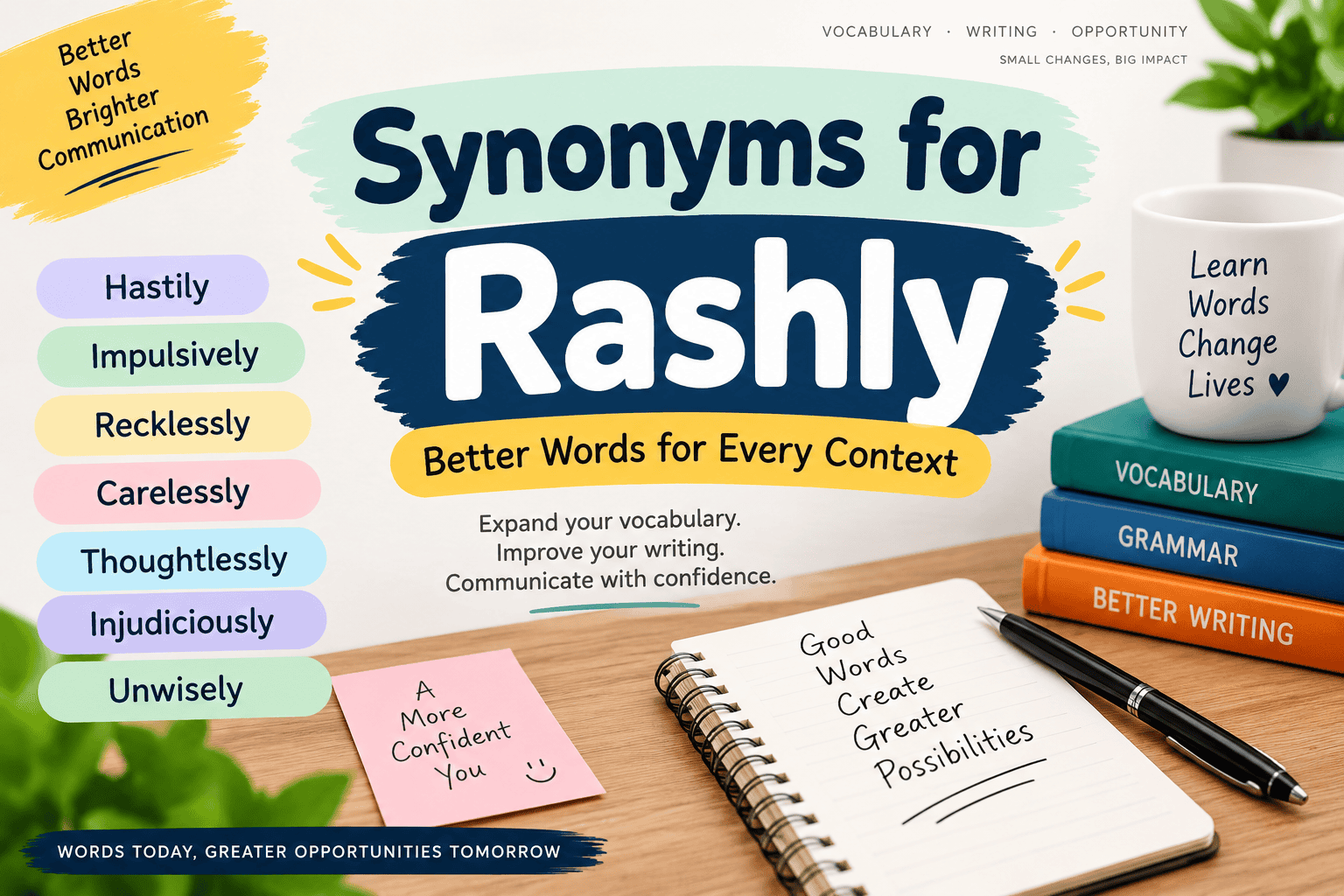
When you need another word for rashly, the best choice depends on exactly what you want to emphasize. Rashly describes acting in a careless or unwise way without adequately considering what might happen. Strong alternatives include recklessly, impulsively, hastily, heedlessly, thoughtlessly, carelessly, imprudently, incautiously, unwisely, and impetuously. However, these words are not interchangeable in every sentence: recklessly emphasizes danger, impulsively emphasizes sudden instinct, and hastily emphasizes excessive speed.
Quick Answer: What Are the Best Synonyms for Rashly?
The closest synonyms for rashly include recklessly, imprudently, incautiously, heedlessly, thoughtlessly, hastily, impulsively, impetuously, carelessly, and unwisely. The best choice depends on the nuance. Use recklessly when dangerous behavior is central, impulsively when an action follows a sudden urge, and hastily when someone acts too quickly without enough consideration.
What Does “Rashly” Mean?
Rashly is an adverb meaning to act in a way that is not sensible because the possible consequences have not been adequately considered. Cambridge defines it as acting carelessly or unwisely without thought for what might happen, while Oxford similarly connects it with acting without considering possible results.
For example:
He reacted rashly and immediately resigned from his job.
The sentence suggests that he acted too quickly and without sufficiently considering the consequences.
Pronunciation
Rashly: /ˈræʃli/ in both US and UK English.
Part of speech
- rash — adjective
- rashly — adverb
- rashness — noun
Compare:
- a rash decision
- He made the decision rashly.
- His rashness caused serious problems.
The Best Synonyms for Rashly
Not every thesaurus-related word is an exact replacement. The table below separates close synonyms from words that add a particular shade of meaning.
| Word | Relationship | Strength | Main Nuance | Best Context |
|---|---|---|---|---|
| recklessly | Near synonym | Very strong | Disregard for danger or consequences | Risky behavior |
| imprudently | Near synonym | Strong | Lack of good judgment | Formal/professional writing |
| incautiously | Near synonym | Strong | Failure to exercise caution | Decisions, actions |
| heedlessly | Near synonym | Strong | Failure to pay attention | Warnings, consequences |
| thoughtlessly | Near synonym | Moderate–strong | Acting without sufficient thought | Behavior, remarks |
| carelessly | Near synonym | Moderate | Lack of care or attention | General actions |
| hastily | Near synonym | Moderate | Acting too quickly | Decisions, conclusions |
| impulsively | Near synonym | Moderate–strong | Acting on a sudden urge | Emotional decisions |
| impetuously | Near synonym | Strong | Acting suddenly and energetically | Behavior, reactions |
| unwisely | Near synonym | Moderate | Poor judgment | Decisions, choices |
| precipitately | Contextual alternative | Strong | Acting with excessive haste | Formal/literary writing |
| hurriedly | Contextual alternative | Mild | Doing something quickly | Physical actions or processes |
Cambridge’s thesaurus groups rashly with words including recklessly, hastily, impetuously, heedlessly, thoughtlessly, carelessly, and imprudently. Collins likewise identifies hastily, too quickly, impetuously, and related expressions.
1. Recklessly
Recklessly is one of the strongest alternatives to rashly. It suggests acting without sufficient concern for danger, harm, or consequences.
Example:
He drove recklessly through the crowded streets.
How it differs from rashly
Rashly focuses broadly on poor judgment or insufficient consideration. Recklessly usually carries a stronger implication that the behavior involves serious or obvious risk.
- rashly: poor consideration
- recklessly: disregard for danger or consequences
Best for: dangerous actions, risky decisions, irresponsible behavior.
2. Impulsively
Impulsively describes doing something because of a sudden urge rather than after careful thought.
She impulsively bought a plane ticket and left the next morning.
The word does not necessarily imply stupidity or recklessness. Someone can act impulsively without causing serious harm.
Choose impulsively when:
The important idea is sudden, instinctive action.
3. Hastily
Hastily emphasizes speed. Someone acts before allowing enough time for thought, investigation, or consideration.
The committee hastily approved the proposal.
This is particularly useful for formal and professional writing.
Rashly vs. hastily
A person can act hastily simply because they are under time pressure. Rashly more clearly suggests that the lack of consideration was unwise.
He made a hastily prepared presentation.
He rashly rejected the offer.
The first emphasizes insufficient time; the second emphasizes poor judgment.
4. Impetuously
Impetuously describes acting suddenly and forcefully, often because of strong emotion or enthusiasm.
He impetuously challenged his manager during the meeting.
It can sound more literary or formal than impulsively.
Best for: emotionally driven actions, sudden reactions, forceful behavior.
5. Heedlessly
Heedlessly emphasizes ignoring warnings, advice, or possible consequences.
She heedlessly ignored the safety instructions.
This is a particularly useful choice when the person had information that should have made them more cautious.
Key distinction
- rashly → without adequate consideration
- heedlessly → without paying attention to warnings or advice
6. Thoughtlessly
Thoughtlessly means without sufficient thought or consideration. It can describe actions, decisions, or remarks.
He thoughtlessly revealed confidential information.
It may also suggest a lack of consideration for other people’s feelings.
That gives thoughtlessly a social or interpersonal nuance that rashly does not always have.
7. Imprudently
Imprudently is a formal alternative meaning in an unwise or insufficiently cautious manner.
The company imprudently expanded before securing enough funding.
This is particularly suitable for:
- academic writing
- business writing
- reports
- formal criticism
- professional analysis
If you need a polished alternative to rashly in formal prose, imprudently is often an excellent choice.
8. Incautiously
Incautiously emphasizes a failure to exercise caution.
The investor proceeded incautiously despite several warning signs.
It is more precise than carelessly when the central idea is insufficient caution.
9. Carelessly
Carelessly is broader and more common than rashly. It can mean without sufficient care, attention, or caution.
He carelessly dismissed the evidence.
However, carelessly does not always imply a rushed decision. It can describe ordinary negligence or lack of attention.
Use it when lack of care matters more than rash judgment.
10. Unwisely
Unwisely directly emphasizes poor judgment.
She unwisely invested all her savings in a single company.
This is useful when you want to criticize the wisdom of an action without necessarily suggesting that it was sudden or dangerous.
11. Precipitately
Precipitately is a formal and somewhat literary alternative associated with excessive haste.
The government precipitately withdrew the proposal.
It is appropriate in formal analysis but is less common in everyday conversation.
For ordinary writing, hastily is usually more natural.
12. Hurriedly
Hurriedly simply means quickly or in a rushed manner.
He hurriedly packed his belongings and left.
It is therefore only a contextual alternative, not a full synonym for rashly. Something can be done hurriedly without being unwise.
That distinction matters:
She hurriedly finished the report.
does not necessarily mean:
She rashly finished the report.
The second suggests poor judgment or insufficient consideration.
Closest Synonyms vs. Contextual Alternatives
The most useful distinction is between words that preserve the idea of poor judgment and words that preserve only the idea of speed or suddenness.
Closest alternatives
- imprudently
- recklessly
- incautiously
- heedlessly
- thoughtlessly
- unwisely
Strong contextual alternatives
- impulsively
- impetuously
- hastily
- precipitately
Weaker or narrower alternatives
- carelessly
- hurriedly
- too quickly
- in haste
Collins specifically groups rashly with expressions such as in haste, hastily, too quickly, and impetuously, illustrating why context matters when choosing an alternative.
Rashly vs. Recklessly vs. Impulsively vs. Hastily
These four words are especially easy to confuse.
| Word | Core Idea | Does It Imply Poor Judgment? | Does It Emphasize Speed? | Does It Suggest Danger? |
| rashly | Insufficient consideration | Yes | Often | Sometimes |
| recklessly | Disregard for risk/consequences | Yes | Not necessarily | Strongly |
| impulsively | Sudden urge or instinct | Often | Often | Not necessarily |
| hastily | Excessive speed | Sometimes | Strongly | Not necessarily |
Example
He rashly resigned from his position.
This suggests he did not adequately consider the consequences.
He recklessly resigned from his position.
This sounds stronger and may imply that the decision involved serious risk.
He impulsively resigned from his position.
This suggests a sudden emotional or instinctive decision.
He hastily resigned from his position.
This emphasizes that he made the decision too quickly.
Natural Collocations with “Rashly”
Some of the most natural combinations are:
- act rashly
- behave rashly
- react rashly
- decide rashly
- speak rashly
- respond rashly
- judge rashly
- promise rashly
- commit oneself rashly
- make a decision rashly
Examples include:
Don’t react rashly when you receive criticism.
She rashly promised to complete the project by Friday.
He acted rashly and later regretted his decision.
Oxford and Cambridge examples both show rashly naturally occurring with actions such as promising, acting, deciding, and reacting.
Common Mistakes with Synonyms for Rashly
Mistake 1: Treating “quickly” as a perfect synonym
Incorrect assumption:
Rashly = quickly
Not necessarily. Rashly includes an idea of insufficient thought or poor judgment.
Mistake 2: Using “recklessly” when there is no risk
If someone makes a quick but harmless decision, recklessly may be too strong.
Mistake 3: Using “impulsively” for every rash decision
Impulsively suggests a sudden urge. A rash decision can be deliberate but still poorly considered.
Mistake 4: Using “hurriedly” to describe poor judgment
Hurriedly describes manner or speed. It does not automatically criticize the wisdom of the action.
Mistake 5: Assuming “thoughtlessly” always means rashly
Thoughtlessly can also mean inconsiderately toward other people.
He thoughtlessly interrupted her.
Here the problem is social consideration, not necessarily rash decision-making.
Examples in Real-World Contexts
Workplace
The manager rashly dismissed the employee’s concerns.
Formal alternative:
The manager imprudently dismissed the employee’s concerns.
Business
The company rashly entered a new market without adequate research.
Stronger alternative:
The company recklessly entered a new market without adequate research.
Academic Writing
The theory should not be rejected rashly.
A more formal alternative is:
The theory should not be rejected precipitately.
Everyday Conversation
Don’t react rashly to what she said.
More conversational:
Don’t react impulsively to what she said.
Personal Decisions
He rashly agreed to the contract.
Possible alternatives:
- He hastily agreed to the contract.
- He impulsively agreed to the contract.
- He imprudently agreed to the contract.
Each version changes the emphasis slightly.
Antonyms of Rashly
The opposite of acting rashly is acting with appropriate thought, patience, or caution.
Useful antonyms include:
- carefully
- cautiously
- deliberately
- thoughtfully
- prudently
- wisely
- methodically
- considerately
For example:
Instead of acting rashly, she considered the consequences carefully.
FAQ
What is the closest synonym for rashly?
Imprudently is one of the closest formal synonyms because both words describe acting without sufficient wisdom or consideration. Recklessly is also close but stronger because it more strongly suggests disregard for risk.
What is another word for acting rashly?
Depending on the context, you can say acting recklessly, impulsively, hastily, imprudently, heedlessly, incautiously, thoughtlessly, or unwisely.
What is a formal synonym for rashly?
Imprudently, incautiously, and precipitately are useful formal alternatives. Imprudently is generally the most straightforward choice for professional or academic prose.
Is “impulsively” the same as “rashly”?
Not exactly. Impulsively emphasizes a sudden urge or instinct, while rashly emphasizes insufficient consideration of consequences. An impulsive action can be rash, but the two words are not interchangeable in every context.
Is “recklessly” stronger than “rashly”?
Usually, yes. Recklessly often suggests a more serious disregard for danger or consequences. Rashly can describe poor judgment without implying extreme risk.
Is “hastily” a synonym for rashly?
It can be a contextual synonym. Both can describe acting too quickly, but hastily primarily emphasizes speed, while rashly emphasizes inadequate consideration.
What is the opposite of rashly?
Common opposites include carefully, cautiously, prudently, deliberately, thoughtfully, and wisely.
Can “rashly” be used in formal writing?
Yes. Rashly is a standard English adverb and works in formal, academic, journalistic, and professional writing when the meaning is appropriate. Oxford and Cambridge both list it as a standard adverb.
Conclusion
The best synonym for rashly depends on the exact criticism you want to make. Choose recklessly for dangerous disregard of consequences, impulsively for sudden instinctive action, hastily for excessive speed, heedlessly for ignoring warnings, and imprudently for formal descriptions of poor judgment. When none of these specific nuances is required, rashly itself remains a precise and natural choice.

Sarah Williams is an ESL teacher and content writer with a passion for simplifying English vocabulary. She creates easy-to-understand synonym guides and learning resources that help beginners and intermediate learners build strong language skills.