The word arbitrary describes something that is not clearly based on reason, a consistent system, or a deliberate plan. It can also describe the unfair or unrestricted use of power. Because of these different shades of meaning, there is no single synonym that works in every sentence.
For example, random is often the best alternative when something is determined by chance, while subjective works better when a decision depends on personal opinion. Capricious emphasizes unpredictable changes, and dictatorial is appropriate when arbitrary behavior involves excessive or oppressive authority.
This guide explains the closest synonyms of arbitrary, how they differ, and which word to choose in common contexts.
Quick Answer: What Are the Best Synonyms of Arbitrary?
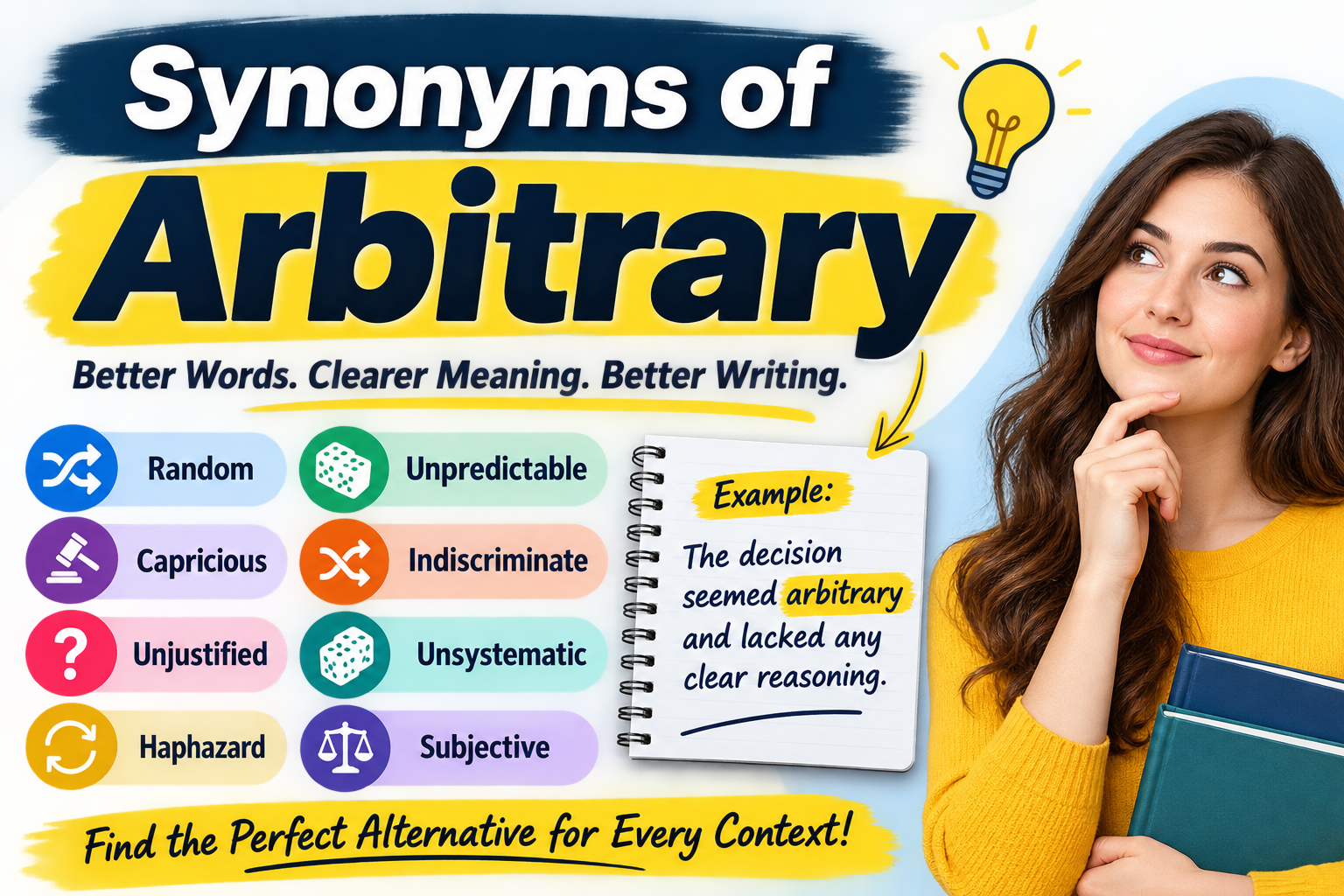
The closest synonyms of arbitrary include random, chance, subjective, unreasonable, capricious, haphazard, erratic, inconsistent, discretionary, whimsical, irrational, and unpredictable. For the power-related sense, alternatives include authoritarian, dictatorial, autocratic, oppressive, and tyrannical.
The best synonym depends on what you mean. Use random for chance, subjective for personal judgment, haphazard for an unplanned arrangement, capricious for unpredictable decisions, and dictatorial when someone uses power without sufficient regard for others.
Core Synonyms of Arbitrary
The best synonym for arbitrary depends on the meaning and context. Some words emphasize chance, while others describe personal judgment, unpredictability, inconsistency, or the misuse of authority.
Direct and Close Synonyms
These words have the strongest semantic connection with arbitrary, although they are not interchangeable in every sentence.
| Word | Relationship | Meaning | Best Context |
|---|---|---|---|
| Random | Close synonym | Based on chance rather than a reasoned method | Selection, numbers, events |
| Subjective | Near synonym | Based on personal opinions or preferences | Opinions, judgments, evaluations |
| Unreasonable | Near synonym | Not supported by sound reasoning | Demands, decisions, rules |
| Capricious | Strong near synonym | Changing unpredictably according to mood or impulse | Decisions, behavior, authority |
| Erratic | Near synonym | Irregular, unpredictable, or inconsistent | Behavior, performance, decisions |
| Inconsistent | Near synonym | Not following the same standard or pattern | Rules, treatment, decisions |
| Whimsical | Near synonym | Based on playful or unusual personal ideas | Choices, ideas, designs |
| Irrational | Near synonym | Not based on reason or logical thinking | Beliefs, decisions, behavior |
| Willful | Near synonym | Deliberately determined by personal choice | Actions, refusal, behavior |
Contextual Alternatives
These words can work as alternatives to arbitrary in specific situations, but they carry additional meanings that make them unsuitable as universal replacements.
| Word | Relationship | Meaning | Best Context |
|---|---|---|---|
| Chance | Contextual alternative | Happening or occurring by chance | Events and encounters |
| Haphazard | Contextual alternative | Lacking organization, planning, or order | Arrangements, methods, work |
| Discretionary | Contextual alternative | Left to someone’s judgment or choice | Powers, decisions, authority |
| Unpredictable | Related alternative | Difficult to anticipate | Behavior, outcomes, decisions |
| Personal | Contextual alternative | Based on an individual’s preference or judgment | Choices and preferences |
| Fanciful | Contextual alternative | Based on imagination rather than practical reasoning | Ideas, explanations |
| Optional | Limited contextual alternative | Available as a matter of choice rather than necessity | Rules, requirements |
| Unjust | Contextual alternative | Contrary to fairness or justice | Treatment, decisions, rules |
| Unfair | Contextual alternative | Not treating people fairly | Rules, decisions, treatment |
Power-Related Alternatives
When arbitrary describes someone exercising authority without sufficient restraint, justification, or regard for others, these words may be more precise.
| Word | Relationship | Meaning | Best Context |
|---|---|---|---|
| Authoritarian | Power-related synonym | Favoring strong, centralized authority | Governments, leadership |
| Dictatorial | Power-related synonym | Exercising authority in an oppressive or domineering way | Leaders, rules, decisions |
| Autocratic | Power-related synonym | Giving one person extensive or unchecked power | Leadership, government |
| Imperious | Power-related alternative | Expecting obedience in an arrogant or commanding way | People, behavior |
| Domineering | Power-related alternative | Controlling others forcefully | People and behavior |
| Oppressive | Power-related alternative | Exercising power in a harsh or burdensome way | Governments, systems, treatment |
| Tyrannical | Strong power-related alternative | Cruelly or oppressively exercising power | Rulers, regimes, authority |
How These Synonyms Differ
Not every word in these tables is interchangeable with arbitrary. Random emphasizes chance, subjective emphasizes personal judgment, haphazard emphasizes poor organization, and capricious emphasizes unpredictable changes.
For authority-related contexts, dictatorial, authoritarian, and autocratic add a specific meaning related to power. Choosing the right alternative therefore depends on the exact sense of arbitrary intended in the sentence.
What Does Arbitrary Mean?
Arbitrary is an adjective used for something that appears to be based on personal choice, chance, impulse, or preference rather than a clear reason, system, or plan. It can also describe the unrestricted or unfair exercise of power.
For example:
- The deadline seemed arbitrary.
- The committee made an arbitrary decision.
- The ruler was accused of arbitrary use of power.
The word therefore has two major semantic directions:
- Unreasoned, random, or lacking a consistent basis
- Unrestricted, unfair, or authoritarian use of power
Recognizing which meaning is intended is essential when choosing a synonym.
1. Random
Random is one of the closest alternatives to arbitrary when something is selected without a predictable method or according to chance.
Example:
The computer generated a random number.
You can sometimes replace arbitrary with random:
The number was chosen arbitrarily.
The number was chosen randomly.
However, the two words are not always identical. Random strongly suggests chance, whereas arbitrary can imply that someone simply chose something without a convincing reason.
Best for: numbers, selections, events, sequences, samples, and chance.
2. Subjective
Subjective describes something influenced by personal opinions, feelings, tastes, or judgments.
The grading system seemed arbitrary.
can become:
The grading system seemed subjective.
But the meaning changes slightly. Arbitrary suggests that the grading may lack a rational or consistent basis. Subjective simply indicates that personal judgment is involved.
Best for: opinions, evaluations, judgments, artistic preferences, and personal standards.
3. Unreasonable
Unreasonable is useful when arbitrary suggests that a decision or demand lacks a sensible justification.
The manager imposed an arbitrary deadline.
Possible alternative:
The manager imposed an unreasonable deadline.
This emphasizes that the deadline is excessive or unjustified rather than merely selected without a clear system.
Best for: demands, rules, deadlines, decisions, expectations, and arguments.
4. Capricious
Capricious is a particularly useful synonym when arbitrary behavior involves sudden, unpredictable changes based on someone’s mood or impulse.
The director made arbitrary decisions about the cast.
could become:
The director made capricious decisions about the cast.
Capricious often carries a stronger suggestion of unpredictability and changing personal preferences.
Best for: decisions, behavior, authority, preferences, and moods.
5. Haphazard
Haphazard describes something done without careful planning, organization, or order.
The files were arranged in an arbitrary order.
A more natural alternative in some contexts is:
The files were arranged in a haphazard order.
However, haphazard focuses on disorder or poor organization. It does not necessarily imply unfairness or personal authority.
Best for: arrangements, methods, processes, organization, and planning.
6. Erratic
Erratic means irregular, unpredictable, or inconsistent.
His arbitrary behavior made the team nervous.
could sometimes become:
His erratic behavior made the team nervous.
The second sentence emphasizes unpredictability rather than the absence of a rational basis.
Best for: behavior, performance, decisions, movement, and patterns.
7. Inconsistent
Inconsistent is a strong choice when an arbitrary rule or decision is problematic because it is not applied consistently.
The company used arbitrary standards.
could become:
The company used inconsistent standards.
This changes the emphasis from lack of justification to lack of uniformity.
Best for: rules, standards, policies, treatment, judgments, and decisions.
8. Discretionary
Discretionary has an important relationship with arbitrary, but it is not automatically negative.
Something discretionary is left to someone’s judgment or choice.
The director has discretionary authority over the budget.
That does not necessarily mean the director uses the authority unfairly.
By contrast:
The director exercised arbitrary authority.
usually carries criticism because the authority appears unjustified or unrestricted.
Best for: official powers, decisions, spending, procedures, and professional judgment.
9. Whimsical
Whimsical can describe choices based on unusual personal ideas, playful impulses, or fancy.
She made a whimsical choice of colors.
It can overlap with arbitrary when a choice is made without a conventional reason, but it usually has a lighter and less critical tone.
Best for: creative choices, designs, ideas, stories, and personal preferences.
10. Irrational
Irrational means not based on reason or logical thinking.
His arbitrary fear of the procedure affected his decision.
could sometimes be:
His irrational fear of the procedure affected his decision.
But irrational is stronger. It directly judges something as lacking rationality, whereas arbitrary can simply mean that no clear basis has been established.
Best for: beliefs, fears, decisions, arguments, and behavior.
Arbitrary Synonyms by Context
For an arbitrary decision
Good alternatives include:
- unreasonable
- capricious
- subjective
- random
- irrational
- unjustified
- inconsistent
The best choice depends on the problem with the decision.
No clear reason: random or unreasoned
Personal opinion: subjective
Changing according to impulse: capricious
Poor reasoning: irrational
Unfair or unjustified: unreasonable or unjust
For an arbitrary rule
Consider:
- unreasonable
- unjust
- inconsistent
- subjective
- unjustified
- discretionary
For example:
The school introduced an arbitrary rule.
If the rule has no rational justification:
The school introduced an unreasonable rule.
If the rule is applied differently to different people:
The school introduced an inconsistent rule.
For arbitrary behavior
Useful alternatives include:
- erratic
- unpredictable
- capricious
- irrational
- inconsistent
- willful
Here, erratic emphasizes irregular behavior, while capricious suggests unpredictable changes driven by personal impulses.
For arbitrary authority or power
This is where the vocabulary changes significantly.
Useful alternatives include:
- authoritarian
- dictatorial
- autocratic
- oppressive
- tyrannical
- imperious
- domineering
For example:
The government was criticized for its arbitrary use of power.
A stronger version might be:
The government was criticized for its authoritarian use of power.
The second sentence makes the power relationship more explicit.
Which Word Should I Use Instead of Arbitrary?
Choose random when:
The key idea is chance.
The winner was selected randomly.
Choose subjective when:
The key idea is personal opinion or judgment.
The evaluation was highly subjective.
Choose haphazard when:
The key idea is lack of organization or planning.
The documents were stored in a haphazard manner.
Choose capricious when:
The key idea is unpredictable personal decisions or changing moods.
The manager’s capricious decisions frustrated the staff.
Choose unreasonable when:
The key idea is lack of sensible justification.
The landlord made an unreasonable demand.
Choose inconsistent when:
The key idea is failure to follow a consistent standard.
The policy was applied inconsistently.
Choose dictatorial when:
The key idea is oppressive or domineering authority.
The leader adopted a dictatorial approach to decision-making.
Choose discretionary when:
The decision is left to someone’s judgment, without necessarily implying unfairness.
The agency has discretionary authority to approve applications.
Arbitrary vs. Random
Arbitrary and random overlap when something is selected without an obvious reason.
The committee chose an arbitrary number.
The computer generated a random number.
The difference is that random more strongly suggests chance, while arbitrary can describe a human choice that has no obvious justification.
Simple rule:
Random = chance.
Arbitrary = no clear reason or basis.
Arbitrary vs. Subjective
Subjective means influenced by personal opinions or perspectives. Arbitrary suggests that a decision lacks a clear rational, systematic, or objective basis.
Beauty standards can be subjective.
This does not necessarily mean they are arbitrary.
The manager’s decision seemed arbitrary.
This suggests that the manager did not provide a convincing basis for the decision.
Simple rule:
Subjective = based on personal judgment.
Arbitrary = lacking a clear or rational basis.
Arbitrary vs. Capricious
These words are close, particularly when describing decisions or authority.
Arbitrary focuses on the lack of a rational or consistent basis.
Capricious emphasizes unpredictability, impulsiveness, or sudden changes.
The rule seemed arbitrary because no explanation was provided.
The manager was capricious, changing the rule whenever his mood changed.
Simple rule:
Arbitrary = unjustified or unprincipled.
Capricious = unpredictable and impulsive.
Arbitrary vs. Discretionary
These words are especially easy to confuse.
Discretionary means that someone has the authority or freedom to make a choice. It is generally neutral.
Arbitrary is often critical because the choice appears unsupported by reason, rules, or fairness.
Compare:
The judge has discretionary authority.
with:
The judge made an arbitrary decision.
The first describes a permitted area of judgment. The second criticizes how that judgment was exercised.
Simple rule:
Discretionary = permitted personal judgment.
Arbitrary = seemingly unjustified personal judgment.
Common Mistakes With Arbitrary Synonyms
Mistake 1: Treating “random” as a universal replacement
Not every arbitrary decision is random.
If a manager deliberately chooses a deadline based on a personal preference, random may not accurately describe the decision.
Mistake 2: Treating “subjective” as negative
Subjective does not automatically mean unreasonable or unfair.
A subjective opinion can be perfectly legitimate when personal taste is relevant.
Mistake 3: Using “dictatorial” for every arbitrary decision
Dictatorial belongs mainly to the power-related sense. It suggests oppressive or domineering authority.
A random choice is not necessarily dictatorial.
Mistake 4: Assuming “discretionary” means unfair
A discretionary decision can be completely reasonable and lawful. The word simply indicates that someone has room to exercise judgment.
Mistake 5: Using “haphazard” for people with arbitrary power
Haphazard describes disorder or lack of planning. It does not by itself communicate authoritarian power.
Related Words
Some words are closely connected to arbitrary without being direct synonyms:
- arbitrariness — the quality of being arbitrary
- arbitrarily — in an arbitrary manner
- arbitrate — to make a formal decision between parties
- discretion — freedom to make a judgment or choice
- subjectivity — reliance on personal perspective
- randomness — the quality of being random
- caprice — an unpredictable change of mind or impulse
- authority — legitimate power or control
These terms belong to the same semantic neighborhood but should not be treated as interchangeable synonyms.
Antonyms of Arbitrary
The opposite of arbitrary depends on which sense you mean.
For decisions that are not arbitrary, useful antonyms include:
- reasoned
- rational
- logical
- systematic
- objective
- consistent
- justified
- reasonable
- principled
- deliberate
For example:
The committee replaced its arbitrary process with a systematic one.
Or:
The company adopted consistent rules instead of making arbitrary decisions.
FAQ: Synonyms of Arbitrary
What is the closest synonym for arbitrary?
Random is one of the closest synonyms when arbitrary means based on chance or lacking a predictable method. However, unreasonable, subjective, capricious, or inconsistent may be more accurate depending on why something is considered arbitrary.
What is a formal synonym for arbitrary?
There is no single formal replacement that works in every context. Capricious, unreasoned, discretionary, and subjective can work in formal writing depending on the intended meaning. For arbitrary use of power, authoritarian or dictatorial may be appropriate.
What is another word for an arbitrary decision?
Possible alternatives include unreasonable decision, capricious decision, subjective decision, random decision, or unjustified decision. The best option depends on whether the problem is lack of reason, personal preference, unpredictability, or unfairness.
Is random the same as arbitrary?
Not exactly. Random emphasizes chance, while arbitrary can describe something chosen without a clear reason, principle, or system. A choice can be arbitrary without being mathematically or statistically random.
Is subjective a synonym for arbitrary?
Sometimes, but they are not exact synonyms. Subjective means based on personal judgment or perspective. Arbitrary usually suggests that the decision lacks a clear rational or systematic basis.
What is the opposite of arbitrary?
Common opposites include reasoned, rational, logical, systematic, objective, consistent, justified, and reasonable. The best antonym depends on the context.
What does arbitrary mean in law or government?
In legal or governmental contexts, arbitrary can describe an exercise of power that lacks a sufficient rational basis or is exercised without proper regard for rights, rules, or fairness. The related power sense is why words such as authoritarian, dictatorial, and autocratic can sometimes be appropriate alternatives.
What is the difference between arbitrary and capricious?
Arbitrary emphasizes a lack of clear reason, principle, or consistent basis. Capricious adds the idea of unpredictability, impulsiveness, or sudden changes based on personal whims.
Conclusion
The best synonym for arbitrary depends on the exact meaning you want to express. Use random when chance is central, subjective when personal judgment is involved, haphazard when planning or organization is missing, capricious when decisions are unpredictable, and unreasonable when a decision lacks sensible justification.

Sarah Williams is an ESL teacher and content writer with a passion for simplifying English vocabulary. She creates easy-to-understand synonym guides and learning resources that help beginners and intermediate learners build strong language skills.